Putin Declares Moscow the Third Rome — But History Has Heard This Sermon Before

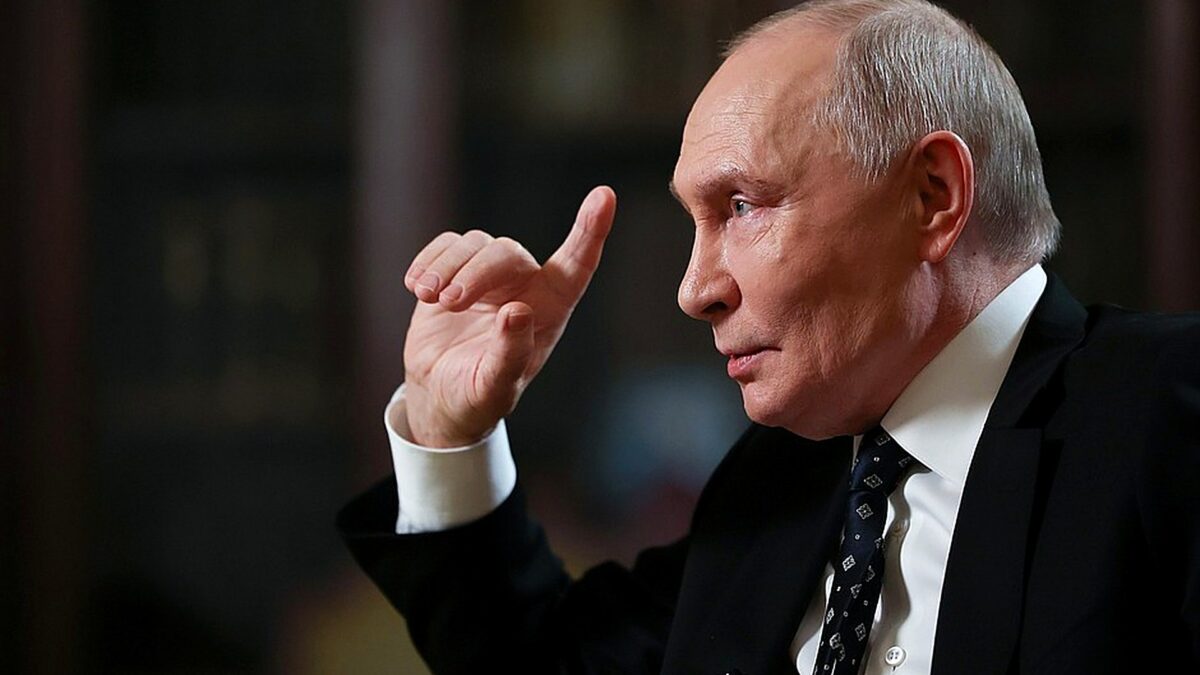
Two Romes have fallen. The third stands. And a fourth there shall not be.
Five hundred years ago a monk in a monastery near Pskov wrote those words to his prince, and the world forgot them, as the world forgets most warnings. Last week, in a wood-panelled library in Moscow, the most powerful man in Russia picked them up again, dusted them off, and spoke them into a camera as though they were news. “Moscow is the Third Rome, a fourth there shall not be.” And then, with the calm of a man announcing the weather, he added the sentence that has set the world arguing ever since: Russia can become an ark. An ark for all who believe in Christ.
Stop there. Read that sentence again, slowly, because everything that matters about our century is hiding inside it. An ark. Not a country. Not a power. An ark. The word is not an accident. Noah’s ark was built because the flood was coming and everything outside it would drown. When a president reaches for that word, he is not describing a foreign policy. He is dividing the world into the saved and the drowned, and he is telling you which side of the water he stands on. I have spent my life reading the columns of history, and I can tell you this much for certain: whenever a ruler starts talking about arks and holy missions, the rest of us had better start listening very carefully, because the sermon is never only a sermon. It is a claim. And claims like this one have a habit of being paid for in other people’s blood.
The monk who invented an empire
To understand what Vladimir Putin said on 20 November, you must first meet the monk who said it first. His name was Philotheus, Filofei in Russian, a monk of the Yelizarov Monastery near Pskov, and some time around 1510 he wrote a letter to Vasili III, the Grand Prince of Moscow. The world Philotheus lived in had just watched its centre collapse. In 1453 the Ottoman Turks had taken Constantinople, the Second Rome, the city that had carried the Christian empire for a thousand years. The first Rome had fallen to heresy, in his telling. The second had fallen to the sword. And so the monk looked at Moscow, a rising principality in the forests of the north, and he gave its ruler a destiny: two Romes have fallen, the third stands, and a fourth there shall not be.
It was a magnificent piece of writing, and like all magnificent pieces of writing it was also a magnificent piece of politics. For Moscow had been preparing for this role for decades. In 1472 Ivan III, Vasili’s father, had married Sophia Palaiologina, the niece of Constantine XI, the last Byzantine emperor, who had died on the walls of Constantinople. The double-headed eagle of Byzantium became the emblem of Moscow. The marriage was a message written in bloodlines: the inheritance had passed. The fallen empire had a new address. And Philotheus, writing a generation later, merely put into words what the court already believed in its bones: that Moscow was not just another capital, but the last guardian of the true faith, and that if Moscow fell, the light itself would go out.
Now here is the first thing history teaches us, and it is a lesson I want you to hold on to as you read the rest of this column. The Third Rome was never, in its origin, a claim about conquering anyone. Philotheus was writing to a prince, reminding him of a duty: protect the faith, keep the lamps burning, do not let the inheritance be squandered. It was a burden before it was a boast. The tragedy of great ideas is that they rarely stay in the hands of the people who first understood them. A burden, handed down through five centuries of emperors and commissars and presidents, becomes a boast. A boast becomes a justification. And a justification, sooner or later, becomes a war cry. That is the road this idea has travelled, and it is the road we must walk together now, step by step, because the man who revived it last week is walking it still.
The library, the filmmaker, and the ark
The setting matters, so let me describe it to you. The interview was given to Emir Kusturica, the Serbian filmmaker, a man who has twice won the Palme d’Or at Cannes and who was born into a secular Muslim family in Sarajevo before being baptised into the Serbian Orthodox Church in 2005. It was recorded for a documentary called “Our Baptism. The Patriarch”, made to mark the eightieth birthday of Patriarch Kirill, who has headed the Russian Orthodox Church since 2009, and it was broadcast on 20 November on Russia’s Channel One. The Kremlin published the full transcript the same day, and I have read every word of it, because a columnist who argues from second-hand summaries is a gossip, not a witness.
Kusturica asked his question with the reverence of a believer. The Russian Orthodox Church, he said, is represented in more than a hundred countries. The Russian state is the foundation of the entire Russian civilisation. Could that civilisation become a sort of ark that can save all those who believe in Christ? And Putin answered without a second’s hesitation. “It can. Absolutely.” Then he gave his reason, and his reason was the monk’s formula, quoted almost word for word: Moscow is the Third Rome, a fourth there shall not be. Christianity came into existence in ancient Rome, he said, then Rome fell, and Christianity moved to Byzantium. Constantine became the first emperor to convert to Christianity. The Byzantine Empire also fell, but by that time Christianity had already spread to Russian soil and reached Moscow. Thus Moscow inherited this faith and these traditions. In a way, it became the Third Rome, the spiritual keeper of those holy values, that heritage.
But then came the sentence that tells you this was not a history lecture. “Yet this theological, or philosophic, idea, which, as I said, Russia has cherished for ages, is not the main point here. It is all about today.” Read that again. It is all about today. The theology is the doorway; the present is the room he wants you to enter. And what is in that room? People moving to Russia from European countries, he said, because they want to preserve their values and raise their children in traditional religious ways. Orthodox Christianity attracting converts, Kusturica added, one and a half million newly converted in North America over the past five years, a figure he offered and Putin accepted with satisfaction. Four traditional religions in Russia, Putin said, Buddhism, Judaism, Islam and Orthodox Christianity, living side by side with the same fundamental values. And therefore Russia could become the ark. Not only for Orthodox Christians, he was careful to add, and actually not just for Christians.
I am a man who has spent years studying how words are chosen, and I tell you plainly: this is a careful construction, a cathedral built sentence by sentence. The history gives it grandeur. The converts give it momentum. The four religions give it tolerance. And the ark gives it urgency. If the flood is coming, you do not ask questions about the carpenter. You climb aboard. That is the argument. And it is an argument of genius, because every part of it is designed to make disagreement feel like ingratitude. Who would argue against an ark?
The claim that history will not let pass
But history, dear reader, is not a congregation. History does not applaud. History keeps receipts. And the receipts in this case demand to be read aloud, because in the same interview, in the same calm voice, the president made another claim, and it is a claim so large that it swallows the first one whole. “The Russian civilisation never took over others,” he said. “It provided for the evolution of the Russian people, the Russian ethnicity, but it also provided enabling conditions for the development of other peoples and ethnicities that made part of the Russian empire, of the family formed by the Russian state.”
Never took over others. I read that sentence three times, and each time I heard the same sound: the sound of a door closing on five hundred years of evidence. Let us open that door, gently, fact by fact, because facts are the only honest company in a debate like this. The Russian Empire grew from a principality around Moscow into the largest country on earth, across Siberia, Central Asia, the Caucasus and Eastern Europe. That growth did not happen by invitation. Poland was partitioned three times in the eighteenth century, and vanished from the map. The Caucasus was conquered in wars that lasted generations. In 1811 the Russian Empire abolished the autocephaly, the independence, of the Georgian Orthodox Church, folding one of the oldest Christian churches in the world into its own synod by imperial decree. A church, mind you. The guardian of the faith, abolishing the independence of another ancient church, because empire required it. That is not a rumour. That is the record.
And then there is the matter that sits in the middle of this interview like a guest nobody wants to name. The same conversation in which Moscow was declared an ark for Christians also contained a message to Ukrainian soldiers, men who are themselves, in their overwhelming majority, Orthodox Christians, baptised in the same faith, praying, many of them, to the same saints. Putin told them to come over to his side, because it is, in his words, “our shared side, and the right side of history.” I ask you, as one reader to another, and I ask it in all seriousness: what kind of ark fires missiles at the people it claims to be saving? What kind of guardian wages war against the very flock whose faith it says it protects? The Ukrainians and the Russians share the baptism of 988, when Prince Vladimir brought Christianity to Rus’. They share the saints, the liturgy, the language of prayer. And for nearly four years now they have shared something else too: a war, begun by Moscow’s full-scale invasion in 2022, that has killed and maimed on a scale Europe had not seen in generations. An ark does not do that. A flood does that.
I do not write this lightly, and I do not write it as an enemy of the Orthodox faith, which has given the world saints and scholars and some of the most beautiful music ever composed. The point is precisely the opposite. The faith deserves better than to be used as the uniform of an army. In March 2022, hundreds of Orthodox theologians from around the world signed the Volos Declaration, condemning the ideology of the “Russian World” as a heresy, and naming the old sin that underlies it: ethno-phyletism, the confusion of the Church with a single nation, a confusion the Orthodox Church itself condemned at a council in Constantinople in 1872. That is not Western propaganda. That is Orthodox theologians speaking about their own faith, in sorrow, not in anger. When your own theologians tell you that the doctrine has become a heresy, a wise ruler listens. A ruler who repeats the doctrine louder has stopped listening to the Church and started listening only to the echo of his own voice.
Why the sermon finds listeners
Now, fairness demands that I tell you the other side of this story, because a column that only condemns is a pamphlet, not an argument. The reason Putin’s words travelled so fast, the reason clips of that interview were shared and argued over on every platform within hours, is that they touch something real. There are people in the West, and not only cranks and fanatics, who look at their own societies and feel that something has been lost. Churches emptied. Families uncertain. Children taught that nothing is sacred and everything is negotiable. When Kusturica says that a million and a half people in North America have converted to Orthodoxy in five years, whether or not the number is exact, he is describing a hunger that is real, and anyone who dismisses that hunger as mere politics has understood nothing about the human heart.
Putin understands it. That is why he quoted Dostoevsky in the same interview, the great novelist’s idea that the Russian has a strong “pan-humanity” instinct, an ability to live alongside others and adapt to anything different. That is why he reached for the German poet Rilke, who once wrote that Russia is a country that borders on God. That is why he told the old story of Field Marshal Münnich, who supposedly said Russia is a country directly governed by God, because if it is not, it is not clear how it continues to exist. A man who can quote poets and novelists in a single conversation is not a man to be underestimated, and I will not underestimate him here. His diagnosis of Western spiritual confusion has force. His prescription is where the trouble begins.
For here is the question that no sermon can avoid, and it is the question I put to you now, directly, as one person thinking aloud to another. If Moscow is the ark, then who is the flood? The ark only makes sense if the waters are rising. And in Putin’s telling, the waters are the West itself, with its struggles over rights and minorities and the loosening of old canons, which he described in the interview as a backsliding that weakens the churches’ grip on society. Perhaps there is truth in that criticism. But notice what the criticism does. It turns a spiritual argument into a civilisational verdict, and a civilisational verdict into a political weapon. The West is not merely mistaken; it is drowning. Russia is not merely different; it is dry land. And once you have divided the world that way, every act of power becomes an act of rescue, and every critic becomes a person who would rather drown than be saved. That is how holy words become the handmaidens of war, and that is why the Volos theologians reached for the word heresy. Not because they hate Russia, but because they love the Church enough to see when it is being spent like small change.
The mirror of empires
History is a mirror, and I have held this idea up to it all week. What do I see? I see Rome itself, the first Rome, which claimed that its empire was the will of the gods, and that its conquests were the spread of civilisation. I see Byzantium, the second, which called its emperor God’s viceroy on earth, and which fell, in the end, not because its theology failed but because its walls did, and because it had spent centuries treating its neighbours as subjects rather than brothers. I see the British Empire, which told itself and the world that it was carrying a civilising mission to the heathen, and which left behind railways and famines in equal measure. I see every empire that ever draped its ambitions in the language of heaven, and I see the same ending every time: the language survives, the empire does not, and the people who believed the language are left to count the cost.
And I see something else in that mirror, something closer to home for those of us who have watched empires rise and fall in our own region. I see the old truth that the most dangerous moment for any great idea is the moment a powerful man adopts it. Philotheus wrote his letter to remind a prince of his duty. Five centuries later a president quotes it to explain a war. The words are the same. The hands holding them are not. That is the whole tragedy in a single sentence, and it is a tragedy that belongs to no one nation. It belongs to all of us, because every faith and every civilisation has its Philotheus, and every one of them is waiting to be quoted by someone who needs a blessing for a decision already made.
Putin said one more thing in that interview that deserves to be remembered, because it is the truest sentence he spoke. Asked about the end of the war, about whether the speed of missiles or the Orthodox spirit would decide it, he answered that what matters most today is not the speed of missiles but the speed of thought, and that whoever thinks more clearly and reacts more quickly is the one who wins. He is right. The speed of thought is what matters. So let us think, clearly and quickly, while there is still time. Let us think about what an ark actually is. An ark is a vessel of rescue, and rescue does not arrive by invasion. An ark is built for the drowning, and the drowning are not the enemy. An ark has room for all, and it does not ask the rescued to surrender before it opens its door.
The verdict
So I return to where I began, to the monk’s sentence, and I give you my verdict as plainly as I can. “Moscow is the Third Rome, a fourth there shall not be.” The monk was right about the weight of the inheritance, and he was right that it must be guarded. But an inheritance is guarded by living up to it, not by announcing it. Rome fell when it believed its own propaganda. Constantinople fell when its walls became more important than its wisdom. Moscow will not be saved by declaring itself the Third Rome. It will be saved, if it is saved, by the same thing that saves every nation: by telling the truth about itself, by making peace with its brothers instead of war upon them, and by remembering that the God of the ark is the God who told Noah to save the animals two by two, not to drown the ones that would not obey.
The flood, if it is coming, will not be stopped by a slogan. And the ark, if it is real, will be recognised not by the man who claims to command it, but by the people who find shelter in it, freely, without fear, and without being asked to lay down their arms first. Until that day, I will keep the monk’s words where they belong: not on a banner, and not on a missile, but on a page, as a warning. Two Romes have fallen. The third stands. Whether it stands as a lighthouse or as a fortress is not decided by history. It is decided by the men who hold it now. And history, patient as ever, is watching.
Sources & References
Clash Report — Putin Says Moscow Is the Third Rome, Russia an ‘Ark’ for Christians
Federation of Egalitarian Communities — Moscow Is the Third Rome: There Will Be No Fourth
InRadio — Putin Claims Moscow Inherited Christianity; Russia Abolished Georgia’s Church Independence

About the Author — Abdul Mannan
Related Articles
Sheikh Hasina Is Coming Home on Victory Day — to Face a Death Sentence
Sheikh Hasina has named the day: 16 December, Victory Day. The daughter of Bangladesh's founder says she will…

The King Returns: Jensen Huang’s Eleven-Day Exile and the Trillion-Dollar Verdict of the Market
Eleven days after resigning in scandal, Jensen Huang is back as Nvidia's chief executive — restored by a…

Twelve Thousand Souls Walked Into the Manchester Night — and the City Remembered 2017
On Sunday night, 12,000 people fled Manchester's Co-op Live arena as an unknown substance filled the air. No…