Assisi 2026: Forty Years After John Paul II, the World’s Religions Pray Together Again

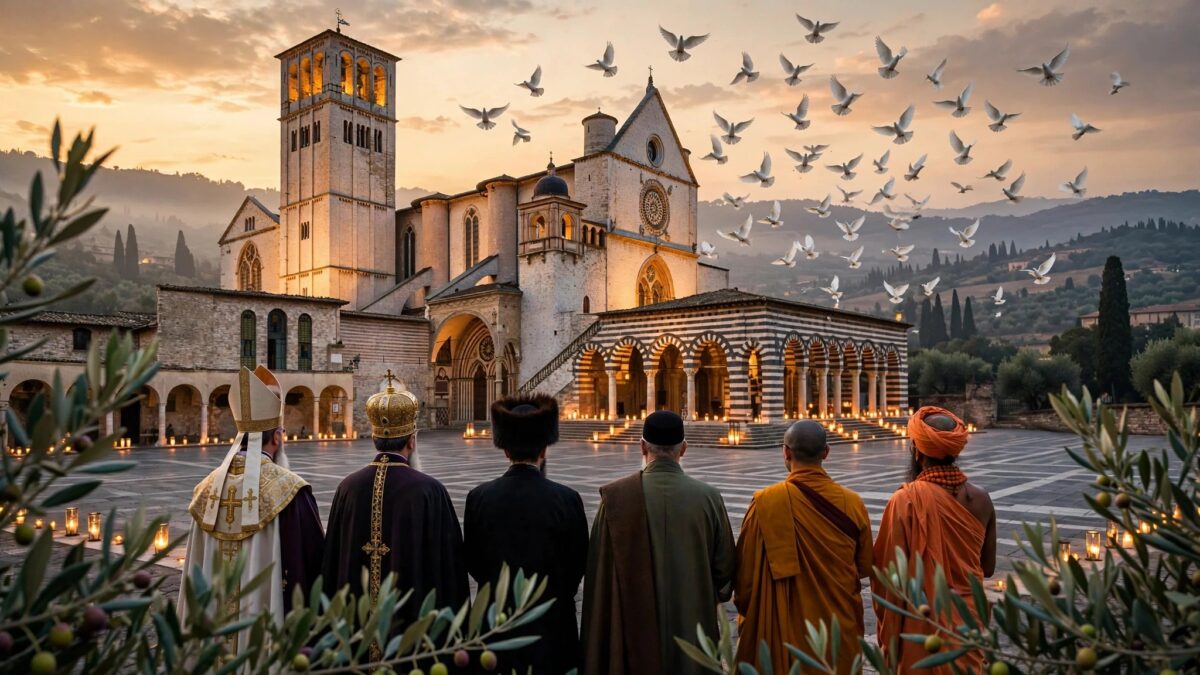
When Did the World Last Kneel Together?
There is a small hill town in Italy where, forty years ago, something happened that the powerful of this earth could neither order nor imitate. Men and women who worshipped different names of God stood in one square, facing one sky, and prayed — each in his own tongue, each in his own rite — for a world that had nearly forgotten the word peace. Today, on the 27th of October 2026, it is happening again. Pope Leo XIV is returning to Assisi, exactly four decades after Saint John Paul II first summoned the religions of the world to pray together there. And I ask you, dear reader: in a world this frightened, what is the greater act of faith — to lift a weapon, or to kneel?
The question is not poetry. It is arithmetic. In 1986, when John Paul II called the leaders of the world’s religions to Assisi, Europe lived under the shadow of intermediate-range nuclear missiles. The Cold War had armed the continent like a loaded gun pressed to its own temple. And yet — mark this well — within a little more than a year of that prayer, on 8 December 1987, Ronald Reagan and Mikhail Gorbachev signed the INF Treaty, banning an entire class of nuclear weapons and ending the threat of nuclear war in Europe. I do not claim the prayer signed the treaty. I claim something larger: that when religions dare to kneel, the powerful sometimes remember they can stand down.
1986 Holds Up a Mirror to 2026
Look at the mirror now. The INF Treaty, that fruit of hope, has been cast aside — America withdrew in 2019, Russia followed, and a new arms race marches in its boots. Ukraine bleeds into its third year of full-scale war. Gaza lies in ruins. Christians are being massacred in Nigeria by the thousands, while Washington’s “Country of Particular Concern” designation — restored by President Trump on 31 October 2025 — has become the diplomatic lever of the hour. In England and Wales, religiously motivated hate crimes rose 13 per cent in the year to March 2026. Religion, my friends, is still being used as a knife. Assisi asks whether it might yet be used as a bandage.
That is why this gathering is not nostalgia. From 25 to 27 October, the Community of Sant’Egidio — the Catholic lay movement founded by Andrea Riccardi that has carried the flame of Assisi every year since 1987 — is hosting 384 representatives from 53 countries, with 155 speakers across 24 thematic forums: armed conflicts, nuclear disarmament, immigration, poverty, the young, new technologies, human dignity. Some 5,000 people are expected to fill the town. On the closing day, 27 October — the exact anniversary — Pope Leo XIV will pray with the Christian community in the Lower Basilica of Saint Francis, beside Ecumenical Patriarch Bartholomew I of Constantinople, and then step into the square before the basilica to deliver his message of peace to the world. Around 80 religious leaders will jointly proclaim and sign an appeal for peace, while the names of countries torn by war are remembered aloud.
Consider who is coming. The Archbishop of Canterbury, Sarah Mullally. Metropolitan Antonij of the Russian Orthodox Church — present, though he has chosen not to make a public intervention, a silence that speaks its own diplomacy. Representatives of Judaism, Islam, Hinduism, Buddhism, and other faiths. In a time when clerics too often appear on television to bless armies, here they gather to disarm them.
“To Be Together to Pray” — Not Syncretism, but Courage
Now hear me carefully, for the critics have already sharpened their pens, as they did in 1986. Is this not a betrayal of faith — this standing side by side with unbelievers? John Paul II answered them five days before the first gathering, on 22 October 1986, and his answer is the whole theology of Assisi. What happens there, he said, “will certainly not be religious syncretism.” The formula chosen for Assisi is: to be together to pray — not to pray together in one blended prayer, but to be present while others pray. In 2026, Sant’Egidio preserves that discipline with almost monastic care: Christians will pray in the Lower Basilica; Muslims, Jews, Hindus, Buddhists and others will pray separately, in their own spaces, according to their own beliefs — and only afterwards will all gather in the square for the common appeal.
I find this honesty more moving than any spectacle. Assisi does not ask anyone to surrender his faith. It asks only that no one use his faith as a weapon. Marco Impagliazzo, the president of Sant’Egidio, said it plainly at the Vatican this month: the world today is “very frightened, fearful and torn apart, prey to nationalism and racism — a world that needs to be reunited once again.” And he added the sentence that should haunt every preacher on earth: without a spiritual unification of the world, it will be difficult for men and women to unite and to think of themselves as “brothers and sisters to all.”
The Motto: “Disarmed and Disarming Peace”
The title of this year’s meeting — “Disarmed and Disarming Peace” — comes from Pope Leo XIV’s own words, and from his July 21 book, Disarmed and Disarming: Peace Is a Gift, published by the Vatican Publishing House. In his very first public appearance after his election, Leo spoke of the peace of the risen Christ as a peace that is “disarmed and disarming, humble and persevering.”
Pause on those two words. Disarmed — a peace that has laid down its weapons, that does not threaten, coerce, or blackmail. Disarming — a peace that then disarms others, that melts the sword in the enemy’s hand because he can find no reason to strike. This is not the peace of the strong imposing terms on the weak; it is the peace of Saint Francis himself, who in the middle of the Crusades walked unarmed into the camp of Sultan al-Kamil in Egypt to talk of God — and returned alive, because the Sultan, for all his power, could not find a weapon against a man who carried none. Eight hundred years later, the friar’s hometown is still teaching the world what the war colleges cannot: that the strongest army is the one nobody needs.
But Is Prayer Enough for a Bleeding World?
Here the sceptic interrupts me — and, dear reader, I welcome him, for his question is honest. What good is a prayer in Assisi when a village burns in Plateau State, when a synagogue in Manchester is attacked, when bombs fall on Gaza and on Ukrainian cities? Does a candle in a square stop a missile?
No. It does not. And anyone who tells you otherwise is selling you opium, not faith.
But listen to the deeper arithmetic. In September of this year, after a year of American pressure following the CPC designation, Nigerian forces surged into Barkin Ladi with air support and curfews and deterred a nearly 1,000-strong militant buildup that could have become a massacre — the pressure, observers say, is finally yielding results. Pressure works. And what is a gathering like Assisi if not pressure of another kind — moral pressure, applied not to governments but to the consciences that vote for them, fund them, and forgive them? The INF Treaty was not signed in Assisi, but the world in which Reagan and Gorbachev could sign it was a world in which the religions had just stood together and said: we are against this madness. Symbols move history more than cynics admit. A treaty is ink; but the courage to sign it is born in the spirit of the age — and the spirit of the age is born in places like Assisi.
And let us be just in both directions. The same religions that gather to pray in Assisi have, in other times and other towns, supplied the fuel for the fire. Faith is the most powerful force ever placed in human hands, and like every power, it can be turned to murder. That is precisely why Assisi matters: it is the religions themselves declaring, before God and the cameras, that they refuse to be the world’s armoury. Every imam, rabbi, priest, monk and patriarch who signs that appeal is signing a warrant against the misuse of his own tradition. That is not weakness. That is the bravest sentence religion can utter.
The Verdict: Pray Together, or Perish Apart
So here we are, forty years on. In 1986, the religions of the world knelt in a frightened age, and within months the world stepped back from the nuclear abyss. In 2026, they kneel again — in a world frightened anew, torn apart by nationalism, bleeding in half a dozen wars, where the missiles are back on their launchers and the hatred is back in the streets.
I will not end this column with a summary, for history is not a lesson you file away; it is a courtroom in which you are already standing. The men in Assisi cannot stop a single bullet. But they can do the one thing that no army, no sanctions regime, and no summit of presidents can do: they can stand before the world and prove that the deepest differences among human beings — the differences over God Himself — need not end in blood. If Muslims and Jews, Catholics and Orthodox, Hindus and Buddhists can be together to pray without surrendering an inch of what they believe, then what excuse remains for those who kill in the name of what they believe?
Forty years is a lifetime — or merely a pause between two prayers. When the doves rise over the basilica square on the 27th of October, and the names of the war-torn countries are read aloud one by one, ask yourself the only question that matters: will this generation be remembered as the one that prayed together, or the one that perished apart? Assisi has given its answer. The rest is up to us.
Sources & References
- CathNews — “Pope to deliver message of peace in Assisi” (9 October 2026; via OSV News)
- InfoVaticana — “Assisi will revive 40 years later the interreligious meeting of 1986” (7 October 2026)
- EIR News — “Pope Leo Will Convene International Religious Leaders for Peace in Late October”
- Catholic News World — 40th Annual Interreligious Prayer for Peace, Assisi 2026
- Religion Media Centre — Religion news bulletin, 9 October 2026 (UK Home Office hate-crime figures)
- TruthNigeria — “A Nigerian Christian Borderland Burns Again as Washington Watches” (October 2026)
- The Daily Caller — “Faith Groups Warn Proposed Law Could Blind America to Christian Massacres” (9 October 2026)
- KnotOnBoard — Trump’s 22 September 2026 UN General Assembly address (Open Doors 2026 World Watch List)

About the Author — Abdul Mannan
Related Articles

When the Classroom Becomes a Battlefield: Texas, the Prophet, and the War Over History
The Texas State Board of Education has voted to teach students that the Prophet Muhammad led "brutal" military…