Who owns Latin America?

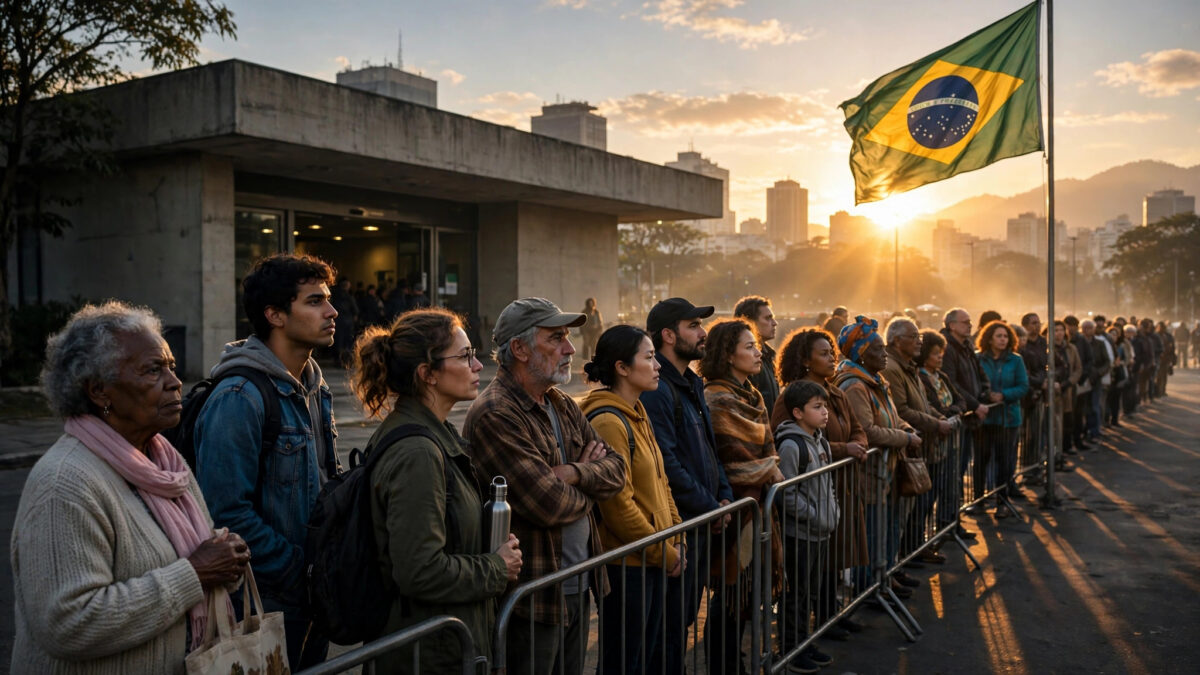
Who owns Latin America?
That is not a question diplomats ask in public. But it is the question 158.7 million Brazilians are answering today, in the longest queues democracy has ever seen in the Americas. For on this Sunday, the 4th of October 2026, Brazil — the fifth-largest country on earth, the engine of an entire continent — is voting for its president. And this, my reader, is no ordinary election.
Two centuries ago, in 1823, President James Monroe stood before the American Congress and declared the Western Hemisphere off-limits to European powers: “America for the Americans.” It sounded like liberation. History proved it was a deed of ownership. The “Monroe Doctrine” became Washington’s quiet license to treat an entire hemisphere as its estate — its “backyard.” Presidents were installed and removed in that backyard; fruit companies wrote the laws of banana republics; and when Brazil’s own democracy was strangled by a military coup in 1964, the tanks rolled with Washington’s blessing and its warships waiting offshore.
So when, twelve days ago, an 80-year-old Brazilian stood at the podium of the United Nations General Assembly and said “Brazil is nobody’s backyard,” he was not making a campaign slogan. He was answering two hundred years of history. And today, Brazil’s voters will decide whether that answer stands — or whether the backyard door is opened again.
Two Visions of One Continent
The choice could not be starker. On one side stands Luiz Inácio Lula da Silva, 80 years old, seeking a fourth and likely last term. His is one of the most extraordinary lives in modern politics: a former metalworker who governed Brazil from 2003 to 2010, who then spent 580 days in a prison cell on corruption convictions that the Supreme Court later annulled in 2021, who rose from that cell to defeat Jair Bolsonaro and return to the presidency in 2023. His pitch today is multilateralism, the Global South, and a Brazil that bows to no capital — Washington’s or Beijing’s.
On the other side stands Senator Flávio Bolsonaro, 45, heir to the most combustible political dynasty the Americas have produced in decades. His father, Jair Bolsonaro, cannot run: he is barred from office, under humanitarian house arrest, and serving a 27-year sentence for attempting a coup to overturn his 2022 election defeat. The son campaigns as the dynasty’s moderate face — the young face, the negotiator’s face — but make no mistake about the direction he represents. When he launched his candidacy in July, Israel’s Benjamin Netanyahu appeared by video to endorse him. In May, Flávio sat in the Oval Office with Donald Trump to discuss organised crime, tariffs and critical minerals, and met JD Vance and Marco Rubio the next day. Argentina’s Javier Milei travelled to Brazil to campaign for him, called Lula a “convict,” and got Brazil’s ambassador recalled to Buenos Aires for his trouble.
As Brian Winter, editor-in-chief of Americas Quarterly, told CNN, “It’s two competing visions of what the country should look like and what Latin America should look like.” If no candidate crosses 50% of valid votes today, the two will meet again in a runoff on October 25th.
The Tariff Empire
But here is the delicious irony of this election — and the reason the whole world is watching. The single most effective campaigner for Lula da Silva has not been Lula da Silva at all. It has been Donald Trump.
In the summer of 2025, Trump announced tariffs on Brazilian goods, explicitly citing what his administration called the politically motivated prosecution of Jair Bolsonaro. The tariffs were rolled back that November — but this summer they returned, fresh measures still in effect as Brazilians vote today. Lula rejected them, threatened retaliation, and — in an interview with CNN’s Christiane Amanpour in September — said he would hold off while negotiations with Washington continue.
And what did the pressure achieve? Exactly what the East India Company achieved with its own “trade pressure” three centuries ago in our part of the world: nothing but resentment, and a rallying cry for the other side. “Some have joked that the most effective campaigner for Lula has been Donald Trump,” Winter told CNN. “The tariffs and the other efforts to interfere in Brazil’s politics have, for the most part, backfired and helped Lula.”
Pause on that sentence, reader. The East India Company did not conquer India with a flag; it conquered it with ledgers, with debts, with “trade agreements” enforced by tariffs and gunboats. The modern tariff is yesterday’s musket with better public relations. When a foreign power punishes a nation’s voters for their own courts’ decisions — when it punishes them, quite literally, for being sovereign — it does not bend them. It reminds them of what sovereignty is, and why their grandfathers bled for it.
Lula carried that argument onto the world stage on September 22nd. “We know that some abuse that freedom to align themselves with foreign interests that run counter to the country’s interests,” he said at the UN — words everyone understood as aimed at Flávio. “We will not allow the enemies of democracy, internal or external, to undermine the popular will… We are once again witnessing external interference in electoral processes.” Two days later, Brazilian diplomats walked out of the hall as Netanyahu began his address, amid Lula’s sharpening criticism of Israel’s conduct in Gaza. The backyard, it seems, has begun answering back.
The Dragon and the Eagle
There is, however, a second empire in this story, and honesty demands we name it. China has been Brazil’s biggest export market since 2009, and its lead has widened sharply since Trump’s return. Total bilateral trade hit a record $171 billion in 2025 — more than double the roughly $83 billion Brazil traded with the United States, according to analysis by ORF America. In the first eight months of 2026 alone, China absorbed 30.7% of Brazilian exports against 9.6% for the United States; in soybeans — the lifeblood of Brazil’s farm belt — China takes roughly 70% of shipments.
Even a Bolsonaro presidency could not escape this gravity. As Brookings notes, Jair Bolsonaro campaigned on distancing Brazil from China, then as president watched bilateral trade reach record levels, made a state visit to Beijing, and resisted American pressure to exclude Huawei from Brazil’s 5G rollout. Flávio’s own platform promises commercial engagement “from China to the European Union, from the United States to Asian markets.” The soy must go somewhere; the iron ore must go somewhere. Geography is not ideology.
This is the deeper truth of the multipolar age, and Brazil is its perfect laboratory. The old game was: choose your empire. The new game is: make the empires compete for you. Lula’s genius — and whatever one thinks of the man, it is genius — has been to turn Brazil’s very bigness into a negotiating position: its soybeans, its iron ore, its niobium (Brazil holds some 90% of the world’s reserves), its newly legislated critical-minerals regime. Whoever wins today inherits not a choice between masters, but an auction.
An Apathetic Polarisation
Yet I would be a dishonest columnist if I painted this as a morality play with a clean hero. Brazil’s democracy is exhausted, and both camps carry the stain.
The country has been consumed for months by the collapse of Banco Master and its former chief, banker Daniel Vorcaro — a scandal whose tentacles reach across the political, financial and judicial establishment. Supreme Court Justice Alexandre de Moraes, Bolsonarism’s great adversary, faces claims that he advised Vorcaro while a law firm run by his wife held a three-year, R$131 million contract with the bank. And Vorcaro’s leaked messages have now pulled Flávio himself under investigation for alleged corruption and money laundering over financing for “Dark Horse,” a film about his father. As Bruno Brandão of Transparency International Brazil told CNN: “One side only cares about the corruption of the other side and closes its eyes to corruption among those in its own political camp.”
This is why the pollsters speak of “apathetic polarisation” — Winter’s phrase for an electorate that still wears its team’s shirt, but without enthusiasm. Brazilians are tired: tired of corruption that neither camp can credibly claim to oppose, tired of an economy whose official numbers say “fine” while salaries buy less, tired of crime — the issue that has powered the Latin American right to victory in 13 of the last 16 presidential elections across the region. Religion has become a fault line too: Datafolha’s latest polling has Flávio leading among evangelicals 47% to 27%, Lula leading among Catholics 45% to 33%.
And the continent is shifting beneath Brazil’s feet. Colombia elected the right-wing Abelardo de la Espriella in June; Peru’s Keiko Fujimori won her runoff weeks later. A Flávio victory, Winter argues, “would cement this move to the right that we’ve seen in so much of Latin America over the last two years.” The pink tide is receding. The question is whether it leaves a desert — or a delta.
The Moral of the Ballot
So here we stand, reader — you and I, watching from half a world away as 158 million people file past ballot boxes that two empires are watching with held breath. And what does it mean for us? For Pakistan, for Asia, for every nation that has ever been someone’s “backyard”?
It means this: sovereignty, in the 21st century, is not won with armies. It is won at the negotiating table, in the soybean contract, in the minerals bill, in the refusal to let a foreign capital dictate who may be prosecuted in your courts. And it is defended, above all, in the mind of the voter who walks into the booth knowing that the whole world is watching — and votes as a free person anyway.
Lula’s campaign adapted a protest song this month with a line worth remembering: “Our strength does not bend, our flag does not surrender, and our sovereignty has no price.” Strip away the campaign theatre and you find a sentence that belongs to no party. It belongs to every nation that was ever told to know its place.
History’s verdict on this election will not be written tonight, nor on October 25th if a runoff comes. It will be written in the decades that follow — in whether the Global South’s largest democracy proved that a nation can trade with dragons and argue with eagles without becoming the servant of either. Empires never knock, reader. They send invoices. The wise nations are the ones that learned, at last, to read the invoice — and then to set their own price.
Brazil is nobody’s backyard. Let us hope, for all our sakes, that today Brazil believed it.
Sources & References
- CNN — “Trump, crime and corruption loom over Brazil’s presidential vote” (4 October 2026)
- Reuters — “At the UN, Brazil’s Lula warns against foreign interference in upcoming election” (22 September 2026)
- ORF America — “Brazil’s Election Will Shape Relations with the United States and China” (September 2026)
- Brookings Institution — “What kind of Brazil will emerge from this election?” (September 2026)
- Global Agriculture — “Brazil’s Election Puts Soybean Farmers in the Middle of US-China Trade Politics” (3 October 2026)
- Consequence — Lula’s Bad Bunny campaign adaptation (September 2026)
- Travel and Tour World — Brazil 2026 general election logistics (October 2026)

About the Author — Abdul Mannan
Related Articles
Iran Says Strait of Hormuz Stays Shut Until Its Seven Conditions Are Met
Iran's parliament speaker says the Strait of Hormuz will remain closed until Tehran's seven conditions from the June…
China Opens Rare Joint Military Air Facility in Laos, Satellite Images Reveal Scale
China says the Ban Keun facility will train Lao air force pilots and is "not directed against any…
Russian Strike on Liberian-Flagged Cargo Ship in Odesa Port Kills One Sailor
A Liberian-flagged civilian cargo ship was struck at an Odesa-region port on Saturday, killing one sailor and injuring…