They Fired the General Who Counted the Missiles: America’s Empty Quiver in the Iran War

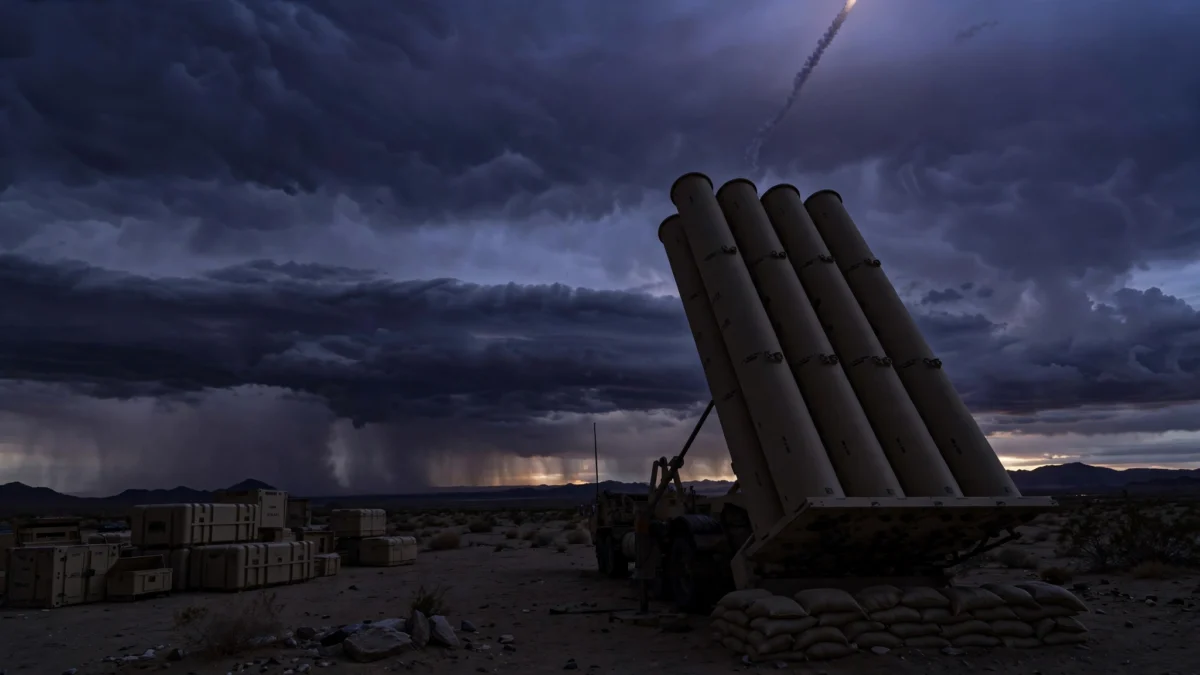
What Do You Do to the Man Who Counts Your Missiles and Tells You the Truth?
In the last week of December 2025, in a building in Washington where truth has to clear a security checkpoint, a four-star general sat down and did the arithmetic of empire. He counted the interceptors. He counted the years it would take to replace them. And then he wrote it down in the Pentagon’s most official document — the Global Force Management Allocation Plan, the annual order that decides where America’s troops and weapons go — knowing that what he was about to say would please no one.
The general’s name was Randy George, Chief of Staff of the United States Army. His warning, delivered two months before the American war with Iran began, was simple: his service was critically short on missile-defense munitions, and the shortage would last another five years — until 2030.
Four months later, while that very war was raging, the Secretary of Defense, Pete Hegseth, fired him.
On 15 October 2026, CBS News reported the story — and with it, the confirmation that General George’s prophecy has come true with a precision that ought to frighten anyone who still believes that superpowers tell themselves the truth. The war with Iran, now in its seventh month, has burned through America’s missile shield at a rate the Pentagon’s own ledgers cannot sustain. Four-fifths of the THAAD interceptors gone. More than half of the Patriots. Tomahawks fired by the thousand. And the one man who had warned, in writing, in the official plan, that exactly this would happen — removed in April, mid-war, as if the arithmetic were his fault.
I have spent my life watching powerful men, and I have learned this: an empire does not fall when its enemies grow strong. It falls when its own generals are punished for counting.
The Cassandra of the Pentagon
The Greeks understood this drama three thousand years before the Pentagon existed. Cassandra, the daughter of King Priam of Troy, was given the gift of prophecy — and the curse that no one would believe her. She stood before her people and described, in perfect detail, the wooden horse, the soldiers inside it, the fire that would follow. They called her mad. The horse came through the gates. Troy burned. Cassandra was right about everything, and it did not save her, and it did not save them.
General George is the Cassandra of this war — except that in Washington the punishment for being right is not being ignored. It is being removed.
Consider what CBS News has now established through multiple United States officials who spoke on condition of anonymity. The general’s risk analysis did not appear in some leaked memo or whispered briefing. It appeared in the defense secretary’s own annual order — the plan for fiscal year 2027 — and it said plainly that stocks of THAAD and Patriot missiles would remain at “low strategic-risk levels” until 2030. CBS is withholding the exact percentage figures conveyed by officials because of security concerns, and General George himself has declined to comment, which is exactly what a soldier does when he has already said what he had to say and paid the price for it.
The officials told CBS where the rot began, and this is the part that deserves your full attention, dear reader: the shortage did not start with the Iran war. It was built in layers — the transfer of Patriot missiles to Ukraine after Russia’s invasion in 2022, the expenditure of munitions defending Israel, and above all the slow withering of the American defense industrial base, the factories and forges that once made the arsenal of democracy and now struggle to make enough rounds for a single war. The war with Iran did not create the empty quiver. It merely exposed it.
And what did the institution do when a man in its highest ranks named the danger in writing? It fired him. In April. While the war was on. Let that date sit in your mind like a stone.
The Numbers Nobody Wanted to Read
Numbers are the most honest witnesses in any war, because unlike press secretaries they cannot be briefed. Let me lay before you the numbers that the estimates of the Center for Strategic and International Studies — CSIS, one of Washington’s own institutions — have put on the record.
Before the Iran war began on 28 February 2026, the United States possessed roughly 355 THAAD interceptors, the missiles designed to kill ballistic missiles in the high reaches of the atmosphere, and about 2,300 Patriot interceptors, the workhorses of lower-altitude defense. The war has consumed between 190 and 290 of those THAADs — roughly 82 per cent of the prewar stock — and between 1,050 and 1,430 of the Patriots, up to 61 per cent. CNN’s reporting, citing sources familiar with recent Pentagon inventory assessments, put it even more starkly: nearly four-fifths of the THAAD inventory burned through, about half of the Patriots gone, with senior military commanders warning that some Pentagon munitions reserves had fallen to “dangerously low” levels.
Pause on that phrase — “dangerously low” — spoken not by an enemy propagandist, not by a critic of the war, but by America’s own senior commanders.
The offense tells the same story. Analysts estimate American forces have fired more than a thousand Tomahawk cruise missiles in the Iran campaign, drawing the stockpile down by close to half from levels that were already modest in peacetime. The Precision Strike Missile has been burned through at 45 per cent; the long-range JASSM standoff weapons by more than a fifth. Each THAAD interceptor costs well over ten million dollars. Each Patriot PAC-3 takes an average of three and a half years from order to delivery.
And here is the number that should stop you cold, the one a United States official gave to CBS News: even if America fired not one more interceptor — not in Iran, not in any other conflict — it would take until 2030, the midterm elections of the next presidential administration, to rebuild the stockpile merely to the already-low levels of December 2025. There were no THAAD replenishment deliveries expected in fiscal year 2026 at all. Fewer than 500 Patriot munitions were expected. In the current fiscal year, 2027, the United States has requested more than 800 THAADs — a number that reads less like a procurement plan than like a confession.
The pace of replenishment tells you everything about the industrial base the general warned about. Under current delivery schedules, the Pentagon is receiving roughly fifteen Tomahawks and twenty Patriot missiles a month. Lockheed Martin announced in January a plan to quadruple THAAD production capacity from 96 to 400 interceptors a year — a commendable ambition that also tells you, by arithmetic alone, that the factory cannot make them as fast as the war can spend them. CSIS concludes that Tomahawk, THAAD and Patriot inventories will take three or more years from today to return to prewar levels. These are not munitions. They are complex, software-driven machines with intricate supply chains, advanced seekers, specialized propellants and guidance electronics — built in limited quantities, on specialized lines, by skilled labor, in plants sized for peacetime. You cannot surge them the way you surge a crowd.
“Virtually Unlimited” — The Ledger and the Lie
Now set those numbers beside the words of the men in charge, and watch what happens to truth in wartime.
President Donald Trump has repeatedly brushed off concerns about depleted weapons stores during the six months of war, declaring that the United States has “virtually unlimited” ammunition. On a Monday in September he posted to his Truth Social platform that America is producing “more Exquisite and Elite Weapons than at any time in our History” — capital letters his, as always.
Contacted by CBS News, the Pentagon’s chief spokesman, Sean Parnell, said: “Claims of U.S. munitions shortages are false.” The sentence has the polished certainty of a press release and the life expectancy of one.
Because on 14 September, the Defense Department’s own inspector general — the Pentagon’s internal auditor, not a journalist, not an opponent — delivered a first-of-its-kind mandatory report to Congress. Between 28 February and 30 June alone, the inspector found, Operation Epic Fury had cost an estimated $33.4 billion, with $22.3 billion of that spent on expended munitions. And then came the sentence that should have ended the argument: the munitions expenditure, the report said, “has resulted in strategic inventory shortfalls and revealed industrial base bottlenecks for munitions resupply.”
The same report, covered by AFP, listed what the war has already cost the American fleet: four F-15s destroyed, one F-35 damaged, seven KC-135 tanker aircraft damaged, and up to 30 MQ-9 Reaper drones destroyed. These are not rumors from social media. These are the Pentagon’s own auditors, in a mandatory report, to Congress.
So we are left with a curious arrangement. The inspector general tells Congress there are strategic inventory shortfalls. The general who warned of them in the official plan is fired mid-war. The spokesman calls the claims false. The president calls the ammunition virtually unlimited. And the missiles keep being fired at a rate the factories cannot match. I ask you, reader — in the history of the world, has any empire ever gone bankrupt while its accountants insisted the vaults were full?
The Price of the Empty Quiver
What does an empty quiver cost a superpower? Not merely the missiles. Something far more precious: choices.
When your shield is four-fifths spent, every decision becomes a hostage of arithmetic. Gulf allies that depend on American missile defense have privately told CNN they fear another major escalation could leave American bases, energy facilities and critical infrastructure exposed to Iranian ballistic missiles and drones. The depletion has already shaped strategy: the issue was reportedly raised again ahead of President Trump’s decision last weekend to cancel planned strikes on Iran. A war you cannot resupply is a war you cannot escalate — and your enemy knows it.
And the strain is not confined to one theater. The same stockpiles that are being emptied over the Gulf are the ones that would be needed in a crisis in Europe or the Western Pacific. One war has consumed what three contingencies were supposed to share. Analysts now speak openly of a “near-term risk” of running out of ammunition across the combined drain of Iran and Ukraine — the latter having already taken roughly a third of America’s Javelin inventory, a quarter of its Stingers, more than two million artillery rounds and thousands of rockets since 2022.
There is a final irony that would be comic if it were not tragic. Rebuilding the arsenal will require rare-earth minerals and industrial inputs whose supply chains run through China — the very rival the American arsenal is ultimately meant to deter. Fortune’s analysis of the combined wars put it with brutal clarity: the weapons cupboard is bare, and restocking it will not happen without Beijing’s cooperation. The sanctioner needs the sanctioned. The jailer needs the prisoner’s permission to make new bars.
And the human ledger, which no spreadsheet captures: at least thirteen American service members have been killed in this war, and more than three hundred wounded, with the fighting now stretching into its seventh month while the Secretary of State tells the public it is expected to last “weeks, not months” and promises no ground troops. The families of the fallen do not care about replenishment timelines. But they should care — as you should — about why their sons and daughters were sent to fight a war whose arsenal was already, in the written judgment of the Army’s own chief, mortgaged to 2030 before the first shot was fired.
History Is a Mirror, and It Is Never Kind
Every empire keeps a room where it stores the weapons it no longer has. Rome had such a room in its final century — the legions were still on the maps, the eagles still on the standards, but the recruiting grounds were empty and the treasury was paying barbarians to guard the gates. The maps said “empire.” The ledger said otherwise. The maps were wrong.
Britain learned the same lesson in November 1956, at Suez. London and Paris sent their fleets to seize the canal, confident in the old arithmetic of gunboats — and discovered, in a week of American financial pressure and empty threats, that the empire which had ruled the waves could no longer afford a single canal. The Suez Crisis did not destroy a single British ship. It destroyed something larger: the belief, at home and abroad, that Britain could still do what empires do. The weapons were there. The will of others was not. The mirror showed a great power; the reflection was a middle power with good memories.
America’s Suez moment may be quieter — no canal, no humiliating withdrawal, just a spreadsheet in the Pentagon that no press release can edit. But the structure is identical. An empire discovers, mid-war, that its strength was partly a story it told itself; that the industrial base which won the Second World War now delivers twenty Patriot missiles a month; that the general who said so in writing was removed while the war he predicted was still being fought. Suez took Britain a week. The empty quiver is taking America seven months and counting — and unlike Suez, this lesson is being learned under fire, with ballistic missiles in the air.
There is a pattern in history that no empire has ever escaped, and it runs like this: first the treasury is mortgaged, then the factories are hollowed, then the warnings are punished, and only then does the enemy need to arrive. The enemy does not have to defeat you. He only has to wait for you to discover, at the worst possible moment, what your own general tried to tell you in December.
The Verdict of the Fired General
So I return to the question I asked at the beginning: what do you do to the man who counts your missiles and tells you the truth?
The honest answer is the one Washington has given: you fire him in April, you call his numbers false in October, and you keep firing the missiles anyway — because admitting he was right would mean admitting that the “virtually unlimited” arsenal was a story, that the industrial base was hollowed on your watch, that the war was launched on a ledger that was already red. It is easier to remove the witness than to refute the arithmetic. Troy did the same to Cassandra. The horse came through the gates anyway.
But here is what the powerful never understand about truth-tellers: firing them does not unfire the warning. General George’s assessment sits in the Global Force Management Allocation Plan, approved by the very department that removed him, and every month of this war writes its confirmation in fire over the Gulf. The interceptors are gone whether or not the spokesman admits it. The factories cannot surge whether or not the president capitalizes his adjectives. The allies are worried whether or not the press releases soothe them. Reality does not require permission to proceed.
And so I leave you with the thought that has followed me through every page of history I have ever read, from the fall of Troy to the firing of a general in April: nations are not destroyed by the enemies who hate them. They are destroyed by the ledgers they refuse to read — and by the men they punish for reading them aloud.
The missiles are spent. The messenger is gone. The war goes on. Tell me, reader — who, in this story, was the enemy?
Sources & References
- CBS News — “Ousted general warned of missile defense shortage before Iran war” (15 October 2026): Gen. Randy George’s December 2025 warning in the Global Force Management Allocation Plan; ousted by Defense Secretary Pete Hegseth in April 2026; CSIS estimates on THAAD (190–290 used, ~82%) and Patriot (1,050–1,430 used, up to 61%) stockpiles; 2030 replenishment timeline; Lockheed Martin quadrupling THAAD production.
- WANA News — “What Did the Iran War Do to U.S. THAAD and Patriot Stockpiles?” (25 August 2026): CNN reporting on ~80% THAAD and ~half of Patriot stockpiles expended; “dangerously low” warnings from senior commanders; Gulf allies’ concerns.
- The Business Standard (AFP/BSS) — “US military says Iran war has led to munitions shortfall” (15 September 2026): Department of Defense Inspector General’s mandatory report to Congress — Operation Epic Fury cost $33.4 billion (Feb–June), $22.3 billion on expended munitions; “strategic inventory shortfalls and revealed industrial base bottlenecks”; aircraft losses.
- People — reporting on U.S. service member casualties in the Iran war (at least 13 killed; wounded figures via U.S. officials).

About the Author — Abdul Mannan
Related Articles
The Emperor of the Sky: When One Man Holds a Nation’s War in His Hand
When SpaceX throttled Ukraine's Starshield access at 100 mph during Russian missile strikes, one private man's network dimmed…

A Crown on the Pavement: What a Fallen Royal in London Teaches About Power
An Abu Dhabi royal, found slumped unconscious on a London street while a barefoot three-year-old played near traffic,…

When the Pope Wears a Hospital Gown: What Leo XIV’s Cancer Teaches the Powerful About Dying
On Sunday, Pope Leo XIV told the world that surgeons would open his chest. Two days later, Rome's…