Twelve Arrested in Gosport as Anti-Migrant Protesters Clash With Police Over Normandy Mega-Dinghy Arrival

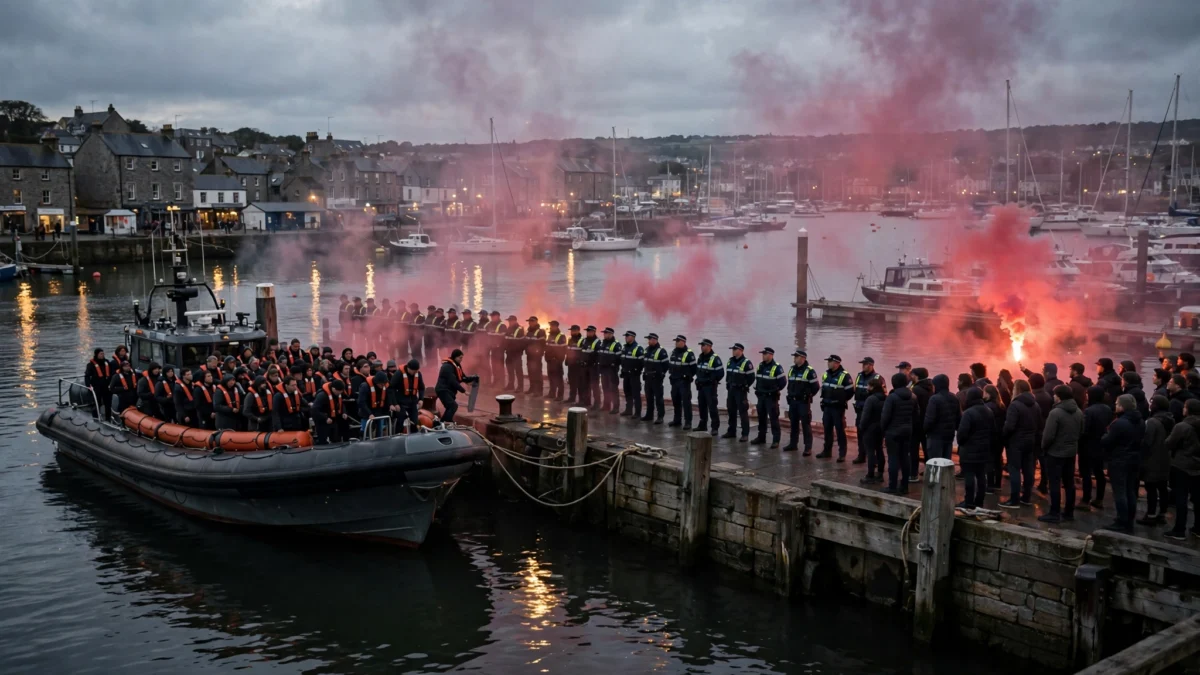
British police arrested twelve people on Sunday night after scuffles broke out between officers and anti-migrant protesters in Gosport, Hampshire, as around 150 migrants were brought ashore from a mega dinghy that crossed the Channel from Normandy — one of the furthest crossings yet attempted, according to Reuters.
About 350 people gathered at Haslar Marina in the southern English town as two RNLI boats escorted the migrants into the harbour at around 10.15pm, Reuters reported. Protesters, contained behind a police cordon on Haslar Road, chanted “send them back” and “stop the boats” as the vessels docked, according to The Sun, which cited PA News Agency footage of the scene.
Tensions flared roughly twenty minutes after the migrants came ashore, The Sun reported. Red flares were let off as demonstrators pushed back against a line of officers, and a fight appeared to break out amid chants including “deport the f****** lot”. Hampshire police confirmed the twelve arrests on Monday.
The migrants are believed to have set off from the Normandy coastline in France early on Sunday, according to The Sun. Some 149 people were reportedly aboard the dinghy, which was shadowed by French rescue vessels until it was met by RNLI boats in English waters, ship-tracking data showed. The Home Office said those aboard would be transported to short-term holding facilities in Kent for processing, including health, security and biometric checks.
The crossing marks the third boat in a month to depart from Normandy, a break from the traditional launch points around Gravelines and Calais, The Sun reported. The first mega dinghy from Normandy reached Portsmouth in September, and a second spent some thirty hours at sea before being rescued and brought to Dover.
According to a senior French Frontier Police officer quoted by The Sun, smugglers are now dropping migrants along the Normandy coast late at night and launching dinghies in the early hours. The crossing covers roughly 400 kilometres from the main patrol zones around Calais — well away from the main police patrols, the officer said.
Analysis: Why It Matters
The Gosport incident compresses Britain’s small-boats dilemma into a single evening. The smugglers’ tactical shift is the bigger story beneath the clashes: by moving launch points hundreds of kilometres west to Normandy’s quiet beaches, criminal gangs are exploiting the geography of the coastline itself. French police openly admit the stretches of sand dunes and wartime bunkers around Utah Beach make detection “usually impossible” — an extraordinary concession that signals a genuine operational problem for France’s border security.
For the British government, each landing outside the familiar Dover corridor widens the political surface of the crisis. Protesters no longer need to travel to Dover; the boats are now arriving at marinas across the south coast — from Portsmouth to Gosport to, just a week ago, Falmouth in Cornwall. That geographical spread feeds a narrative of a border that is not just porous but unpredictable, which is politically far more combustible than a single crossing point.
The dozen arrests in Gosport also point to a hardening pattern: Sunday’s was not the first protest to turn physical — The Sun notes that the September Portsmouth arrival also sparked violent protests — and with the crossing routes spreading, police forces in quiet coastal towns now face crowd-control operations they were never structured for. The government’s response, which relies on processing capacity in Kent, has so far not produced a visible deterrent; the only visible new variable is the smugglers’ ability to adapt faster than enforcement. Unless France can disrupt the Normandy staging areas — a challenge its own officers describe as near-impossible along 400 kilometres of coast — the long route looks set to become a regular corridor rather than an exception.
Sources
- Reuters — “UK police make 12 arrests after anti-migrant protest”
- Nearly 150 mega dinghy migrants arrive in UK on ‘new route’ from Normandy as 12 protesters arrested — The Scottish Sun
- Nearly 300 miles of UK coast now targeted by small boats as mega dinghy migrants try to dodge cops on ‘new routes’ — The Sun

About the Author — Abdul Mannan
Related Articles

Police Log Nearly Five Child Sex Offences a Day at England and Wales Schools
A Guardian investigation of police data found at least 8,500 sexual offences against under-13s recorded at schools in…
Andrew Mountbatten-Windsor Takes Police to Court Over Epstein-Files Arrest, Reports Say
Andrew Mountbatten-Windsor has launched a judicial review challenge against Thames Valley Police over his February arrest linked to…

Manchester Council Gave Man City Owners “Sweetheart” Land Deal, FOI Documents Reveal
FOI documents reveal Manchester City Council gave Sheikh Mansour's Abu Dhabi United Group a "sweetheart" deal with first…