The Sea’s Most Honest Photograph: A Great White Shark, a Smiling Woman, and the Truth That Needed Proving

The Instant That Felt Impossible
She smiled for the camera, and behind her, death itself jumped out of the sea.
It was a Saturday in October, the kind of golden afternoon that California hands out like a promise. Erin King, a local who calls herself an “ocean girl” — born and raised on these shores, a woman whose home is not a house but a coastline — was walking Marina State Beach in Monterey County when she noticed three young women taking photographs of one another. With the easy generosity of someone who belongs to a place, she offered to take their pictures. They were, she would later say, “really kind young ladies,” and they immediately insisted on returning the favour: let us take one of you.
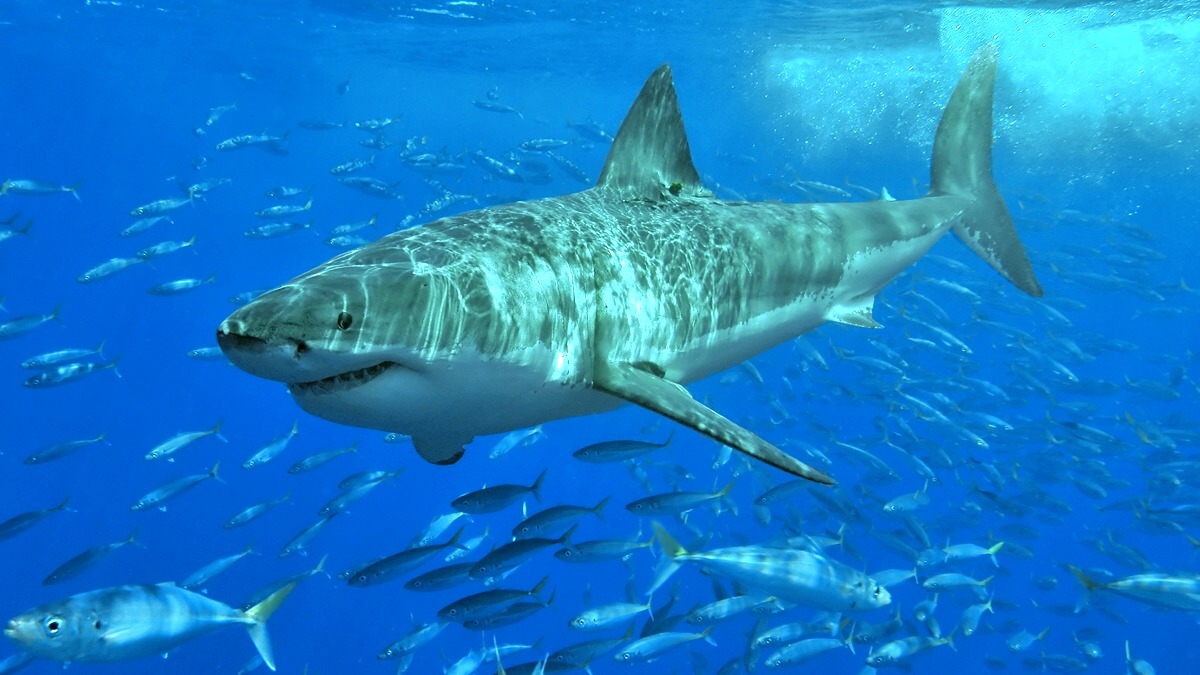
So Erin King stood at the water’s edge, the Pacific foaming white around her ankles, and smiled. The shutter clicked. And in that exact fraction of a second, yards behind her, a great white shark — one of the ocean’s great apex predators, an animal that has prowled these waters for hundreds of millions of years — launched its entire body clear out of the sea.
The photograph raced around the internet within hours. A smiling woman in the foreground. A leviathan suspended mid-air behind her, frozen in the very act of breaching. It looked like a film poster. It looked, frankly, impossible. And so the internet did what the internet now does to everything beautiful: it accused the photograph of lying.
Jonah, Ahab, and the Leviathan
Before I tell you what happened next, let me take you backwards, because the sea demands it. The sea has always been the one mirror in which mankind cannot fake its own reflection.
Three thousand years ago, the sailors of the Mediterranean whispered of the great fish that swallowed the prophet Jonah — not as a children’s tale, but as the deepest terror of men who made their living on open water. The Book of Job does not describe the Leviathan as a metaphor; it describes it as a fact of nature, a creature whose “heart is as firm as stone,” against which “the sword that reaches him cannot avail.” The ancients did not invent these monsters to frighten their children. They invented them because they had seen something, out there beyond the horizon, and their language for what they had seen was awe.
Herman Melville, who spent years staring at the same Pacific that Erin King calls home, understood this better than anyone. In Moby-Dick, Ishmael confesses that it was not the whale’s strength that appalled him but its whiteness — “the whiteness of the whale appalls me,” he writes, because it was a blankness, a purity, a thing beyond the reach of human judgement. Captain Ahab spent an entire novel chasing a white shadow across the ocean, and the shadow won. That is the recurring pattern of every sea story ever told: man goes out seeking mastery, and the sea answers with something larger than his frame of reference.
The Hawaiians had their own version. Kāmohoaliʻi, the shark god, was not a villain in their stories but a guardian — an ancestor who took the form of a shark, to be honoured rather than hunted. Contrast that with us. We spent a century turning the shark into a villain, a cinematic monster, a symbol of everything we fear in the water. Peter Benchley sold the world a nightmare; the ocean kept doing what it has always done.
And that is the first thing this photograph teaches. Erin King was not hunting the shark. She was not fleeing it either. She was simply there — present, smiling, human — and the sea, in its own time, rose up behind her and revealed itself. The ancients would have called it an omen. We call it a photobomb. The difference is vocabulary, not wonder.
The Trial of a Photograph
Now here is the part of the story that should make you sit very still, because it is really about you and me.
The moment the image went viral, the comments flooded in with a single, suspicious question: is it real, or is it AI? In the year 2026, every spectacular image stands guilty until proven innocent. We have trained ourselves, with good reason, to distrust our own eyes. The age of deepfakes has made cynicism a survival skill, and so the most astonishing genuine photograph of the year had to stand trial for the crime of being astonishing.
And so something extraordinary happened — something I want you to hold in your mind like a photograph of its own. The State of California, through its Department of Parks, opened an investigation not into a crime, not into a scandal, but into reality itself. Officials obtained footage from a nearby Surfline surf camera — a second, independent eye, mounted on the coastline, recording the same stretch of water — and they compared the timestamps. The timestamp on Erin King’s video matched the timestamp on the Surfline footage perfectly. The same breach. The same moment. The same shark.
Mike Dippel, the chief ranger for California State Parks, confirmed it on the record: “Given where she was standing, and the timestamp on her video, which matched up perfectly with the timestamp on the Surfline video, it’s very likely to be the same shark.” A parks official named Chris Cerney verified the breach as completely authentic. The State Parks issued a formal statement: the department had “independently confirmed a shark matching the characteristics of a great white breached off the shore near Marina State Beach at the same time.”
Read that again slowly. A government agency had to certify that the ocean did something. We have reached a moment in human history where reality requires documentation, where truth needs two camera angles and an official statement to be believed. The shark did not change. The sea did not change. We changed. We became a species that looks at a miracle and reaches first for the debunking.
I do not say this to mock the sceptics — their suspicion was earned; we are drowning in fakes. I say it to mark the cost. When every image is suspect, the price is not merely confusion. The price is that the next genuine wonder will be dismissed before it is celebrated. The next Erin King will smile at the camera, the next sea will rise behind her, and half the world will scroll past muttering “AI” before the Parks department has time to check the timestamps.
Sharktober: Why the Shark Was There
The shark, of course, was not performing. It was hunting — or rather, it was being itself, which is rarer and more beautiful than any performance.
What surfers call “Sharktober” is real oceanography wearing a nickname. Between September and November, adult great white sharks return to California’s central coast in numbers. They have spent months far offshore, in a patch of open Pacific that scientists call the White Shark Café — a mysterious mid-ocean gathering ground whose purpose researchers are still unravelling. Then, driven by hunger, they migrate thousands of miles back toward the coastline, to the rocky headlands and seal colonies where the real feeding begins: Monterey Bay, Point Reyes, the Farallon Islands.
The conservation group Shark Stewards, which coined the “Sharktober” label, describes the great whites as being drawn to the beaches and islands “where seals and sea lions haul out.” This stretch of coast — California’s infamous Red Triangle — is where the ocean’s oldest food chain plays out within sight of the shore. A breaching shark is a hunting shark: it attacks from deep below at tremendous speed, and the momentum of the strike can launch its entire body clear of the water. Breaches happen in an instant. Witnessing one is rare. Filming one, by accident, in the exact second a stranger takes your photograph — the odds of that, in Erin King’s own words, feel “almost impossible.”
Chris Lowe, the Cal State Long Beach shark expert, recently told the Los Angeles Times something worth pinning to your wall: “sharks are around people all the time.” The remarkable thing about this story is not that a shark was near the beach. It is that we finally saw one, in a flash, and the seeing was verified. Just days before this breach, a reported 10-to-12-foot great white prompted a temporary beach closure at Huntington Beach. The ocean was already speaking. We simply were not listening with our cameras on.
And before fear takes the paragraph — because fear always tries to take the paragraph — let the record speak. California State Parks reminds visitors that sharks are “an important part of the coastal ecosystem” and that interactions between people and sharks are rare. Attacks remain exceedingly rare. The agency issued a temporary shark advisory for Marina State Beach, as protocol demands in autumn, and life continued: the surfers returned, the walkers returned, the ocean kept its appointments.
Bonded for Life
But here is the part of the story that no camera captured, and it is the part I cannot stop thinking about.
Three young women — strangers to Erin King, visitors to her beach — took the photograph of a lifetime. They could have kept it. In the economy of virality, an image like that is currency; it can buy followers, licensing fees, a moment of internet fame. Instead, they gave it to her. They handed Erin King the most unbelievable photograph she will ever own, freely, the way you hand someone their own reflection.
“We’re bonded for life,” King laughed afterwards. Three people she had never met, and one shark she never saw, and now they are stitched into the same story forever. Think about the symmetry of it: she offered to take their photograph first. Kindness opened the door; the ocean walked through it.
I have spent years writing about treachery — about Mir Jafars and Mir Sadiqs, about the small betrayals that rot nations from within. Forgive me, then, if I linger on this small act of grace. In a story that contains a great white shark, the most human moment is not the shark at all. It is three strangers who did not monetise a miracle. It is a woman who shared her beach before she shared her fame. It is the reminder that decency, like breaching, happens in an instant — and that unlike breaching, it is entirely within our control.
You, reading this: when was the last time you offered something to a stranger with no thought of return? The ocean does not keep accounts. Neither, on that Saturday, did Erin King, and neither did the three young women. The sea rewarded them all.
The Verdict of the Sea
So what does the sea’s most honest photograph finally tell us? It tells us that reality is still out there, larger and stranger than anything we can generate. Our machines can fake a face, a voice, a war, a press conference — but they cannot fake a three-and-a-half-metre predator deciding, in the cold arithmetic of hunger, to launch itself at the sky behind a smiling woman on a Saturday afternoon. The ocean does not do deepfakes. The ocean does not need to. Its truths are older than our doubts and will outlast them.
It tells us, too, that awe is a discipline. Erin King calls the beach her home, and homes are known by attention. She noticed the three young women. She noticed the light. She was present — and presence is the price of admission to wonder. The rest of us scroll through wonders daily and feel nothing, because we have mistaken the screen for the sea.
And it tells us, finally, something about proof. A government agency matched two timestamps to certify a miracle. Let that be the epitaph of our cynical age: we demanded evidence that the world is still wonderful, and the world, patient as ever, provided it. The shark breached. The cameras agreed. The sceptics were answered. The sea, as always, had the last word — and the last word was this: I am still here. I am still real. Come and see.
The question is whether we will.
Sources & References
- SURFER magazine — “Watch: Viral Great White Photobomb Confirmed As Real, Not AI” (20 October 2026); and the first report, “Great White Shark Photobombs Woman in Peak ‘Sharktober'” (18 October 2026)
- Adventure Sports Network — report on the Marina State Beach breach, the Sharktober migration season and the Red Triangle
- Yardbarker / SURFER — the verification of the footage via California State Parks and Surfline camera footage
- KSBW Action News 8 — Erin King’s interview (“It happened so fast… a very magical moment”; “We’re bonded for life”)
- California State Parks — official statement and shark advisory for Marina State Beach; confirmation by Chief Ranger Mike Dippel
- Shark Stewards — Sharktober season (September–November), the White Shark Café migration, and the “celebrate, not hate” conservation message
- Chris Lowe, Cal State Long Beach shark expert, via the Los Angeles Times — “sharks are around people all the time”
- Herman Melville, Moby-Dick; or, The Whale (1851), Chapter 42, “The Whiteness of the Whale”

About the Author — Abdul Mannan
Related Articles

What Is the Price of a Generation? Musk’s $10.5 Billion Gift to America’s Children
What is the price of a generation? I do not ask this as an economist. Economists have their…

The Last War Correspondent: Christiane Amanpour Signs Off After 43 Years
Christiane Amanpour announced she will leave CNN next June after 43 years. From Sarajevo to Rwanda, she made…

The Gun Returns to Bollywood: Tiger Shroff, the Bishnoi Gang, and the Disposable Shooters
Five shots rang out in Juhu on a Sunday evening, and Bollywood heard an echo from 1997. Three…