Isaias Strengthens Toward Category 3 as Gulf Coast Orders Evacuations and Oil Majors Shut In Platforms

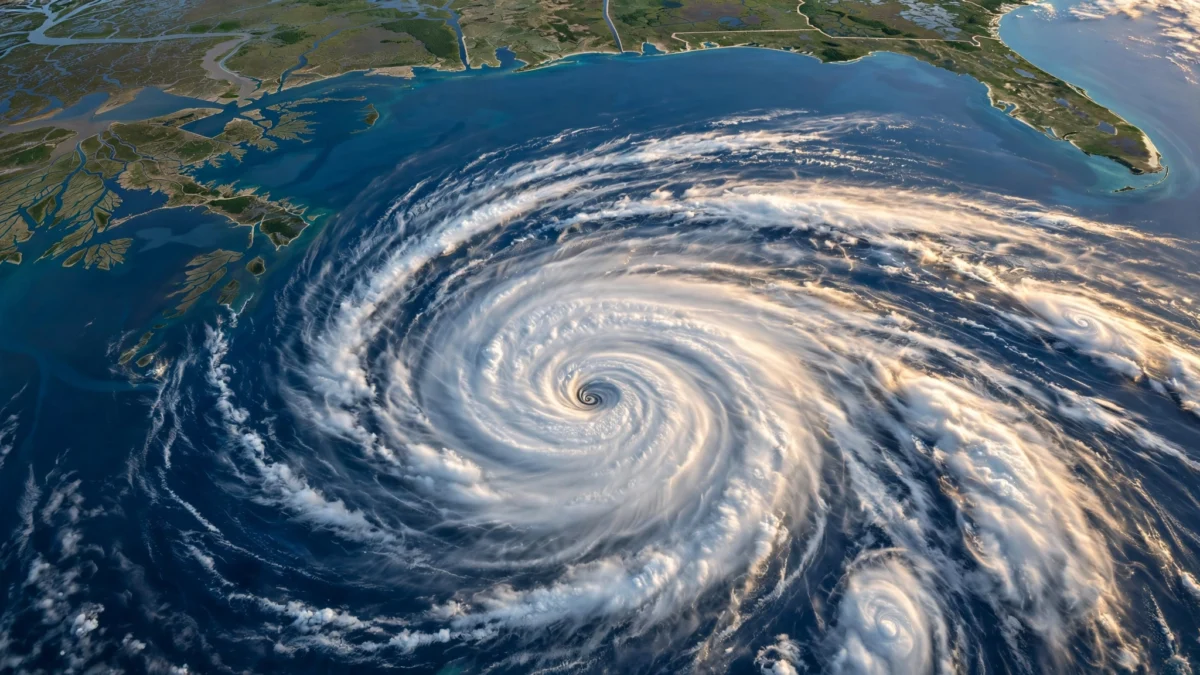
Hurricane Isaias, the first hurricane of the 2026 Atlantic season, intensified steadily over the warm Gulf of Mexico on Thursday, with forecasters warning it could approach Category 3 strength before making landfall late Friday or early Saturday, according to the National Hurricane Center.
In its 4:00 a.m. CDT advisory on Thursday, the hurricane center said Isaias had maximum sustained winds of 80 miles per hour and a minimum central pressure of 979 millibars, with the storm’s centre about 170 miles north-west of Progreso, Mexico, and roughly 420 miles south-south-west of the mouth of the Mississippi River. The storm was moving east-northeast at 9 miles per hour. “NOAA hurricane hunters indicate that Isaias continues to intensify,” the centre said, urging residents along the warning area of the Gulf Coast to rush preparations to protect life and property “to completion today.”
The upgrade to hurricane status came overnight Wednesday, when an Air Force Reserve Hurricane Hunter aircraft found sustained winds of 75 miles per hour and a central pressure of 982 millibars, according to the hurricane center. The National Hurricane Center’s forecast advisory projects winds reaching 110 miles per hour — a strong Category 2 — by 5 a.m. on Friday, and forecasters said the storm could come “just short of Category 3 strength within the next 24 hours.”
A storm surge warning is in effect from the mouth of the Mississippi River to the Steinhatchee River in Florida, a hurricane warning runs from Ocean Springs, Mississippi, to the Bay-Gulf County line in Florida, and tropical storm warnings cover the fringes from Jefferson Parish in Louisiana to the Aucilla River in Florida, according to the National Hurricane Center. Forecasters warned of 5 to 7 feet of storm surge from Ocean Springs to Indian Pass, Florida, and in Mobile Bay, with 3 to 7 inches of rain expected across the region and as much as 10 inches locally. Heavy rain with the risk of flooding could reach as far inland as the Tennessee Valley over the weekend, according to the Associated Press.
The National Weather Service told communities from Ocean Springs to Gulf County, Florida, to prepare for the possibility of “long-duration power outages.”
Coastal Florida moved quickly. Okaloosa County officials ordered visitors out of the forecast impact area beginning at 8 p.m. Wednesday, and a mandatory evacuation took effect at 12 p.m. Thursday for coastal residents in Zones A and B, including Okaloosa Island and parts of coastal Fort Walton Beach, Destin, Mary Esther and Niceville, according to the Northwest Florida Daily News. The county will open two shelters, including one at Davidson Middle School in Crestview, at 6 p.m. Thursday. At least four Florida school districts cancelled classes later in the week, and governors in Florida and Alabama declared states of emergency for dozens of counties, the Associated Press reported.
The storm’s approach collided with an already tight national energy picture. Shell said it was evacuating all personnel and shutting in production at five Gulf platforms — Mars, Olympus, Ursa, Vito and Appomattox — and had moved non-essential personnel from its Stones asset, according to Reuters. Chevron said it had begun shut-in procedures at four of its Gulf facilities and was transporting additional personnel onshore, while production at five other Chevron Gulf sites continued normally. Britain’s Harbour Energy also said it was curbing production and evacuating personnel at select facilities, the Wall Street Journal reported.
The U.S. Marine Minerals Administration said about 511,619 barrels a day — roughly a quarter of Gulf oil production, and more than 16 per cent of Gulf natural gas output — had been shut in as of midday Wednesday, according to the Wall Street Journal. Offshore fields in the Gulf of Mexico account for about 15 per cent of total U.S. crude production and 5 per cent of natural gas production, and forecasters note the storm’s projected path could threaten refineries along the northern Gulf Coast, where about half of America’s refining capacity sits.
Prices were already elevated before the storm. The average price of petrol across the United States reached $4.34 a gallon on Wednesday night, according to GasBuddy, up about a quarter from a month earlier and $1.23 higher than a year ago, USA Today reported. Brent crude gained more than 4 per cent as Houthi attacks on shipping in the Middle East and the Gulf shut-ins squeezed supply, the Wall Street Journal reported, while U.S. crude inventories fell by a larger-than-expected 3.2 million barrels in the week ended October 2, according to the Energy Information Administration.
CNN reported that U.S. refineries are running at maximum output to offset war-driven outages overseas, that diesel prices have reached all-time highs, and that America’s emergency oil stockpile sits at its lowest level since 1982. The International Energy Agency said Wednesday that member countries supported accelerating the remaining emergency oil-stock releases pledged in March — prioritising diesel — with around 325 million barrels already released.
The storm’s timing has rewritten the season’s narrative. The 2026 Atlantic season was one of the quietest on record, suppressed by a record-strong El Niño, and Isaias — which formed off Mexico on Wednesday as Tropical Depression Nine — became the season’s first hurricane within a day of the 121-year-old record for the latest-arriving first hurricane, set on October 8, 1905.
The Southeastern Conference is monitoring Saturday’s No. 2 Georgia versus No. 6 Alabama game in Tuscaloosa, where ESPN’s College GameDay is scheduled and President Trump is expected to attend; college football officials have described the storm’s possible path through the region as a “nightmare scenario,” though AccuWeather forecasts a weaker outcome for the area.
Analysis: Why It Matters
A quiet hurricane season is not a safe one, and Isaias is the season’s late verdict on that distinction. Forecasters had long warned that the record-strong El Niño suppressing Atlantic activity this year offered no guarantee against a single, well-timed storm — and Isaias found exactly the combination that matters: warm Gulf water, waning shear, and a path aimed at the most economically loaded stretch of American coastline.
The second, more consequential collision is with the energy system. The storm is arriving at a moment when global fuel markets have no shock absorbers left. Diesel inventories sit well below seasonal norms, commercial crude stocks just fell by more than analysts expected, the emergency reserve is at a four-decade low, and refineries are already running flat out to cover war-related outages abroad. A major hurricane aimed at the Gulf refining nerve centre — in the words of one energy analyst, the worst timing in 25 years — risks turning a manageable supply disruption into a price event. What is shut in offshore this week can come back; what is damaged at a refinery cannot, and that asymmetry is what traders are pricing.
That is also why the distinction between platforms and refineries matters. The shut-in figures — 511,000 barrels a day, roughly a quarter of Gulf output — look dramatic but are a normal precaution that producers execute routinely; Chevron itself noted it has already kept five of its nine Gulf facilities at normal production. The real vulnerability sits onshore: six refineries in the potential path, in states holding roughly half of U.S. refining capacity, at a moment when those plants are the system’s last line of defence. Markets understand the difference, which is why gasoline — not crude — is where the sharpest moves have shown up, with pump prices at their highest for this time of year on record.
There is also a politics-of-timing dimension worth watching. The storm is bearing down on the Gulf less than a month before the midterm elections, with average petrol prices already above $4.30 a gallon and rising about a quarter in a single month. Voters tend to blame sitting administrations for pump prices whatever the cause, and a storm that knocks refining capacity offline in the final weeks of the campaign would hand the opposition a ready-made symbol. The White House’s response — including how quickly federal resources move into Florida, Alabama and Mississippi — will be watched as closely as the storm track.
What to watch next: the intensity trend through Friday — whether Isaias tops out as a strong Category 2 or punches through to Category 3 will decide the damage profile; the landfall point, since a track east of New Orleans spares Louisiana’s refineries but puts Florida’s Panhandle under the surge; the energy market’s Friday response as shut-in numbers update; and the inland flooding risk as the storm’s remnants push into the Tennessee Valley, where the weekend’s rain could matter as much as Friday night’s wind.
Sources
- National Hurricane Center — Hurricane Isaias Public Advisory #7
- CNN — A major hurricane could cripple US refining when the world can least afford it
- Reuters — Shell, Chevron cut Gulf of Mexico output as Tropical Storm Isaias approaches
- USA Today — Isaias strengthens into hurricane ahead of expected landfall
- Associated Press — Isaias becomes the first hurricane of the Atlantic season
- Wall Street Journal — Brent gains more than 4% on U.S.-Iran tensions, Hurricane Isaias

About the Author — Abdul Mannan
Related Articles
Texas Executes Jamaal Howard in Nation’s First Lethal Injection Since Tennessee’s Botched Attempt on Christa Pike
Texas executed Jamaal Howard on Wednesday evening — the first lethal injection in America since Tennessee's botched attempt…
Christa Pike, the Only Person Known to Survive a Lethal Injection, Is Conscious and Speaking as a Tennessee Court Orders Execution Evidence Preserved
Tennessee death row inmate Christa Pike is conscious and speaking six days after surviving the state's failed lethal…

Trump Makes Third Texas Trip in a Month as Paxton Trails Talarico in Toss-Up Senate Race
President Donald Trump returns to Texas for the third time in a month on Wednesday, rallying in San…