Israel to Close British Consulate in Jerusalem on Thursday, Marking New Low in UK Relations, as 11 Arrested at London’s October 7 Anniversary Protests

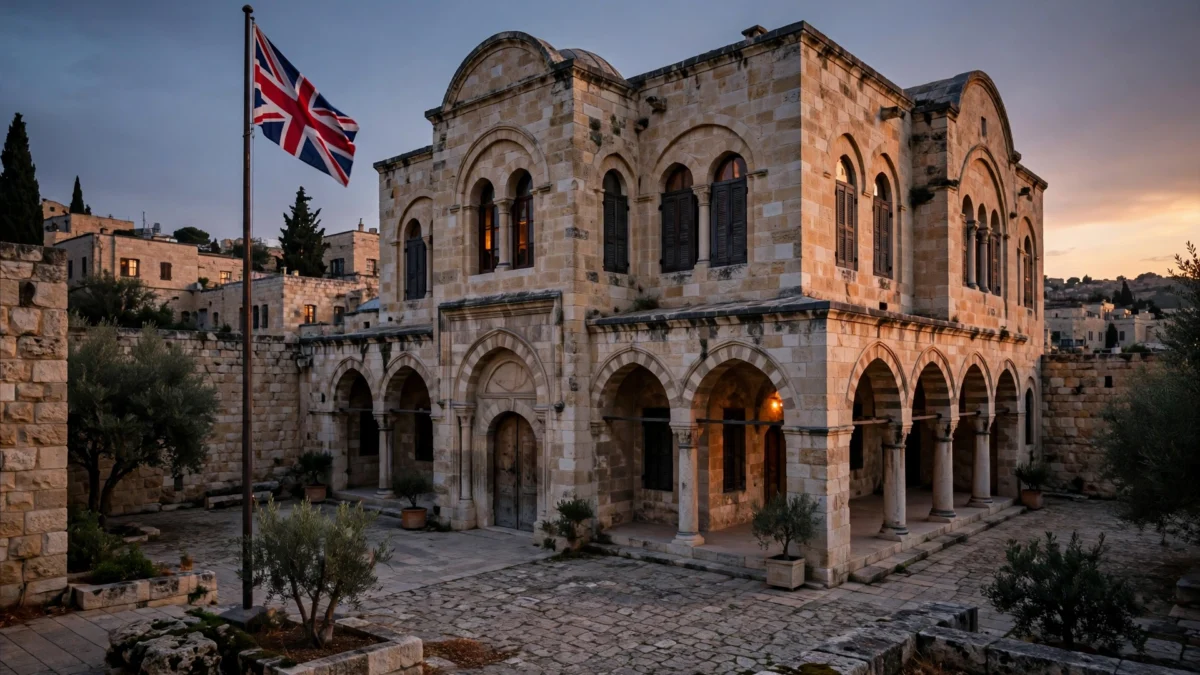
Israel is set to close the British consulate in East Jerusalem on Thursday, according to The Times, in a retaliatory move against the United Kingdom’s trade ban on goods from Israeli settlements — a development that would mark a new low in relations between the two countries. The announcement landed on the same day that British police arrested 11 people at pro-Palestine demonstrations in London on the third anniversary of the October 7 attacks, capping a day of extraordinary tension in the British capital and in UK-Israel relations.
Gideon Saar, the Israeli foreign minister, said on Wednesday that Israel would hold firm on the closure despite British efforts to reach an agreement to prevent it, according to The Times. It is understood that the consulate’s diplomatic status will be removed, which would bar about 30 British diplomats from legally operating from the building. Israel will stop short of expelling the diplomats and sending them and their families home, The Times reported; instead, it believes they should work from the British embassy in Tel Aviv.
The consulate provides consular services to Palestinians out of East Jerusalem and handles British relations with Palestinians in the city, the West Bank and Gaza, according to The Times. The mission carries extraordinary historical weight: it was first established in 1838, more than a century before the founding of the state of Israel, and operates from Sheikh Jarrah in East Jerusalem with its own staff and a consul general who reports directly to the Foreign Office.
The 30-day deadline for Britain to close the consulate runs out on Thursday, Reuters reported on Monday, citing sources. The wire agency reported that Britain’s national security adviser, Jonathan Powell, travelled to Israel last week on an undisclosed visit in a bid to persuade Israeli officials to reverse or defer the decision. Two of the sources told Reuters that talks were still ongoing and that while an agreement to keep the consulate open was possible, it was unlikely one would be struck by the Thursday deadline. Asked about Powell’s visit and the talks with London over the consulate, a spokesperson for Saar told Reuters that it would close on Thursday, as announced. A UK government spokesperson had no immediate comment, Reuters reported.
The closure was ordered in retaliation for the UK’s sanctions package on Israeli settlements. According to Reuters, the sanctions were announced by Foreign Secretary Ed Miliband in response to Israeli government-backed plans to expand settlements in the occupied West Bank and rising settler attacks on Palestinians, and include a ban on trade in goods from the settlements along with measures against British firms that support settlement construction. Britain said Israel’s actions were undermining the possibility of a two-state solution, Reuters reported, and the measures are to take effect next year.
Saar has described Britain’s sanctions decision as “morally distorted,” accusing Britain’s ruling Labour party of being hostile towards the country and of interfering in Israel’s upcoming general election on October 27, according to Reuters. Britain has repeatedly criticised Israel over its actions in the war in Gaza and over Israeli settler attacks on Palestinians, Reuters noted.
The United Kingdom has threatened a tit-for-tat expulsion of Israeli diplomats from London if British diplomats were expelled, The Times reported. A separate report by Israeli journalist Itamar Eichner, carried by JFeed, said Britain was weighing the expulsion of as many as 27 Israeli diplomats if Saar did not reverse the closure decision.
London’s legal position is that Israel does not have the right to close the mission. Former attorney general Dominic Grieve advised the Foreign Office that Israel lacks sovereign rights over East Jerusalem, which international bodies define as occupied Palestinian territory, according to The Guardian. In a legal brief, Grieve argued that “retaining a consulate general in East Jerusalem after recognition of the state of Palestine preserves the UK’s position that Jerusalem’s final status remains to be determined,” and that London has a duty to resist the move under international rulings. When challenged in the House of Lords by the former UK ambassador Lord Hannay, Foreign Office minister Lord Wood conceded the legal challenge holds merit but admitted he feared Israel could render the diplomatic compound unusable in practice, according to reports of the debate.
The consulate’s practical role extends well beyond symbolism. It manages aid efforts and field monitoring throughout the West Bank and Gaza, and is the British government’s primary channel to the Palestinian Authority in Ramallah. Israel has also said it planned to revoke the credentials of Dutch diplomats from that country’s mission to Palestine, in response to the Netherlands’ ban on imports from the settlements, according to The Guardian — signalling that the East Jerusalem closure is part of a wider Israeli retaliation against European governments.
On the same day as the closure deadline approached, London witnessed tense scenes on the streets. Eleven people were arrested at pro-Palestine demonstrations in the capital on Wednesday, the third anniversary of the October 7 attacks, according to The Times and the PA news agency. Five people were arrested for inciting racial hatred and breaching protest conditions in what police described as a “spontaneous protest” outside the offices of the Board of Deputies of British Jews in Camden, where officers said demonstrators were shouting or chanting slogans calling for intifada — an Arabic term for “uprising” or “shaking off.”
Another six people were arrested at a pro-Palestinian student march and a counter-protest in Holborn, The Times reported. Five of them were arrested for breach of conditions, including one for “failing to remove a face covering,” and one was arrested for common assault. The Metropolitan Police imposed strict conditions on the march, including banning face coverings, but said it could not ban the demonstration outright. Senior government figures had called on the organisers to reschedule the demonstration, but they refused.
Hundreds of students took part in pro-Palestinian protests across Britain, according to The Times. In central London, about 60 students marched from King’s College London in the Strand to University College London in Holborn to chants of “free, free Palestine” and “free the people, free the land,” holding banners that read “3 years since Oct 7, 78 years since 1948” and “keep boycotting.” Near Russell Square, they were met by counter-protesters holding Israeli flags and chanting “Terrorist supporters off our streets,” and police had to intervene on several occasions to keep the two sides apart. Officers were seen asking students to remove their masks or scarves, and most appeared to comply, according to The Times. Separate pro-Palestine rallies took place at Queen Mary University in east London and at Edinburgh and Glasgow universities, the PA news agency reported.
The political reaction was swift. Wes Streeting, the defence secretary, called the protests “shameful” on social media. “Two decades ago,” he wrote, the Union of Jewish Students had “taught me about antisemitism,” adding: “Today’s generation of Jewish student leaders are confronting a far bigger challenge than we faced. Student marches planned for this anniversary are shameful. It is vital that Jewish students do not stand alone,” according to The Times. The education secretary, Lucy Powell, had previously urged students “to show compassion and protest on another day.” Raphie Leon, the president of the Union of Jewish Students, said: “It is outrageous that student groups across the country are planning protests on October 7. There are 365 days of the year. The decision to protest on this day is provocative, deliberate and must be condemned to the fullest extent,” according to The Times. Jewish leaders said they would “not be threatened or intimidated by this small and extremist minority.”
The prime minister issued a statement marking the anniversary, telling British Jews: “We stand with you.” He outlined the impact of the attacks on Jewish communities across the world and the rise in antisemitism, according to the Religion Media Centre. He noted that in Britain, two Jewish men were killed in the attack on Heaton Park synagogue in Manchester, and said abuse and violence against Jewish people “in any form, will not be tolerated. Not on our streets, not online, not in our schools or universities.” He said the government was funding protection for synagogues, schools and community buildings, and would “come down hard on antisemitism wherever it is found — in classrooms, on campuses and in neighbourhoods,” while continuing to work towards a two-state solution, with Israelis and Palestinians living side by side in peace and security.
At the University of Leeds, “chalked markings,” some of which said “Zionism = Racism,” were removed from campus grounds where Jewish students were gathering for an anniversary vigil, according to a university spokesperson quoted by The Times.
The police operation around the student march had been prepared in advance. The Metropolitan Police warned students that anyone breaching the conditions — including wearing a face covering, breaking away from the prescribed route, or failing to disperse by 2pm — would face arrest. Demonstrators were required to gather in a specific area, Lincoln’s Inn Fields, by 12:30pm and follow a prescribed route to Russell Square, with the rally ordered to finish by 2pm, according to the Daily Mail’s coverage of the Met’s briefing. Deputy Assistant Commissioner James Harman, who leads Met public-order operations, said: “This event is being held on the third anniversary of the October 7 terrorist attack on Israel and the start of the ensuing conflict in Gaza. This will be a day of mourning and reflection for many in London and we know the serious concerns that this event has caused Jewish communities in particular.”
The third anniversary marks three years since Hamas-led militants invaded Israel on October 7, 2023, killing about 1,200 people, mostly civilians, and taking more than 250 others hostage, according to the PA news agency. Israel’s retaliatory offensive has since killed tens of thousands of Palestinians, destroyed much of Gaza and driven most of its two million residents from their homes, the PA reported.
Analysis: Why It Matters
The planned closure of the British consulate in East Jerusalem is the kind of event that will be read in history books as a hinge moment in UK-Israel relations. This is not just another diplomatic spat. A mission founded in 1838 — older than Israel itself by more than a century — carries the entire weight of Britain’s historical claim to an independent, balanced role in the Holy City. When a country shuts down a 188-year-old consulate, it is not closing an office; it is closing an era. The consulate embodied the UK’s separate track with the Palestinians: the consul general reports directly to the Foreign Office, not through Tel Aviv, and the mission’s aid work and field monitoring in the West Bank and Gaza made it the practical backbone of British engagement with Palestinian society. Losing it degrades Britain’s capacity to do precisely the things — monitoring, aid oversight, direct contact — that make its two-state policy credible rather than rhetorical.
The legal dimension is where the stakes get quietly radical. Grieve’s advice — that Israel has no sovereign right over East Jerusalem and that the closure asserts a control it does not legally possess — is a direct collision between international law as London reads it and power as Israel exercises it. Lord Wood’s concession that the legal challenge has merit but the compound could be rendered unusable anyway is the honest admission at the heart of the story: the UK may be right in law and helpless in fact. That asymmetry matters because it exposes the limits of the “rules-based order” rhetoric that has defined British foreign policy messaging for a decade. If an occupying power can simply revoke the diplomatic status of a mission on territory the UK regards as occupied, and Britain’s only response is a threat of reciprocal expulsions, then the architecture of international law looks less like a constraint and more like an aspiration — a point adversaries well beyond the region will note.
The timing is also deliberate and should be read as such. The closure lands a day after the third anniversary of October 7, on the exact day Britain is consumed by the protests and arrests at home. Saar’s insistence on proceeding as announced, despite Powell’s secret shuttle diplomacy, is a message to every European capital considering similar sanctions: defy us on settlements and we will dismantle your diplomatic footprint. The parallel move against Dutch diplomats confirms this is doctrine, not temper. For Brussels, which has been edging towards collective measures, the question now is whether Israel’s retaliation strategy deters or galvanises — and whether the UK’s experience becomes a cautionary tale or a template for resistance.
Domestically, Wednesday exposed the fault lines running through British public life three years on from October 7. The ministers’ reactions revealed a government speaking in two registers: Streeting’s “shameful” was the language of moral clarity aimed at reassuring Jewish communities, while Powell’s “protest on another day” was the language of accommodation, conceding the right to demonstrate while disputing the date. That split mirrors a deeper Labour tension — the party needs to be both the guardian of Jewish communal safety and the natural home of pro-Palestinian sentiment, and October 7 anniversaries make those two roles impossible to perform simultaneously. The eleven arrests, the face-covering conditions, the chanting outside the Board of Deputies — all of it will now feed the ongoing argument about policing, free expression, and the boundaries of protest in Britain.
Three things are worth watching next. First, what physically happens on Thursday: whether the consulate’s staff genuinely vacate Sheikh Jarrah, whether Britain retaliates with expulsions, and how the remaining British diplomatic presence in Jerusalem functions without its historic base. Second, whether the Dutch and British experiences coalesce into a joint European response — sanctions coordination has been weak, but shared retaliation could change the calculus in Brussels. And third, the domestic aftermath: the images from Russell Square and Camden will be litigated for weeks in the British press, and with a by-election in Holborn and St Pancras on Thursday as well, the political temperature around protest policing is only going to rise.
Sources
- The Times — “Israel to close UK consulate as 11 arrested at pro-Palestine rallies”
- Reuters — “UK security adviser visited Israel in bid to keep Jerusalem consulate open, sources say”
- Leigh Journal (PA) — “Eleven arrested amid protests on anniversary of October 7 attacks”
- Religion Media Centre — “Religion news 7 October 2026” (PM’s “We stand with you” statement)

About the Author — Abdul Mannan
Related Articles
Britain’s Second Richest Man Quits UK for Monaco in Latest Super-Rich Tax Exodus
Billionaire property tycoon David Reuben, ranked second on the Sunday Times Rich List with a family fortune of…
Kemi Badenoch to Pledge Inheritance Tax Cut in ‘Battle for the Soul of the Nation’ Conference Keynote
Badenoch will use her Birmingham keynote to promise an inheritance tax cut and halved employer national insurance for…

Seventh Arrest in RAF Fairford Probe as US Officials Say Iran Drone-Plot Fears Prompted Bomber Pullout
A 22-year-old British man has been arrested in London as the RAF Fairford counter-terrorism probe widens, with US…