The Lost Years: Why India Is Putting Its Five-Year-Olds in Class 1 Instead of Preschool

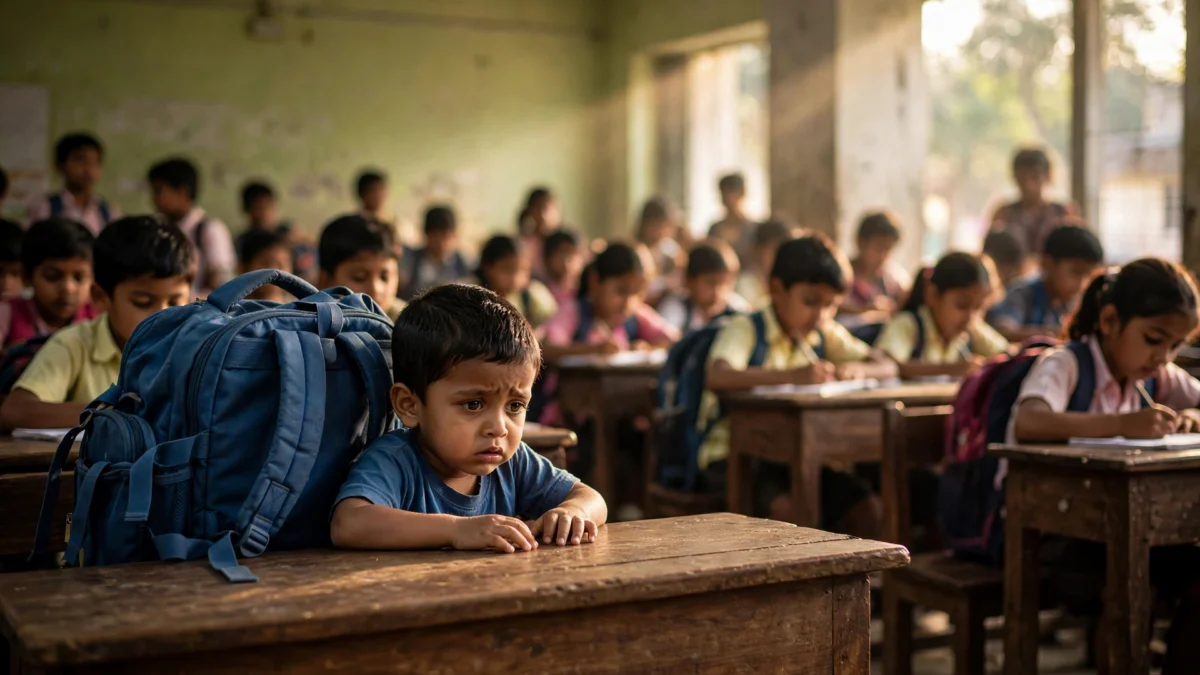
Look at a five-year-old. No — really look. The small fingers that still fumble a crayon, the eyes wider than the world they are supposed to conquer, the voice that asks “why” of everything because curiosity is still the whole curriculum. Now tell me, my friend, whose idea was it to place a school desk between that child and his childhood?
I ask because this week the United Nations Educational, Scientific and Cultural Organisation handed us a number I cannot get out of my head: fifty-one per cent. According to UNESCO’s 2026 Global Education Monitoring Report, 51% of India’s five-year-olds are enrolled in primary school — sitting in Class 1 — instead of receiving the pre-primary education they are entitled to. The share of children under six pushed into primary classrooms has risen from around 35% in 2019 to 60% in 2022. Read that again and let it settle: six out of every ten children under six are where they do not belong. (UNESCO 2026 GEM Report)
So I want to ask you a question, and I want you to answer it honestly, the way you would answer your own conscience at midnight: when did we decide that childhood was a luxury we could no longer afford?
The factory we inherited
History, I have always believed, is not a museum. It is a mirror — and the face staring back at us this week is uncomfortably familiar. In 1835, Lord Macaulay stood before the British Parliament’s council in Calcutta and declared that a single shelf of a good European library was worth the whole native literature of India and Arabia. What followed was not education in any honest sense; it was a manufacturing process. Children were drilled to recite before they learned to reason, to memorise before they learned to question. The goal was never wisdom. The goal was a class of clerks — brown in skin, English in taste, efficient in obedience.
We won our freedom in 1947. But did we ever win our schools back? Look at the scene UNESCO has just described: tiny children, barely out of their mothers’ laps, lined up at the gates of Class 1 because someone, somewhere, decided the race begins at five. The British built a factory that turned children into clerks; we have kept the factory running and merely changed the ownership papers. The machinery is the same. Only the masters have changed their accents.
And here is the cruel irony my grandfather’s generation would have recognised instantly. In our own civilisation, a child was not admitted to a gurukul until the acharya judged him ready. The first lessons were not of commerce or competition; they were of character — of patience, of discipline, of respect for knowledge itself. The guru asked one question before accepting a pupil: is this child ready to learn? Today we ask a different question: is this school’s admission form filled in time? We have inverted the ancient wisdom entirely. Once, the school waited for the child. Now the child must wait for nothing — he must run.
A race nobody wins
Let me speak plainly, because this column has never been a place for polite evasions. Who is pushing these five-year-olds into Class 1? Not UNESCO. Not the National Education Policy of 2020, which on paper promises three full years of preschool before primary school begins. No — the push comes from us. From parents who fear that if their child starts “late,” he will be left behind. From private schools that quietly prefer admitting younger children because younger children are easier to mould and keep longer as fee-paying customers. From a society that has confused speed with excellence and calls it ambition.
And what do we get for this hurry? UNESCO’s own analysts point to something the report calls the measurement illusion: because so many five-year-olds are already sitting in primary classrooms, the headline participation figures look healthier than they are. Globally, 27% of children aged one year before the official primary entry age are already in primary school — and that global figure is, in UNESCO’s own words, “largely driven by India.” We are not educating our youngest more; we are counting them wrong and calling the miscount progress. (UNESCO GEM 2026: Access and equity)
Ask yourself: what does a five-year-old actually do in Class 1? He cannot hold a pencil properly. His attention span is measured in minutes. His bones, his brain, his emotional world — all of them are built for play, for stories, for the slow unfolding that the world’s best early-childhood research calls the foundation of everything. The first thousand days of life, and the years that follow, are when the architecture of the brain is laid down. Push formal schooling into those years and you do not get a smarter child. You get a tired one.
The evidence is not sentimental; it is economic. Analysis prepared for the 2026 GEM Report found that in rural Karnataka, scholarships covering preschool fees raised participation by 20 percentage points, and the cognitive gains persisted into primary school. In El Salvador, children exposed to a conditional cash transfer programme from birth to age five or six were 12 percentage points more likely to be enrolled in preschool. Preschool is not a waiting room before real education begins. It IS real education — the most important kind. (World Education Blog)
The conference and the contradiction
And now, my friend, consider the theatre of it all. Yesterday — 8 October — the capital hosted Udaan 2026, described as India’s largest convening on Early Childhood Care and Education, themed “From Surviving to Thriving.” Government ministers, NITI Aayog members, World Bank veterans, professors from Stockholm — the finest minds in the republic gathered in New Delhi to discuss, among other things, “enhancing Anganwadis” and “investing in early childhood development.” (Udaan 2026)
I do not mock their intentions. But I must ask the question that hangs over every such gathering: how does a nation hold a conference on the sanctity of early childhood while 51% of its five-year-olds are sitting in primary classrooms? How do we speak of “thriving” when we have skipped the “surviving” of a proper childhood altogether? The contradiction is not between the conference and the report. The contradiction is between what we say in New Delhi’s seminar halls and what we do in a million homes, where a mother wipes her four-year-old’s tears and tells him that big boys don’t cry on the first day of Class 1 — because the neighbour’s son, who is also four, has already been admitted.
The poorest children pay twice
There is one more mirror I must hold up, and it is the ugliest of all. UNESCO’s accompanying Gender Report, released ahead of the International Day of the Girl Child, notes that while India has achieved gender parity in urban areas, in rural India only 59 girls complete upper secondary education for every 100 boys. The children pushed earliest into primary classrooms, without the cushion of preschool, are overwhelmingly the children of the poor — the ones whose parents cannot afford private kindergartens, the ones whose Anganwadis are under-staffed and under-fed. A rich child who enters Class 1 at five has a tutor at home, books on the shelf, and a mother who can sit with him through the homework. A poor child who enters Class 1 at five has none of these — and the system then blames him for falling behind. (UNESCO Gender Report)
We have built a system in which the poorest children are rushed the fastest and supported the least. And then, with the solemnity of priests, we examine their test scores and pronounce them slow.
Meanwhile the global picture darkens behind these numbers. The same 2026 GEM Report warns that 273 million children and young people are out of school worldwide — the seventh consecutive annual rise. One in six school-age children on this planet is excluded from education entirely, while we debate whether five is too young for Class 1. The absurdity would be funny if it were not tragic: humanity cannot get its children INTO school, and cannot keep its youngest OUT of it at the right time. (Devdiscourse / UNESCO 2026 GEM Report)
What I am really saying
I have written this column for years, and my readers know I do not deal in policy papers. I deal in questions of the soul. So here is mine, addressed to every parent, every teacher, every policymaker who will read these words: what exactly are we racing toward?
A child who learns his alphabet at five instead of six gains nothing measurable and loses something immeasurable — the unhurried years in which wonder is the curriculum and play is the pedagogy. The Finnish child, whose country tops every global education ranking worth the name, does not begin formal schooling until seven. Seven! And no one calls Finland backward. Yet we, who invented the gurukul, who taught the world that a teacher is second only to God, panic if our neighbour’s four-year-old can recite the alphabet and ours cannot.
I am not against ambition. I am against the counterfeit of ambition that mistakes haste for progress. Macaulay wanted children who could recite; the gurukul wanted children who could reflect. Somewhere between 1835 and 2026, we were supposed to choose the gurukul. Instead we chose the faster Macaulay.
So here is my verdict, and I deliver it the way this column always has — as a moral accounting, not a news summary. A nation that cannot give its children three years of play before demanding twelve years of obedience should not be surprised when its graduates can repeat everything and understand nothing. The preschool years are not empty time waiting to be filled. They are the foundation on which everything else is built — and you cannot build the second floor before the first.
The five-year-old in that Class 1 desk will grow up. He will learn to read, to write, to pass his examinations. But something in him — the part that asked “why” of everything, the part that learned through wonder rather than through fear — will have been quietly filed away, like a document in one of Macaulay’s clerk-offices. And years from now, when we wonder why our brightest young people can execute instructions but cannot imagine alternatives, we will have forgotten that the answer was sitting in front of us all along: in a classroom, in a desk too big for him, a small boy with an oversized school bag, waiting for a childhood that never came.
Sources & References
- UNESCO Global Education Monitoring Report 2026 — “Access and equity”: the flagship report behind this column’s findings, including the finding that 51% of India’s five-year-olds are enrolled in primary school and that 27% of children globally enter primary a year early. UNESCO 2026 GEM Report and the report’s main page
- World Education Blog (GEM Report team) — “Ineffective financing is holding early childhood education back”: evidence on preschool financing, including the Karnataka scholarship findings and the El Salvador cash-transfer results. World Education Blog
- UNESCO — “Gender gaps in education narrow globally, yet early marriage remains a major barrier”: the 2026 GEM Gender Report, including the finding on rural India’s upper-secondary completion gap. UNESCO
- Udaan 2026 — India’s largest convening on Early Childhood Care and Education (“From Surviving to Thriving”), New Delhi, 8 October 2026, hosted by Rocket Learning. Event report
- Devdiscourse — “Global Education Crisis Deepens: 273 Million Children Out of School, UNESCO Warns”: coverage of the 2026 GEM Report’s headline out-of-school figures. Devdiscourse
- Inshorts / Hindustan Times — “51% of India’s 5-yr-olds in Class 1 instead of preschool: UNESCO”: the week’s reporting of the GEM finding, including the rise from ~35% (2019) to 60% (2022) of under-sixes in primary school. Inshorts

About the Author — Abdul Mannan
Related Articles
The Law That Keeps Changing Its Mind: Who Owns America’s Classroom?
The US Department of Education has formally rescinded the Biden-era Title IX rule and restored the 2020 text.…