Northern Lights Sweep Across the UK Overnight — and May Return Tonight and Monday

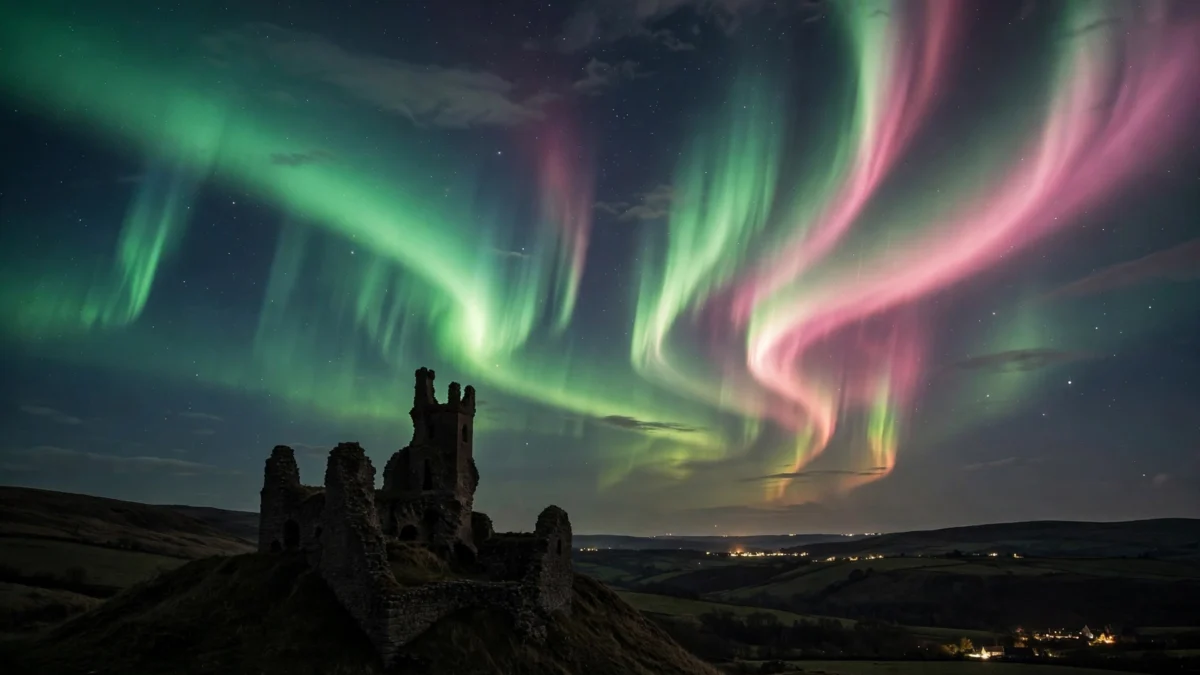
The Northern Lights put on one of their most spectacular displays over Britain in recent memory on Saturday night, dazzling skywatchers across the country and appearing in photographs taken as far south as Kent, Surrey and Devon. According to the Met Office, the aurora could return on Sunday and Monday nights, offering stargazers a second and third chance to catch the show.
The aurora borealis lit up skies over the ruins of Dunstanburgh Castle on the Northumberland coast in the early hours of Sunday, in images captured by the Press Association’s Owen Humphreys that were widely syndicated through Sunday morning. Elsewhere, pictures captured the green and pink spectacle as far south as Kent and Surrey, according to the PA wire reporting, while Particle News reported sightings stretching from Scotland down through the West Midlands to Devon, Hampshire, Kent and Dorset.
The Met Office said on Sunday that the Northern Lights could be visible in the UK again on Sunday and Monday night. Forecaster Greg Dewhurst said Sunday’s display could be a little weaker than Saturday’s, making it most likely to be seen across Scotland, Northern Ireland and northern England. Monday night, he said, may bring a stronger display that could reach further south into central areas of the country.
“The spectacle can sometimes be better seen through a camera than by the naked eye,” Dewhurst said, adding that “long exposure camera shots may show something each night a little further south than the above visible by eye forecast.”
The official forecaster thanked the public for sharing their photographs on Sunday morning, posting on X: “Thank you for all the lovely photos and videos of the northern lights last night! They were brilliant!”
It is a rare treat for British skywatchers. The natural phenomenon, known as the Aurora Borealis, is normally visible only from near the Arctic Circle and northern Scotland. But the strong solar activity levels on Friday and Saturday evenings meant it could be seen far beyond its usual hunting grounds, according to reporting by the Daily Mail’s Noor Qurashi, who wrote that thousands of Britons were left awestruck overnight after the Northern Lights turned the sky a hazy purple and green.
Stargazers uploaded photos to social media taken from their own back gardens and surrounding public roads, the Mail reported.
What caused the display
The light show is triggered by solar activity, the Met Office said. The sun emits charged particles known as solar wind, which, when they interact with the Earth’s magnetic field, are funnelled towards the magnetic poles. As the energetic particles collide with gases in the upper atmosphere, they release energy as light. Oxygen produces green and, at higher altitudes, red, while nitrogen creates blue and purple hues, according to the forecaster.
Behind Saturday night’s display were two glancing coronal mass ejections — vast eruptions of magnetised plasma from the Sun — followed by a high-speed solar wind stream from a coronal hole, according to the Met Office’s official space weather forecast. The forecaster’s aurora outlook, issued at 18:16 GMT on 10 October 2026, said these disturbances could increase the size and intensity of the auroral oval, with Scotland and locations at comparable geomagnetic latitudes identified as potential viewing areas through 13 October, provided skies remain clear.
A subsequent forecast issued at 00:23 GMT on 11 October refined the outlook: G1 minor storms likely on 11 October, with G2 moderate storms possible and a slight chance of G3 strong activity; G1 storms likely on 12 October, with possible G2 intervals and a slight chance of isolated G3 activity; then a declining chance of minor storms on 13 October. The Met Office also recorded a G2 geomagnetic alert covering 21:00 GMT on 10 October to 00:00 GMT on 11 October — the window in which Saturday night’s display unfolded.
AuroraWatch UK, the Lancaster University-run monitoring service, issued a red alert for the peak nights, according to Particle News — the highest level on its alert scale, indicating that auroras are likely to be visible from anywhere in the UK under clear skies.
The run-up to the display had been tracked all week by solar observers. EarthSky reported on 8 October that a coronal mass ejection leaving the Sun on October 6 was racing toward Earth, with forecasters expecting it to arrive early on October 9 and likely trigger G1 to G2 geomagnetic storms, while a second CME launched on October 7, associated with a C7.9 flare from active region AR4549, was expected to deliver a glancing blow late on October 10 or early October 11 — a prediction that turned out to be exactly right.
Solar Cycle 25: why Britain keeps seeing the lights
Saturday night’s display is part of a broader pattern that has made the past two years unusually generous to British aurora hunters. The scientific explanation, as set out by travelandtourworld.com, lies in Solar Cycle 25 — the current period of changing magnetic activity on the Sun. Solar cycles last approximately 11 years, during which the Sun moves between relatively quiet conditions and periods of stronger magnetic activity.
Solar Cycle 25 began after the solar minimum in December 2019. Activity subsequently increased, producing more sunspots, solar flares and coronal mass ejections. On 15 October 2024, NASA and NOAA announced that the Sun had reached its solar maximum phase — an announcement that followed an exceptionally active period including a G5 extreme geomagnetic storm in May 2024 and a G4 severe storm in October 2024.
According to Gadgets360, the end of 2025 saw bright auroras over northern skies following a strong solar flare, and on November 11, 2025, a massive X5.1-class solar flare sent charged particles toward Earth, sparking the brightest aurora seen in the UK. Experts predicted that 2026 would be a peak year for aurora-spotting, with the Sun in a heightened state of activity as part of its 11-year natural cycle.
Even though solar activity has technically begun its gradual decline since the 2024 peak, the Sun remains hyperactive with numerous sunspots and storms, Gadgets360 reported. A single flare can still create spectacular displays, especially due to seasonal coincidences during the equinoxes, which statistically double the chances of viewing an aurora. October sits in that sweet spot: the phenomenon is generally most visible between September and early April, and most likely in the weeks around the spring and autumn equinoxes.
The solar maximum is not a single event, travelandtourworld.com noted. It represents a broader period of heightened activity, and substantial geomagnetic storms can also occur as the cycle declines. October 2026’s renewed activity therefore fits within a wider period of significant solar variability.
How to see the lights
Anybody hoping to catch the display should look northwards, away from bright streetlights, and through a phone camera, the Mail’s reporting advised. The lights usually appear between 10pm and 2am at night.
Forecasters give consistent advice for would-be aurora spotters, according to Particle News: seek dark, north-facing rural spots after nightfall, and use phone cameras, which often reveal colours the eye misses. Long-exposure shots on a modern smartphone can pick up greens and reds that appear only as a faint grey smudge to the naked eye — which is why so many of Saturday night’s most striking images came from ordinary back gardens rather than professional observatories.
The Met Office’s Dewhurst noted that camera shots may show the aurora further south than the naked-eye forecast suggests, meaning even viewers in southern counties should not give up if their eyes initially see nothing. Cloud cover remains the biggest enemy: the Met Office’s own weather forecast will determine which parts of the country get a clear view on Sunday and Monday nights.
Sightings could continue under clear skies into Tuesday, according to the Mail’s reporting on the Met Office’s assessment.
Analysis: Why It Matters
There is something quietly remarkable about a country stopping, collectively, to look at the sky. Saturday night’s aurora turned millions of back gardens into observatories and millions of phones into scientific instruments, and that matters for reasons that go well beyond a pretty picture.
First, displays like this one are a public gateway into space weather — a field that is rapidly moving from academic curiosity to national-infrastructure concern. The same geomagnetic storms that paint the sky can disrupt satellite navigation, degrade high-frequency radio communications, interfere with GPS-dependent systems from aviation to precision agriculture, and, in extreme cases, induce currents in power grids. Particle News noted that experts warn stronger geomagnetic storms can disrupt satellite navigation and some technologies. Britain’s grid operators have learned to watch solar storms the way flood forecasters watch rain gauges. The beauty of the aurora is, in a real sense, the visible signature of a force that modern civilisation now has to actively manage.
Second, the southern reach of this display — Devon, Hampshire, Kent, Surrey, Dorset — is itself a marker of the solar cycle’s strength. The auroral oval normally hugs the polar regions; it takes a serious geomagnetic disturbance to drag it over southern England. That such displays have become semi-regular features of British skies in 2025 and 2026, rather than once-in-a-generation events, tells us that Solar Cycle 25 is delivering on the forecasts made for it — and then some. The X5.1 flare of November 2025, which produced the brightest UK aurora in living memory, may yet be outdone before this cycle winds down.
Third, there is the democratisation of the spectacle. A generation ago, aurora hunting meant expensive trips to Tromsø or Reykjavík. Saturday night, it meant stepping into your garden with a phone. Modern smartphone sensors, long exposures and computational photography have collapsed the distance between the Arctic and the home counties. That is partly why the aurora now trends nationally on social media within hours — the barrier to capturing it has fallen to near zero, and the Met Office’s own delighted response to the public’s photographs on Sunday morning showed how quickly the crowd becomes part of the story.
Finally, Britain is quietly becoming an aurora nation — at least for this cycle. The combination of a hyperactive Sun, dark rural skies in places like Northumberland, and a public that has now been trained by repeated displays to look up, means that aurora tourism, aurora alerts and aurora photography are all growing here rather than only in Scandinavia. The AuroraWatch UK red alert on Saturday night reportedly sent thousands of subscribers scrambling outside — a small, happy sign of how a citizen-science network has built a national audience in just a few years.
The display also arrives with a built-in reminder of impermanence. Solar cycles decline. By the late 2020s, displays like Saturday night’s will grow rarer again until Cycle 26 ramps up in the mid-2030s. For anyone who missed it, Sunday and Monday nights offer a closing window — and there may not be many more like them for a decade.
What to Watch Next
Sunday night’s display: The Met Office expects a slightly weaker show, most likely visible across Scotland, Northern Ireland and northern England to the naked eye — with long-exposure cameras potentially picking it up further south. Check the sky after 10pm if clouds allow.
Monday night’s stronger chance: Forecasters say the aurora may strengthen again on Monday night, potentially reaching further south into central areas. This could be the better viewing night for much of England and Wales.
Clear skies are the deciding factor: All aurora forecasts come with the same caveat — clouds. The Met Office’s standard weather outlook for Sunday and Monday nights will determine which regions actually get to see the show.
Coronal mass ejection arrivals: Solar observers will be watching active region AR4549 and any new Earth-directed eruptions. EarthSky’s space-weather updates track incoming CMEs in near-real time, and a fresh eruption could extend the display window past Tuesday.
The November 2025 benchmark: Watchers will compare this weekend’s photographs with those from the X5.1 flare of November 2025 — currently regarded as the brightest UK aurora of the modern era. Did October 2026 come close?
Sources
- PA wire via the Evening Standard, syndicated by indy100: “Northern Lights display seen across UK may be visible again on Sunday night” — photographs by Owen Humphreys/PA; Met Office forecaster Greg Dewhurst quotes on Sunday/Monday outlook
- PA wire via the Leigh Journal: “Northern Lights display seen across UK may be visible again on Sunday night”
- Particle News: “Northern Lights Sweep Across UK With Sightings Reported as Far South as Devon” — Met Office space-weather forecast details, AuroraWatch UK red alert
- The Guardian, via ghanamma.com: “Skies across the UK illuminated by the northern lights”
- EarthSky: Sun news — coronal mass ejection arrivals, geomagnetic storm forecast, October 8–9 updates
- Travel and Tour World: “England Follows Scotland and Wales into the Northern Lights Spotlight” — Met Office forecast table and Solar Cycle 25 background

About the Author — Abdul Mannan
Related Articles
National March for Palestine in Central London Ends in 20 Arrests After Battle of Britain Memorial Climb
The Palestine Coalition's national march through central London ended with 20 arrests on Saturday after six protesters climbed…

Man Dies After Entering Tiger Enclosure at Yorkshire Wildlife Park Near Doncaster
A man has died after being attacked by a tiger at Yorkshire Wildlife Park near Doncaster, police say,…

Thousands March Through Central London in Palestine Protest Under Strict Met Conditions
Thousands of pro-Palestine demonstrators are marching through central London today under strict police conditions, with the Met expecting…