A Pakistani Reached the Stars Today — and Iqbal Saw It Coming a Century Ago

What do you say to a nation that has waited sixty-five years to touch the sky? What do you say when the waiting finally ends — not with a speech, not with a promise, but with fire and thunder at dawn, and a man in a white spacesuit carrying the name of 250 million people on his shoulder?
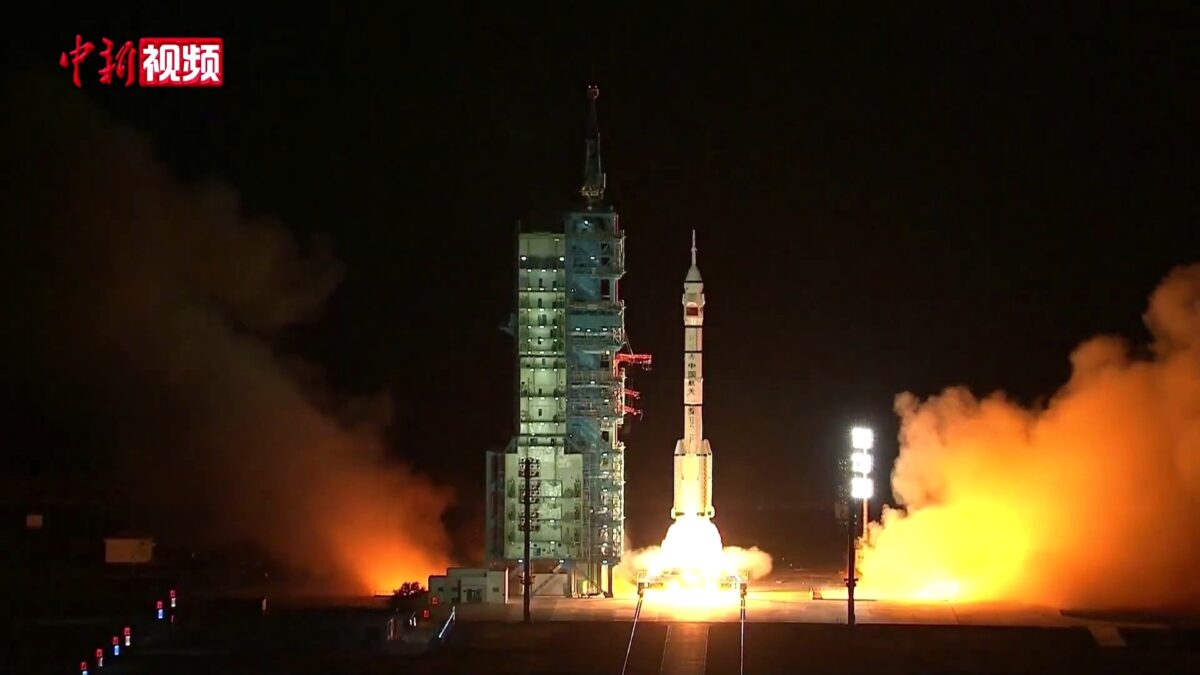
At 8:18 on the morning of Tuesday, 25 November 2026, a Long March 2F rocket rose from the Jiuquan Satellite Launch Centre in the Gobi Desert, and aboard it was Muhammad Zeeshan Ali — a 40-year-old Pakistani military pilot, the first Pakistani ever to reach orbit, and the first foreign astronaut ever to board China’s Tiangong space station. Three and a half hours later, at 11:56 Beijing time, the Shenzhou-24 spacecraft docked with the station the Chinese call the Heavenly Palace. And in that moment, a story that began in Karachi in 1961 finally reached the stars.
Do not hurry past that sentence. Sit with it. A Pakistani is in orbit today. Not in a textbook. Not in a dream. In orbit — 400 kilometres above the Earth, circling the planet every ninety minutes, watching sixteen sunrises in a single day. If that does not stop you, nothing will.
The Man Who Carried a Nation on His Shoulder
Zeeshan Ali did not arrive at the launch pad by accident. He was chosen in February 2026, one of two Pakistani pilots — the other, Khurram Daud, trained beside him as backup — selected under an agreement signed between China’s Manned Space Agency and Pakistan’s space agency, SUPARCO, in February 2025. Since April he has lived and trained in Beijing, and his preparation reads like a lesson in humility: seven months of intensive training, Mandarin classes, Chinese songs, Chinese poetry, calligraphy, table tennis. A fighter pilot learning to write another civilisation’s characters by hand, because respect, he understood, is the first qualification for a guest in someone else’s heaven.
On the eve of the flight, speaking to reporters at Jiuquan, he said the words that will follow him into every history book this country ever writes about space: “I’m not flying for myself. I carry the name of Pakistan on my shoulder.” And in Mandarin, the language he had spent seven months mastering, he added that his first flight “not only represents myself, but also my country” — and that he carried “the dream of 250 million Pakistani people” when he entered the training centre.
Reader, I ask you plainly: when was the last time you heard a Pakistani speak like that on the world stage? Not about a scandal. Not about a loan. Not about a crisis. About a dream. About 250 million people, carried on one man’s shoulder, into the sky.
He flies as a payload specialist, which means his work is science, not steering. He will spend five to ten days aboard Tiangong — about a week — conducting four biotechnology experiments developed by universities in Pakistan, including, according to Chinese state broadcaster CCTV, an in-orbit experiment on photosynthetic microorganisms. The details of the research have not yet been made public, but its purpose is plain: Pakistan is not going to space as a tourist. It is going as a student of the universe, and as a contributor. When his short mission ends, he will return to Earth aboard the Shenzhou-23 spacecraft, alongside two of its crew — Zhang Zhiyuan and Li Jiaying, the first woman taikonaut from Hong Kong.
His crewmates are Commander Tang Hongbo, 51, a veteran of two previous spaceflights who now becomes the first astronaut to board Tiangong three times, and Wu Yi, 39, flying for the first time. Three men. Three flags, in a sense — though only two nations. And one of them is ours.
1961: The Year We Started First — and Then Forgot to Run
Here is where history holds up its mirror, and the mirror is not flattering.
Pakistan’s space programme did not begin yesterday. It began on 16 September 1961 — sixty-five years ago — when the Space and Upper Atmosphere Research Commission, SUPARCO, was established in Karachi under the chairmanship of Professor Abdus Salam, the physicist who would later win the Nobel Prize. It was the first space agency in South Asia. Let that fact sink in: Pakistan started before India. Before China had a crewed programme at all. Eight years before ISRO was founded in 1969, Pakistan was already reaching for the sky.
And reach it did — at first. In June 1962, less than a year after the agency’s founding, a sounding rocket called Rehbar-I rose from the Sonmiani range on the Balochistan coast and climbed some 130 kilometres into the upper atmosphere. Rehbar-II followed within days. Young Pakistani engineers, trained at NASA facilities in the United States, were learning to build, launch and track rockets while the rest of the region was still watching the Space Race on the radio.
Then came the long sleep. The satellite Badr-1 — designed and built by SUPARCO’s own engineers, named after the Battle of Badr — was meant to fly aboard an American space shuttle. The Challenger disaster of 1986 grounded the shuttle fleet, and the little satellite waited years until, on 16 July 1990, it finally rode a Chinese Long March 2E rocket into orbit from Xichang. A second satellite, Badr-B, followed in 2001. PakSAT-1R, a communications satellite, in 2011. The remote-sensing satellite PRSS-1 in 2018. Each step real. Each step years apart. Each step a reminder of what might have been.
Ask yourself, honestly: how does a nation that founded the first space agency in South Asia in 1961 wait until 2026 to put its first citizen in orbit? The answer is not a lack of talent. Pakistan has never lacked talent — Abdus Salam proved that to the world. The answer is a lack of continuity. A lack of patience. A lack of the stubborn, boring, decade-after-decade commitment that space demands. We are a nation of brilliant beginnings and abandoned middles. We plant the seed, we water it once, and then we walk away to argue about the garden.
China, meanwhile, did the opposite. It started later and never stopped. It built its station module by module — Tianhe, Wentian, Mengtian — until the Heavenly Palace was complete. Shenzhou-24 is China’s eighteenth crewed spaceflight. Eighteenth. And now, having mastered the art, China is doing something the old space powers never truly did: it is opening the door. The first foreign astronaut aboard Tiangong is a Pakistani. That is not charity. That is diplomacy written in orbit.
The Poet Who Saw It First
Long before there were rockets, there was a poet in Sialkot who looked at the night sky and refused to accept it as a ceiling. Allama Muhammad Iqbal wrote, in Bal-e-Jibril, the couplet every Pakistani schoolchild has heard and too few have understood:
Sitaron se aage jahan aur bhi hain, abhi ishq ke imtihan aur bhi hain.
Beyond the stars, there are more worlds still; the trials of love are not yet over.
Read that again — slowly. Iqbal was not writing astronomy. He was writing about the human soul’s refusal to stop. The stars are not the destination; they are the doorway. And today, a Pakistani pilot has walked through that doorway — not metaphorically, not in a poem, but in a spacecraft, at 27,000 kilometres per hour, above the very stars Iqbal gazed at.
But Iqbal’s verse carries a second meaning, and it is a warning. “Abhi ishq ke imtihan aur bhi hain” — the trials are not over. The flight is the beginning, not the end. A single astronaut is a symbol. A space programme is a system. Symbols inspire; systems endure. The question before Pakistan today is whether Zeeshan Ali’s flight will be remembered as the day the programme woke up, or as the day we celebrated a symbol and went back to sleep.
I think of Abdus Salam, who founded SUPARCO and then watched his country drift away from the scientific temper he embodied. I think of the young engineers at Sonmiani in 1962, who believed they were building the future. What would they say today, watching a Pakistani finally reach orbit — sixty-five years later, aboard another nation’s rocket? Would they weep with pride, or with grief for the lost decades? I believe they would do both. And I believe they would be right.
The Heavenly Palace and the Changing of the Guard
There is a larger story unfolding above our heads, and it would be foolish to miss it while celebrating. The International Space Station — the great symbol of post-Cold War cooperation, led by NASA — faces possible retirement by 2030. China, meanwhile, is promoting Tiangong as a hub for international cooperation, and it means it: the Shenzhou-24 mission is the first joint flight of Chinese and foreign astronauts in the history of China’s crewed programme. Nature, the world’s most respected scientific journal, calls the launch a milestone that signals China’s “aspirations to become a top space power”.
Consider what that means. For decades, the door to orbit was guarded by two gatekeepers: America and Russia. If you were not their ally, not their partner, not their friend, the door stayed shut. China is building a second door — and it has chosen to open it first for Pakistan. This is the year the two countries mark the 75th anniversary of diplomatic relations, and the timing is no coincidence. Space, like the sea before it, is becoming the place where the new world order is being written.
And the science matters too. One goal of this mission, according to the China Manned Space Agency, is to establish a study of how the human body adapts to spaceflight — and the astronaut Zhu Yangzhu, who entered Tiangong in May, will remain aboard for another six months to allow that experiment to continue. The four Pakistani biotechnology experiments, the study of photosynthetic microorganisms in orbit, the slow accumulation of knowledge about how living things behave where there is no up and no down — this is not spectacle. This is the patient work of science, the same patient work Abdus Salam tried to teach us sixty-five years ago.
There is a lesson here for every developing nation watching from the ground: you do not need to be the richest country to reach space. You need a partner, a plan, and the patience to train a pilot in Mandarin for seven months. Pakistan found all three. The question is whether it will find the fourth thing — the will to continue.
What a Week in Orbit Must Become
Let me speak to you directly now, reader — because a column that only celebrates is a column that has failed.
Zeeshan Ali will come home in about a week. He will land, he will be garlanded, he will be photographed, he will be invited to every television studio in the country. And then — then — the real test begins. Will the four experiments he carried lead to a fifth, and a fiftieth? Will the universities whose biotechnology rode with him receive the funding to build on what they learn? Will the next Pakistani astronaut train not as a guest but as a partner, and the one after that as a commander? Will SUPARCO, which began in 1961 with the world watching in admiration, finally receive the budget and the political protection that a space agency needs — not for a year, but for a generation?
Or will we do what we have done so many times before: celebrate the man, forget the mission, and return to the noise?
I do not write this to spoil a day of joy. I write it because joy without a plan is just a holiday, and Pakistan has had too many holidays and too few plans. The boy in Lahore or Larkana or Gilgit who watched the launch this morning and whispered, “I want to go there” — what will we tell him tomorrow? That the door is open, or that it was open for one day only?
The answer is in our hands, not in orbit. A space programme is not built by rockets. It is built by classrooms. By laboratories. By the unglamorous decision, made year after year, to fund science when there are a hundred louder demands on the treasury. Abdus Salam knew this. Iqbal knew this. The young engineers of Sonmiani knew this. The only question is whether we, in 2026, finally know it too.
The Verdict of the Stars
On the morning of 25 November 2026, a rocket rose over the Gobi Desert and carried a Pakistani into the heavens. The poet said there are worlds beyond the stars, and the trials of love are not yet over. The pilot said he carries the name of Pakistan on his shoulder. The scientist said it is a huge step. The historian will say it took sixty-five years.
All of them are right. And all of them are watching to see what we do next.
A nation is not measured by the height its rockets reach, but by the depth of its resolve when the applause fades. The stars have done their part — they waited for us, patient as ever, exactly where Iqbal left them. Now the trial begins. Not in orbit. Here, on the ground, in the budgets and the classrooms and the quiet decisions nobody applauds.
Beyond the stars there are more worlds still. The question is whether we have the courage to keep walking toward them — or whether we will stand on the launch pad, waving at a departing rocket, and call that enough.
It is not enough. It was never enough. And today, of all days, we should finally admit it — and then get to work.
Sources & References
- Reuters — “China’s Shenzhou-24 space flight takes off with Pakistani national as first foreign astronaut”, 25 November 2026 (launch time, docking, crew, training, Ali quotations).
- Nature — “Pakistani astronaut to become first foreign visitor to China’s space station”, 24 November 2026 (mission details, experiments, expert comment, human-adaptation study).
- NASASpaceflight — “Tiangong Space Station to welcome first international visitor”, 25 November 2026 (crew, agreement of February 2025, 75th anniversary of diplomatic relations, 18th crewed flight).
- SpacePolicyOnline — “First Pakistani Astronaut Enroute to Tiangong”, 24 November 2026 (selection, training timeline, return aboard Shenzhou-23).
- Wikipedia — SUPARCO — founding 16 September 1961, Rehbar-I 1962, Badr-1 launch 1990 (accessed 25 November 2026).
- Wikimedia Commons — featured image: Long March 2F launch photograph by China News Service, CC BY 4.0.

About the Author — advmannan1
Related Articles

Putin Declares Moscow the Third Rome — But History Has Heard This Sermon Before
"Moscow is the Third Rome, a fourth there shall not be." In a 20 November interview, Vladimir Putin…
Sheikh Hasina Is Coming Home on Victory Day — to Face a Death Sentence
Sheikh Hasina has named the day: 16 December, Victory Day. The daughter of Bangladesh's founder says she will…
The King Returns: Jensen Huang’s Eleven-Day Exile and the Trillion-Dollar Verdict of the Market
Eleven days after resigning in scandal, Jensen Huang is back as Nvidia's chief executive — restored by a…