Make It So: Patrick Stewart, the Boy from Mirfield Who Taught the World How to Lead

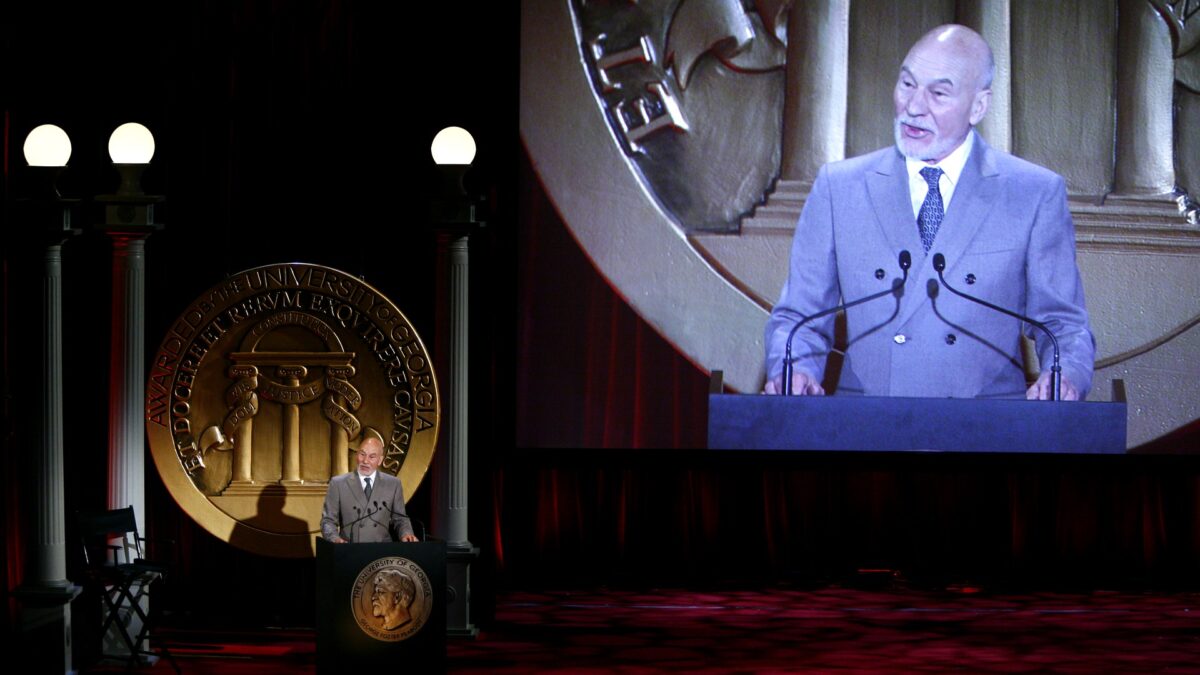
Who teaches a generation how to lead?
Not the generals, with their maps and their medals. Not the presidents, with their podiums and their polls. Not the loud men who mistake volume for authority and cruelty for strength. No — the man who taught millions of us what leadership actually looks like wore a uniform that never existed, commanded a ship that never sailed, and spoke in a voice so calm that a whole planet leaned in to hear it.
On Thursday, 29 October 2026, the world learned that Sir Patrick Stewart is gone. He died the day before — Wednesday, 28 October — at his home in Los Angeles, in the loving care of his wife Sunny, after what his family called “a brief and poignant journey with Alzheimer’s Disease and Lewy Body Dementia”. He was 86 years old. And within hours, something extraordinary happened: the tributes did not come only from Hollywood. They came from soldiers and teachers, from scientists and schoolchildren, from people who had never met him but felt they had served under him. Because in a strange and wonderful way, they had.
I have spent my life watching leaders rise and fall, and I have learned to distrust the loud ones. Stewart’s life is the opposite lesson — the proof that the quietest voice in the room can be the one history remembers. To understand why his death has shaken so many people who never knew him, you must go back to where he began. Not to a starship. To a small house in a small Yorkshire mill town, where a frightened boy learned what fear was — and decided, without ever saying so, that he would spend his life turning fear into something else.
A House Where Fear Lived
Patrick Stewart was born on 13 July 1940 in Mirfield, in the West Riding of Yorkshire, the youngest of three sons. His mother Gladys worked in the textile mills. His father Alfred was a regimental sergeant major in the Parachute Regiment, one of the last men evacuated from Dunkirk, who came home from the war carrying wounds no surgeon could see and no one in that generation knew how to name.
We know now what it was. Post-traumatic stress disorder. Then, it had no name at all — only symptoms. The drinking. The sudden rages. The violence against his wife that the small boy watched and could not stop. Stewart spoke about it openly in his later years, with a candour that startled people who thought of him only as a starship captain. He made a film for Amnesty International about domestic violence. He became a patron of Refuge, the British charity for survivors of domestic abuse. He said, plainly and repeatedly, that he had grown up in a house where his mother was beaten, and that the memory never left him.
Now pause here, reader, and consider what that means. History is full of men who were broken by violent fathers and went on to break others. The cycle is so common that we treat it as a law of nature — the wounded wounding in turn, the abused becoming the abuser, generation after generation, like a curse passed down in the blood. Stewart broke the chain. And I want you to notice how he broke it, because the method matters more than the miracle.
He found the stage. As a boy, he discovered that on a stage he could be someone else, somewhere else, in another time — and that the fear that ruled his house had no power there. Acting was not a career choice for him. It was an escape route, and then a refuge, and then a calling. He left school at fifteen, worked as a reporter on a local newspaper and sold furniture, and threw himself into amateur theatre with a hunger that everyone around him could see. A local teacher, Cecil Dormand, put Shakespeare in his hands. A county arts council grant sent him, at seventeen, to the Bristol Old Vic Theatre School in 1957. Two years later he had his first professional job, in Cyrano de Bergerac. And in 1966, at twenty-six, he joined the Royal Shakespeare Company — and stayed for sixteen years.
Sixteen years. Hold that number in your mind, because it is the first clue to the man. This was not an overnight sensation. This was a craftsman serving an apprenticeship longer than most careers last. He played Oberon and Shylock, Claudius and Prospero, Macbeth and Enobarbus, alongside Judi Dench and Ian McKellen. He made his Broadway debut in 1971 in A Midsummer Night’s Dream. He won Laurence Olivier Awards. He returned to the stage again and again for the rest of his life — a one-man A Christmas Carol, Waiting for Godot and No Man’s Land with his dear friend McKellen. The stage was his first home, and he never really left it.
And here is the mirror history holds up to us. In our age of instant fame — of children made famous by a single video, of celebrities manufactured in a week and forgotten in a month — here was a man who spent two decades learning his craft before the world knew his name. The world tells young people today that if you have not succeeded by twenty-five, you have failed. Stewart’s life answers: you have not even started. He was forty-seven years old when fame finally found him. Forty-seven. And what fame it was.
“Make It So” — The Captain Who Never Shouted
In 1987, a balding, middle-aged Shakespearean actor from Yorkshire was cast as Captain Jean-Luc Picard in Star Trek: The Next Generation. The casting seemed absurd to almost everyone, including Stewart himself. He expected the show to fail within a season. He kept his bags packed, in his own telling, ready to go home to the theatre.
Instead, he commanded the starship Enterprise for seven seasons and 178 episodes, from 1987 to 1994, then in four feature films, and then — seventeen years after he had said goodbye to the role — he returned to it in Star Trek: Picard, which ran for three seasons from 2020 to 2023. He was still playing the captain at eighty-two years old.
But the numbers are not the point. The point is what kind of captain he was. And this is where Stewart’s life stops being a biography and becomes a lesson — a lesson our world, drunk on strongmen and shouting, desperately needs to relearn.
Picard never raised his voice. He did not rule by fear. He did not humiliate his crew to prove his authority. He listened — actually listened — to people who disagreed with him, changed his mind in public when the evidence demanded it, and took responsibility when his decisions cost lives. In the episode “The Inner Light”, he lives an entire lifetime in twenty-five minutes and wakes weeping; in “The Best of Both Worlds”, he is captured and turned into the enemy’s weapon, and his crew must fight the man they love to save him. The show’s most famous line is not a battle cry. It is an instruction, given quietly: “Make it so.”
Think about what that means. In an age when our screens are filled with leaders who govern by insult and intimidation, here was a fictional captain — played by a real man who had grown up watching a violent father — showing millions of young people that authority could look like calm, that strength could look like restraint, that a leader’s first duty was not to dominate his people but to deserve their trust. Stewart used to say that Picard’s moral code was not so different from his own. And why would it be? The boy who had watched power abused in his own home spent his whole career imagining power used well.
That is why the tributes poured in from places Hollywood never reaches. Soldiers wrote that Picard was the commander they wished they had served under. Teachers wrote that they showed his speeches to their students. Diplomats quoted him. A generation of scientists and engineers — the people who actually build the future — have said for decades that they chose their careers because of that calm man on the bridge of the Enterprise. What greater legacy can an actor leave than that? Not an award. Not a fortune. A generation of decent people who learned decency from pretending.
The Professor in the Wheelchair
And then, at sixty, when most actors are winding down, Stewart began again. In 2000 he took on a second iconic role: Professor Charles Xavier in the X-Men films, the telepath in the wheelchair who believed that human beings and mutants — the feared, the different, the persecuted — could live together in peace.
He played Xavier across seven films over seventeen years, opposite his close friend Sir Ian McKellen as Magneto, the man who had given up on coexistence and chosen war. The two old Shakespeareans turned a comic-book franchise into a philosophical argument: Xavier, the patient teacher who believes in dialogue; Magneto, the survivor of the Holocaust who believes dialogue has failed. Stewart and McKellen, friends since their Royal Shakespeare Company days, played that argument with the gravity of men who knew it was not really about mutants at all. It was about us — about every society that must decide whether the stranger is an enemy or a neighbour.
His final scenes in Logan in 2017, as an old and broken Xavier cared for by Hugh Jackman’s Wolverine, are among the most moving in the history of the genre — two ageing men, one of them losing his mind, holding on to each other because there is no one else left. Jackman paid tribute to his co-star on the day the news broke, and the grief in it was real: they had played father and son, teacher and student, for nearly a quarter of a century.
Stewart and Jackman share a Guinness World Record for the longest career as a Marvel character — more than two decades in the same role. And Stewart was to have one final bow: he completed work as Professor Xavier in Marvel’s Avengers: Doomsday, due in cinemas on 18 December 2026, which will now stand as his last screen appearance. The professor will outlive the actor by a few weeks. There is something fitting in that — the teacher’s final lesson delivered after he has gone.
The Wound He Refused to Hide
But I have left the most important part of this story for now, because it is the part that separates Patrick Stewart from every other beloved actor who has died in our lifetime.
Most famous people hide their wounds. Stewart displayed his — not for sympathy, but for service. He spoke about his father’s violence against his mother at a time when men of his generation simply did not speak about such things. He campaigned for survivors of domestic abuse, for refugees, for veterans’ mental health, for human rights, for animal welfare — he fostered pit bulls, the most misunderstood of dogs, because he understood what it was to be judged for something you did not choose. He became Chancellor of the University of Huddersfield, the town beside his own, and supported Huddersfield Town football club all his life. He was made an Officer of the Order of the British Empire in 2001 and knighted by Queen Elizabeth II in 2010, for services to drama — and when he was knighted, he used the moment to pay tribute to the English teacher who had first put Shakespeare in his hands. He owed, he said, “literally everything” to that man.
Do you see the pattern? The boy who watched his mother suffer became the man who spent his fame defending the suffering. The boy who was frightened in his own house became the man who gave courage to frightened people everywhere. The boy who had no power became the man who showed the world what power should look like.
This is the oldest story in human history, and the most hopeful one. The philosophers call it redemption. The poets call it grace. Ordinary people just call it a good life. And it is the reason Stewart’s death feels different from other celebrity deaths. We are not only mourning an actor. We are mourning proof — living, breathing proof, for eighty-six years — that a wounded child can grow into a healer, that a violent home can produce a gentle man, that the past does not have to be a prison.
The Cruel Irony of the Final Chapter
And yet, life is not a storybook, and I will not pretend it is. There is a cruelty in how this story ends, and we must name it honestly.
Alzheimer’s disease and Lewy body dementia took Patrick Stewart’s mind. Think about what that means. His mind was his instrument — the memory that held whole Shakespeare plays, the voice that could make a single sentence carry the weight of a fleet, the intellect that made Picard’s moral reasoning feel like something real and not a script. Dementia is a thief that steals exactly what a person most is. For an actor whose whole life was his mind and his voice, it is the cruellest of endings.
His family chose to say so plainly, in their statement: “a brief and poignant journey with Alzheimer’s Disease and Lewy Body Dementia”. They did not hide it. They did not dress it up. And they asked that, in lieu of flowers, contributions be made to the Johns Hopkins Alzheimer’s Disease Research Center Fund and to the Alzheimer’s Foundation of America — turning even his death into a chance to help others facing the same thief.
In 2023, Stewart published his memoir, Making It So, which became a bestseller. The title was Picard’s catchphrase, of course — but it was also his own life’s summary. Make it so: take the life you were given, however broken its beginning, and make something of it. His family’s statement closed with a quotation from that book, and it is worth sitting with: “Like me, Jean-Luc has lived an unusual life that has taken him far beyond the bounds of normal human experience. But he is also someone who has remained true to his earthbound roots, for they are what gave him his identity. In the end, he feels the call of home, as do I.”
The call of home. The boy from Mirfield, who had travelled to the stars, ended his life remembering where he came from. There is a lesson in that too — that the greatest journeys do not erase our origins; they give them meaning.
What Remains When the Captain Leaves the Bridge
So what remains? That is the question every death asks of the living, and it is the question I want to leave with you.
What remains is not the starship. The starship was never real. What remains is the idea that a leader can be gentle and still be strong. That a man can be wounded and still be whole. That a boy from a poor house in a Yorkshire mill town, with a violent father and no money and no connections, can become the moral compass of millions of strangers — not by shouting, not by threatening, not by humiliating anyone, but by speaking quietly and meaning every word.
Our world is full of captains now who shout. They shout on television and they shout on social media and they shout from podiums, and they call the shouting “strength”. Patrick Stewart’s life is the answer to them. Real strength does not need to shout. Real authority does not need to frighten. The man who taught us that has left the bridge — but the lesson remains, if we are willing to learn it.
He is survived by his wife Sunny, whom he married in 2013 in a ceremony officiated by his friend Ian McKellen, and by his children Daniel and Sophie. He will appear once more on our screens in December, as the professor in the wheelchair, teaching his final lesson about coexistence. And after that, there will be no more new performances. Only the old ones — and they are enough. They will be enough for a very long time.
So I ask you, reader, the question with which I began: who teaches a generation how to lead? The answer, for millions of us, was a boy from Mirfield who learned the answer in the hardest school of all — a frightened house, a violent father, a stage where he could finally breathe — and then spent eighty-six years teaching it to the rest of us.
Make it so. He did. Now it is our turn.
Sources & References
- People — “Patrick Stewart, Legendary ‘Star Trek’ and ‘X-Men’ Actor, Dies at 86” (29 October 2026)
- Radio Times — “Patrick Stewart, Star Trek and X-Men star, dies aged 86” (29 October 2026)
- World Right Now (BBC News) — “Sir Patrick Stewart: The life of a legendary actor” (29 October 2026)
- Gizmodo — “Legendary ‘X-Men’ and ‘Star Trek’ Actor Patrick Stewart Has Died” (29 October 2026)
- Litehouse Media — “Sir Patrick Stewart, Star Trek’s Captain Picard and X-Men’s Professor X, Dies at 86” (29 October 2026)
- The Ancient Sky — “Sir Patrick Stewart, 1940–2026: From a Yorkshire Mill Town to the Captain’s Chair” (29 October 2026)
- Astro-Databank — “Patrick Stewart, birth date 13 July 1940, with biography” (drawing on “Making It So: A Memoir”, Simon & Schuster, 2023)

About the Author — Abdul Mannan
Related Articles
She Left the Most Powerful Chair in Europe to Speak: Christine Lagarde, the Euro, and the Price of Silence
Christine Lagarde will step down as ECB president on 7 February 2027, about nine months early, saying she…

The Day Data Became Oxygen: What Jio’s $131 Billion Debut Really Bought — and What It Cost
Jio Platforms opened at Rs 1,358 against an issue price of Rs 1,119 and closed at Rs 1,419,…

Ras Tanura Burns in the Headlines: One Missile, One Refinery, and the Price the Whole World Pays
On 27 October 2026 the Houthis said they had struck Ras Tanura, Saudi Arabia's largest refinery, and Brent…