The Strait of Fire: Hormuz, Qeshm and the Week the World Held Its Breath

Seven Days in the Strait
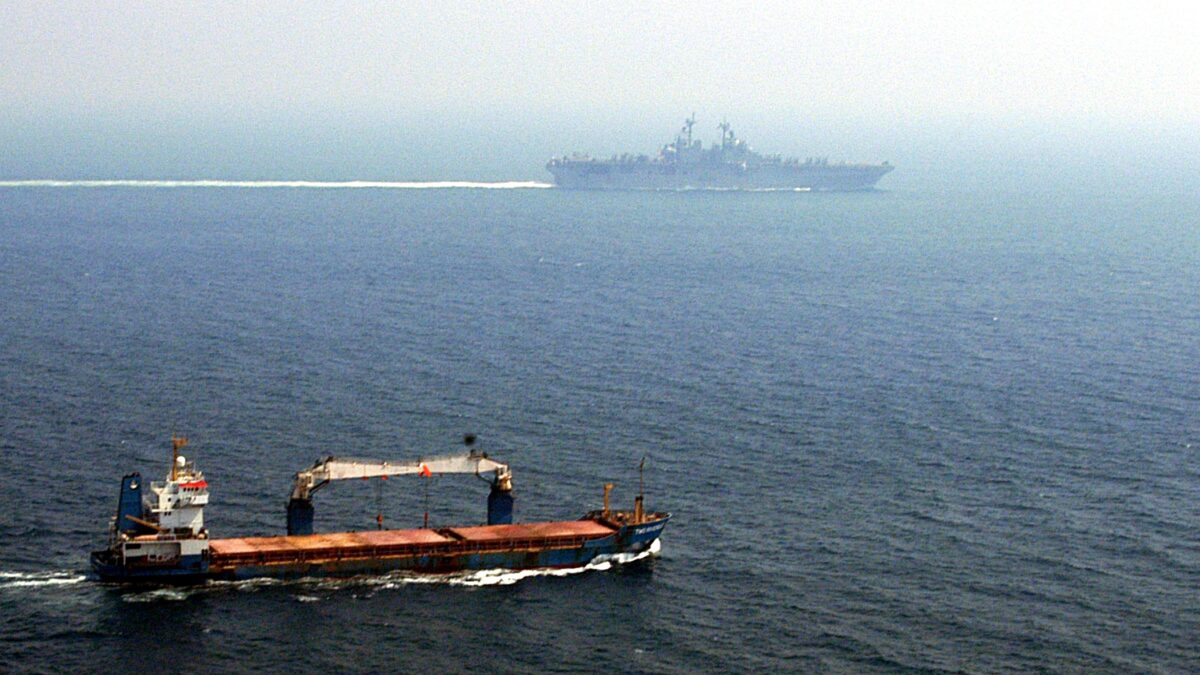
There is a stretch of water on this earth, barely thirty-three kilometres wide at its narrowest point, through which the lifeblood of the modern world must pass. Twenty million barrels of oil a day. A fifth of the liquefied gas that warms the homes of Asia and Europe. The tankers that carry it move in lanes only two miles wide, like camels threading a mountain pass, and every captain who has ever sailed them knows the same quiet truth: this is the throat of the world, and a throat can be squeezed.
Last week, the hand around that throat tightened again.
On the night of 2 November, American forces struck a missile launcher on Qeshm Island, the long, arrow-shaped island that sits like a dagger at the mouth of the Strait of Hormuz. Three United States officials told American networks that the Revolutionary Guard had first fired surface-to-air missiles at an American aircraft over the strait, and the strike was the answer. President Donald Trump confirmed the operation on polling day, 3 November, and called it a “minor strike”. Iranian state media reported five explosions on Qeshm and further blasts at Bandar Lengeh, on the mainland across the water.
Four days later, it happened again. On the evening of 7 November, two missiles struck the Suza area of Qeshm, witnesses telling the Iranian news agency IRNA that they had heard aircraft overhead before the impacts. Mr Trump, speaking to reporters in West Palm Beach, said American forces had “knocked out” an anti-aircraft device “in about fifteen minutes”. Hours later, Iranian state television was reporting explosions at Jask, Sirik and Bandar Abbas as well, and an Israeli outlet was reporting casualties at the port of Jask — a claim no American or Iranian official had confirmed by nightfall, and one I will not dress up as fact.
On that same Saturday, in the Gulf of Oman beyond the strait, American forces disabled the St Kitts-flagged cargo vessel M/V Huda, which the United States Central Command said was attempting to breach the American naval blockade. Thermal footage released by Central Command, and carried by Al Jazeera, showed the ship struck and burning under a targeting reticle, the sea dark around it. It was not the first such disabling. It will almost certainly not be the last.
And on that same Saturday, the Revolutionary Guard’s spokesman, Hossein Mohebbi, announced that Iran’s self-imposed limit on the range of its ballistic missiles — two thousand kilometres, a limit Tehran had long advertised as proof that Europe need not fear its arsenal — had been lifted. “This limitation has been lifted for us,” he said. The words were a declaration, not yet a deed; but declarations, in a week like this one, are deeds of a kind.
Reader, sit with that for a moment. In seven days: two rounds of strikes on the same island, a ship disabled in open water, a missile limit discarded, and a new American task force announced to choke Iran’s supply lines by land as well as by sea. This is not a skirmish. This is a siege, tightening in plain sight, and the whole world is watching it through a keyhole of thirty-three kilometres.
Qeshm: The Island That Keeps Returning
Qeshm is not a name the world knew a year ago, and now it cannot forget it. The island is a hundred and thirty-five kilometres long, the largest in the Persian Gulf, separated from the Iranian mainland by the narrow Clarence Strait. Its southern shore looks across the shipping lanes of Hormuz. According to an Anadolu Agency fact sheet, it houses a Revolutionary Guard naval installation, an underground missile facility and a desalination plant. CommandEleven’s intelligence dossier counts at least seven Qeshm incidents since March of this year alone.
That is the pattern, and the pattern is the point. Qeshm keeps returning because geography keeps returning. An island at the mouth of a chokepoint is a fortress that cannot be moved, and a fortress that cannot be moved will be struck again and again until one side or the other changes the arithmetic. After the American strike of June, Central Command reported Iranian missiles fired at Kuwait and Bahrain. After the July strikes, the Guard claimed missiles at an American base in Jordan while Kuwait and Bahrain reported incoming fire. Each round answers the last. Each answer writes the next question.
There is a lesson here that the strategists in Washington and Tehran both know and neither will say aloud: limited strikes are only limited until they are not. Mr Trump called both rounds “minor”, and by the standards of modern war they were — a launcher here, an anti-aircraft device there, fifteen minutes of fire. But the men who fired the surface-to-air missiles at the American aircraft, and the men who ordered the fifteen minutes of fire in return, were not playing a parlour game. They were testing the edge of a cliff, one step at a time, in the dark, with the world’s oil supply standing behind them.
And the island remembers. Its salt caves are among the longest in the world; its mangrove forests have stood for centuries; its fishermen have worked these waters since before any empire drew a line on a map. Now its name is spoken in the same breath as missile ranges and blockades. That, too, is a kind of casualty — the quiet erasure of a place into a target.
The Iron Gate Closes on Land
If the sea is the throat, then the land is the spine, and on 7 November the United States moved to close that too. Central Command announced the creation of Task Force Iron Gate, a team of roughly twenty civilian and military personnel based in Tampa, Florida, under the direction of Admiral Brad Cooper, to prevent Iran from using ground routes to transport advanced weapons, dual-use technologies and other sanctioned materials across its land borders and the Caspian Sea.
Consider the modesty of the number. Twenty people. A roomful, not an army. But the modesty is the message: this is not an invasion force; it is a net, cast across seven borders — Afghanistan, Armenia, Azerbaijan, Iraq, Pakistan, Turkiye and Turkmenistan — and across the Caspian, where the cargoes move in the grey space between sanction and smuggling. Admiral Cooper said the task force would reinforce “the success of our ironclad blockade against Iran at sea”. Central Command estimates that the naval blockade, in place since July, has already prevented Iran from exporting more than twenty-five billion dollars’ worth of crude oil, and that American forces have redirected a hundred and forty-four commercial vessels through October.
The same day, the Revolutionary Guard announced ambitious plans for underground complexes capable of sustaining missile and drone production under bombardment. The symmetry is almost perfect, and perfectly bleak: one side builds a net above ground, the other digs deeper below it. The siege and the bunker, each answering the other, each making the other necessary.
I ask you to notice what is happening here. A blockade is not a battle; it is a slow sentence, passed day by day, on a whole nation. Twenty-five billion dollars of oil kept from market is not an abstraction — it is hospitals without medicine, factories without fuel, a currency sliding toward worthlessness, a people punished for the decisions of their rulers. And a missile range limit lifted is not an abstraction either — it is a promise, made in public, that the next round will reach further than the last. Between the net and the bunker, the space for diplomacy grows thinner by the week.
History Is Not a Metaphor Here — It Is a Warning
My readers know my habit: when the present grows too loud, I turn to history, not to escape it but to hear it more clearly. History is the mirror in which the present sees its own face — and in the Strait of Hormuz, the mirror is polished bright by blood.
We have been here before. In the nineteen-eighties, during the long war between Iran and Iraq, the strait became the stage of the Tanker War. For four years, ships were attacked, crews were killed, and the great powers of the world — America, Britain, France, the Soviet Union — sent their navies to escort the tankers through. The war ended, as wars do, but the strait did not forget. A derelict tanker, a casualty of that war, lay anchored in the strait for years afterwards, rusting in the sun like a monument no one had asked for.
And then there was the third of July, 1988. On that day, the American cruiser USS Vincennes, in the heat of a naval engagement in the strait, shot down Iran Air Flight 655, a civilian airliner climbing out of Bandar Abbas, killing all two hundred and ninety people aboard. The United States called it a tragic error; Iran has never accepted that account, and the dead have never answered. I do not raise that flight to score a point. I raise it because it is the single most important fact about this strait that no briefing paper ever prints in bold: in these waters, in these tensions, a mistake does not stay a mistake. It becomes a massacre, and a massacre becomes a memory, and a memory becomes a motive.
That is why the events of this week frighten me more than the headlines suggest. A surface-to-air missile fired at an American aircraft. A drone claimed shot down — the Guard said it was an MQ-1 Predator, the sixteenth of its kind; the army said it was an MQ-9 Reaper; the two accounts do not agree, and disagreement itself is a kind of fog. Explosions at four ports in one evening, their cause unclear, their meaning contested. This is the fog of war, and the fog of war is thickest exactly where the water is narrowest.
The strait has taught this lesson before, in 2019, when tankers were attacked and the world held its breath, and again in June of last year, when American bombers struck the nuclear sites at Fordow, Natanz and Isfahan. Each time, the world learned the lesson and then, with the discipline of a people determined to forget, unlearned it. And so we are here again, at the same water, with the same ships, the same missiles, the same fifteen minutes of fire — and the same question, unanswered after forty years: how many times can great powers play at the edge of the same cliff before the cliff gives way?
The Ledger of the Blockade
Let me now speak plainly, in numbers, because numbers are the one language in which this crisis cannot hide.
The United States Energy Information Administration calls the Strait of Hormuz the world’s most important oil transit chokepoint, and the figures bear it out. In normal times, about twenty million barrels of oil a day move through it — roughly a fifth of all the petroleum liquids the world consumes, and more than a quarter of all the oil traded by sea. About a fifth of the world’s liquefied natural gas passes through the same channel, most of it from Qatar. Four-fifths of the crude that transits the strait is bound for Asia; China, India, Japan and South Korea alone take two-thirds of it. There is no practical alternative: the pipelines that bypass the strait could carry, at most, about two and a half million barrels a day against the twenty that normally flow through it.
Now look at what the war has done to those numbers. According to the United Kingdom Maritime Trade Operations, at least eleven ships were attacked in and around the strait in the week ending 6 November alone, and three of them sank. Western military intelligence has documented eighty-eight projectile strikes since hostilities resumed in early July. Transits through the strait have fallen by roughly sixty-five per cent from pre-conflict levels. The Energy Information Administration’s figures put the collapse in starker terms still: flows that averaged more than twenty-one million barrels a day before the conflict had fallen to under five million barrels a day by the second quarter of this year — more than three-quarters of the world’s most important energy artery, gone.
Behind every one of those numbers is a human being. The seafarers who crew those tankers — Filipinos, Indians, Ukrainians, Russians, men from a dozen poor countries — sail now into waters where a ship can be struck from the sky, boarded by marines, or disabled by a missile fired into its funnel. The families in Lahore and Manila and Dhaka who wait for the remittance that does not come when a ship does not sail. The commuters in Tokyo and Mumbai and Seoul who will pay more for fuel, for food, for everything that moves by truck and train, because the oil that feeds their economies must now travel further, costlier, or not at all.
This is the part of the story the strategists never put in their statements. A blockade is aimed at a government, but it lands on a people. A missile limit is announced by a spokesman, but it is paid for by a mother in Tehran who cannot afford cooking oil, and by a fisherman in Qeshm whose sea has become a battlefield. Power speaks in the language of percentages; ordinary people live in the language of prices.
The Mediator’s Hour
And yet — and yet — there is still a door open, and it is held open by Qatar. Qatari mediators have been carrying proposals between Washington and Tehran, and this week they put forward a forty-eight-hour de-escalation plan. Neither side has formally accepted it. Iran, for its part, has set seven conditions for reopening the strait, and has said it could be reopened within two days if the American naval blockade were lifted and its conditions met. An Iranian spokesman said Iran’s forces were “stronger than at the beginning of the war”, and warned that all American assets, “regardless of their geographical location”, were potential targets if aggression continued.
Read those two statements together and you will see the shape of the negotiation. One side offers forty-eight hours. The other offers two days, at a price. Both sides are counting the same clock, and both are pretending the other is the one who must blink first.
History tells us that mediators succeed only when both sides have already decided, privately, that they cannot afford the next step — and fail when either side still believes it can. The question is not whether Qatar’s plan is clever enough. The question is whether Washington and Tehran have reached the point where the cost of the next fifteen minutes of fire exceeds the cost of the concession. The blockade has cost Iran twenty-five billion dollars. The strikes have cost America the pretence that this is a small war. The strait has cost the world three-quarters of its oil flow. If those are not enough to make two proud governments talk, then I must ask, with all the bluntness I can muster: what price will be enough?
I do not pretend to know the answer. But I know this: every war in this strait has ended the same way — not with a victory parade, but with a negotiation, conducted in exhaustion, over terms that were available months earlier at a fraction of the cost. The Tanker War ended in a ceasefire. The June strikes ended in a ceasefire. The pattern is not mysterious. It is only ignored.
What the World Must Decide
So here we stand, reader, at the edge of the same water where the world has stood so many times before, and I will not insult you with a tidy conclusion. There is no tidy conclusion to be had. There is only a choice, and the choice is being made, day by day, by people whose names you will never know and whose decisions you will live with.
The strait will not save us from ourselves. It is water and rock, a passage thirty-three kilometres wide, and it has no opinion about the ships that cross it. It is we who must decide what passes through it — oil and gas, or fire and wreckage. The captains will keep sailing, because that is what captains do. The fishermen of Qeshm will keep fishing, because that is what fishermen do. The question is whether the governments of the world will keep doing what governments have done in this strait for forty years: strike, answer, strike again, and call the whole grim arithmetic a strategy.
I began with a throat, and I will end with one. The world has a throat, and it runs through the Strait of Hormuz, and this week a trembling hand closed around it once more. A throat can be squeezed only so many times before it closes altogether — and when it closes, it does not close for one country or one navy or one revolution. It closes for the mother in Tehran and the commuter in Mumbai and the seafarer from Manila, all at once, all together.
The mediators have forty-eight hours. The island has seven conditions. The missile men have no limit at all. And history — patient, merciless history — is watching from the shore, waiting to see whether we have learned anything at all.
Let us hope, for all our sakes, that this time we have.
Sources & References
- Vigil Consilium — Iran–Gulf weekly brief, 8 November 2026 (US strikes on Qeshm, 3 and 6 November; Iran’s seven conditions; missile-range limit lifted)
- House of Saud — Trump Confirms US Strikes on Iran; Qatar Pushes 48-Hour Plan (7 November strikes in the Suza area; Qatar mediation)
- TrendArab — US Strikes Iran’s Qeshm Island Amid Escalating Tensions and Mediation Efforts in Strait of Hormuz (11 ships attacked, 3 sunk; transits down about 65%; 88 projectile strikes since early July)
- Bytes Europe — CENTCOM’s ‘Iron Gate’ targets Iran’s weapons routes (Task Force Iron Gate; Admiral Brad Cooper; Tampa)
- Newspresso — US Sets Up 20-Person Team to Block Iran’s Weapons Routes (144 vessels redirected; US$25 billion in crude blocked)
- CommandEleven Intelligence — Qeshm, the Qataris and the Post-Midterm Window (Qeshm incident pattern; Qatari mediation)
- Geopolitiki — Strait of Hormuz Explained (EIA flow figures: 20.9 million barrels a day; about 20% of global consumption; LNG share)
- Jagran Josh — School Assembly News Headlines, 9 November 2026 (Task Force Iron Gate announcement; migrant boat off Senegal; Krakow mourning)
- Al Jazeera English (Instagram) — US military attacks cargo ship in the Gulf of Oman, 7 November 2026 (CENTCOM thermal footage of the M/V Huda strike)
- Wikimedia Commons — Featured image (U.S. Navy photo by Photographer’s Mate 3rd Class Angel Roman-Otero, 5 July 2004, public domain: a merchant ship sails past USS Kearsarge while transiting the Straits of Hormuz)

About the Author — Abdul Mannan
Related Articles
The Girls Who Lost First and Won the World: Nigeria’s Flamingos and the Night Africa Stood Tall
Nigeria's Flamingos lost their first match of the U-17 Women's World Cup — then won six in a…
The Square That Survived Empires: Kraków, and the Enemy Who Came From Within
On a Saturday afternoon, a gunman drove into Kraków's Main Market Square and opened fire. Six people died.…
When the City of Lights Could Not See the Sky: Delhi’s Smog and the Price of Our Own Fire
Tomorrow is Diwali, the festival of lights. Tonight, Delhi — a city a thousand years old — cannot…