Einstein Probe Catches Hidden X-Ray Glow After Neutron Star Merger

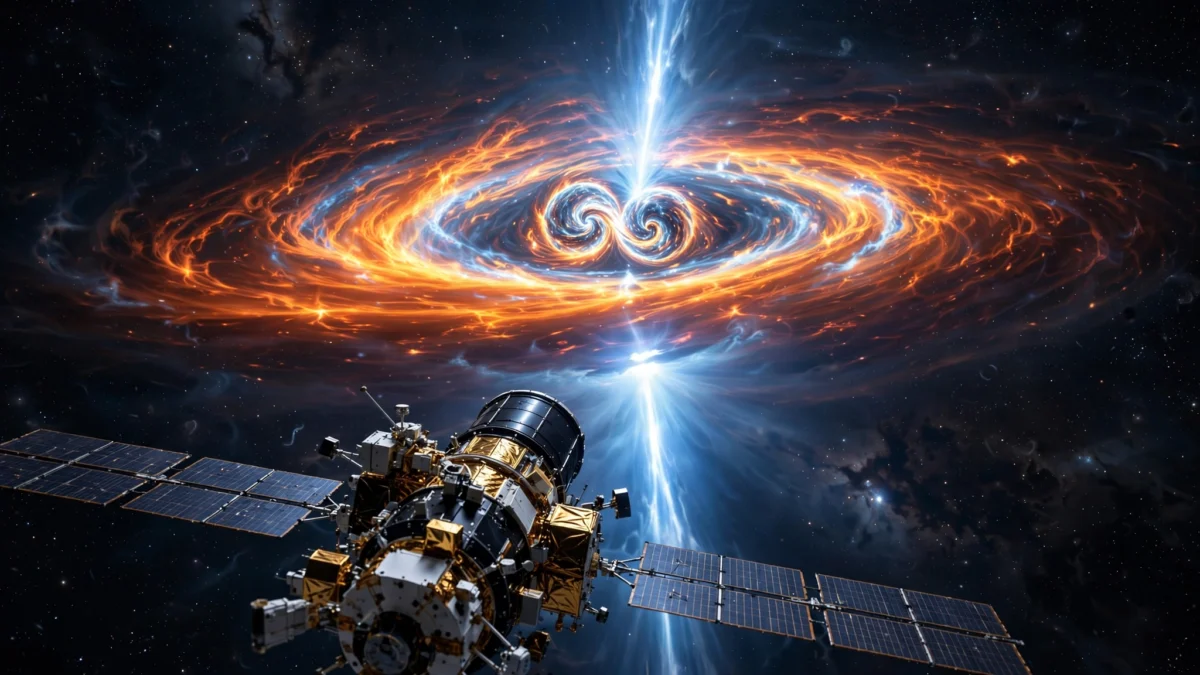
A brief flash of gamma rays lasting less than half a second turned out to be only the opening act of a cosmic explosion that astronomers are now studying in a whole new light. According to an international team of researchers, the China-led Einstein Probe captured soft X-ray emission from the same event continuing for nearly ten minutes — a phase of activity that conventional instruments would almost certainly have missed.
The explosion, catalogued as EP250704a in X-rays and GRB 250704B in gamma rays, was observed jointly by the Einstein Probe, the Space Variable Objects Monitor (SVOM) and the Insight-Hard X-ray Modulation Telescope (HXMT), the researchers report. Their findings, published as a cover article in the journal Science Bulletin, suggest the merger of compact objects — most likely neutron stars — leaves behind a central engine that keeps releasing energy long after the initial flash.
The rapidly flickering, colour-shifting X-rays point to continued activity at the heart of the explosion, according to the team. One possible explanation is a newborn magnetar: a rapidly spinning, intensely magnetised neutron star powering the glow. The study was led by An Li of Beijing Normal University and Bin-Bin Zhang of Nanjing University, with the high-energy analysis led by HKU doctoral student Yi-Han Iris Yin as co-corresponding author.
The researchers also conclude that similar hidden X-ray phases may have accompanied earlier short gamma-ray bursts but went undetected, being too soft and faint for previous instruments. The result opens a new window on neutron-star remnants — and could help astronomers pair such flashes with gravitational-wave signals from the same cosmic collisions.
Sources

About the Author — Abdul Mannan
Related Articles
NASA Advances PRIMA Telescope Into Next Phase as First ‘Probe Explorer’ Mission
NASA has cleared its PRIMA far-infrared observatory to enter preliminary design as the first mission in a new…

World Space Week 2026 Begins Today With “Rocket Revolution” Theme in Over 100 Nations
World Space Week 2026 kicks off today, October 4, with the "Rocket Revolution" theme celebrating how reusable rockets…
Scotland’s ‘Lizzie’ Fossil Dethroned: 345-Million-Year-Old ‘Oldest Reptile’ Was a Water-Dweller
Synchrotron X-ray scans reveal Scotland's 345-million-year-old "Lizzie" had internal gills and a fish-like mouth — it was an…