Scotland’s ‘Lizzie’ Fossil Dethroned: 345-Million-Year-Old ‘Oldest Reptile’ Was a Water-Dweller

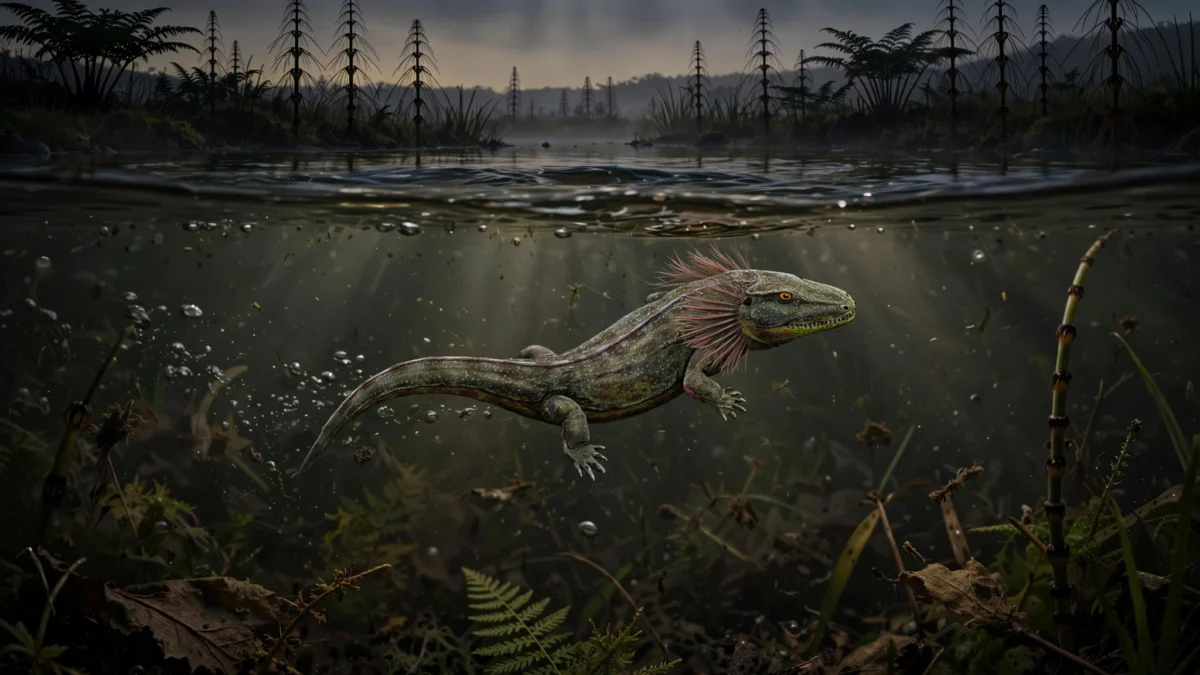
One of palaeontology’s most famous fossils has just been stripped of its title.
Westlothiana lizziae, nicknamed “Lizzie”, is a tiny 345-million-year-old fossil found in Scotland in 1984. When it was described in 1990, its lizard-like body, four limbs and claw-tipped toes convinced scientists they were looking at the earliest known reptile — a landmark in the story of how vertebrates first conquered dry land. For more than three decades, Lizzie has been one of the most-cited fossils in debates about the origin of amniotes, the group that includes reptiles, birds and mammals.
But new synchrotron X-ray scans have exposed anatomy that was invisible inside the crushed rock, and the verdict is decisive, according to researchers at the American Museum of Natural History and the University of Oxford who led the study, published in the journal Nature. Hidden inside the fossil were ossified internal gills, a primitive skull and a fish-like mouth lined with thousands of tiny teeth — features that rule out any amniote identity. Lizzie, it turns out, was an aquatic or amphibious stem tetrapod that lived in and around water.
The twist is that the very features once taken as proof of its reptile status — five claw-tipped digits on hands and feet — evolved much earlier among water-dwelling tetrapods than anyone suspected. “Lizzie has been an icon for the early evolution of amniotes for decades,” said study co-lead author Xavier Jenkins of the American Museum of Natural History. “But when we were finally able to see inside the fossil, we found an animal that looked very different from what we expected.” His fellow co-lead, Ben Igielman, noted that the skull’s surprisingly primitive features show Lizzie belonged to a much more ancient lineage, while co-author Roger Benson called it “a big surprise” — the result shows some so-called reptile traits were already present in the common ancestor of amphibians and reptiles.
SOURCES

About the Author — Abdul Mannan
Related Articles

They Have Left the Earth: Google’s Suncatcher and the New Empire of the Sky
Google's Project Suncatcher has carried AI chips into orbit — an escape, or an evasion? A column on…

Hawaii’s Iconic Hōlei Sea Arch Collapses Into the Pacific After 500 Years
Hawaii Volcanoes National Park has confirmed that the 90-foot Hōlei Sea Arch, formed more than five centuries ago,…

New AI ‘Brain Decoder’ Reconstructs What People Are Viewing From Brain Scans
Weizmann Institute scientists have built an AI "brain decoder" that reconstructs what a person is viewing from fMRI…