Francis Halzen Wins 2026 Nobel Prize in Physics for the IceCube Neutrino Observatory

The 2026 Nobel Prize in Physics has been awarded to Belgian-American physicist Francis Halzen for what the Royal Swedish Academy of Sciences called his “decisive contributions to the IceCube Neutrino Observatory and the discovery of high-energy neutrinos of astrophysical origin,” according to Reuters.
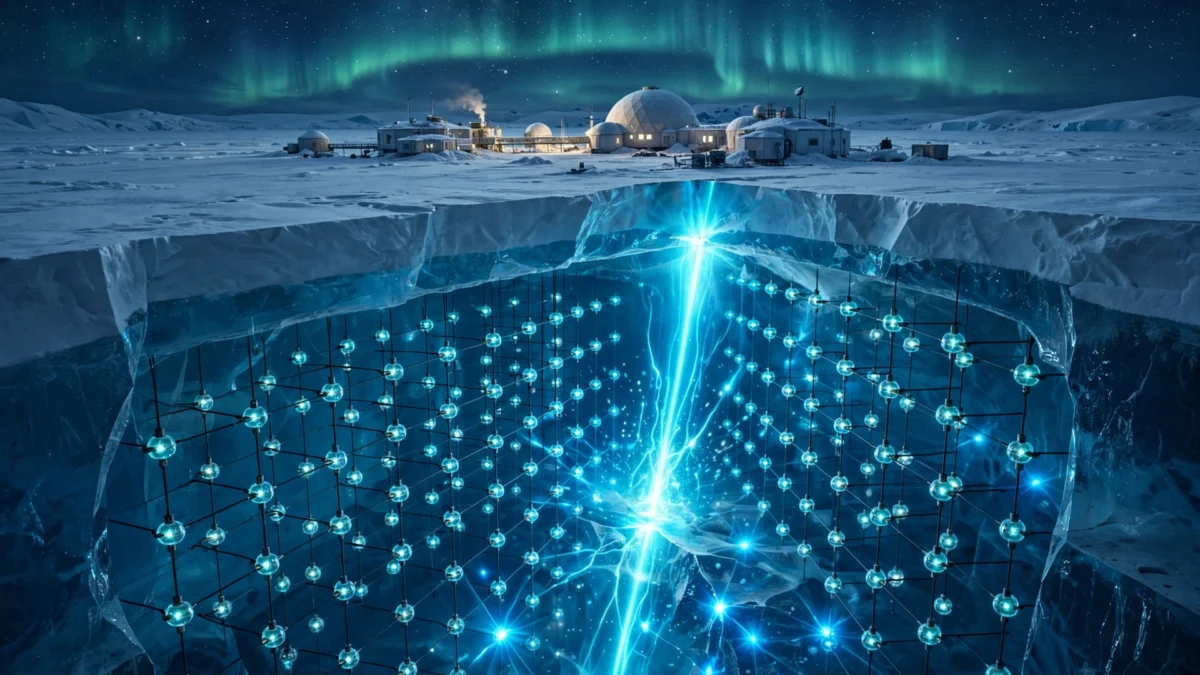
Halzen, 82, is a professor at the University of Wisconsin–Madison and the principal investigator of IceCube, the world’s largest neutrino detector: a cubic kilometre of Antarctic ice at the Amundsen-Scott South Pole Station threaded with thousands of optical sensors, operational since 2010, the Associated Press reported.
The Academy announced the award on Tuesday in Stockholm. The prize carries a total award of 12 million Swedish kronor, roughly $1.2 million, according to Reuters.
Speaking by telephone from Italy after the announcement, Halzen said the news had come as “a great surprise” and a pleasure, the Associated Press reported, adding that while others had long predicted he might one day win, the moment still felt strange.
“Francis Halzen has led an international team of researchers and engineers who have provided us with a fantastic instrument,” said Mark Pearce, chair of the Nobel Committee for Physics, in the Academy’s statement. “His tenacity and scientific vision has paved the way for a new kind of astronomy.”
Neutrinos are elementary particles with almost no mass and no electric charge. They stream through stars, planets and entire galaxies almost entirely unchanged, earning them the nickname “ghost particles.” Scientists cannot observe them directly; instead, IceCube’s sensors watch for the faint flashes of blue light emitted when a neutrino very rarely collides with an atomic nucleus in the exceptionally clear glacial ice, CNN reported.
The road to the prize spanned decades. Halzen first presented plans for an Antarctic neutrino telescope in 1988 and led the earlier, smaller AMANDA detector that operated from 1995 to 2000 before the full IceCube array was completed. The decisive scientific payoff arrived in 2013, when IceCube confirmed that a group of neutrinos with energies above 30 teraelectronvolts — millions of times more energetic than particles produced by the Sun — originated beyond the solar system. Unlike cosmic rays, which are deflected by magnetic fields, neutrinos travel in nearly straight lines, so they point back almost directly to their sources: the universe’s most violent environments, such as exploding stars and distant galaxies.
Tuesday’s announcement was the second of this year’s Nobel Prizes, following Monday’s award of the physiology or medicine prize. The chemistry prize is due on Wednesday, followed by literature on Thursday, the peace prize on Friday and the economics award on Monday, Reuters reported.
The medals will be presented by Sweden’s King Carl XVI Gustaf at a ceremony in Stockholm on December 10, the anniversary of Alfred Nobel’s death, followed by the traditional banquet at Stockholm City Hall.
Analysis: Why It Matters
This year’s physics prize is as much an award for vision and perseverance as for a single discovery. Halzen proposed his improbable idea — turning a cubic kilometre of Antarctic ice into a telescope — in 1988. It took more than two decades of engineering before IceCube confirmed its first cosmic neutrinos in 2013, and more than a decade after that for Stockholm to call. Few projects in science have demanded such sustained faith that nature would cooperate.
The “new kind of astronomy” that committee chair Mark Pearce spoke of is the heart of the matter. For centuries, astronomy meant studying light — but light is easily blocked by dust and gas. Neutrinos, almost never stopped by anything, carry information straight from the engines of the universe’s most extreme events. Combined with gravitational waves and conventional telescopes, they complete the toolkit of what scientists now call multi-messenger astronomy: listening to the cosmos in several languages at once.
There is also a lesson in the timeline. The 2013 detection of astrophysical neutrinos was not an endpoint but the opening of a new observational science. Every subsequent detection has sharpened the question IceCube was built to answer: what are the cosmic accelerators firing these particles across the universe? The answer is still being written — and the prize signals that the field, and the instrument itself, has come of age.
What to watch next: the remaining prizes of Nobel week — chemistry on Wednesday, literature on Thursday and the peace prize on Friday — and the December 10 ceremony in Stockholm. For IceCube, the coming years should bring ever more sensitive hunts for the universe’s faintest messengers.
Sources

About the Author — Abdul Mannan
Related Articles
First-Ever ‘Phoenix Planet’ Discovered Reborn From the Ashes of a Dead Star
Astronomers say a Jupiter-sized world orbiting the white dwarf HS 0209+0832 may be the first planet ever found…
2026 Nobel Prize in Medicine Awarded to Trio Behind Optogenetics, the Light-Control Technique for the Brain
Karl Deisseroth, Peter Hegemann and Georg Nagel have won the 2026 Nobel Prize in Physiology or Medicine for…
Einstein Probe Catches Hidden X-Ray Glow After Neutron Star Merger
Astronomers have found that a 0.4-second gamma-ray flash from a likely neutron-star merger was followed by nearly ten…