First-Ever ‘Phoenix Planet’ Discovered Reborn From the Ashes of a Dead Star

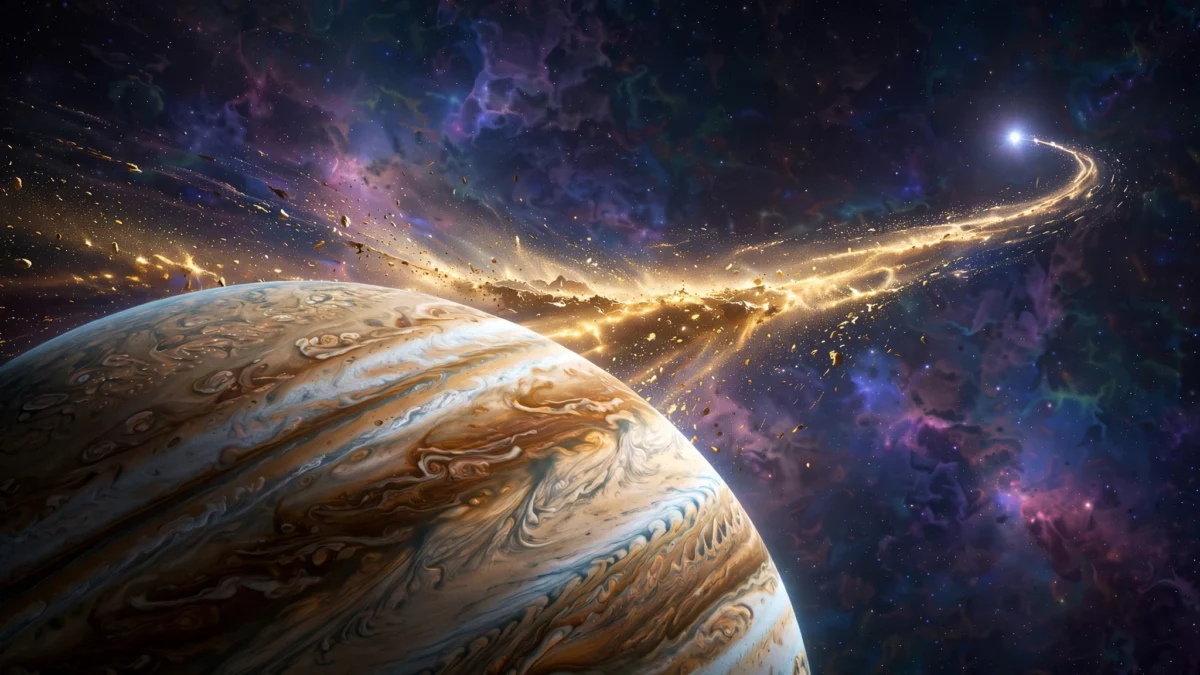
Astronomers have detected what they believe is the first planet ever found to have formed from the burned remains of its own dead star — a Jupiter-sized world orbiting the white dwarf HS 0209+0832, about 270 light-years from Earth. The finding, reported Monday in the journal Nature Astronomy by a University of Warwick-led team, rests on unusual chemical fingerprints on the stellar remnant’s surface that point to planetary material raining down on it.
When a star like our Sun exhausts its nuclear fuel, it swells into a red giant and then sheds its outer layers into space, leaving behind a dense, Earth-sized ember called a white dwarf. Planets that formed alongside the star can sometimes survive this violent transition if their orbits are wide enough — astronomers have spotted a handful of such first-generation survivors around white dwarfs. But no one had ever seen a world built anew from a star’s own death debris. Similar “reborn” planets have been suspected around pulsars, the spinning corpses of much heavier stars, but never around the far more common white dwarfs, according to the researchers.
The smoking gun is niobium. Hubble first observed the star in 1999, and its spectrum contained roughly 100 chemical features nobody could identify at the time. Lead author Jamie Williams, a doctoral student in physics at the University of Warwick, re-examined that 27-year-old data with a modern chemical database and found that niobium matched many of the mystery features — the first time the element has ever been detected in a white dwarf. The star’s surface is more than a thousand times richer in niobium than the Sun, alongside unusual amounts of copper, zinc and carbon. To the team, that mix implies the material falling onto the dead star was cooked up in the star’s own death throes — the signature of a planet assembled from its ashes.
The case is built on three lines of evidence, according to NASA. Archived observations from NASA’s retired FUSE ultraviolet mission also showed strong niobium signatures in the same system. And NASA’s TESS planet-hunting satellite watched the star for four months and picked up a faint brightness dip repeating every 4.4 days — consistent with a giant planet orbiting just 6 million kilometres from the white dwarf, far closer than Mercury orbits the Sun. The candidate is estimated at about Jupiter’s size, but the young, still-blistering-hot white dwarf appears to be blasting its atmosphere away; that stripped material may form a comet-like tail feeding a disk that rains niobium back onto the star.
Caution is warranted: “It’s not a confirmed planet,” Williams told CNN. “It’s only a candidate for now.” More observations will be needed to rule out alternative explanations for the brightness signal.
Analysis: Why It Matters
If confirmed, the “phoenix planet” rewrites what astronomers think is possible after a star’s death. Rather than the white-dwarf stage being the epilogue of a planetary system, as Williams put it, it may be merely the end of the first chapter — with whole new worlds condensing out of the debris. That matters far beyond this one system: white dwarfs are the most common stellar corpses in the galaxy, and the Sun itself will become one in about five billion years.
The discovery also sharpens the long-running hunt for life-friendly worlds in unlikely places. White dwarfs cool slowly and predictably, so a planet at the right distance can sit in a stable habitable zone for tens of billions of years — far longer than around a Sun-like star. This candidate itself is far too close and too scorched to host anything familiar, but the template now exists: hot white dwarfs with unusually high carbon and heavy-element enrichment are promising places to look for more.
Finally, there is a quiet lesson in the method. The crucial Hubble spectrum sat in an archive for nearly three decades before anyone could read it. Twenty-seven years and one better chemical database later, it revealed a phenomenon never seen before. The sky has already been recorded; we just keep getting better at seeing it.
What to watch next: Williams plans to keep observing such systems with Hubble over the coming years to build a statistical picture of how second-generation planets form and how common they are. The team’s paper proposes a practical search recipe — hot white dwarfs showing high carbon and heavy-element enrichment — which could soon turn a single candidate into a whole population. The confirmation observations, from Hubble and ground-based instruments, will decide whether the phoenix planet holds up.
Sources
- NASA — Suspected Second-generation Planet Solves NASA Hubble Cold Case: https://science.nasa.gov/missions/hubble/suspected-second-generation-planet-solves-nasa-hubble-cold-case/
- Nature Astronomy — Discovery of a second-generation planet candidate accreting onto a white dwarf: https://www.nature.com/articles/s41550-026-02983-7
- CNN — First-ever evidence of a second-generation planet detected around dead star: https://www.cnn.com/2026/10/05/science/second-generation-planet-discovery-white-dwarf?cid=external-feeds_iluminar_meta

About the Author — Abdul Mannan
Related Articles

2026 Nobel Prize in Medicine Awarded to Trio Behind Optogenetics, the Light-Control Technique for the Brain
Karl Deisseroth, Peter Hegemann and Georg Nagel have won the 2026 Nobel Prize in Physiology or Medicine for…
Einstein Probe Catches Hidden X-Ray Glow After Neutron Star Merger
Astronomers have found that a 0.4-second gamma-ray flash from a likely neutron-star merger was followed by nearly ten…
NASA Advances PRIMA Telescope Into Next Phase as First ‘Probe Explorer’ Mission
NASA has cleared its PRIMA far-infrared observatory to enter preliminary design as the first mission in a new…