Saudi Arabia Confirms Houthi Strikes Damaged Two Southern Airports, Wounding Three

The confirmation
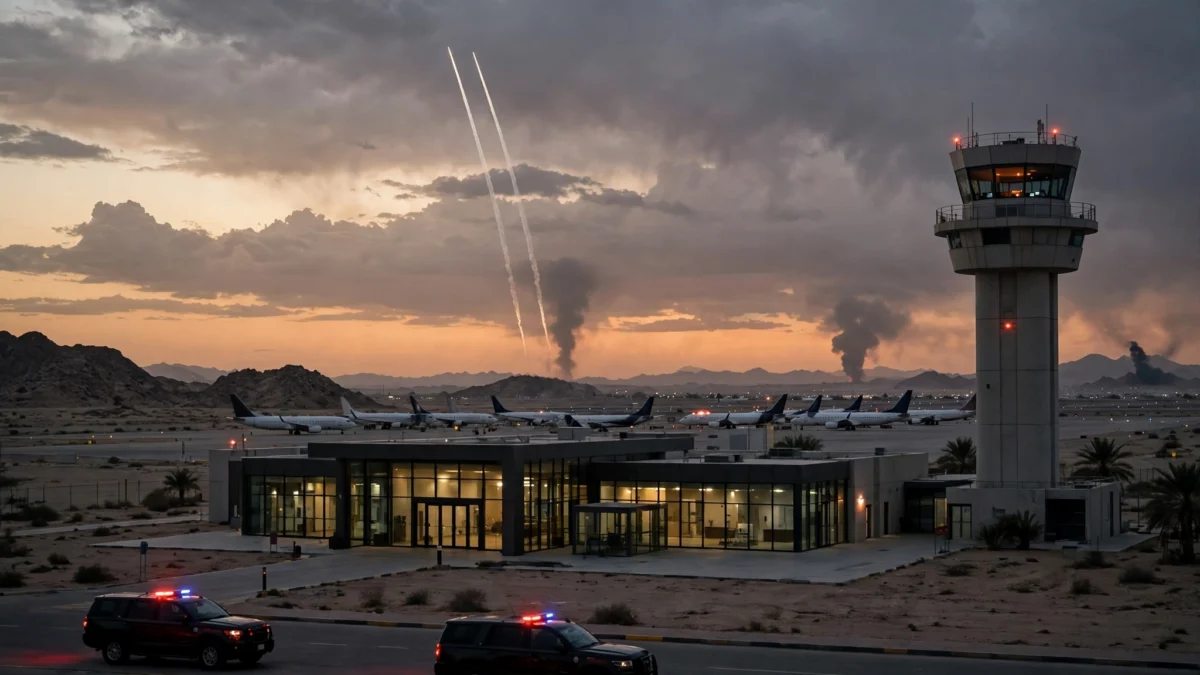
Saudi Arabia acknowledged on Tuesday that two of its southern airports came under attack the previous evening, marking the first time Riyadh has publicly confirmed damage to civilian aviation infrastructure since its renewed confrontation with Yemen’s Houthi rebels began. According to Reuters, the kingdom’s General Authority of Civil Aviation said King Abdullah bin Abdulaziz International Airport in the Red Sea city of Jazan and Najran International Airport were struck on Monday evening, sustaining what the authority described as limited damage while three people were lightly injured.
The statement stopped short of naming who was responsible for the strikes. That attribution question, however, had effectively been answered hours earlier by the other side: the Houthis’ military spokesman, Brig. Gen. Yahya Saree, said late Monday that the group had fired missiles and drones at airports, military sites and other facilities across Saudi Arabia, as reported by The Associated Press and relayed through its regional coverage. The Saudi admission therefore converts a set of rebel claims — the kind of claims officials in Riyadh had previously left unanswered — into a confirmed event with wounded civilians on Saudi soil.
The Wall Street Journal, which also reported the confirmation on Tuesday, added a further wrinkle that had not appeared in the initial Saudi statement. Early Wednesday, authorities in Aden — the city in southern Yemen where the internationally recognised government’s exiled administration is based — said a Houthi attack had targeted Aden’s own airport, with a local security force statement describing two missiles fired at “a vital civilian facility” that endangered passengers, airport workers and flight crews, though no one was wounded. Taken together, the two confirmations sketch a confrontation in which both sides’ civilian aviation infrastructure is now being hit or targeted within a span of hours.
The broader exchange
The attacks on Saudi airports did not come out of a vacuum. They form one half of a rapidly intensifying exchange of fire that has been building for days. The Houthis, who are backed by Iran, responded to a Saudi-led coalition air campaign inside Yemen with a deliberate strategy of taking the fight onto Saudi territory, according to Reuters and AP reporting this week.
On the Saudi side, the response has been military as well as administrative. The Saudi-led coalition fighting in Yemen said on Tuesday that it had intercepted and destroyed a ballistic missile launched by the Houthis toward Khamis Mushait, a southwestern Saudi city that hosts a major Saudi military base, according to AP’s account. The interception claim could not be independently verified, but it fits the pattern of a conflict that has moved decisively beyond the Yemeni border.
On the ground in Yemen, the fighting grinds on with its own fog. The Houthis were fighting on Tuesday around Dhubab, a strategic town on the Red Sea coast, a senior Yemeni military official told The Associated Press on condition of anonymity. The government had previously said it retook Dhubab and nearby areas as part of a campaign to reclaim Houthi-held territory near the southern tip of the Red Sea and the Bab el-Mandeb Strait — the narrow waterway through which roughly 12 per cent of global trade passes. Whether Dhubab has truly changed hands remains contested, and the official’s account to AP suggests the battle for it is still live. Saudi Arabia and its allies in the Yemeni government launched this military campaign, as AP described it, to reclaim territory the Houthis seized along the coast last month and to prevent disruptions to oil being exported out of the region.
The aviation authority’s statement said it was assessing the damage at both airports and taking measures to ensure the safety of passengers and staff and the security of the kingdom’s civil aviation system, according to Reuters. That sentence matters more than its bureaucratic tone suggests: it is the language of a state acknowledging that civilian flight operations in its southern provinces are now a contested space.
Warnings to airlines and the cost to markets
The Houthis have been explicit about wanting to make Saudi airspace itself a pressure point. In the statement late Monday claiming the strikes, the group again warned “all international airlines using Saudi airspace” to halt their flights, except those over the Muslim holy cities of Mecca and Medina, as reported by The Wall Street Journal. It is a threat with teeth behind it: the Journal notes that the Houthis have in the past hit aircraft on the ground in their attacks, and the European Union Aviation Safety Agency has now warned airlines that “recurrent missile and drone attacks, together with the activation of air-defence systems, create an increased risk of misidentification of civil aircraft.”
Financial markets registered the escalation immediately. Reuters reported on Wednesday that major Gulf stock markets were subdued in early trade as fighting intensified on several fronts between the Houthis and Saudi-backed government forces. Saudi Arabia’s benchmark TASI index slipped 0.2 per cent, weighed down by a fall in Al Rajhi Bank, while Abu Dhabi and Qatar eased and Dubai edged up on a toll operator’s gains. A two-airport attack, in other words, is already moving money — and in a region whose energy exports underpin global prices, markets are watching the trajectory closely.
The confrontation has also begun to reshape regional diplomacy. According to Newsmax, citing Al Arabiya, Saudi Defence Minister Prince Khalid bin Salman said following a meeting that Saudi Arabia, Turkey and Pakistan stood “as one” in confronting attacks targeting the kingdom and the Islamic holy sites, and would activate collective deterrence against the attacks and “all those behind them.” The three countries issued a joint statement strongly condemning attempts to target Mecca and Medina and continued attacks on Saudi cities, civilian facilities and economic assets, stressing what they described as their rejection of any attack or threat to the kingdom’s security and territorial integrity.
Analysis: Why It Matters
The significance of Tuesday’s Saudi confirmation lies less in the military damage — which the kingdom characterised as limited — and more in what Riyadh chose to admit. When a government publicly confirms that civilian airports on its own territory were hit, it is accepting a political cost in order to unlock policy options: a confirmed attack on civilian infrastructure provides the justification, both domestically and internationally, for an escalated response. The wording of the aviation authority’s statement, careful to note that it was assessing damage and protecting passengers and staff, reads like groundwork for whatever comes next.
There is a second, subtler shift. The Houthis’ strategy of warning international airlines off Saudi airspace — exempting only the holy cities — is an attempt to internationalise the economic pressure. Civil aviation warnings are not merely rhetoric: the EASA misidentification warning shows that regulators with no dog in the fight are already adjusting their risk models. If major carriers begin rerouting around southern Saudi airspace, the economic friction compounds on top of the Red Sea shipping disruption the Houthis have already inflicted. Riyadh’s confirmation of the airport strikes effectively validates the threat that makes such rerouting plausible.
The Aden airport incident deserves attention too, because it suggests the logic of retaliation is now running on both rails at once. If the WSJ account is accurate — Houthi missiles aimed at a civilian facility in the city hosting the exiled government, with no injuries but clear intent — then both sides are normalising strikes on civilian aviation infrastructure as instruments of pressure. That is a dangerous equilibrium: airports are difficult to defend absolutely, easy to disrupt psychologically, and any misidentification event in this environment would carry catastrophic escalation potential, which is precisely what EASA is flagging.
Then there is the Bab el-Mandeb dimension. The ground fighting around Dhubab, contested as its outcome may be, is about the strait that carries a significant share of the world’s oil and container trade. The Saudi campaign’s stated goal is to prevent disruptions to oil exports from the region; the Houthis’ counter-goal is to make the cost of that campaign felt inside Saudi Arabia. The two airport strikes fit that logic exactly: they do not change the military balance in Yemen, but they force Riyadh to defend a widening perimeter, and they put the confrontation in front of markets, airlines and diplomats who would otherwise treat Yemen as someone else’s war.
The emerging Saudi-Turkey-Pakistan alignment around what Al Arabiya described as the activation of a Mecca Defence Alliance framework adds a multilateral layer worth watching. If Riyadh is building a coalition framed explicitly around the defence of the holy sites — invoking a religious legitimacy that transcends the Yemen war itself — the conflict is being recast from a border campaign into a cause with broader Islamic-world resonance. That framing raises the stakes for Tehran, the Houthis’ backer, while also giving Islamabad and Ankara a visible seat at a table where they can claim to be stabilisers rather than bystanders.
What to watch in the coming days: first, whether the Abha airport claim is confirmed or denied, since a third airport would show the pattern widening rather than settling; second, how airlines actually respond to the EASA warning and the Houthi airline advisory, because schedule changes would be the first real economic transmission of this fight beyond markets; third, the fate of Dhubab and the Saudi ground campaign around Bab el-Mandeb, which determines whether Riyadh’s offensive has momentum or is stalling; and fourth, any visible follow-through from the Saudi-Turkey-Pakistan defence alignment, which will show whether the diplomatic escalation is substance or theatre.
Sources
- Reuters: “Two Saudi airports targeted on Monday as fighting with Yemen’s Houthis escalates”
- Reuters: “Gulf bourses subdued as Saudi-Houthi hostilities escalate”
- The Wall Street Journal: “Yemen’s Houthi Rebels Strike Two Airports in Saudi Arabia”
- The Associated Press: “Saudi Arabia says 2 airports were hit in renewed fighting with Houthis”
- Newsmax (citing Al Arabiya): “Saudis, Allies Activate Pact Amid Houthi Attacks”

About the Author — Abdul Mannan
Related Articles
Three Years After October 7: Trump’s Gaza Plan Turns One as Strikes Continue and Disarmament Stalls
Three years after the October 7 attacks and a year into the US-brokered ceasefire, Trump's Gaza plan has…
Houthis Claim Missile and Drone Strikes on Saudi Airports and Aramco Refinery
The Houthis say they carried out three waves of missile and drone attacks on Saudi targets, including Riyadh's…

Iran’s Oil Minister Mohsen Paknejad Resigns Under US Blockade Pressure; NIOC Chief Hamid Bovard Takes Over
Iran's oil minister Mohsen Paknejad has resigned, state media reported, with the chief of the National Iranian Oil…