Wall Street Drops as 10-Year Treasury Yield Hits Highest Since 2002, With Fed Minutes in Focus

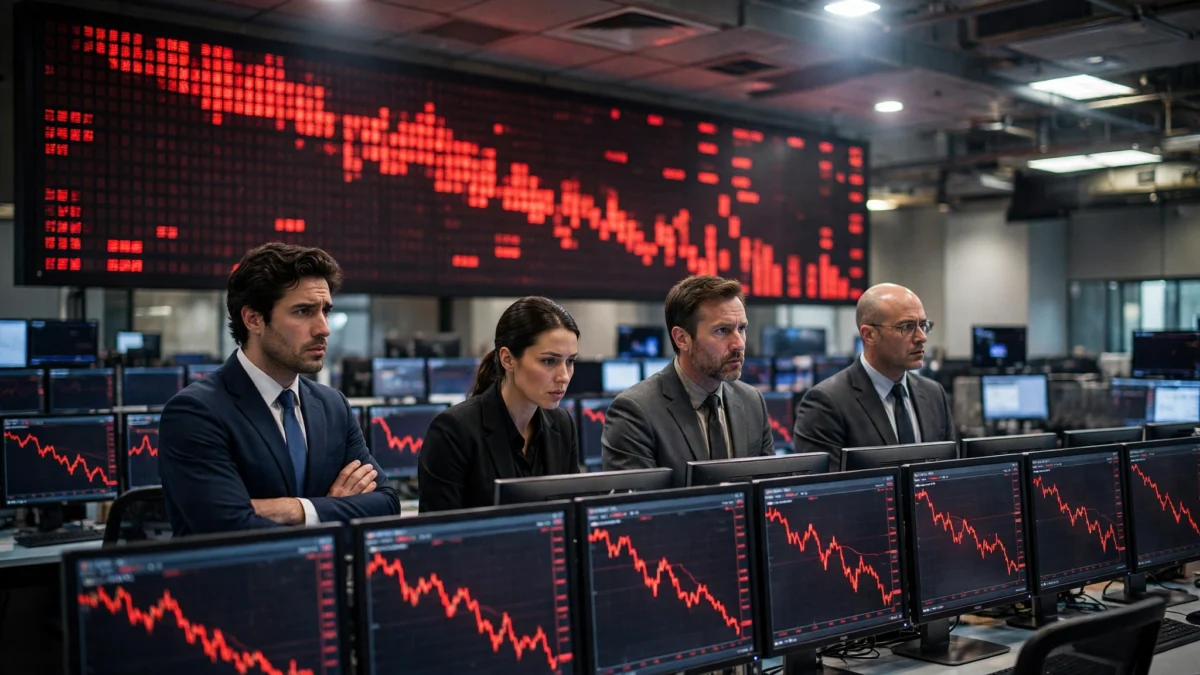
United States equities retreated sharply on Wednesday as a renewed selloff in government bonds pushed the benchmark 10-year Treasury yield to its highest level in roughly a quarter of a century, forcing investors to reassess how much they are willing to pay for stocks a day after the S&P 500 and the Nasdaq Composite both closed at records.
The blue-chip Dow Jones Industrial Average fell about 1.1 per cent in late morning trading in New York, shedding close to 600 points, according to market data reported by Investopedia. The S&P 500 declined roughly 0.7 per cent, marking an intraday low of 7,763, while the technology-heavy Nasdaq Composite fell nearly 0.7 per cent and hovered near a session low of 27,341, according to Investor’s Business Daily’s live coverage.
The trigger was the bond market. The yield on the benchmark 10-year Treasury note, which anchors borrowing costs across the American economy from mortgages to corporate debt, touched above 5.36 per cent early on Wednesday, its highest level since April 2002, Investopedia reported. The yield was last seen above 5.31 per cent, up several basis points from Tuesday’s close. The yield on the 30-year Treasury bond also climbed to levels last seen in 2002, reaching about 5.71 per cent, Reuters reported.
The move came ahead of two events that traders were treating as potential turning points for the market: the scheduled sale of 39 billion dollars of 10-year Treasury notes later on Wednesday, which will test investor appetite for government debt, and the release at 2pm Eastern Time of the minutes from the Federal Reserve’s September policy meeting, at which policymakers raised interest rates for the first time in three years.
Investors are hunting for clues about how the central bank views the path of interest rates from here. Traders see roughly a 78 per cent chance that the Fed holds rates steady at its October meeting, according to CME Group’s FedWatch tool as cited by Reuters, but markets have a roughly 83 per cent chance of at least a quarter-point hike priced in for December, Investopedia reported.
The pullback stands in sharp contrast to Tuesday’s session, when the S&P 500 notched a closing record of 7,818.93 and the Nasdaq also set a new closing high as artificial-intelligence-linked stocks regained momentum. According to The Wall Street Journal’s live market coverage, chip stocks and other AI-linked names that powered the records were among Wednesday’s decliners, with Micron Technology and Marvell Technology falling more than 2 per cent and 1 per cent respectively in premarket trading.
Energy markets added to the unease. Brent crude, the international benchmark, rose about 1.3 per cent to nearly 102 dollars a barrel, while United States benchmark West Texas Intermediate crude rose about half a per cent to near 90 dollars a barrel, Investopedia reported. The gains reflected a rise in Middle East supply risk after attacks by Iran-backed Houthi rebels on Saudi targets, which outweighed an increase in tanker traffic through the Strait of Hormuz.
Bitcoin was also caught in the downdraft, dropping 2.9 per cent to a session low of 82,884 dollars, according to Investor’s Business Daily. The cryptocurrency remains more than 34 per cent below its record high of 126,272 dollars.
Small-capitalisation stocks showed particular sensitivity to the rise in borrowing costs. The Russell 2000 index extended its losses to 1.5 per cent, according to Investor’s Business Daily, a sign that smaller firms, which typically carry more variable-rate debt and thinner buffers, feel the pain of higher yields first.
Yet the selloff was far from uniform. A handful of large technology and infrastructure names pushed back against the tide. Data-management company NetApp rallied more than 2 per cent to a record high of 236.14 dollars, with trading volume running more than 60 per cent above its average pace, according to Investor’s Business Daily. Intel gained 1.3 per cent after a Bloomberg News report said the chipmaker would continue work on Elon Musk’s Terafab chipmaking venture, Reuters reported.
Elsewhere, SpaceX shares fell 2.1 per cent after a Financial Times report said the company was seeking 40 billion dollars in financing to fund purchases of Nvidia chips, Reuters reported.
The bond market’s message is also reaching households. Applications for United States home loans fell 4.2 per cent in the week ended 2 October, according to the Mortgage Bankers Association, marking a fifth consecutive weekly decline and taking activity to its lowest level since January 2025, Sharecast reported. Applications to refinance a mortgage, which respond most quickly to rate changes, slid 7.5 per cent on the week, while applications to buy a home were 2.1 per cent lower. The drop came as the 30-year fixed mortgage rate jumped to 7.49 per cent, its highest in nearly three years.
Investors overseas were watching the same bond-market drama. Yields on French government bonds were also shooting higher on continued worries about the country’s fiscal health, The Wall Street Journal reported, although they remained below the levels that triggered last week’s concerns.
Looking ahead, the third-quarter earnings season kicks off next week, when a number of high-profile financial firms are expected to report, Reuters noted. Jeansmaker Levi Strauss was set to report results after Wednesday’s close, Sharecast reported.
Why It Matters
Wednesday’s session is best read not as an isolated bad day but as the latest instalment of a tug-of-war that has defined markets for months: artificial-intelligence optimism pulling equity valuations higher, while a relentless climb in long-term borrowing costs pulls the other way. On Tuesday, the AI trade won. On Wednesday, the bond market took the round back.
The reason the tug-of-war matters is arithmetic. When the 10-year Treasury yield sits above 5.3 per cent, the earnings that companies are expected to deliver years into the future are worth markedly less in today’s money. Growth stocks, and the AI infrastructure names that dominate today’s indexes, are essentially long-dated claims on future profits, so they are the most sensitive to exactly the kind of yield spike Wednesday delivered. This is why a market can set records on Tuesday and give them up on Wednesday without any single company changing its prospects: the discount rate moved, not the businesses.
There is a second, less mechanical channel through which the bond selloff reaches the real economy. The mortgage market is the transmission belt. When the 30-year fixed mortgage rate reaches 7.49 per cent, its highest in nearly three years, and loan applications sink to their lowest since January 2025, that is the bond market’s stress showing up in household budgets. Housing is one of the largest channels through which monetary policy reaches ordinary families, and Wednesday’s data from the Mortgage Bankers Association suggests the channel is constricting again just as consumer confidence is being tested.
The day’s two scheduled events deserve close attention because they answer different questions. The 39-billion-dollar auction of 10-year notes is a supply question: is there enough demand for the flood of government debt being issued to absorb it at anything like today’s yields, or do buyers need to be paid ever more to take it on? Weak auctions have a history of rattling both bond and stock markets. The Federal Reserve minutes, by contrast, are a policy question: how did the September rate hike get decided, how much disagreement sat around the table, and what would make officials either pause or move again? The two answers could reinforce each other or point in opposite directions.
Finally, the breadth of the retreat matters. Declines outnumbered advances by a wide margin, and the pain spread beyond technology into industrials, materials and small caps. That breadth suggests investors were not simply taking profits on a handful of hot AI names but were repricing risk across the board, a distinction that often separates a one-day shakeout from the start of something longer. The exceptions, names like NetApp and Intel, were driven by company-specific news rather than broad momentum, which only underlines how much the market is now distinguishing between stories rather than buying the index wholesale.
What to watch next is straightforward. First, the Fed minutes at 2pm Eastern Time: any hint that officials are more, or less, inclined toward another hike will move yields within minutes. Second, the outcome of the 10-year note auction: soft demand would be a warning sign for the supply story that underpins much of this year’s bond selloff. Third, the opening of earnings season next week: technology and bank results will show whether corporate profits can grow fast enough to justify valuations at 5.3 per cent yields, or whether the market’s AI bet is running ahead of the numbers.
Sources
Reuters: Wall Street futures slip as yields and oil rebound, Fed minutes in focus
Investopedia: Stock Market Today, October 7, 2026

About the Author — Abdul Mannan
Related Articles
S&P 500 Closes at First Record Since August as AI Rally Broadens — but 5.3% Bond Yields Flash a Warning
The S&P 500 and Nasdaq closed at records on Tuesday as the AI trade broadened into power stocks…

Google Strikes 3.6-Gigawatt Power Deal With Constellation Energy in Latest Big-Tech Nuclear Push
Google has contracted 3,590 megawatts of power from Constellation Energy — including 890 megawatts of new nuclear capacity…

S&P 500 Sets Its First Record Since August as AI Rally Broadens Beyond Tech
The S&P 500 closed Tuesday at a record 7,819.04, its first record since August, powered not by Big…