S&P 500 Closes at First Record Since August as AI Rally Broadens — but 5.3% Bond Yields Flash a Warning

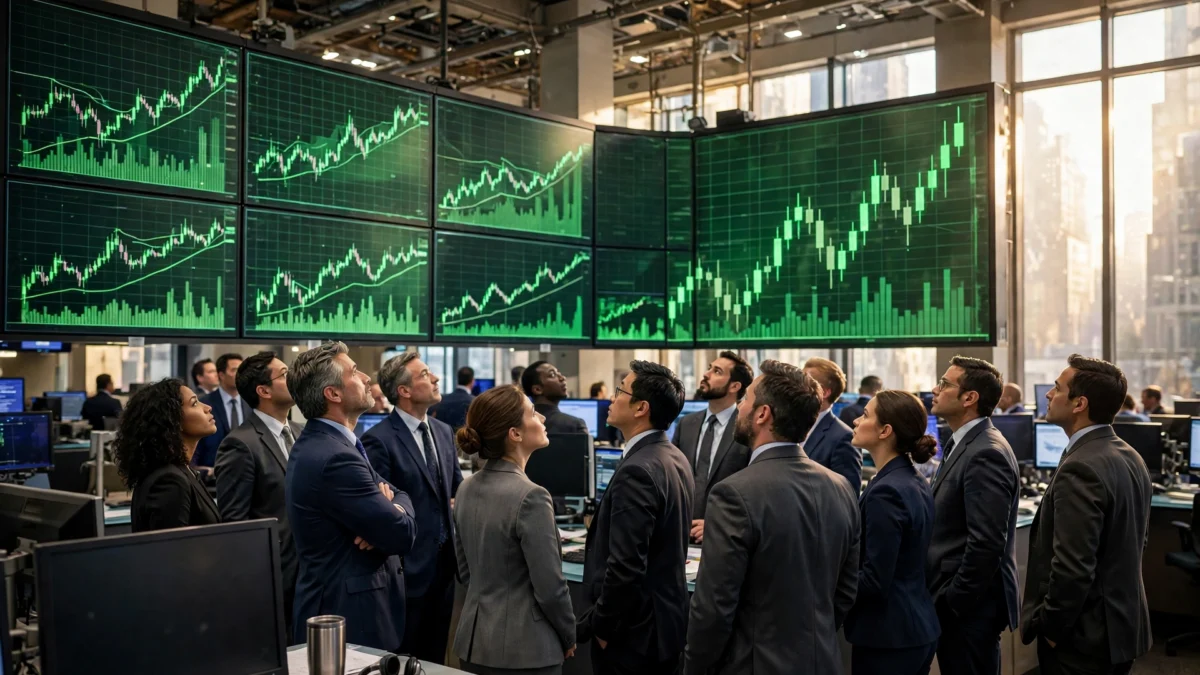
The S&P 500 closed at a record high on Tuesday for the first time since August, rising 0.6 percent to 7,819.04 as the artificial-intelligence trade carried American stocks past another peak, according to Barron’s. The Nasdaq Composite also finished at a record close — its second in as many sessions — while the Dow Jones Industrial Average gained roughly 253 points, or 0.5 percent.
What made Tuesday’s advance remarkable was not just the number on the board but what led it there. The day’s top-performing sector in the S&P 500 was not technology — it was utilities. In the 61 sessions since 1990 in which the index set its first record in more than 30 days, utilities have led on only two previous occasions, Barron’s reported. Tuesday was the third. Constellation Energy and Vistra, two of the country’s largest power companies, were among the S&P 500’s biggest gainers as investors piled into them as indirect plays on the AI build-out’s enormous appetite for electricity.
Nvidia, the chipmaker at the heart of that build-out, reached its second consecutive record closing price on Tuesday, moving closer to a $6 trillion market valuation — a level no company in history has ever touched. The stock has jumped 4.5 percent in the past week to a new all-time high, according to The Wall Street Journal, which describes the company as the world’s most valuable. Meta Platforms, another pillar of the rally, is up 24 percent since August 13, the date of the S&P 500’s previous record close, the Journal reported.
The breadth of the market behind those headline names tells a more cautious story. Fewer than half of the stocks in the S&P 500 finished above their 200-day moving average on Tuesday, a proportion that has been shrinking steadily since August, the Journal reported. Shares of healthcare companies, banks and consumer staples makers have been declining. Small-cap stocks are down. The Dow’s blue chips lag badly. The gap between the market’s winners and everything else keeps getting wider, and the index is increasingly running on a single engine: a familiar cast of companies building — or directly enabling — the artificial-intelligence revolution.
The record came against one of the most punishing backdrops in modern market memory. The yield on the 10-year U.S. Treasury note stood near 5.31 percent on Tuesday — the highest closing level in roughly 24 years, and up about half a percentage point in the past month alone, according to market data cited in a Tuesday market recap. Reuters reported that the 30-year Treasury yield has climbed to its highest level since 2002, reflecting expectations that interest rates will stay elevated. Higher yields normally drag on stock valuations, which is what makes the record so unusual: equities and bonds are pricing two very different futures.
Those futures will come under sharper focus on Wednesday, when the Federal Reserve releases the minutes of its September meeting at 2 p.m. ET. The Fed raised interest rates at that meeting — the first increase in three years — and investors will mine the minutes for any signal about whether the October meeting will bring another move, or whether policymakers will wait. Right now, markets are not expecting one: CME’s FedWatch tool prices only a 22 percent probability of an increase this month, according to Barron’s, while LSEG data cited by Reuters put an 86 percent chance on a quarter-point hike in December.
Oil supplied another layer of volatility. Brent crude, the international benchmark, fell nearly 2 percent on Tuesday to around $98.50 a barrel after Middle East export flows recovered toward pre-war levels and a 100-million-barrel emergency release from G7 stockpiles coincided with a Saudi price cut, according to a Tuesday market recap. By Wednesday morning, Brent was back above the $100 mark at about $101.25, with U.S. West Texas Intermediate near $89.86, Barron’s reported. The monthslong war with Iran has kept crude jumpy, and every spike feeds the inflation fears that keep bond yields elevated.
This market is operating in a vacuum for now, and it knows it. Gold and silver slipped more than 1 percent as the stronger dollar and higher yields weighed on them, Reuters reported, a classic risk-off tell flashing at the same moment stocks were making records. Somewhere, one of these markets is misreading the economy.
Analysis: Why It Matters
This rally has now survived things that were supposed to stop it. It climbed through the Federal Reserve’s first rate increase in three years. It climbed through a monthslong war that pushed oil back over $100 a barrel. It climbed through 10-year yields at their highest in a generation. The standard playbook says expensive growth stocks are the first casualty of high rates, yet the market has decided that the artificial-intelligence build-out is exempt — an extraordinary claim that the third-quarter earnings season, now under way, is about to test.
The expectations baked in are formidable. Analysts expect S&P 500 profits to rise more than 30 percent year over year in the third quarter, according to a Tuesday market recap, with AI-related demand doing much of the heavy lifting. Levi Strauss reports on Wednesday after the close, followed by PepsiCo on Thursday and Delta Air Lines on Friday, and the big banks arrive next week. Nvidia sitting within about 4 percent of a $6 trillion valuation — a threshold no company has crossed — means the stock is priced for perfection. Perfection is not a common earnings-season outcome.
Pay attention, too, to the inversion happening in plain sight. Keith Lerner, chief investment adviser for Truist Advisory Services, told the Journal that technology is “almost seen as defensive in some ways” — investors, scanning a market where healthcare, banks and staples are falling, have decided the safest place to hide is inside the most expensive stocks in history. That is a complete reversal of decades of market logic, and it concentrates risk where it is least visible: if the AI capital-spending cycle slows — if data-center orders pause, if power deals slip — the “defensive” trade will unwind with a violence that genuine defensives were designed to avoid.
Tuesday’s quieter signal came from the power companies. Constellation Energy and Vistra leading the S&P 500 to a record is the market telling you where the next phase of the AI money is going: into electricity. This site reported on Tuesday that Google has contracted 3.59 gigawatts of nuclear power from Constellation in a deal worth billions — the physical backbone of the digital story. When the record is being set by companies that sell electrons rather than software, the AI trade is no longer just about chips. It is about the grid, the reactors, and the decade-long question of whether America can generate enough power to feed its own boom. That reframes the trade from a technology story into an infrastructure one, with very different winners and very different risks.
The deeper tension is between the two markets that refuse to agree. Bond traders, pushing the 10-year past 5.3 percent and the 30-year to its highest since 2002, are pricing sustained inflation and sustained rates — a world in which money stays expensive for a long time. Equity traders, pushing the S&P 500 to a record, are pricing earnings growth strong enough to outrun those rates. Both can be right in a genuine productivity boom, and the AI optimists would argue that is exactly what is happening. But as Barron’s newsletter commentary noted this week, markets have been ignoring the warning signs of persistently high yields at their peril, with inflation clouds gathering. If the December rate hike the futures markets now expect actually arrives, it will squeeze everything from mortgages to corporate balance sheets — and the narrow market under this record has very little margin for disappointment.
What to watch now is a crowded calendar. The Fed minutes land on Wednesday afternoon in New York, when the debate over an October move versus a December one gets its first hard data. A 10-year Treasury auction on Wednesday and a 30-year auction on Thursday will show whether buyers still exist for government debt at these yields. Weekly jobless claims arrive Thursday, and the consumer-facing earnings from PepsiCo and Delta will test whether households are still spending through the inflation the bond market is pricing. The S&P 500’s record is real, and the companies at its center are genuinely growing. But a market where fewer than half the stocks can stay above their own trend lines, and where the “defensive” trade is the most expensive trade, is a market asking investors to believe two opposite things at once. Earnings season will decide which one is true.
Sources

About the Author — Abdul Mannan
Related Articles
Google Strikes 3.6-Gigawatt Power Deal With Constellation Energy in Latest Big-Tech Nuclear Push
Google has contracted 3,590 megawatts of power from Constellation Energy — including 890 megawatts of new nuclear capacity…
S&P 500 Sets Its First Record Since August as AI Rally Broadens Beyond Tech
The S&P 500 closed Tuesday at a record 7,819.04, its first record since August, powered not by Big…

Paramount Completes $110 Billion Warner Bros Takeover, Creating Hollywood Powerhouse Skydance
Paramount Skydance closed its $110 billion takeover of Warner Bros Discovery on Tuesday, forming a new company called…