Houthi Strikes Kill Three and Wound Dozens at Saudi Airports as Yemen War Spreads to Riyadh

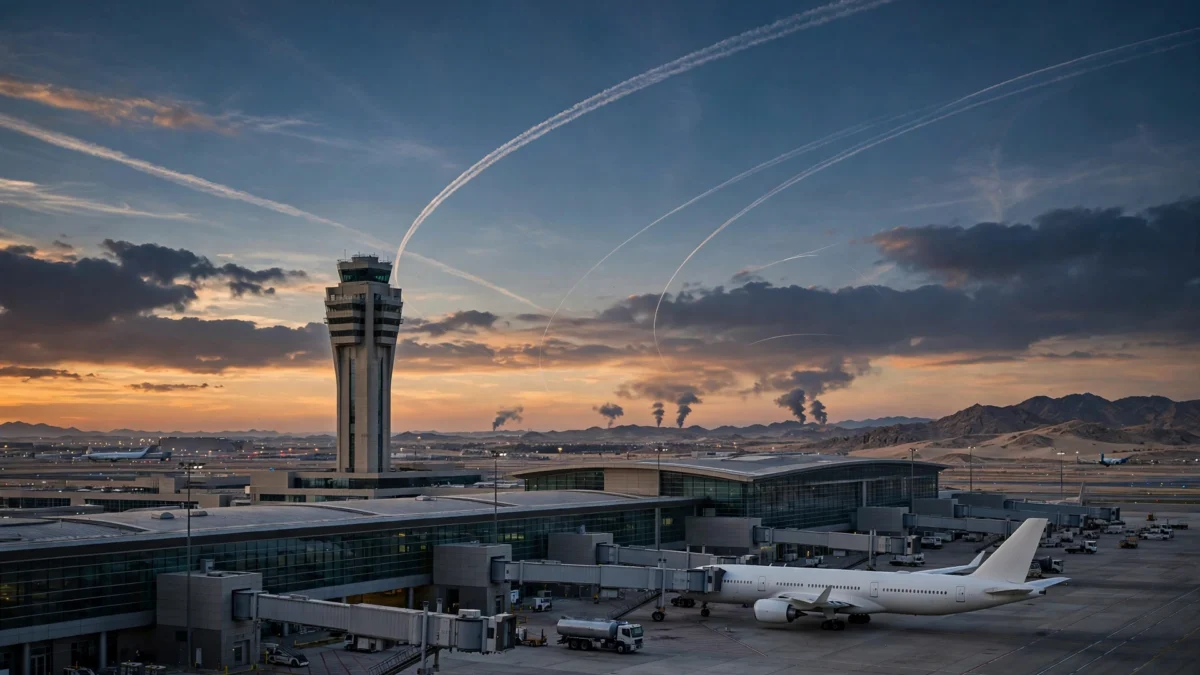
Ballistic missiles and drones claimed by Yemen’s Houthi rebels have struck two airports in Saudi Arabia over two days, killing three people and wounding 36, in what now stands as the deadliest confirmed Houthi attack inside the kingdom during this phase of the Yemen conflict. The strikes — one on the airport in the southern city of Abha on Tuesday, and a second on Riyadh’s King Khalid International Airport on Wednesday — mark a dangerous escalation that has pushed the war from Yemen’s front lines into the heart of the Saudi capital, rattling airlines, passengers, and Gulf markets.
According to CNN, citing Saudi Arabia’s General Authority of Civil Aviation (GACA), the attack on Abha International Airport on Tuesday killed two female residents, one Moroccan and one Algerian national, and wounded 28 others, including Saudi citizens as well as Bangladeshi and Filipino residents. The following day, a separate attack on King Khalid International Airport in Riyadh killed a Sudanese resident and wounded eight people, including five Saudi citizens, two Egyptian residents and one Pakistani resident, the authority said. The Wall Street Journal independently confirmed the same casualty figures, bringing the two-day toll to three dead and 36 wounded.
The Houthi-controlled armed forces claimed responsibility for both attacks. The group said it had targeted King Khalid International Airport with a ballistic missile and claimed the strike disrupted air traffic in the Saudi capital, CNN reported. A day earlier, the Houthis said they had carried out a ballistic missile attack on Abha International Airport and made a similar claim that airport operations had been disrupted. Saudi authorities did not immediately comment on the Houthi claims about disrupted traffic.
The Saudi military response was swift. Saudi military spokesperson Maj. Gen. Turki al-Maliki said Saudi forces had destroyed the ballistic missile launcher used in the attack on Riyadh. In a post on X reported by CNN, al-Maliki said the launcher was destroyed in Sanaa — the Houthi-held Yemeni capital — while preparations were underway for another imminent attack against Saudi Arabia.
The Houthis, in turn, renewed their warning to international airlines against operating flights through Saudi airspace, declaring it had become “a theater for our military operations.” Notably, the group explicitly excluded the airspace around the holy cities of Mecca and Medina from the warning — a careful carve-out that signals the group’s awareness of the religious red lines that would make striking there unthinkable.
This is not the first time this week Saudi airports have come under fire. Two attacks on Monday evening targeted airports in Jazan and Najran in the kingdom’s south, injuring three people and causing limited damage, according to the Saudi aviation authority, as reported by Reuters. The Saudi-led coalition also said it had intercepted and destroyed a Houthi ballistic missile fired towards Khamis Mushait in the kingdom’s south-west. The pattern is unmistakable: a sustained, multi-day campaign against Saudi aviation infrastructure rather than a single dramatic strike.
The attacks are unfolding against the backdrop of a major ground offensive in Yemen. Saudi-backed Yemeni government forces are pressing ahead with Operation “Dawn of Yemen,” a campaign aimed at rolling back recent gains made by the Iran-backed Houthis, backed by stepped-up Saudi air strikes. According to the Wall Street Journal, the Houthis seized a wide swath of territory in a recent lightning offensive against Saudi-backed Yemeni forces, giving the group greater control over the crucial Bab al-Mandeb waterway — the narrow strait through which around 12 per cent of global trade passes. Saudi and Yemeni forces have since pressed a counteroffensive against Houthi fighters, seeking to oust the rebels from the strategic port city of Mokha and ease the threat to energy exports through the strait.
The wider context, as the Wall Street Journal noted, is that these attacks deepen a Saudi-Houthi conflict that has erupted during the United States’ war with Iran — a war now in its eighth month. Every week of that wider war, Reuters observed this week, brings contradictory rumours of diplomatic progress or terrifying new escalations, and the one hard new fact entering the regional equation is Saudi Arabia’s full return to the battle in Yemen.
Markets are already pricing in the risk. Major Gulf stock markets were subdued in early trading on Wednesday as fighting intensified on several fronts, Reuters reported, with Saudi Arabia’s benchmark index slipping and Dubai’s and Abu Dhabi’s indices also under pressure. Oil prices have risen on the combination of the Houthi attacks and an approaching Gulf hurricane, with analysts warning prices could stay elevated near the 100-dollar level without material de-escalation.
Inside Saudi Arabia, the authorities are tightening control over the narrative. According to the Wall Street Journal, Saudi officials issued new public warnings on Tuesday that filming and sharing images of drone and missile attacks — or interceptions — could bring legal charges. Two Saudi officials familiar with the matter told the Journal that the Houthi group has been using missiles to target the kingdom’s airports this week, including the airports in Riyadh and Abha, and that the two attacks caused material damage.
The strikes also intersect with a separate aviation scare still fresh in the region’s memory. Last week, an Omani co-pilot on a flydubai flight from the United Arab Emirates to Israel stabbed his captain in a suspected attempt to down the aircraft — an episode, reported by Reuters, that added to anxieties in a region already buffeted by conflict. European aviation authorities have separately warned of misidentification risks to civil aircraft operating near conflict zones, according to earlier reporting this week.
A Grim First: Deaths Inside the Kingdom
What makes this week’s attacks a genuine inflection point is not the missiles themselves — the Houthis have launched hundreds of projectiles at Saudi targets over the years — but the confirmed civilian deaths at civilian airports. Three dead and 36 wounded, acknowledged by the Saudi aviation authority, is a toll that Riyadh cannot absorb quietly. Earlier confirmed strikes this week, at Jazan and Najran, caused limited damage and light injuries. This is different: funerals, nationalities released, hospital casualty lists.
The deliberate targeting of airports serves the Houthis on multiple levels. First, it imposes a tangible economic cost: airports are economic infrastructure, and every strike — and every claim of disrupted traffic — forces airlines, insurers, and investors to reassess risk. Second, it transfers psychological pressure from Yemen’s battlefields to Riyadh’s doorstep, forcing the Saudi public and leadership to experience the war as something that lands at home rather than something fought across the border. Third, by pairing the strikes with a warning to international airlines — while conspicuously sparing the airspace over Mecca and Medina — the Houthis are practising a form of coercive calibration: terrifying enough to hurt, restrained enough to avoid uniting the entire Muslim world against them.
Saudi Arabia’s response — striking the launcher in Sanaa while it was allegedly being prepared for another attack — shows Riyadh understands the logic and intends to break the cycle at the launch site. But the Houthis have spent years absorbing air strikes and dispersing their missile forces; another imminent attack was likely already in the pipeline.
Analysis: Why It Matters
This week’s events matter for four reasons, each pointing in the same direction: the Yemen conflict is no longer containable inside Yemen.
First, the airport campaign is a deliberate strategy of normalising strikes on Saudi soil as a standing threat. The sequence — Jazan and Najran on Monday, Abha on Tuesday, Riyadh on Wednesday — looks designed to demonstrate reach and persistence: no airport in the kingdom is off-limits, and the campaign will not end with a single headline. The Saudi authorities’ unusual move to criminalise the filming of interceptions suggests they fear the imagery more than the intercepts themselves; a video of a missile streaking over Riyadh does political damage no official statement can repair.
Second, the strikes are leverage in the ground war, not a sideshow. The timing aligns precisely with the Saudi-backed “Dawn of Yemen” counteroffensive and the fight for Mokha and the Bab al-Mandeb strait. By opening a second front over Saudi skies, the Houthis are forcing Riyadh to defend at home while attacking abroad — the classic insurgent’s trade-off, and one that stretches even a well-armed military.
Third, the airline warning is an economic weapon with a long fuse. If international carriers begin rerouting around Saudi airspace — or insurers raise war-risk premiums on Riyadh routes — the cost to the kingdom’s Vision 2030 tourism and aviation ambitions would be measured not in days but in years. The Houthis appear to have studied the lesson of every recent conflict: aviation is the soft underbelly of modern statecraft, and you do not need to close an airport to make flying to it expensive.
Fourth, the regional picture keeps darkening. These strikes are deepening against the backdrop of the eight-month US-Iran war, and every front in that wider conflict — Yemen, the Gulf, the Red Sea — is now interacting with the others. Reuters noted this week that Saudi Arabia’s full return to the battle in Yemen is the hard new fact in the regional equation; the Houthi response has been to make that return as costly as possible, as fast as possible.
What to watch next: whether the Houthis attempt a second strike on Riyadh after Saudi Arabia’s counterstrike on the Sanaa launcher — and whether Riyadh can publicly confirm an interception before imagery spreads on social media; whether any major airline alters its Saudi routings in response to the Houthi airspace warning, which would convert rhetoric into economic fact; whether the “Dawn of Yemen” counteroffensive makes progress around Mokha, since the ground war’s trajectory will determine whether the airport campaign intensifies or pauses; and whether the Saudi warnings against filming attacks signal further domestic tightening as the kingdom manages the politics of a war that has come home.
Sources
- CNN: Deadly attacks by Iran-backed Houthis on Saudi airports highlight widening fallout from Yemen conflict
- The Wall Street Journal: Houthis Escalate Attacks on Saudi Airports, Killing 3 and Wounding Dozens
- Reuters: Gulf bourses subdued as Saudi-Houthi hostilities escalate
- Reuters: The war’s explosive new front

About the Author — Abdul Mannan
Related Articles
Saudi Arabia Confirms Houthi Strikes Damaged Two Southern Airports, Wounding Three
Riyadh confirms Monday evening strikes damaged the Jazan and Najran airports, wounding three, as Houthi rebels claim a…
Three Years After October 7: Trump’s Gaza Plan Turns One as Strikes Continue and Disarmament Stalls
Three years after the October 7 attacks and a year into the US-brokered ceasefire, Trump's Gaza plan has…
Houthis Claim Missile and Drone Strikes on Saudi Airports and Aramco Refinery
The Houthis say they carried out three waves of missile and drone attacks on Saudi targets, including Riyadh's…