South Korea’s Nuri Rocket Places Five NEONSAT Satellites in Orbit on Landmark Fifth Flight, One CubeSat Fails to Separate

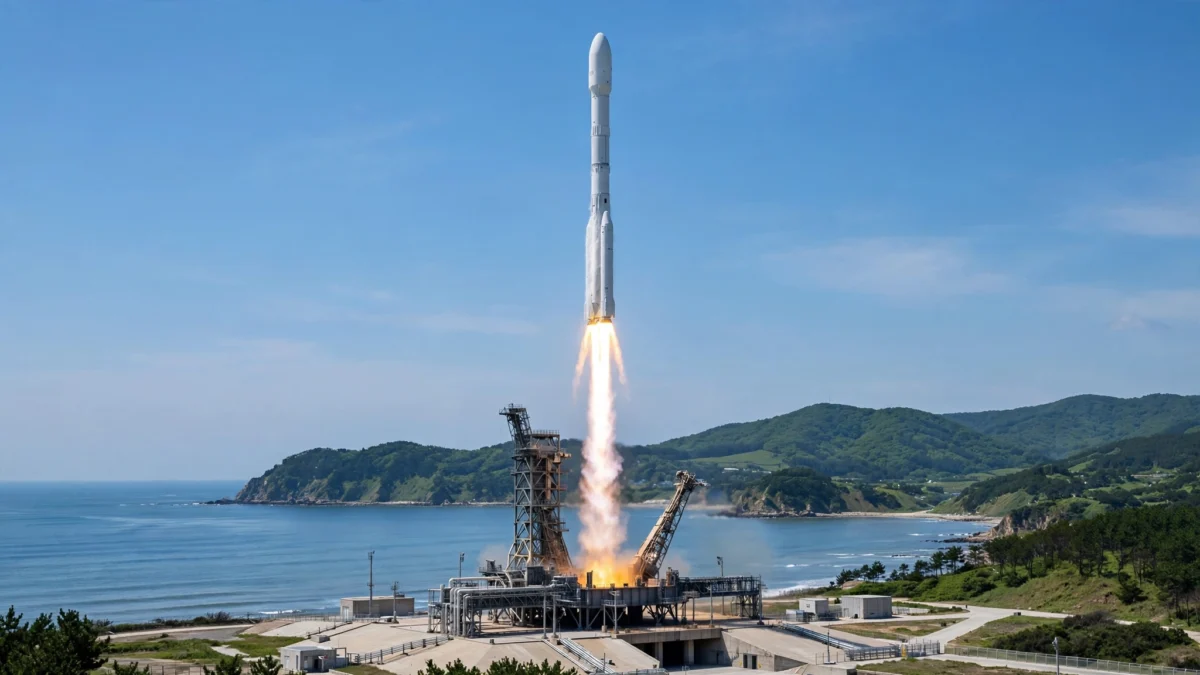
South Korea’s home-grown Nuri rocket completed its fifth and most complex flight on Wednesday, lifting off from the Naro Space Center in Goheung, about 400 kilometres south-west of Seoul, at 12:25 p.m. local time and deploying 14 of its 15 satellites into a sun-synchronous orbit roughly 575 kilometres above the Earth, according to the Korea AeroSpace Administration (KASA).
The mission represented the first time Nuri had been asked to place several primary satellites performing the same mission into orbit on a single flight. The five main payloads were NEONSAT microsatellites — units two through six of a planned ten-satellite Earth-observation constellation built for national safety purposes — and they were released one after another at intervals of about 35 to 40 seconds, according to Xinhua. Following the primary deployment, ten CubeSats were to be ejected in pairs at ten-second intervals, but KASA later corrected its initial announcement that all payloads had been delivered, confirming that nine of the ten CubeSats had separated. The Korea Times identified the satellite that failed to separate as PERSAT02, developed by Quaternion.
The flight lasted roughly 20 minutes. The first stage separated about two minutes and three seconds after liftoff at an altitude of 67 kilometres, according to BigGo Finance’s launch chronology, and the payload fairing — the protective cover for the satellites — was jettisoned about three minutes and 53 seconds into the flight at an altitude of 224 kilometres. Following second-stage separation, the third-stage engine shut down about twelve and a half minutes after liftoff to begin the sequential satellite deployment at the target altitude of 575 kilometres. The flight ended at around 12:45 p.m. once the third stage completed its autopilot sequence.
To prevent the satellites colliding with each other in space, the rocket’s upper stage was rotated by 30 or 60 degrees between satellite releases, according to Dragon Media, and it will perform further manoeuvres to avoid collisions before re-entering the Earth’s atmosphere and burning up. The mission carried about 1,071 kilograms of payload, its heaviest load yet, to a sun-synchronous orbit about 570 kilometres up, according to Aju Press.
The launch also set a procedural record: it was the first time Nuri had lifted off on its scheduled date and time without any delays. The first launch was postponed by an hour for technical checks, while the second and third launches were delayed, and the fourth flight was conducted approximately 18 minutes late due to an issue with an umbilical recovery pressure sensor, according to Aju Press. The rocket left the assembly building at 6 a.m. on Tuesday and crawled 1.8 kilometres to the second launch pad aboard an unmanned transporter, arriving at 7:30 a.m. after about 90 minutes, KASA and the Korea Aerospace Research Institute (KARI) said.
The fifth flight marked another first behind the scenes. Staff from Hanwha Aerospace, the company that builds the rocket, operated 20 of the 22 launch control consoles for the first time, under the supervision of KARI, according to the Korea JoongAng Daily. On the fourth flight in November 2025, KARI staff had operated the consoles with Hanwha staff assisting. “This is the first time we have operated the control panels of the launch control center,” said Kim Sun, who leads Hanwha Aerospace’s space business. “Building a launch vehicle well does not mean you can provide a launch service.” Kim said the company expects to take part in operating nearly all the consoles on the sixth flight, so that a rocket the government developed “is not shelved but properly transferred to the private sector.”
KASA Administrator Oh Tae-seog told a 2 p.m. briefing at the space centre that Nuri had “successfully completed its planned fifth launch mission,” according to the Korea JoongAng Daily. The government will oversee launch operations through 2028, and operations will become fully private-led starting in 2029, Oh said, adding that KASA had asked Hanwha to make production and operations more efficient.
The NEONSAT microsatellites are part of a constellation formally known as the New-space Earth Observation Satellite Constellation for National Safety, and they are intended to provide Earth-observation coverage for civil and public-safety purposes. Development of the satellites was overseen by KAIST’s Satellite Technology Research Center, and they were built by Satrec Initiative, the first units off the company’s satellite production line, according to Aju Press — an early test of whether South Korea can produce constellation-class satellites on an assembly-line basis.
The Nuri programme, formally designated KSLV-II, began in 2010 with the goal of establishing South Korea as a nation capable of independently launching satellites into orbit, according to AirPro News. The project was spearheaded by KARI and supported by a network of more than 300 domestic firms, including Hanwha Aerospace, which played a critical role in engine development. The three-stage liquid-fuelled rocket is powered by KRE-075 engines in the first and second stages and a KRE-007 engine in the third stage, with a payload capacity of approximately 1,900 kilograms to low-Earth orbit.
The programme’s flight history traces a steady learning curve. The first launch in October 2021 fell short of orbit when the third stage shut down 46 seconds early, according to the KSLV-II flight record. A successful mission followed in June 2022, making South Korea the seventh country in the world to place a satellite into orbit with its own rocket. The third flight, in May 2023, carried a new generation of small satellites into space. The fourth flight, in the early hours of November 27, 2025, was notable as Korea’s first overnight launch and the first mission in which Hanwha Aerospace oversaw the rocket’s entire assembly as prime contractor — a handoff widely seen as the vanguard of Seoul’s effort to transfer state-developed space technologies to private industry, according to Korea Bizwire. A sixth flight is planned for September 2027, carrying NEXTSat 3 and NEONSAT units seven through eleven.
The South Korean government invested approximately two trillion won — roughly 1.7 billion dollars — into the development of the Nuri rocket, according to AirPro News, and Hanwha Aerospace acquired full lifecycle rights to the technology in 2025. Seoul has said it hopes to begin annual launches by 2028 with the government shifting to a privately managed launch system thereafter, according to Korea Bizwire. Separately, South Korea has set a 2035 target for a home-grown low-Earth-orbit satellite communications network, as it seeks to reduce its reliance on foreign providers, according to KED Global.
Analysis: Why It Matters
The fifth Nuri flight is best understood as the moment South Korea’s space programme stopped proving it could reach orbit and started proving it could work there. The first four launches were about the rocket itself: getting off the pad, surviving staging, placing a payload where the maths said it should go. This one was about operations — releasing five satellites one after another while turning the upper stage between ejections so they do not collide, then releasing ten more in pairs. That is the choreography of constellation deployment, and it is a fundamentally different skill from simply carrying one satellite to orbit. It is also the skill that turns a demonstration rocket into a working launch service.
The single satellite that failed to separate is the detail that makes the story credible rather than disappointing. Fourteen of fifteen payloads reached orbit, and KASA’s decision to correct its own initial announcement — from “all delivered” to “one CubeSat stuck on board” — within hours is the kind of transparency that builds the confidence insurers, commercial customers and foreign partners require. In an industry where a fraction of a per cent of failure is priced into every mission, how an agency handles a partial anomaly matters almost as much as the mission’s headline numbers. PERSAT02, the satellite that remained on the rocket, is a commercial CubeSat, and its investigation will now become the most scrutinised piece of post-flight engineering on the Korean programme.
The quieter headline is the one in the control room. Hanwha Aerospace moving from assembling the rocket to operating 20 of 22 consoles — with a clear path to nearly all of them on the sixth flight and fully private-led operations by 2029 — is the transfer of capability that decides whether Nuri becomes a programme or an industry. Governments develop rockets; companies fly them often enough to make them cheap. South Korea’s two-trillion-won investment only pays off if the launch cadence justifies the fixed costs, and that requires the private sector to find customers beyond the state’s own satellites. The planned annual launches from 2028 and the homegrown low-Earth-orbit communications network targeted for 2035 are where that demand is supposed to come from.
The regional context is unavoidable. Japan is courting commercial launch customers, China is launching at a cadence no medium-lift newcomer can match, and North Korea’s satellite programme — whatever its reliability — has forced Seoul to treat independent access to orbit as a security question, not just a scientific one. Nuri’s value is that it gives South Korea its own ride to orbit with its own engines, built with its own supply chain of more than 300 domestic companies. The NEONSAT constellation, focused on national safety, makes the connection explicit: this is sovereign capability being exercised on a civil mission, and that duality is the point.
Three things are worth watching next. The sixth flight, planned for September 2027, will carry the next batch of NEONSAT satellites alongside NEXTSat 3, and Hanwha’s expanded role will be the real test of the privatisation timeline. The investigation into the failed CubeSat separation will show whether the problem was a one-off fitting or something that affects the deployment system Nuri depends on for constellation work. And South Korea’s 2035 target for a home-grown low-Earth-orbit communications network — its answer to Starlink — will determine whether Nuri has enough domestic demand to fly often enough to matter. One successful constellation deployment does not make a space power. A schedule of them would.
Sources
Xinhua, “S. Korea’s Nuri rocket deploys 14 out of 15 satellites”, October 7, 2026
Aju Press, “Nuri rocket set for fifth launch after reaching pad”, October 6, 2026
Dragon Media, “South Korea’s Nuri Rocket Deploys 14 of 15 Satellites”, October 7, 2026

About the Author — Abdul Mannan
Related Articles
After Eight Months in Orbit, NASA’s Crew-12 Leaves the Space Station for a Pacific Splashdown
NASA astronauts Jessica Meir and Jack Hathaway, ESA astronaut Sophie Adenot and cosmonaut Andrey Fedyaev ended an eight-month…

Francis Halzen Wins 2026 Nobel Prize in Physics for the IceCube Neutrino Observatory
Francis Halzen, 82, has won the 2026 Nobel Prize in Physics for his leadership of the IceCube Neutrino…

First-Ever ‘Phoenix Planet’ Discovered Reborn From the Ashes of a Dead Star
Astronomers say a Jupiter-sized world orbiting the white dwarf HS 0209+0832 may be the first planet ever found…