After Eight Months in Orbit, NASA’s Crew-12 Leaves the Space Station for a Pacific Splashdown

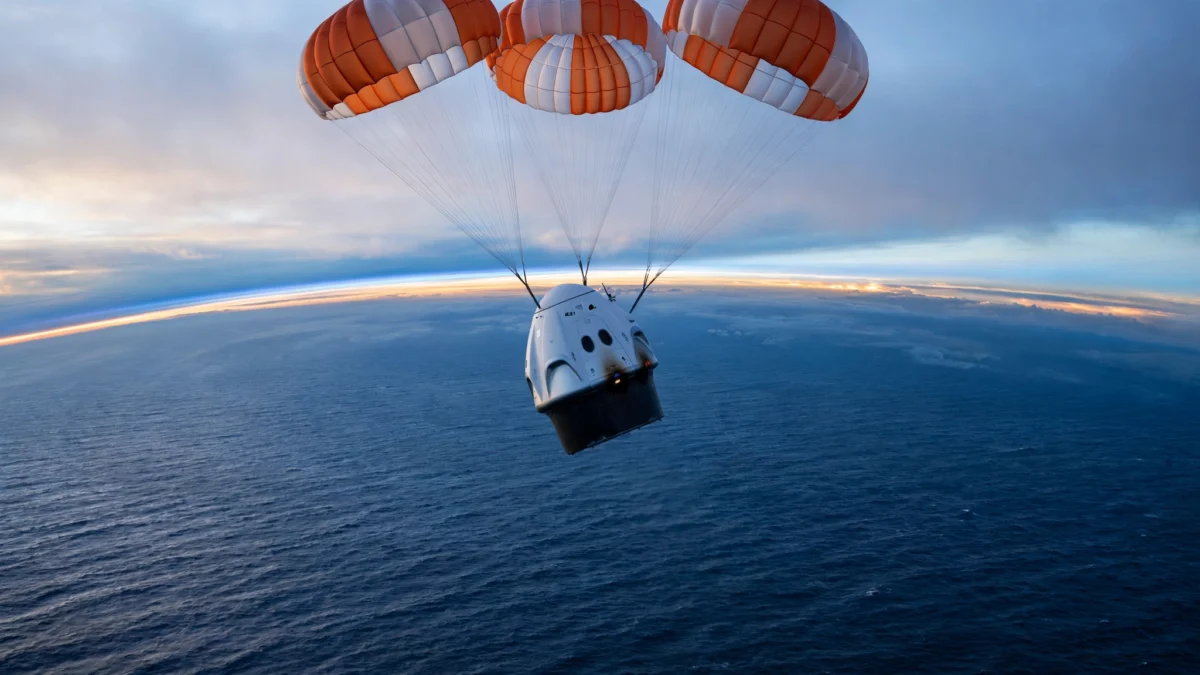
Four astronauts said goodbye to the International Space Station on Wednesday after nearly eight months living and working in orbit, as NASA’s SpaceX Crew-12 mission undocked from the orbiting laboratory and began a day-long journey home to a splashdown in the Pacific Ocean off the California coast.
The departure began in the small hours of the morning. The four crew members boarded their SpaceX Dragon capsule and closed the hatch between the spacecraft and the station at 6:05 a.m. Eastern time, according to NASA, and the capsule then undocked from the space-facing port of the station’s Harmony module at 8:05 a.m. Eastern, according to NASA. From there, the spacecraft was expected to spend roughly 27 and a half hours circling the Earth on its own before re-entering the atmosphere and parachuting to a water landing targeted for Thursday, October 8, at 11:34 a.m. Eastern time, NASA said.
The returning crew is an international one. Commanding the mission is NASA astronaut Jessica Meir, flying with fellow NASA astronaut Jack Hathaway as pilot. They are joined by mission specialists Sophie Adenot of the European Space Agency and Andrey Fedyaev of the Russian space agency Roscosmos. The four launched together aboard the same Dragon capsule on a Falcon 9 rocket from Cape Canaveral Space Force Station in Florida on February 13 — liftoff came at 5:15 a.m. Eastern, according to NASA — and docked with the station the following afternoon. By the time of Wednesday’s undocking, NASA said, the mission had run 237 days in space: close to eight full months.
The homecoming had originally been scheduled to begin two days earlier. NASA and SpaceX had initially targeted no earlier than October 5 for the departure, but pushed the undocking to Wednesday after a review of weather and sea conditions in the splashdown zone off California. Recovery teams need acceptable winds, waves and visibility to retrieve a Dragon capsule and its crew safely from the ocean, and a rough sea can stop a return. A final weather review took place about 48 hours before undocking, NASA said, clearing the way for Wednesday’s departure.
Eight months is a long assignment by the standards of station rotations, and the crew put the time to work. During their stay, the four conducted hundreds of science experiments and station maintenance tasks, according to spaceflight reporting, including four spacewalks carried out by Meir and Adenot. Much of the research was aimed at questions that matter far beyond low Earth orbit. Tech Times reported that the mission’s medical experiments included work on generating intravenous fluids on demand in space, studying how blood flows through the body during long spaceflights, and examining cardiovascular risks linked to pneumonia-causing bacteria — research framed around the problems that would have to be solved before humans could survive a months-long journey to Mars and back.
The departure caps a carefully choreographed crew swap. The astronauts’ replacements arrived well before the handover: NASA’s SpaceX Crew-13 mission launched from Florida on October 1 and docked with the station the same day after what NASA described as a record-setting flight of just 7 hours and 55 minutes from Florida to the orbital outpost. The new arrivals — NASA commander Jessica Watkins and pilot Luke Delaney, Canadian Space Agency astronaut Joshua Kutryk and Roscosmos cosmonaut Sergey Teteryatnikov — briefly pushed the station’s population to eleven people, one of the largest crews the outpost has ever hosted. On Sunday, October 4, Meir formally handed command of the station to Roscosmos cosmonaut Pyotr Dubrov during a traditional change-of-command ceremony.
Once Crew-12 splashes down, seven people will remain aboard the station: the four members of Crew-13, beginning a six-month science mission, plus the three members of the Soyuz MS-29 crew — Dubrov, Roscosmos cosmonaut Anna Kikina and NASA astronaut Anil Menon — who are scheduled to stay in orbit until spring 2027.
The Pacific splashdown continues a shift in how NASA and SpaceX bring their astronauts home. In early 2025, the partners moved spaceflight recovery operations from Florida to the West Coast, and Crew-12’s capsule will be the latest to splash into the Pacific. The most recent such landing was a historic one: the four astronauts of NASA’s Artemis II mission, who travelled around the Moon in April, made a water landing off the coast of San Diego on April 10, according to Florida Today.
NASA is providing live coverage of the return journey. Coverage of Wednesday’s undocking began in the early morning, and the agency plans to resume live coverage at 10:20 a.m. Eastern on Thursday, October 8, as the Dragon approaches Earth and prepares for re-entry and splashdown. The coverage is available on the agency’s free NASA+ streaming service as well as on major platforms including YouTube, and SpaceX is also streaming the undocking and splashdown on its website and on X.
Analysis: Why It Matters
Crew-12’s return looks, at first glance, like routine business — and that is precisely the point. A decade ago, an eight-month crewed mission ending with a precision ocean landing would have been treated as a major event. Today it is the rhythm of operations: one crew hands over to the next, the station never goes uncrewed, and the science never stops. The very ordinariness of this homecoming is the measure of how far commercial crew flight has come since NASA stopped flying its own shuttles.
There is a second, quieter significance in the crew manifest. Aboard one small capsule are astronauts from NASA, the European Space Agency and Roscosmos — American, European and Russian spacefarers who lived and worked together for eight months, conducted spacewalks together, and are now riding home together. At a time when terrestrial relations between their governments remain deeply strained, the space station continues to function as a place where cooperation is not a talking point but a daily operational necessity. That the handover of command passed from an American astronaut to a Russian cosmonaut without drama is worth noticing.
The science return matters too. Long-duration missions like this one are the only way to study what months of weightlessness, radiation and isolation do to the human body — and that knowledge is the bottleneck for everything NASA wants to do next. The medical experiments Crew-12 carried out, from on-demand IV fluids to cardiovascular studies, are not abstract curiosities; they address the specific problems that make a months-long Mars transit medically daunting today. Every data set that comes home aboard a returning Dragon capsule is a down payment on a crewed mission to another planet.
It is also worth noting how compressed the handover has become. Crew-13 reached the station just 7 hours and 55 minutes after leaving Florida — a record for a Dragon flight, and a sign of how routine rapid rendezvous techniques have grown. The eight-day overlap between the two crews, with eleven people briefly aboard, is not ceremonial: it is how experiments are handed from one team to the next without losing a day of data, and how the departing crew’s hard-won experience of the station’s quirks is passed on in person rather than in a manual.
Finally, the delay from October 5 to October 7 is a useful reminder of what still cannot be engineered away. For all the precision of orbital mechanics, the last mile of human spaceflight remains hostage to wind and waves in a patch of Pacific Ocean. The recovery teams off California — and the weather officers who decide whether they can work — are as much a part of the mission as the rocket.
What to watch next: Thursday’s splashdown and the recovery of the capsule and crew; the start of Crew-13’s six-month research mission under Jessica Watkins’s command; and the continuing science output from Expedition 75, which will run under Pyotr Dubrov’s command into next year as NASA’s lunar and Mars ambitions take shape alongside the station’s daily work.
Sources

About the Author — Abdul Mannan
Related Articles

Francis Halzen Wins 2026 Nobel Prize in Physics for the IceCube Neutrino Observatory
Francis Halzen, 82, has won the 2026 Nobel Prize in Physics for his leadership of the IceCube Neutrino…

First-Ever ‘Phoenix Planet’ Discovered Reborn From the Ashes of a Dead Star
Astronomers say a Jupiter-sized world orbiting the white dwarf HS 0209+0832 may be the first planet ever found…

2026 Nobel Prize in Medicine Awarded to Trio Behind Optogenetics, the Light-Control Technique for the Brain
Karl Deisseroth, Peter Hegemann and Georg Nagel have won the 2026 Nobel Prize in Physiology or Medicine for…