Missile Strike Hits Terminal 3 at Riyadh Airport, Many Wounded, as Saudi-Houthi Conflict Escalates

Missile Strike Hits Terminal 3 at Riyadh Airport, Many Wounded, as Saudi-Houthi Conflict Escalates
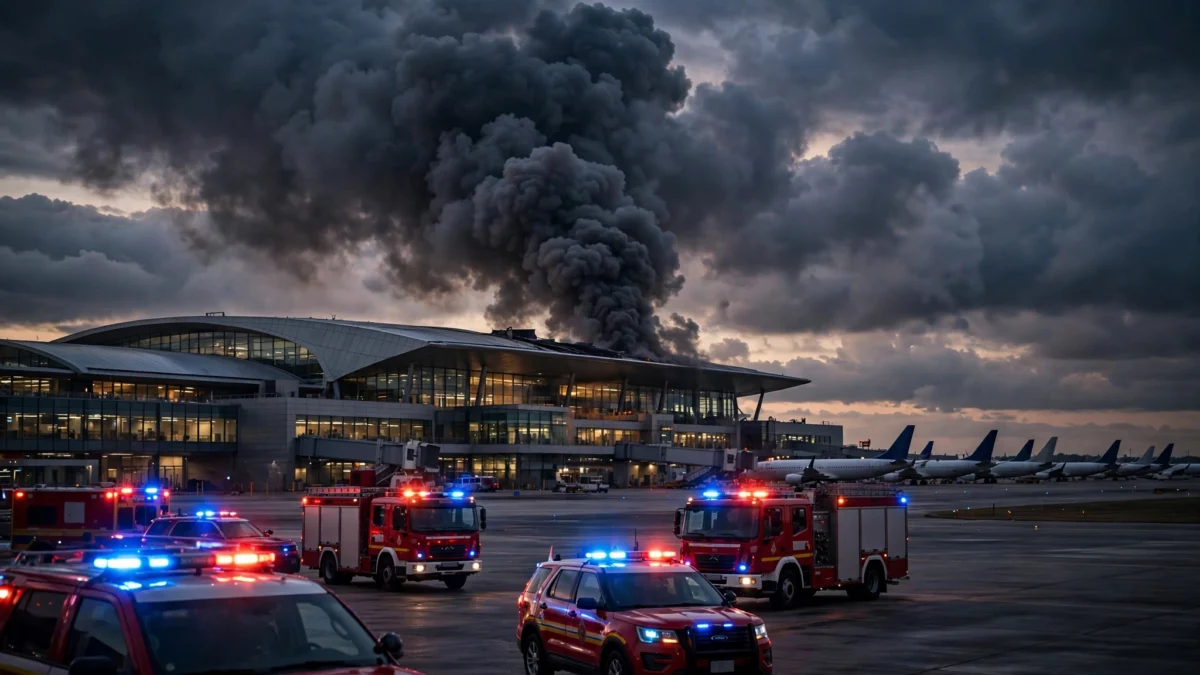
A missile slammed into a passenger terminal at Riyadh’s King Khalid International Airport on Saturday, wounding many people and forcing the evacuation of parts of the facility, in what officials described as the third attack on the Saudi capital’s main airport in less than a week.
According to The Associated Press, two regional officials confirmed that the airport was attacked again on Saturday, just two days after three Saudi citizens — including a pilot for the national carrier Saudia — were killed in a previous strike on the same airport. One of the officials told the AP that a missile struck a passenger terminal and that many people were wounded. The officials spoke on condition of anonymity because they were not authorised to speak to the media.
The Wall Street Journal, citing Saudi officials, reported that Terminal 3 of the airport suffered a direct hit from missiles and was evacuated, with at least some injuries confirmed. The Journal reported that several ambulances and helicopters were dispatched to collect the wounded and transport them to King Fahad hospital in Riyadh. One Saudi official shared a video which he said was authentic, showing blood smeared on the floor of the facility.
CNN, quoting two eyewitnesses and two people briefed on the matter, reported that many people were wounded in the blast and that travellers were evacuated from parts of the airport. One eyewitness told CNN he saw an explosion and then saw multiple people lying injured on the ground inside the airport. More than a dozen ambulances were seen rushing toward the facility.
The Saudi Civil Aviation Authority said operations at the airport were suspended following the attack, according to CNN. The airport itself sent out an alert urging passengers to check their flight status with their airlines before heading to the airport, without immediately explaining the reason.
Flight-tracking service Flightradar24 showed that virtually all flights to Riyadh had been diverted or cancelled, with one helicopter the only aircraft visible over the airport at one point. The last commercial aircraft to land at the airport did so at 2:05 p.m. local time, almost four hours before the reporting of the strike, while the last departure left at 1:39 p.m., according to the tracker. One passenger on a flight bound for Riyadh told the Journal that his plane was diverted to Dammam instead, and that he was taking a taxi back to the capital.
Kuwait Airways said it was cancelling flights to and from the Saudi capital because of what it described as the closure of the Riyadh airport due to the “security situation” there. Etihad Airways and Qatar Airways also cancelled multiple flights between their respective hubs and Riyadh, with some cancellations extending into Monday, according to CNN.
The United States Embassy in Riyadh said it was aware of attacks at the airport and advised American citizens to avoid the airport and surrounding areas. The British Embassy in Riyadh warned UK nationals to avoid King Khalid International Airport, reporting a “serious incident” there. Canada’s embassy advised its citizens to avoid all travel to the airport, noting “ongoing military activity.” According to the Wall Street Journal, Germany and Ireland also warned their citizens to stay away from the airport, with Ireland’s embassy calling it a serious incident.
President Donald Trump was asked about the attacks on the Riyadh airport and told reporters, “It’s not good” and “I’m not happy,” according to the AP.
A Riyadh resident, Ahmed Sayed, told The Associated Press he heard at least two loud explosions that rocked the Saudi capital during the attack. People near the airport told the Journal they heard multiple loud bangs and saw smoke rising from the area.
The Houthis, the Iran-aligned militant group based in Yemen, did not immediately issue a statement about Saturday’s strike. The group had claimed responsibility for the earlier attacks this week, including one on Wednesday that killed a Sudanese national, according to the AP. Earlier this week the Houthis declared that Saudi airspace is now part of the battlefield, the Wall Street Journal reported.
The Saudi government-run Centre for International Communication, which oversees foreign media in the kingdom, did not immediately respond to a request for comment, the AP said. Saudi press officials did not immediately comment on Saturday’s strikes, and the civil aviation authority could not be reached for comment, according to the Journal.
Saturday’s strike comes two days after Thursday’s missile attacks on the same airport, which killed three Saudi nationals and struck a Saudia aircraft on the ground, leaving no passengers aboard at the time. Reuters reported at the time that it was the deadliest attack in Saudi Arabia since a Saudi-led coalition launched a major military offensive against the Houthis last weekend. Civil aviation authorities announced the Thursday casualties on Friday.
Earlier in the week, Houthi strikes on Saudi airports had already killed three people, according to Reuters, and the AP reported that a Sudanese national was killed in a separate attack at the Riyadh airport on Wednesday.
The escalation marks an extraordinary stretch for the kingdom. King Khalid International Airport has now been targeted multiple times in a single week — the third attack in less than seven days. The offensive comes in the wake of the Saudi-led coalition’s major military operation against the Houthis, which began last weekend and included, according to coalition statements, the destruction of three missile launch platforms and a large-scale operation involving 136 targets between October 9 and 10.
The Houthi campaign is the fiercest front of a wider regional conflagration that has been burning since February 28, when the United States and Israel launched a major attack on Iran. The Houthis have struck Red Sea shipping and targeted the Bab el-Mandeb strait, while Iran has partly blocked the Strait of Hormuz. Last month the Houthis made a lightning advance down the Red Sea coast of Yemen, and Saudi Arabia re-entered the conflict backing a government counteroffensive. On Monday, government forces retook the Bab el-Mandeb coastline, according to reports. The current fighting follows the 2022 end of a seven-year war between Saudi Arabia and the Houthis.
The strikes are also disrupting the Saudi capital’s busy conference and travel season. The airport attacks come shortly before Riyadh is due to host major energy and investment conferences later this month, including the Future Investment Initiative — the gathering widely known as “Davos in the Desert.”
Analysis: Why It Matters
Saturday’s strike represents a material escalation from the disruptions of earlier in the week, and the difference is where the missile landed.
Thursday’s attack was devastating — three people killed, an aircraft destroyed on the ground — but it struck the airport’s facilities and parked aircraft. Saturday’s missile, by the accounts of regional officials speaking to the AP and Saudi officials speaking to the Wall Street Journal, hit inside an active passenger terminal. An airport that had already lost three people this week and seen hundreds of flights cancelled is now, at least temporarily, no longer operating as an airport at all. The last landing at 2:05 p.m. and the last departure at 1:39 p.m. mark, for practical purposes, the moment Riyadh’s main air gateway shut its doors.
That closure has economic weight that goes well beyond the runway. Riyadh is weeks away from hosting its annual energy and investment gatherings, events built on the premise that the Saudi capital is open for business — safe, accessible, and connected. Airlines do not suspend service lightly: Etihad, Qatar Airways and Kuwait Airways cutting or cancelling routes, with some cancellations stretching into Monday, is the aviation industry pricing in a risk that is no longer episodic. Each diverted flight and each cancelled connection is a small vote on whether the kingdom’s most valuable infrastructure is secure. When carriers start making decisions that extend days into the future, they are telling their own customers that they do not expect the situation to be resolved quickly.
The embassy warnings are worth reading carefully, because they are doing double duty. When the United States, Britain, Canada, Germany and Ireland all tell their citizens to avoid the airport — some citing “ongoing military activity” — they are protecting their people, but they are also sending a calibrated diplomatic signal. Travel advisories are one of the few levers Western governments can pull quickly in a crisis where they have no direct role in the fighting. Each advisory narrows the space for the idea that this is a containable, bilateral problem. An airport that five foreign governments have effectively placed off-limits to their citizens is, in reputational terms, a crisis.
There is also the matter of deterrence, and whether the coalition’s offensive is achieving what it set out to achieve. The Saudi-led operation began last weekend with the stated aim of degrading Houthi strike capacity — destroying launch platforms, hitting 136 targets in two days. Yet the strikes on Riyadh’s airport have continued through the week and now hit a passenger terminal. The Wall Street Journal noted the Houthis’ declaration this week that Saudi airspace is “now part of the battlefield.” The declaration and the Saturday strike read, together, as a deliberate message: the group is signalling that it can reach the capital’s civilian heart regardless of the coalition’s bombardment. Whether the Houthis can sustain that message depends on their remaining missile stock and their ability to launch them; the coalition clearly believes it is attriting that capacity. The next several days will show which side’s assessment is correct.
The Trump angle adds an unpredictable variable. The US president’s brief comment — “It’s not good” and “I’m not happy” — is mild by his usual standards, but it was delivered on the same weekend that he has been publicly praising a new diesel-supply arrangement with Russia, and as US policy toward the wider regional war remains in flux. Washington’s posture toward the Saudi-Houthi fight has not been defined by the same direct involvement that characterises the Iran front. If airport strikes keep escalating, the pressure on Washington to take a clearer position — whether through stepped-up defensive support to the kingdom, new sanctions on Houthi supply lines, or diplomatic intervention — will grow.
Finally, there is the Pakistan question, which connects this story to this site’s core audience. Pakistan has already condemned the Houthi attacks at the United Nations and is bound to Saudi Arabia by the Makkah Joint Defence Agreement. The coalition’s campaign has raised speculation about whether Riyadh will seek Pakistani or Turkish assistance under mutual defence arrangements. As the conflict escalates from airport disruptions to a terminal strike with casualties, that speculation will intensify — and Islamabad will find the space between its Saudi partnership and its desire to stay out of another Middle Eastern war growing narrower.
What to watch next
1. An official casualty count. Regional officials have confirmed many wounded, but the Saudi government had not released a casualty figure as of Saturday afternoon. The official count — and the nationalities of the wounded — will determine how this story develops.
2. A Houthi claim or denial. The group claimed this week’s earlier attacks but had not commented on Saturday’s strike. A claim would confirm the attribution; silence would raise questions about whether the group’s command structure is intact.
3. The coalition’s response. Expect Saudi airstrikes on Houthi positions, likely in Sanaa and the launch areas, within hours or days. The scale of the retaliation will indicate whether the kingdom treats this as a manageable escalation or a threshold crossed.
4. Airline decisions. Whether Etihad, Qatar Airways and Kuwait Airways extend their cancellations beyond Monday — and whether other carriers follow — will be the market’s verdict on how long Riyadh’s airport stays a contested zone.
5. The conference calendar. The energy and investment gatherings due later this month are the soft-power stakes. Any postponement would turn a security crisis into a reputational one.
Sources
The Associated Press, via Military.com: Missile Strikes Passenger Terminal at Riyadh Airport and Many are Wounded, Official Says
CNN: Multiple people wounded in blast at Riyadh airport, say eyewitnesses
The Wall Street Journal: Iran-Backed Houthis Hit Saudi Capital’s Airport in Damaging New Attack
Reuters: Delhi protests, Trump’s Russia diesel deal and Panama quake — October 10, 2026 podcast
Leigh Journal (AP wire): ‘Many wounded’ after missile strikes terminal at Riyadh airport

About the Author — Abdul Mannan
Related Articles
Israeli Strikes Kill at Least Five in Gaza on First Anniversary of US-Brokered Ceasefire
Israeli strikes killed at least five Palestinians in Gaza City on Saturday — the first anniversary of the…
Gaza Ceasefire at One Year: Promises Unfulfilled as Strikes and Suffering Continue
One year after the 10 October 2025 US-brokered ceasefire was meant to end the Gaza war, its political…
Syria Weighs Military Aid for Saudi Arabia as Yemen War Escalates After Deadly Houthi Airport Strikes
Reuters reports that Damascus is weighing defensive or offensive military support for Riyadh against the Iran-backed Houthis —…