Hall and Woodford Win 2026 Nobel Economics Prize for Models That Help Tame Boom-and-Bust Cycles

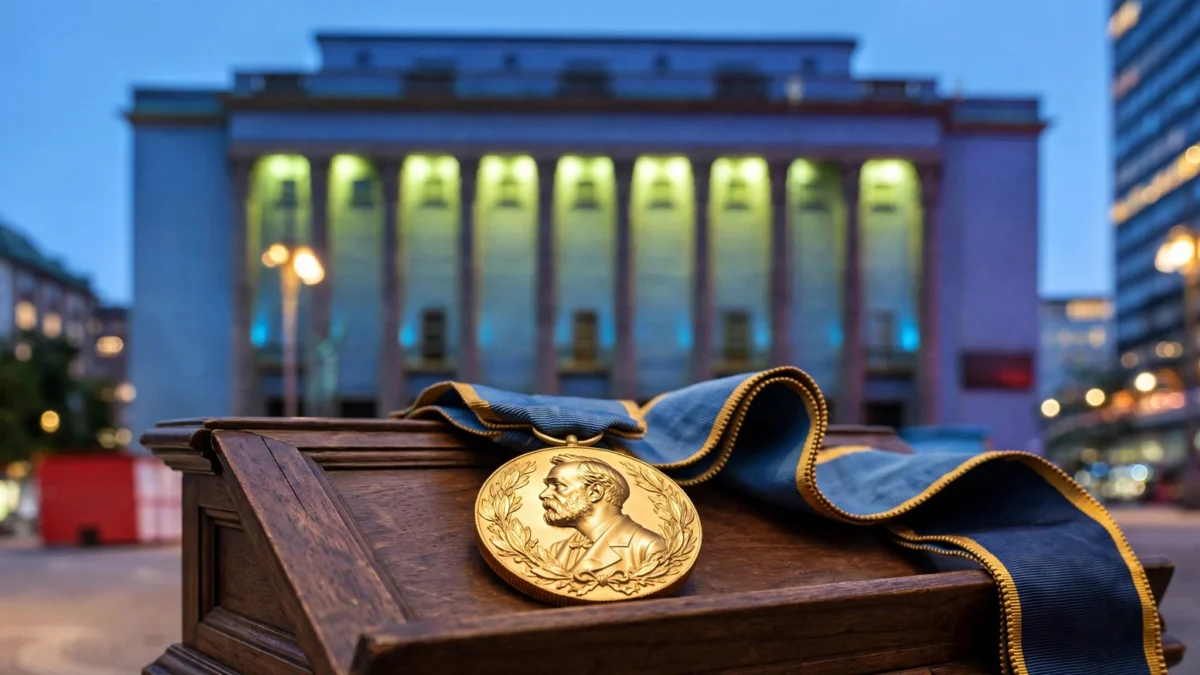
The Royal Swedish Academy of Sciences on Monday awarded the 2026 Nobel Prize in economics to American academics Robert E. Hall and Michael Woodford, honouring decades of work that gave central banks and finance ministries around the world their modern toolkit for stabilising economies against recessions, inflation shocks and energy crises.
The prize, formally the Sveriges Riksbank Prize in Economic Sciences in Memory of Alfred Nobel, was conferred for what the Academy called “microeconomic foundations of macroeconomic stabilisation”. It is the final Nobel prize to be announced this year and carries an award of 12 million Swedish kronor — roughly $1.2 million — to be shared equally between the two laureates, according to the Academy and reporting by Reuters.
Hall, 83, is a professor at Stanford University; Woodford, 70, is a professor at Columbia University. Both were born and educated in the United States, continuing a pattern in which the majority of economics laureates have been American.
The models behind the rate decisions
At the heart of the laureates’ work is a deceptively simple question: how should a government or a central bank respond when the economy is hit by a shock it did not cause — a sudden energy crisis, a pandemic that throws millions out of work, or an abrupt shift in what households decide to spend and save?
Rather than relying on statistical relationships between big-picture aggregates such as inflation, production and consumption, Hall and Woodford built their models from the ground up, starting from the decisions of individual households and businesses. Their central insight, as the Academy explained it, is that those households and firms are forward-looking: a family’s choice about whether to spend or save depends on what it expects interest rates, prices and its own income to look like in the months ahead.
That changes the policymaker’s job profoundly. If expectations about the future drive behaviour today, then the way governments and central banks communicate their plans becomes a policy instrument in its own right — capable, in the Academy’s words, of moving “the economy in the right direction”. John Hassler, chair of the Committee for the Prize in Economic Sciences, said the laureates’ work had provided “a stable theoretical foundation for the models that are now used by central banks and governments around the world”, adding: “With them, we are better equipped to deal with shocks in the economy, such as energy crises or sudden changes in how much households consume.”
The framework proved its worth in crisis. Woodford told a news conference in Stockholm that it guided policymakers during the global financial crisis of the late 2000s, when central banks found that “making more explicit statements about the likely future path of interest rate policy” was an important part of the response from 2009 onward, alongside the traditional tools of monetary policy. That practice — now known as forward guidance — has since become a standard feature of how the world’s major central banks talk to markets.
The two laureates
Robert E. Hall, born in Palo Alto, California, in 1943, has spent a career at Stanford studying how economies behave over the business cycle, with a particular focus on recessions, unemployment and the labour market. Over decades of research he examined why downturns happen and how policy can soften them without setting off new problems elsewhere.
Michael Woodford, born in Chicopee, Massachusetts, in 1955, built his reputation at Columbia University on the theory of monetary policy — above all on how a central bank’s words, credibility and commitment to a future course of action shape the decisions of everyone else in the economy. At his Stockholm news conference he captured the philosophy in a single contrast: authorities, he said, should not view stabilisation as an exercise “simply conducted by people pulling levers to control the economy independently of what people in the economy understand about this”. In the 1970s, he noted, central banks struggled badly against sky-high inflation during the oil shocks; the newer framework gave their successors a far better set of tools.
From Keynes to stagflation to the New Keynesians
The prize also closes a loop that began nearly a century ago. After the Great Depression, John Maynard Keynes persuaded policymakers that governments sometimes needed to stimulate demand in downturns to curb unemployment, or cool demand in booms to restrain inflation. That Keynesian recipe worked well — until it did not. In the 1970s, economies were hit by rising unemployment and inflation at the same time, a combination the old models could neither explain nor fix. “The Keynesian recipe was shattered,” Tim Boppart, a member of the prize committee, said, according to NPR.
Hall and Woodford, working separately, rebuilt the foundations. Instead of starting from assumed links between national-level variables, they derived macroeconomic behaviour from microeconomic choices — the spending, saving and pricing decisions of millions of people and firms. The result became a cornerstone of what economists call the New Keynesian approach: old Keynesian ambitions of stabilisation, rebuilt on modern, rigorous foundations about how rational, forward-looking people actually behave.
The importance of that work, as NPR noted, has been underscored repeatedly in recent years — first by the pandemic, which pushed millions out of work, and then by the supply shocks that followed, driving up the cost of living across the globe.
A prize that lands in a live experiment
Few Nobel economics prizes have arrived while their ideas were being tested quite so publicly. Reuters reported that the world’s top central banks are currently grappling with the energy shock triggered by the Iran war, just as they were absorbing the inflation surge of 2022 that followed the COVID-19 pandemic. The laureates’ models are the ones those banks use, day in and day out, to calibrate their responses.
Europe offers the clearest current illustration. On June 11 this year, the European Central Bank raised its three key interest rates by 25 basis points — the first increase since September 2023 — after the war in the Middle East drove energy costs up and pushed euro-area inflation above 3 per cent, according to the Brussels Signal. The deposit rate now stands at 2.25 per cent, and ECB President Christine Lagarde presented the move explicitly as a signal designed to stop the energy shock from spreading into wider prices — an exercise in managing expectations as much as in adjusting borrowing costs, and a near-textbook application of the ideas Stockholm rewarded on Monday.
The Academy’s choice had been widely anticipated in spirit, if not in name. Analysis by the Institute for Scientific Information, part of Clarivate, had tipped researchers working on monetary policy, the economics of information technology and evolutionary economic theory as likely recipients this year.
The economics prize is itself a relative newcomer. Unlike the original five awards created in Alfred Nobel’s 1895 will, it was established by Sweden’s central bank, the Sveriges Riksbank, and first awarded in 1969. Last year’s winners — Joel Mokyr, Philippe Aghion and Peter Howitt — were honoured for work on “creative destruction” and how new technology and production methods lift growth and living standards. Only three women have ever received the economics prize, most recently Claudia Goldin in 2023 for her research on how gender has shaped pay and employment in the United States.
Analysis: Why It Matters
This year’s prize is, at one level, a lifetime-achievement award for two distinguished careers. At another level, it is the Academy making an argument about what economics is for — and the timing of that argument matters.
For most of the Nobel season’s history, the economics prize has oscillated between abstract theory and practical policy. This year it landed decisively on the practical side: not a beautiful theorem, but a set of working models that central bankers consult when deciding whether millions of households will face higher mortgage payments. In a decade of overlapping shocks — pandemic, supply-chain seizure, war-driven energy crisis — the Academy has chosen to celebrate the economics of the control room. That is a statement of values as much as a recognition of science.
There is a second, subtler message embedded in the citation. “Microeconomic foundations of macroeconomic stabilisation” is the Academy insisting that the economy is not a machine with levers, but millions of people making guesses about tomorrow. That framing has a democratic intuition inside it: policy works when it is understood, credible and communicated honestly — and fails when officials pretend they can steer outcomes behind the public’s back. Woodford’s own warning at the press conference, that authorities should not treat stabilisation as lever-pulling “independently of what people in the economy understand”, reads as much as a warning about technocratic arrogance as about economic theory.
But the prize also invites scepticism, and the scepticism is worth stating plainly. Models do not print energy, end wars or build houses. The energy shock now straining central banks — the one the Reuters reporting tied directly to the Iran war — is a real, physical shortfall in supply that no amount of elegant expectation-management can conjure away. Forward guidance can anchor inflation expectations; it cannot fill a fuel tank. The laureates’ framework tells central banks how to talk and when to move — but it does not spare them the genuinely hard choice between crushing demand and tolerating inflation. The ECB’s June rate rise, for instance, will have been cold comfort to households paying more for heat. Good theory narrows the set of bad options; it does not eliminate the pain of the remaining ones.
That limitation is precisely why the developing-world angle deserves attention. The models honoured on Monday were built in, and largely for, advanced economies with credible currencies and deep financial markets. For emerging economies — where central banks must weigh exchange-rate pressure, dollar-denominated debt and food-price inflation alongside the textbook trade-offs — the framework’s guidance is more conditional. Pakistan’s own central bankers, like their peers across South Asia and Africa, operate versions of these models while managing constraints the originals never assumed. The Nobel citation describes universal tools; their usefulness is, in practice, local.
Finally, there is the question the prize does not answer but cannot avoid: who gets to shape economic thought. Three women in more than half a century of awards, and an overwhelming American tilt, is not a verdict on this year’s two worthy laureates — it is a verdict on the discipline’s pipeline. If the Academy wants economics that speaks to how all households make decisions, the profession will eventually have to reckon with whose households’ experiences inform the models.
What to Watch Next
- The energy-shock stress test. With central banks openly wrestling with war-driven energy prices, watch whether forward guidance and calibrated communication can keep inflation expectations anchored — or whether the shock forces the kind of blunt demand destruction the models are meant to avoid.
- Communication as policy. The laureates’ core lesson is that what central banks say is part of what they do. The next round of rate decisions in Frankfurt, Washington and London will be judged as much on the messaging as on the numbers.
- Emerging-market adaptation. How central banks in economies like Pakistan, India and Brazil adapt micro-founded stabilisation frameworks to exchange-rate and debt pressures will be the real-world laboratory for the theory’s next decade.
- The gender pipeline. After Claudia Goldin’s 2023 win, watch whether the economics profession’s slow diversification accelerates — or whether Monday’s all-male pairing becomes the familiar pattern again.
- The next Clarivate shortlist. The Academy followed the citation-classic forecasters’ monetary-policy tip this year; their shortlists for 2027 — information technology and evolutionary economics were also flagged — are already the betting market’s starting point.
Sources
- Reuters — “Americans Hall and Woodford win 2026 Nobel economics prize”
- CNN — “Two Americans win Nobel prize for models to tackle economic downturns”
- NPR — “2 Americans win Nobel Prize in economics for work on boom-bust cycles”
- Brussels Signal — “Nobel economics prize rewards the theory behind ECB rate decisions”

About the Author — Abdul Mannan
Related Articles

Deloitte Helped Abramovich Conceal $10 Billion Through Falsified Documents, Joint Investigation Finds
A joint BBC Panorama, Bureau of Investigative Journalism, Guardian and OCCRP investigation found Deloitte's Cyprus branch backdated more…

Zelensky Accuses Putin of Tearing Up Trump’s “Energy Ceasefire” as Fresh Strikes Hit Ukraine’s Power Grid
Volodymyr Zelensky accused Vladimir Putin of violating Donald Trump's declared "energy ceasefire" within hours, reporting fresh Russian strikes…

US Threatens to Suspend Ukraine Intelligence Sharing and Weapons Purchases if Refinery Strikes Continue
Washington has warned Kyiv and European capitals that American intelligence sharing and the mechanism for European purchases of…