The Treasure That Never Was: Hormuz, the AI Shipwreck, and the Death of “Seeing Is Believing”

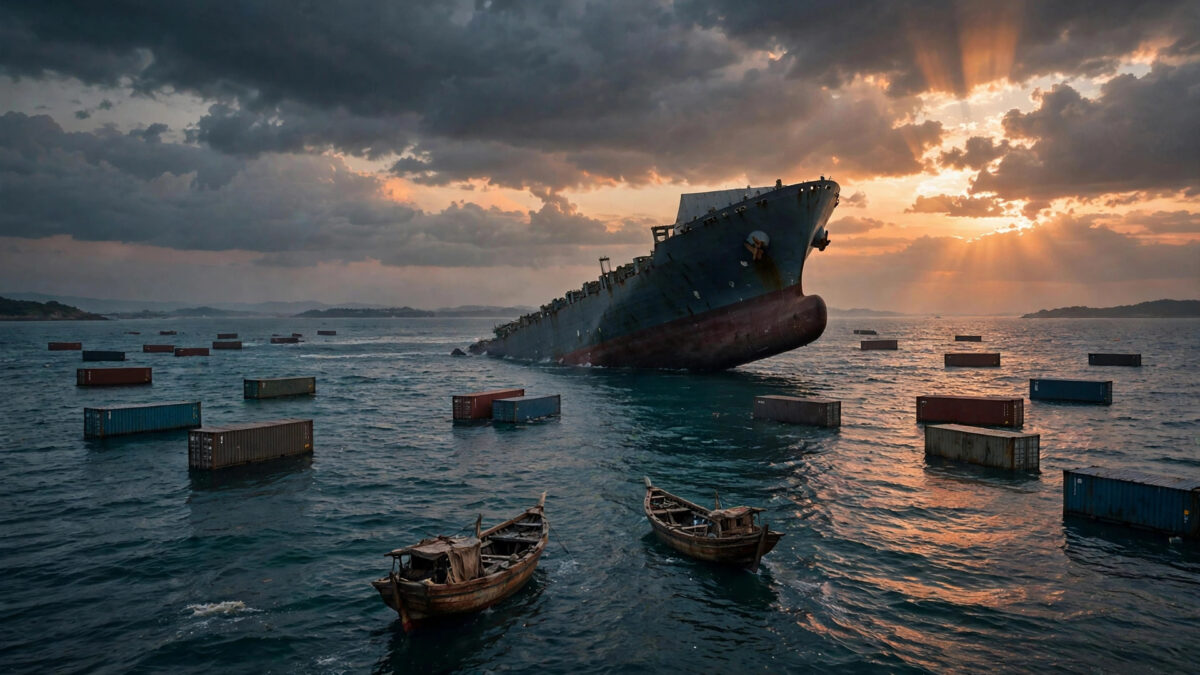
What would you do, dear reader, if someone told you that the sea itself had opened its treasure chest?
That somewhere in the warm waters of the Strait of Hormuz, among the floating containers of a sunken ship, brand-new iPhones were bobbing on the waves — thousands of them, sealed in their boxes, waiting for anyone with a boat and a strong back to fish them out? Would you believe it? Would you share it? Would you, somewhere in a quiet corner of your heart, wish that you were standing on that shore?
Millions of people did not have to answer this question in theory. This week, they answered it in practice. The videos showed Iranian fishermen in small skiffs, threading between half-submerged shipping containers, hauling boxes from the swell — one small boat straining to tow a full-size container behind it. The soundtrack was excitement. The promise was simple: the sea was giving away iPhones and French perfume, free of charge, to whoever arrived first.
And then Al Jazeera did what almost nobody else bothered to do. It looked.
The ship is real. The sinking is real. The treasure — the treasure was never there. It was born in the imagination of a machine, delivered to the hunger of millions, and it has something terrible to teach us about the age we are living in. Come with me, reader. Let me show you the wreck, the wreckers, and the gold rush that never happened — and the one that did.
The Ship That Really Sank
First, the facts — because facts are the ground we stand on, and the ground is narrow these days.
On October 13 and 14, two Singapore-flagged container ships, the GFS Pride and the GFS Giselle, were struck while transiting the Strait of Hormuz. The GFS Pride — a vessel built in 2008, operated by Global Feeder Shipping, a subsidiary of the Abu Dhabi Ports Group, with a capacity of some 2,824 containers — caught fire and sank. Singapore’s Maritime and Port Authority confirmed the sinking and, mercifully, that all 21 crew members were safely evacuated without injury. The GFS Giselle suffered hull damage but reached a safe anchorage under her own power, according to The Apple Post’s roundup of the official statements.
The cause is disputed, as causes are in wartime. Singapore’s maritime authority and reports citing the United Kingdom Maritime Trade Operations spoke of an unidentified projectile. Iran’s Islamic Revolutionary Guard Corps said the vessel had strayed onto an “unauthorised and dangerous” route and struck a naval mine. Reuters, cited by NewsBeep, reported that maritime industry sources pointed to a direct attack rather than a mine. What is not disputed is that the ship went down with more than two thousand containers aboard, in the middle of a conflict that has already made the Strait of Hormuz — the narrow throat through which a fifth of the world’s oil flows — the most dangerous waterway on earth.
So far, so factual. A tragedy at sea, a geopolitical incident, twenty-one rescued sailors. But the internet does not trade in facts, reader. It trades in hunger. And hunger, as we are about to see, is the most reliable currency on earth.
The Videos That Set the World Drooling
Within a day of the sinking, the videos began to spread. The Daily Jagran was not the only outlet to notice, but the footage spoke for itself: small boats among floating containers, men hauling boxes from the water, iPhone packaging gleaming in the sun, bottles of luxury perfume lined up like trophies. The Telegraph reported that hundreds of Iranian fishermen and salvage-boat operators had headed into the strait after hearing that valuable cargo had spilled from the vessel — some, the paper said, setting out specifically in search of iPhones and perfume. “We are gathering and heading towards the Strait of Hormuz,” one man said in a video. “We heard a container ship sank, so we’re going to collect iPhones and perfume.”
Millions watched. Millions shared. Millions believed. Who would not? The story had everything the modern mind craves: disaster, treasure, ordinary men outsmarting fate, and the delicious justice of luxury goods raining free from a burning ship in the middle of a war zone.
There was only one problem, and it was fatal. The videos were not real.
The Wreckers of Cornwall
Let me take you back, reader, two hundred years — because history is a mirror, and in it we can see our own faces more clearly than in any photograph.
On the rocky coast of Cornwall, in the eighteenth and nineteenth centuries, there lived men called wreckers. When a storm rose at night, they would climb the cliffs and light false beacon fires — flames positioned to mimic the harbour lights, but placed over the deadliest rocks on the coast. Merchant ships, trusting the lights, steered toward what they believed was safe harbour and shattered themselves on the reef. By dawn, the wreckers were on the beach, plundering the cargo: silk, wine, tobacco, sometimes gold. The sea did the killing; the wreckers did the harvesting.
It was a crime, and it was punished when it was caught. But notice the mechanism, reader, because the mechanism is everything. The wreckers did not build the storm. They did not lay the rocks. They simply understood one thing: that men in danger will trust a light. All they had to do was manufacture the light, and human hope did the rest.
Now look at the Strait of Hormuz this week, and tell me the wreckers are gone.
Al Jazeera’s investigators traced some of the most widely viewed “iPhone fishing” videos to an Instagram account called Nativora — an account that describes itself, openly, as a creator of fictional stories and imagery made with artificial intelligence. The telltale signs were there for anyone who looked with unhurried eyes: the unnatural movement of objects on the water, boxes with oddly distorted shapes, illegible writing on the phone packaging, people standing motionless aboard boats that were supposedly moving through the waves, as the Iranian UAE outlet’s summary of the Al Jazeera investigation documented. The ship’s sinking was genuine. The dispersal of its containers was genuine. But the widely circulated images of hundreds of iPhones floating or being retrieved were fabricated — and, crucially, no credible evidence has been published that the vessel was carrying a shipment of iPhones at all.
Do you see it now? The Cornish wreckers lit false fires to lure real ships onto real rocks, and harvested real cargo. The digital wreckers of 2026 have improved on the method. They no longer need a storm, or a rock, or even a ship. They manufacture the wreck itself — out of pixels — and the cargo too, and they harvest something the old wreckers never dreamed of: the attention of millions, the only true gold of our century.
The Gold Rush of 1849 — and the Shovel-Sellers
But the wreckers are only half the story. The other half is us — the millions who rushed to the shore, or at least to the share button, with our hearts pounding.
In January 1848, a carpenter named James Marshall found flakes of gold in the millrace of Sutter’s Mill in California. The rumour travelled the way rumours travel — first as a whisper, then as a scream. By 1849, some three hundred thousand men and women had abandoned farms, shops, families, and entire countries to rush to California. They called them the forty-niners. They came with pans and picks and dreams the size of mountains.
And here is the part the legend usually skips, reader: almost none of them found gold. The rivers were picked clean within months; the real fortunes of the Gold Rush were made not by the miners but by the merchants who sold them shovels — by Levi Strauss, who sold them denim trousers; by the Wells Fargo Company, which moved their money; by the men who sold picks at ten times their price to desperate dreamers. The gold was in the hunger, not in the ground. The shovel-sellers understood this. The miners did not.
Now look at our week again. A rumour of treasure in the water. Millions rushing — not with boats, but with clicks, shares, and wide-eyed belief. And who are the shovel-sellers this time? They are the accounts like Nativora and the hundred anonymous AI-fake farms like it: they do not need gold, or iPhones, or even a real ship. They need only our hunger — our ancient, incurable hunger for the story in which the sea gives away treasure and the little man wins. They manufacture the dream for pennies, and they harvest millions of views. The miners of 1849 at least had real rivers. We have pixels.
And I ask you, reader — I ask you directly, because this column is a courtroom and you are in the witness box — why did you want it to be true? Be honest. Was it the romance of the fisherman outsmarting the warship? Was it the secret pleasure of imagining luxury humbled, the mighty iPhone reduced to flotsam? Or was it something simpler: that in a week of real wars and real sinkings, you wanted one story in which the sea, for once, was generous?
The wreckers know this hunger better than we know ourselves. That is why they win.
When Seeing Stops Being Believing
There is a proverb in every language on earth, and in English it goes like this: seeing is believing. For the whole of human history, it was the final court of appeal. A man could lie, a newspaper could lie, a government could certainly lie — but the eye, the eye was honest. Show me, we said. Show me the photograph, the film, the footage. And when the footage came, the argument ended.
That court has now been adjourned, perhaps permanently. Consider what this week proved: that a convincing video of an event that never happened can be manufactured by an anonymous account, in hours, for nothing — and that millions of intelligent, educated, sceptical people will believe it, share it, and defend it before any investigator has had time to clear his throat. The Al Jazeera debunk reached a fraction of the audience the fakes reached. The lie travelled around the world while the truth was still putting on its shoes — and by the time the truth arrived, the audience had moved on to the next wreck.
And here is the part that should frighten you more than the lie itself, reader. The danger of the AI age is not that we will believe false videos. The danger is that we will stop believing true ones.
Think it through with me. If any video of fishermen pulling iPhones from the sea can be faked, then the next real video — of a real atrocity, a real rescue, a real crime — can be dismissed with two words: probably AI. The liar’s greatest victory is not making you believe the false. It is making you doubt the true. A world in which everything can be faked is a world in which nothing has to be believed — and in that world, the people with the guns and the ships and the ministries of truth win every argument, because evidence itself has been abolished.
This is not speculation. The pattern is already here. In this same war, in these same months, fact-checkers have documented AI-generated videos of burning cities that never burned, of mass funerals that never happened, of missile strikes on bases that were never struck — some posted with disclaimers, most without, all of them consumed as reality by audiences who had no reason, and now no ability, to tell the difference. The Strait of Hormuz this week was not an exception. It was a demonstration.
The Real Treasure, and the Real Thieves
So let me give you the verdict, reader, because a column that only describes is a coward’s column.
The real treasure in the Strait of Hormuz this week was not iPhones. The real treasure was your attention — those millions of views, those millions of shares, that vast river of human focus flowing toward whoever could manufacture the most delicious lie. And the real thieves were not the fishermen in the skiffs, real or imagined. The real thieves were the wreckers with their false lights: the AI-fake farms who have industrialised the oldest crime on the coast — luring hopeful ships onto rocks that do not exist, and plundering cargo that was never there.
And what of us, the millions who believed? I will not call you fools, because I am not your judge — I am your fellow passenger. I will say only this: the wreckers could not have succeeded without our hunger, and our hunger is the one thing we can govern. The next time the sea offers you treasure, ask the fisherman’s question, the question the gold rush taught too late: who is selling the shovels? Who profits if I believe this? Who harvested my click?
Centuries ago, the Cornish courts hanged wreckers when they caught them. We cannot hang an Instagram account. But we can do something the old coastal villages could not: we can refuse to be the ships. We can learn to distrust the light — not every light, not the harbour lights, but the light that appears exactly where our hunger told us to look.
The GFS Pride lies on the seabed now, her containers scattered, her twenty-one crew safe ashore. The sea kept its real secret: whatever was truly in those containers, we may never know. But the videos will keep coming — the floating iPhones, the burning cities that never burned, the miracles manufactured to order. The wreckers have new lamps now, and they burn brighter than ever.
Seeing is no longer believing, reader. From today, only thinking is.
Sources & References
- The Apple Post — “iPhones pulled from Strait of Hormuz after cargo ship sinks” (17 October 2026): the GFS Pride sinking, Singapore’s Maritime and Port Authority statement, all 21 crew evacuated safely, the GFS Giselle damaged but reaching anchorage, and The Telegraph’s reporting on fishermen heading into the strait.
- Iranian UAE (citing Al Jazeera) — “Images of iPhones Floating in Strait of Hormuz Are Fake; Vessel Sinking Confirmed”: Al Jazeera’s investigation tracing viral clips to the AI-content Instagram account Nativora, the telltale signs of fabrication, and the finding that no credible evidence shows the vessel carried iPhones.
- NewsBeep (citing Reuters and AP) — “Viral footage shows iPhones floating in Strait of Hormuz”: Reuters’ reporting on the GFS Pride sinking via maritime industry sources, Singapore’s confirmation of the fire and evacuation, and the AP’s report of two Singaporean cargo ships attacked.
- InShorts (citing Asianet Newsable) — “AI-generated videos of Iranians collecting iPhones go viral” (18 October 2026): the viral spread of the clips, the Al Jazeera finding that they were AI-generated, and the millions of views across social platforms.

About the Author — Abdul Mannan
Related Articles
The Day the Lie Learned to Swim: What the Strait of Hormuz Taught Me About Truth
The viral videos of fishermen hauling iPhones from the sea in the Strait of Hormuz were watched by…

The Street Has Spoken Again: France’s Yellow Vests Return — and the Ghost of 1789 Walks with Them
On 17 October 2026, hundreds of thousands of French citizens — students, workers, pensioners, and the veterans of…

How Much Does a Country Cost? The $366 Million Question Over America’s Midterms
Elon Musk has spent $366 million trying to decide America's midterms — and history has seen this auction…