The Day the Lie Learned to Swim: What the Strait of Hormuz Taught Me About Truth

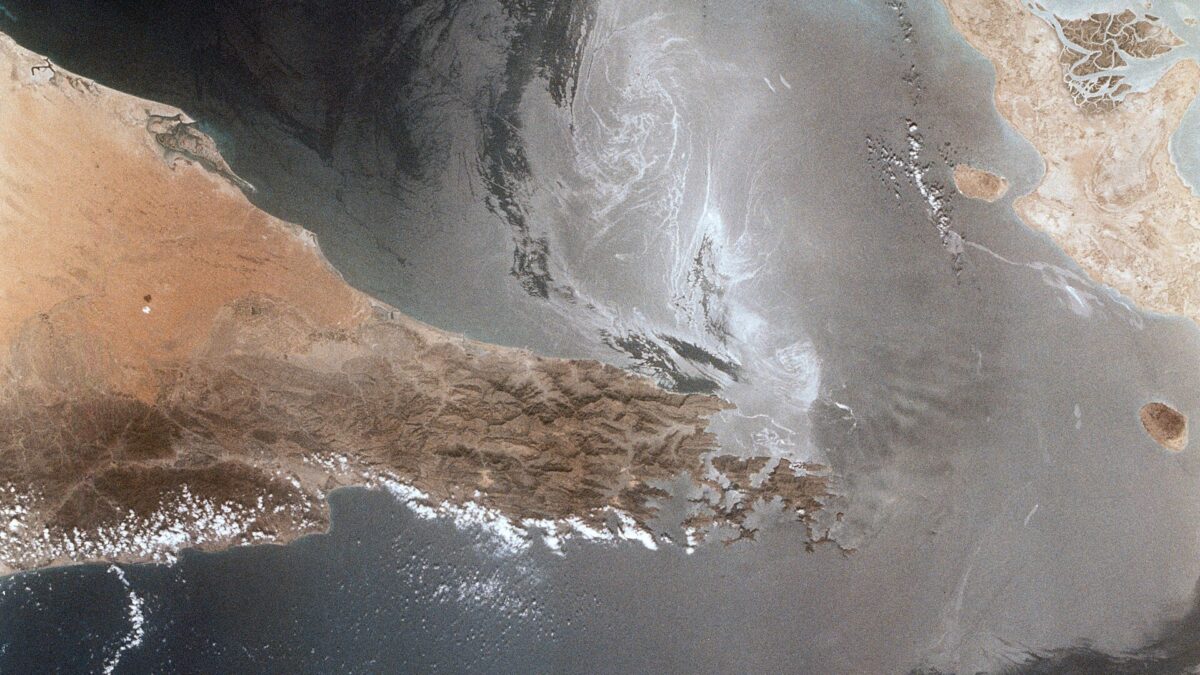
Be honest with me — did you watch it?
The little boats bobbing on the blue water. The white boxes, hundreds of them, scattered across the waves like a strange harvest the sea had decided to give back. Men leaning over the sides, laughing, reaching down, scooping them up — brand-new iPhones, luxury perfumes, a fortune floating free in the Strait of Hormuz. You watched it for less than a minute, and you felt something: delight, disbelief, envy, amusement. Perhaps you wrote, look at this, this is unbelievable.
It was unbelievable. That was the problem. It was never true.
The ship that really sank
Before I take you into the lie, let me give you the truth, because the truth deserves to go first for once. On Tuesday, 13 October 2026, the GFS Pride — a small Singapore-flagged container ship operated by the UAE-based GFS Ship Management, with room for 2,824 standard containers — was struck by an unidentified projectile while passing through the Strait of Hormuz. Fire broke out aboard her. She sank the following day. And here is the part the videos never showed you, because it does not trend: all twenty-one crew members were safely evacuated. No one died. The world moved on.
The Strait of Hormuz itself was never in any doubt. It is the narrow throat through which roughly a fifth of the world’s oil has historically flowed, and right now it is a waterway at war. British maritime monitors at the United Kingdom Maritime Trade Operations centre have recorded the tempo of attacks on commercial shipping climbing to its highest level since the war between the United States and Iran began in February. A second vessel, the GFS Giselle, was hit the very next day. The Cape Dao had already gone down in September. Only three ships have sunk since February — ships sink rarely even in wartime, because modern vessels are built to survive what cameras cannot. Behind all of it, the machinery of oil prices, of a United States midterm election on 3 November, of a great-power contest in which every tanker is a pawn and every headline a weapon.
That is the truth: a real ship, real fire, real sailors saved, real geopolitics churning underneath. And floating on top of it — literally, in the videos — a fantasy. Fishermen scooping iPhones out of the waves. Perfume bottles glittering on the surface. Boxes of Apple’s latest model piled high in little wooden boats, as if the ocean had run a discount sale.
There were no iPhones in the sea. There never were.
The fiction that travelled faster than the ship
The clips, an investigation by Al Jazeera has now established, were generated by artificial intelligence. Millions of people watched them. Some were seen tens of millions of times. And what gave the fiction its dangerous credibility is that it was not entirely invented: it was built on the truth. The sinking was real. The scattered containers were real — satellite imagery published by Reuters confirmed debris spread across the water. The AI needed only to dress the skeleton of a real event in the costume of a dream, and the dream walked straight past every checkpoint of our judgement.
Some of the most widely shared videos, Al Jazeera found, traced back to an Instagram account called Nativora — an account that describes itself, openly, as a creator of fictional stories and imagery made with artificial intelligence. Read that again. The creator told the truth. It was the audience, and the endless reposting machine, that laundered fiction into fact. By the time the video reached your phone, the label was gone, the context was gone, and all that remained was the irresistible image: free iPhones, fished from the sea.
BBC Verify and the fact-checking organisation Factnameh catalogued the fingerprints of fabrication: phones moving on water in ways physics does not permit, strangely shaped boxes, writing on the packaging that dissolves into gibberish, people sitting motionless aboard boats that are supposedly moving. These are the tiny fractures in the illusion — the equivalent, in the age of AI, of noticing that the stage scenery is painted on canvas. The trouble is that nobody in 2026 pauses a video to inspect the typography on a phone box. We consume video the way our ancestors consumed dreams: immediately, emotionally, and without waking up.
And so the lie swam. The truth — twenty-one rescued sailors, a burned-out hull on the seabed, a war grinding on — limped behind it, exactly as the old proverb promised.
An old ghost with a new engine
Jonathan Swift wrote, three centuries ago, that “falsehood flies, and the truth comes limping after it.” Swift never saw a smartphone, but he understood the human machine perfectly: the lie is light because it has nothing to carry; the truth is heavy because it must carry evidence.
On the evening of 30 October 1938, the actor Orson Welles broadcast a radio play of H. G. Wells’s The War of the Worlds — a fictional Martian invasion told in the urgent cadence of a news bulletin. Listeners who tuned in late believed it was real. Panic spread across New Jersey; switchboards jammed; people fled their homes. In 1938, to forge a convincing lie, you needed a radio network, a cast of actors, and Orson Welles. In 2026, you need a laptop, twenty seconds, and an Instagram account.
This is the historical mirror I keep returning to, because history is the only honest teacher we have. Every age has believed its own senses were the final court of appeal. The radio generation trusted its ears and was fooled by its ears. The television generation trusted its eyes — and now, in the Strait of Hormuz, the screen generation has learned that its eyes can be manufactured. We have not become more gullible. We have become gullible at scale, in high definition, with background music.
Consider what else the sea of misinformation has carried this year alone. Africa Check exposed a photograph from a 2025 cargo ship collision being passed off as a vessel burning after an Iranian attack. The New York Times documented a whole cascade of AI fakes about the war with Iran — computer-generated explosions, phantom missile strikes, and at one point an entirely synthetic frenzy over the fate of the USS Abraham Lincoln, an aircraft carrier that was never harmed. Back in January, a viral “All Eyes on Iran” protest video, shared as a gesture of solidarity, turned out to be AI-generated art. The pattern is no longer the exception. The pattern is the weather.
Why this lie worked — and why you helped it
Now let me address you directly, reader, because there is a part of this story that belongs to you, and I will not let you leave the room before we look at it together.
The lie worked for the oldest reason in the world: it told you what you wanted to believe. Who does not, in some quiet corner of the heart, wish the sea would deliver free iPhones? It was delightful. It was harmless-seeming. It flattered our secret suspicion that the rich world’s treasures are one lucky wave away from the poor world’s hands. And it arrived wrapped in the one thing every lie needs to survive the modern immune system: a grain of truth. The ship was real. The sinking was real. Your mind did the rest of the work for the forger — it connected the two and called it a story.
But here is the harder truth, and I say it as someone who has spent his adult life at the microphone, in studios and on air, telling stories to millions of people: you were not merely the audience of this lie. You were its distribution network. The old lie needed a printing press; the new lie needs your thumb. Every share, every forwarded message, every “look at this!” was a broadcast tower the forger never had to build. Nativora made a fiction and labelled it fiction. It was the great relay race of reposting — millions of ordinary, decent people — that stripped off the label and delivered it to the world as news.
The algorithm deserves its share of the blame, and I will not spare it. These machines were not built to reward truth; they were built to reward attention, and nothing holds attention like the impossible. A debunking — careful, qualified, boring — will never outrun a fantasy. Factnameh’s patient catalogue of gibberish text on floating boxes will reach, at best, a fraction of the millions who gasped at the fisherman’s catch. The lie has a head start, a faster horse, and a cheering crowd. The truth arrives later, on foot, carrying documents.
And notice where the lie chose to live: in the fog of war. The Strait of Hormuz in October 2026 is the perfect habitat for fabrication, because so much of the truth there is genuinely unknowable to the public. Was the GFS Pride hit by a projectile, as Reuters’s maritime sources say, or did she strike a naval mine on an “unauthorised” route, as Iranian state media claims? Was she carrying 2,500 containers? No official cargo manifest has been released, and neither claim has been independently verified. When the facts are classified, contested, or simply absent, the imagination moves in like water filling a footprint. The lie does not fear the truth. The lie fears only a well-lit room — and war is the darkest room of all.
The fog machine of Hormuz
Let me widen the lens, because this story is not only about gullible viewers. It is about the uses of confusion itself.
The Strait of Hormuz is, at this moment, one of the most consequential stretches of water on earth. Roughly a fifth of global oil consumption has historically passed through it. When ships are attacked there, oil prices move — and oil prices, in the autumn of 2026, have already climbed past $110 a barrel, as I wrote in this space only yesterday. Two senior Iranian officials told Reuters that Tehran’s stepped-up campaign against shipping is a deliberate strategy: keep oil prices high, frustrate Washington’s efforts to bring them down, and shape the American midterm elections of 3 November. “This is a game of chess,” one of them said. The logic is visible in the water: tempo up, prices up, pressure up.
In such a game, information is not a bystander. It is a piece on the board. A video of Iranians happily fishing iPhones out of the sea does several quiet pieces of work at once: it makes the attackers look triumphant, it makes the war look almost festive, it buries the grim reality — sailors evacuated from a burning ship, a hull on the seabed, a region inching toward wider war — under a layer of entertainment. This is the oldest trick of the warlord and the newest trick of the algorithm, and in October 2026 they have finally merged into one machine. The lie no longer merely distracts from the war. The lie is the war, fought in the theatre of your attention.
History’s mirror again: in 1990, a weeping fifteen-year-old girl testified before the United States Congress that Iraqi soldiers had torn Kuwaiti babies from incubators. The testimony helped sell a war. Years later it emerged that the girl was the Kuwaiti ambassador’s daughter and the story was a fabrication, crafted by a public relations firm. The incubator lie needed a congressional hearing and a PR agency. The iPhone lie needed a GPU and an afternoon. The distance between those two technologies is the distance between a lie that takes months to build and a lie that takes minutes — and the damage, I submit, is the same. The first casualty of war was always the truth. What is new is that the truth is now outnumbered before the first shot is fired.
What the sea gave back
So what did the Strait of Hormuz actually give back to us this week?
It gave back no iPhones. It gave back no perfumes. It gave back a burned ship, twenty-one living sailors — praise be for that — and a lesson written in letters of fire across the water: your eyes are no longer evidence.
I have spent years in front of cameras and behind microphones, and I have learned that credibility is not a possession; it is a loan, renewed daily by the audience’s trust. That loan is now being called in across the entire industry, because the forgers have learned to print counterfeit credibility by the million. When anyone can manufacture footage of anything, the journalist’s old boast — “I was there, I saw it” — loses half its power. What remains is discipline: verification, sourcing, humility, the willingness to say we do not yet know in an age that rewards those who claim to know everything instantly.
And what remains for you, the reader — for all of us who are no longer merely the audience but the broadcast towers? A small, unfashionable discipline: pause. When a video makes you feel delight, outrage, or envy in the first five seconds, treat that feeling as a warning light, not a green light. Ask who benefits from your belief. Check whether the account that posted it says “fiction” in its bio. Wait for the second source, the third, the dull official statement with no music and no close-ups. The truth is almost never as entertaining as the lie. That is precisely why it needs your protection.
Swift’s proverb has a second half that people forget. Falsehood flies, and the truth comes limping after it — but the truth arrives. It arrived this week, carried by Al Jazeera’s investigators, by BBC Verify, by Factnameh’s patient analysts, by the unglamorous machinery of verification. It arrived late, tired, and underdressed. It almost always does.
The sea gave back no iPhones. It gave back something rarer: a reminder. In the age when any dream can be rendered in high definition, the most radical act left to a thinking person is the oldest one — to doubt, to verify, and to refuse to pass the lie along. The next war will not be fought only with missiles in the Strait of Hormuz. It is already being fought with pixels in your pocket. And every time you share before you verify, you have chosen your side.
Choose carefully. The water is deep, and the things floating in it are not always what they seem.
Sources & References
Iranian UAE — “Images of iPhones Floating in Strait of Hormuz Are Fake; Vessel Sinking Confirmed” (summarising BBC Verify, Al Jazeera’s investigation and Factnameh’s analysis)
Inshorts / Asianet Newsable — “AI-generated videos of Iranians collecting iPhones go viral”
NewsBeep — “Viral footage shows iPhones floating in Strait of Hormuz after Iran sinks Singaporean” (reporting Reuters, Associated Press, Singapore’s Maritime and Port Authority and UKMTO data)
The Orbit Post — “Two Cargo Ships Sink Near the Strait of Hormuz as Attacks Surge” (citing the International Maritime Organization and maritime officials)
The New York Times — “Cascade of A.I. Fakes About War With Iran Causes Chaos Online”

About the Author — Abdul Mannan
Related Articles
The Treasure That Never Was: Hormuz, the AI Shipwreck, and the Death of “Seeing Is Believing”
The GFS Pride sank in the Strait of Hormuz on October 14. Within days, videos showing Iranians hauling…
The Street Has Spoken Again: France’s Yellow Vests Return — and the Ghost of 1789 Walks with Them
On 17 October 2026, hundreds of thousands of French citizens — students, workers, pensioners, and the veterans of…
How Much Does a Country Cost? The $366 Million Question Over America’s Midterms
Elon Musk has spent $366 million trying to decide America's midterms — and history has seen this auction…