The Earth Spoke at 10:33 PM — and the World Kept Scrolling

What does the earth say when it speaks? Not in words — the earth has no tongue — but in the only language it knows: movement. On Thursday night, at 10:33, it spoke in Nagqu. And I have been asking myself, since the first reports arrived with the dawn, a question that will not leave me alone: were any of us listening?
Imagine the hour. Half past ten on an October night, in Baqên County, on the roof of the world, nearly five kilometres above the sea. Families asleep in mud-and-stone houses. Yaks in their sheds. The wind doing whatever the wind does at that altitude — and then, for sixty seconds, the ground forgetting its promise. A magnitude-7.0 earthquake tore through the darkness at a depth of barely ten kilometres, its epicentre in Maru township, some 190 kilometres east-northeast of Nagqu city and 390 kilometres from Lhasa. The China Earthquake Networks Center recorded 413 aftershocks. By Friday, the toll stood at sixteen dead and sixty-five injured. More than three hundred homes had collapsed. Over twelve thousand people had been moved to safer ground. The strongest earthquake to strike China since January 2024 — and most of the world learned about it the way we learn about everything now: as one more notification, competing for a thumb.
I do not write this as a seismologist. I write it as a man who has stood in the rubble of such nights before, in his own country, and who believes the mountains are keeping a ledger. This is not a news report. This is a column about what the mountains are trying to tell us — and why we keep failing the examination.
The Night the Mountains Moved
Let us be precise about what happened, because precision is a form of respect for the dead. The quake struck at 22:33 local time on Thursday, 22 October 2026. Shallow — about ten kilometres down — which is why a magnitude 7.0, powerful but not extraordinary by Himalayan standards, did the damage it did. Shallow quakes are the cruel ones; their fury has no distance to travel before it reaches your bedroom wall. Power and telecommunications were cut in Baqên. Rockfalls blocked sections of National Highway 317, the lifeline road. Sections of the Qinghai–Tibet Railway — that engineering marvel pinned to the permafrost — were halted while tracks were inspected, trains held at safe points in the dark.
The response, it must be said, was swift. More than three hundred police officers were sent to the epicentre in the night, packing supplies by flashlight. The regional fire and rescue corps mobilised 347 rescuers. Over 1,600 personnel in total joined the relief effort. A thousand prefabricated housing units, some three thousand tents and folding beds, winter clothing — because at Nagqu’s altitude, October nights are already a second enemy. China’s emergency management activated a national-level response, and President Xi Jinping ordered all-out search and rescue and prompt medical treatment for the injured. I note this not as praise or criticism — rescue is rescue, and a hand pulling a child from rubble needs no ideology — but as a fact, which is what the dead deserve from us: facts, and then thought.
Here is the thought that came to me first, and I offer it to you without decoration: sixteen people went to sleep on Thursday night believing in tomorrow. They had plans. Debts. Quarrels to settle. Children to wake for school. The earth, which had held still beneath their feet for every one of their days, withdrew its patience in sixty seconds. If that sentence does not stop you — if your thumb is already reaching for the next thing — then the rest of this column is written for you most of all.
The Himalaya Has Warned Us Before
This is where I ask you to walk with me into history, because the Himalaya is not a stranger to this grief. It is, in fact, the most faithful witness of it. The mountains that rose when the Indian subcontinent slammed into Asia fifty million years ago — the Indian plate still drifting northward at more than an inch every year, as the earth scientists tell us — have been shaking human settlements for as long as humans have built them. And every generation, it seems, must learn the lesson freshly, in its own blood.
Some of you reading this will remember where you were on 8 October 2005. I do. At 8:50 in the morning, a magnitude-7.6 earthquake struck near Muzaffarabad, in Azad Kashmir — my own country’s wound, and I write that word deliberately, because it has never fully healed. The United States Geological Survey put the dead at 87,351; Britannica says at least 79,000 were killed and more than 32,000 buildings collapsed. The town of Balakot was ninety per cent destroyed — ninety per cent, reader, imagine your street with nine of every ten houses gone. Entire villages vanished. More than three million people were left homeless as winter came down on the mountains. I have seen grown men weep describing that October. I have seen the photographs that no newspaper could bear to print in full.
Then came 25 April 2015: the Gorkha earthquake in Nepal, magnitude 7.8, striking at 11:56 in the morning. The USGS records close to 9,000 dead and more than 21,000 injured — the worst natural disaster in Nepal since the great 1934 Nepal–Bihar earthquake. An avalanche swept down Everest and killed climbers on the mountain’s deadliest day. Centuries-old temples in Kathmandu’s Durbar Square — wood and brick that had stood since kings with unpronounceable names — folded like paper. I remember the footage of the Dharahara tower falling. I remember thinking: nothing we build is permanent; we only rent our skylines from geology.
And who can forget 12 May 2008: Wenchuan, Sichuan — a magnitude-7.9 earthquake that killed nearly 70,000 people and injured nearly 375,000, displacing some fifteen million. Schools collapsed on children in the afternoon. An entire province became a triage ward. The relief effort was one of the largest in human history — 1.6 million tents, millions of blankets — and still it was not enough, because it is never enough when the earth moves at that scale.
Do you see the pattern, reader? 2005. 2008. 2015. 2025 — yes, January last year, when a 6.8-magnitude quake in Tingri county, also in Tibet, killed 126 people. And now 2026, Nagqu. The Himalaya and its restless neighbours do not send their warnings once. They send them the way a teacher repeats a lesson to a student who refuses to learn: again, and again, and again, each time a little louder. The only question is whether we are the student who finally opens the book, or the one who keeps staring out of the window.
And What Did We Do on Friday Morning?
Now I will tell you something that shames me, and I suspect it will shame you too, if you are honest. On the very Friday morning that rescuers in Nagqu were pulling the injured from collapsed homes in the thin, freezing air — on that same morning — the other great global story was this: queues outside Apple stores.
It is true, and I have verified it rather than trusted the rumour of it. Apple’s first foldable phone, the iPhone Duo, went on sale on Friday, 23 October, in the United States and more than seventy countries. In Sydney — the first Apple store in the world to sell it — customers queued outside before the 8 a.m. opening. One engineer paid the equivalent of $2,734 for a 512GB model and told reporters, cheerfully, “Life’s too short.” In Shanghai, a young man queued from 6 a.m. Pre-order delivery dates had already slipped into late January; Apple called the response, and I quote, “nothing short of extraordinary.” The phone starts at $1,999. The top configuration costs $3,199 — as much as a MacBook Pro.
Now — listen to me carefully, because I am not a Luddite and this is not a sermon against telephones. I own one. You are probably reading this on one. There is nothing sinful in a folding phone, and nothing virtuous in rubble. My point is narrower, and sharper: on the same morning, the world had two headlines, and I know which one trended. Sixteen dead under a Himalayan sky, and a queue for a $2,000 gadget — and our collective attention, that finite currency, flowed like water downhill toward the gadget. Do not tell me this is merely how news works. It is how we work. The algorithm did not make us shallow; it only discovered that we were, and built a business on the discovery.
I ask you directly, reader, as I ask myself: when did you last share a story about a stranger’s suffering with the same enthusiasm with which you shared an unboxing video? When did a stranger’s grief last interrupt your scrolling for more than four seconds? I am not exempt from this indictment. I write it with the pen pointed at my own chest first. We have built a civilisation that can fold a computer into a pocket and cannot fold its attention around sixteen coffins in Tibet. That is not a technology problem. That is a soul problem.
An Inch a Year, Sixty Seconds of Reckoning
There is a scientific coda to this moral, and I find it oddly beautiful. The Indian tectonic plate, the scientists tell us, creeps northward at more than an inch every year — a pace so slow that a human lifetime barely registers it, yet so relentless that it raised the highest mountains on earth. Stress accumulates along the faults for decades, for centuries, in perfect silence. Nothing moves. Nothing warns. And then, in sixty seconds, the account is settled all at once.
Is that not a parable of everything? We live as though the ground of our lives — our health, our wealth, our certainties — is fixed, because it has been still for all the mornings we can remember. The Nagqu herder and the Shanghai queuer and you and I: we all sign the same unconscious contract with the earth, that tomorrow will resemble today. The earthquake is the universe’s way of stamping that contract void. Not cruelly — the earth is not cruel; cruelty requires intention, and plate tectonics has none — but indifferently, which is somehow worse. The mountains do not hate us. They simply do not need us. We are tenants who mistook the lease for ownership.
Consider the numbers again, and let them do their quiet work on you. Four hundred and thirteen aftershocks. Each one a reminder that the first shock was not an event but the beginning of a conversation. Three hundred and thirty-nine homes collapsed — each home a biography: the doorway a grandfather built, the wall where a child’s height was pencilled, the roof under which a thousand ordinary evenings happened. Twelve thousand people relocated. At 4,800 metres above the sea, where the air itself is thin and every breath is work, rescue is not a metaphor. It is men with flashlights in the dark, packing trucks while their own hands shake — from cold, from altitude, from the aftershocks that keep coming.
What Rescue Looks Like at 4,800 Metres
And yet — and this is why I refuse despair, and why you should too — look at what rose to meet the disaster. Before dawn on Friday, more than three hundred police officers were at the epicentre, checking damaged homes, moving people to safety. The fire and rescue corps sent 347 specialists. Sixteen hundred personnel in all. A thousand prefabricated houses, three thousand tents, winter clothing for families who would otherwise freeze in the open. Whatever one thinks of governments, of politics, of the great arguments that divide nations — a tent in a freezing night is not an argument. It is an answer.
I have covered enough disasters in my years as a journalist to know the two photographs every earthquake produces. The first is the rubble: the cruelty of physics. The second is the rescuer’s hand: the stubbornness of humanity. The rubble always comes first in the news cycle, because destruction is photogenic. But it is the second photograph that decides what kind of species we are. In Nagqu, as in Muzaffarabad in 2005, as in Kathmandu in 2015, as in Wenchuan in 2008, the hands went in. They always go in. Strangers dig for strangers. That has never trended the way a phone launch trends, and perhaps that is the most damning and the most hopeful sentence in this entire column: humanity’s finest hour happens daily, and we keep missing it because we are looking at our screens.
To the rescuers in Baqên County — the police officers who packed trucks in the dark, the medics treating the sixty-five injured, the drivers clearing rockfalls from Highway 317, the railway crews walking the Qinghai–Tibet line with lamps — I offer what a columnist can offer, which is not much beside your work, but it is sincere: this record. That you were there. That it mattered. That sixteen lives were not a statistic but a summons.
The Question the Earth Leaves Behind
So what does the earth ask of us, now that it has spoken? Not fear — fear is useless, and the Himalaya will shake again whether we fear it or not; the inch-a-year drift of a continent is not negotiable. Not guilt either — guilt is the cheapest currency of the comfortable, spent freely and signifying nothing. The earth asks something harder: attention, and then amendment.
Attention, because sixteen people in a remote Tibetan county are not less human for being remote, and a disaster does not become small because it happened far from a camera crew. The next time the ground moves — and it will; the ledger of the mountains is long, and our names are all written in it somewhere — let the first question be “who needs help?” and not “is there footage?”
And amendment, because the Himalaya’s repeated lessons are not only about geology. Every one of these earthquakes — Kashmir, Sichuan, Nepal, Tingri, Nagqu — exposed the same human failures underneath the natural one: buildings raised without codes, warnings unheeded, preparedness postponed until the postponement itself became the disaster. We cannot stop the plates. We were never asked to. We were asked to build honestly, to plan humbly, to remember that the ground beneath the school and the hospital is not a promise but a loan. The 2005 quake killed nineteen thousand students and teachers in collapsing schools. Nineteen thousand. If that number does not change how we build a classroom, then we have learned nothing, and the next earthquake will simply be the same examination, re-sat, with new dead.
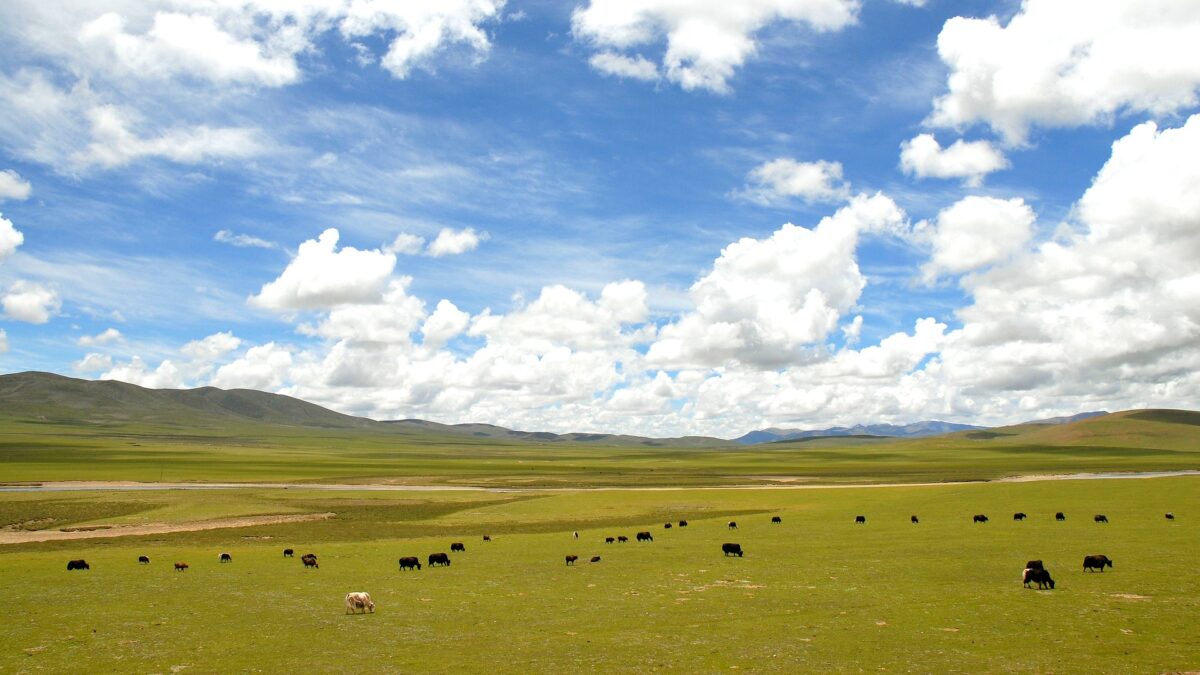
I will end where I began, with the night. At 10:33 on Thursday, in a township most of us could not find on a map, the earth moved, and sixteen stories ended mid-sentence. Somewhere above them, the same vast Tibetan sky that you see in the photograph above this column — the yaks grazing, the clouds piled like slow cathedrals — went on being beautiful, indifferent, eternal. The mountains do not mourn. That is our job. Mourning is the tax the living pay for the privilege of still standing on solid ground — and the only honest way to pay it is to live, and build, and pay attention, as though the ground could move at any moment.
Because it can. Because tonight, somewhere along the inch-a-year drift of a continent, the stress is accumulating in silence again. The mountains are keeping their ledger. The only question — the one I asked at the start, the one I leave with you at the end — is whether any of us is listening.
Sources & References
- Reuters — “Injuries in China’s Tibet rise to 65 after earthquake, death toll remains at 16” (23 October 2026)
- BusinessWorld Online — “Apple launches into foldable market as iPhone Duo sales begin” (23 October 2026)
- U.S. Geological Survey (USGS) — 2005 Kashmir earthquake loss data (87,351 fatalities)
- Encyclopaedia Britannica — “Kashmir earthquake of 2005” (impact, death toll, response)
- U.S. Geological Survey (USGS) — “Introduction to the special issue on the 25 April 2015 Mw 7.8 Gorkha (Nepal) earthquake”
- ReliefWeb / USAID — “China – Earthquake Fact Sheet #6, FY 2008” (Sichuan earthquake figures)
- EBSCO Research Starters — “Kashmir earthquake 2005” (tectonic background: Indian plate drift)

About the Author — Abdul Mannan
Related Articles
Ebola Has Reached Nigeria — And the World Is Looking Away Again
Nigeria — 230 million people — has confirmed its first Ebola case in the fastest-spreading outbreak in history.…

The Frozen Map: Ukraine’s 75-Percent Peace Gamble and the Ghosts of History
What is the price of a country? Not the whole country — just twenty-five percent. Zelensky's "freeze and…

The Last Phone Call: What Prince Harry’s Regret Teaches Us About Grief, Guilt, and the Words We Never Said
Prince Harry told GQ his biggest regret is the last phone call he ever had with his mother,…