The Frozen Map: Ukraine’s 75-Percent Peace Gamble and the Ghosts of History

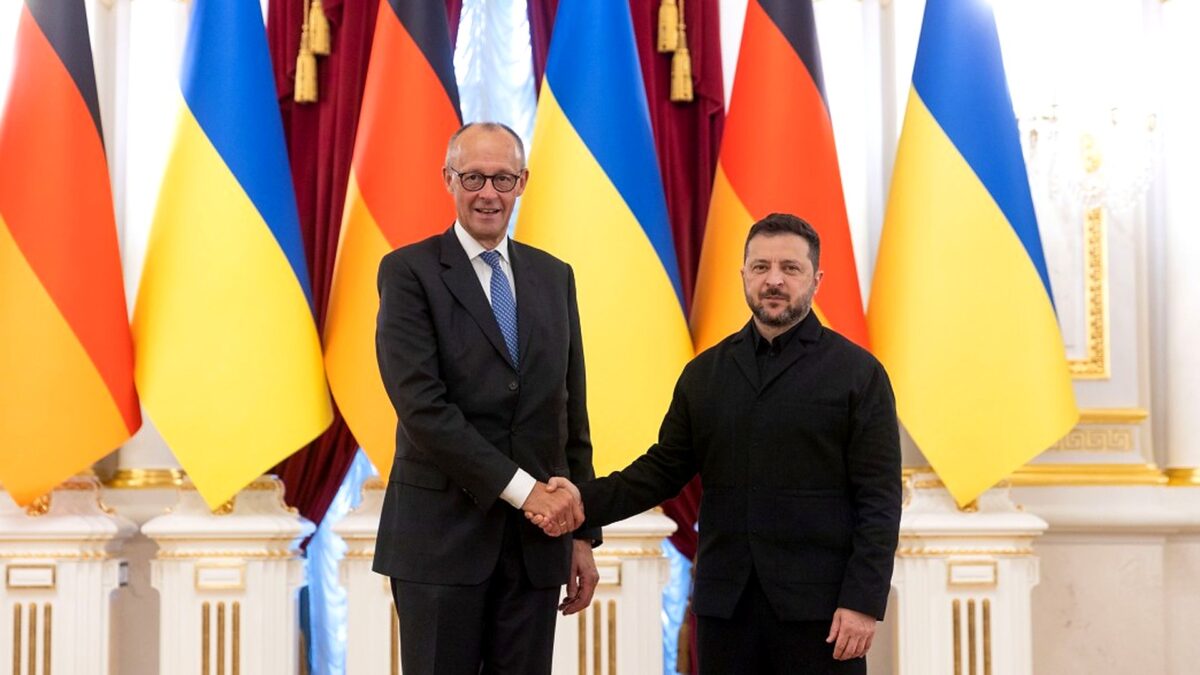
What is the price of a country?
Not the whole country, mind you. History does not bargain in wholesale anymore. It asks for a quarter. A quarter of the soil, a quarter of the flag, a quarter of the map — twenty-five percent of a homeland, weighed on a scale in a television studio in New York, while the men who will decide whether the killing stops are dining three time zones away in a palace outside St. Petersburg.
That is what happened this week, and I ask you to sit with it the way you would sit with a doctor’s diagnosis, because the sentence that came out of Volodymyr Zelensky’s mouth on Fox & Friends on Wednesday morning will be read by your grandchildren in textbooks: “Yes, right now we have to freeze, and I think this is a real way to end this war. We call it a ceasefire — or, as President Trump called it, stop the killing. Freeze and stop.”
Freeze and stop. Two verbs. One would end the war. The other would only end the shooting. And the difference between the two, dear reader, is where this whole century keeps losing its way.
The seventy-two hours that shook the map
Let me give you the facts first, because a columnist who begins with poetry and ends with rumour is a storyteller, not a witness.
On Tuesday, in Oslo, Norway, Ukraine’s president sat down with America’s special envoy Steve Witkoff and European leaders to weigh a framework document — security guarantees, post-war economic recovery funds, a broader European security architecture, even the prospect of Ukraine joining the European Union. A US official called the session “productive”; Washington and Kyiv, he said, were in “strong alignment” on next steps. Ukraine consented there to trilateral talks with the United States and Russia.
On Wednesday morning, Zelensky appeared on Fox News. Brian Kilmeade asked him the question directly: would he accept a peace deal that freezes everything exactly as it is right now, with Ukraine still holding “75 percent or more” of its territory? Zelensky said yes — and then said something more important. “This is the minimum of what we need from Russia today,” he said. “Then, of course, we will go to the president and to Europeans and we will ask for security guarantees.” He rejected giving up the Donbas outright. “Not fair,” he called it, and added that Russian forces were “not winning on the battlefield.”
He also said he needs his people back — the 9.5 million Ukrainians who have lost their homes and fled abroad. “We need them to come back to Ukraine just to live and to build their country.” Nine and a half million. Pause on that number. That is more than the population of most European nations, scattered to the winds of someone else’s war.
Hours later, Witkoff was in St. Petersburg at the Constantine Palace, sitting across from Vladimir Putin for some three hours — the ninth such meeting between the two men. At the table were Putin’s foreign-policy adviser Yuri Ushakov and the Russian envoy Kirill Dmitriev; Trump’s son-in-law Jared Kushner joined by video link. And out of that room came the sentence the world had been waiting to hear: Russia, Ushakov announced, is “in principle” ready to resume trilateral talks with Washington and Kyiv after November 10 — possibly in Abu Dhabi, at the “technical level”, on “building a security system for Russia and Ukraine after the conflict ends.”
The war, Ushakov added, “is coming to an end.”
Trump, watching from Washington, said he believes a deal to end the war may be the closest it has ever been.
Read the fine print before you applaud
Now, I have read enough diplomatic statements in my life to know that “in principle” is the most heavily fortified phrase in the English language. Behind it, armies hide. Putin has agreed — “in principle” — to talks in which he himself will not sit face to face with the leaders of the United States or Ukraine. The next round will be at the “technical level”. Lavrov, the foreign minister, said Moscow would examine Washington’s proposals while playing down expectations of concessions.
And then there is what happened on the ground, which no press briefing can erase. On Monday, a Russian drone strike on a park in Kharkiv killed a beloved Ukrainian teacher, Inna Mariukhna, and her one-year-old baby, Angelina — the child dead in her stroller — along with four others. The same week, a retired American teacher, Stephen Hubbard, 72, walked free from a Russian prison after more than four years on charges of fighting as a mercenary for Ukraine. And in a clip shared by Russian state media, America’s own envoy Steve Witkoff called Vladimir Putin “a humanitarian,” saluting and commending him. The teacher was freed; the teacher was buried. This is the grammar of our diplomacy now — a life exchanged for a handshake, a corpse counted as a rounding error.
In September alone, Putin’s offensive killed 328 civilians as Russia bombarded Ukraine’s cities and energy infrastructure, the United Nations reported. And hours after the Kremlin’s “ready in principle” statement, Russia’s missiles were falling on Kyiv again.
So forgive me if I do not pop the champagne. I have seen this film. The question is whether we have learned its ending.
Korea: the freeze that froze everything except the war
History is the only honest fortune-teller, and it tells me to take you to 1953. The Korean War ended not with a peace treaty but with an armistice — a freeze along a line drawn in blood, roughly where the fighting stood. Generals called it a ceasefire. Seventy-three years later, there is still no peace treaty between North and South Korea. The line became a four-kilometre-wide minefield, the DMZ, the most militarised scar on Earth. The war never ended; it was only paused, and the pause became permanent.
Zelensky’s “freeze” would draw the same kind of line across Europe’s largest country. Ukraine would hold 75 percent or more of its land. Russia would hold the rest. The shooting would stop. The maps would freeze. And the children born in 2026 would grow up — as Korean children grew up — with a war that is technically over and actually eternal, with soldiers staring at each other across a field that used to be someone’s village.
Ask yourself, honestly: is that peace? Or is it a postponement with paperwork?
Munich, 1938: the quarter that kept growing
But there is an older ghost at this table, and it speaks German. In September 1938, the leaders of Britain, France, Italy and Germany met in Munich and agreed that Czechoslovakia would hand over the Sudetenland — a slice of its territory — to Adolf Hitler, in exchange for “peace in our time”. Neville Chamberlain flew home waving a piece of paper. Six months later, Hitler took the rest of Czechoslovakia. Seventeen months later, the world was at war.
I am not calling anyone Hitler. I am too old and too careful for that cheap arithmetic. What I am saying is this: the logic of the transaction is identical. A strong state takes a piece of a smaller neighbour by force. The world, exhausted by the crisis, solemnises the taking and calls it peace. And the smaller state is told to be grateful that it kept 75 percent of itself.
Here is what the Sudetenland taught us, and what no one in St. Petersburg said out loud: a quarter of a country is never a quarter. It is a down payment. Territory ceded under the barrel of a gun teaches the gunman only one lesson — that the gun works.
Budapest, 1994: the paper that promised to protect
And then there is the memory that must be haunting Zelensky every hour of this negotiation. In 1994, Ukraine — freshly independent — signed the Budapest Memorandum. It gave up the third-largest nuclear arsenal on the planet: some 1,900 strategic warheads inherited from the Soviet Union. In exchange, Russia, the United States and Britain gave Ukraine “security assurances” — solemn promises to respect its independence, sovereignty and existing borders.
Paper. It was paper. In 2014, Russia seized Crimea and lit the fire in the Donbas. The assurances were not worth the ink. In 2022, Russia invaded outright. And now, thirty-two years after that memorandum, Ukraine is being asked to accept a freeze and to believe in a new round of “security guarantees” — the very currency that defaulted the last time.
This is why Zelensky’s demand is not obstinacy; it is memory. “We will go to the president and to Europeans and we will ask for security guarantees,” he said, “so that we are not afraid that the occupation will return, the aggression will return, the killing will return.” Read that sentence twice. The most important word is “afraid”. A nation that has buried its children is not negotiating from a spreadsheet. It is negotiating from a graveyard.
And Secretary of State Marco Rubio’s tough love — that Ukraine “would not exist” without American backing — cuts both ways. If Ukraine’s existence depends on Washington’s will, then what are American guarantees worth? Promises from the strong to the weak have a way of expiring with administrations.
The Donbas lesson: the freeze that bled for five years
Nobody needs a history book to prove the danger of a frozen Ukraine, because Zelensky himself has lived it. In July 2022, he told The Wall Street Journal why a freeze was unacceptable: “Freezing the conflict with the Russian Federation means a pause that gives Russia a break to rest.” In February 2025, he told ITV News: “During all five years of the frozen conflict there [in the Donbas], there was shooting, artillery fire, people were dying.”
The Donbas was frozen from 2014 to 2022. It did not produce peace. It produced a low, grinding slaughter — 14,000 dead before the full invasion — and then, when Russia had rested and rearmed, the freeze melted into the largest land war in Europe since 1945. A freeze is not a firebreak. It is kindling, neatly stacked, waiting for a match.
This is the terrible contradiction at the heart of this week’s news: the man who once warned that freezing the war only gives Russia a pause to rest is now saying, “Right now we have to freeze.” Why? Because four and a half years of war have an arithmetic of their own. People are tired, Zelensky said plainly on Fox. “Of course we want to end this war as quickly as possible.” Exhaustion is the one negotiator no president can overrule.
So what should the world do? Look at the mirror, then act
Here is where the columnist must stop narrating and start judging, because you did not come here for a summary — the news gives you those for free. You came for a verdict.
The verdict is this: a freeze is not immoral. It is incomplete. It is a tourniquet, and a tourniquet is noble — it stops the bleeding — but no surgeon mistakes it for a cure. If the world freezes this war and calls the freeze “peace”, it will have performed Munich’s arithmetic with Korean tools on Ukrainian soil.
What would make the freeze honest? Three things, and I write them as plainly as I can.
First, the guarantee must be a mechanism, not a memorandum. Budapest failed because assurances are words. What Ukraine needs is machinery: forces on the ground, tripwires that cannot be unplugged by a change of government, memberships that cannot be vetoed by the very aggressor they are meant to deter. Zelensky is right to demand this before anything else. A freeze without an enforcement mechanism is not a ceasefire; it is a countdown.
Second, Europe must not be a spectator at its own funeral. Zelensky said the trilateral format would be “better with Europeans.” He is right, and more than right: this is Europe’s war at Europe’s door. When Witkoff’s team discussed a post-war economic and prosperity plan and a European security architecture in Oslo, that was the sound of the adults entering the room. The 9.5 million displaced Ukrainians are Europe’s neighbours, not America’s abstraction. “Don’t speak about us without us,” Zelensky said — and he might have added: don’t decide Europe’s century without Europe.
Third, the world must stop buying peace with other people’s land. This is the moral core of it, and I address it to you directly, reader, because it is your conscience that is being invoiced. If a burglar occupies your neighbour’s drawing room and the police propose that your neighbour keep the bedroom and the kitchen and call it a resolution, you would not call the policeman a peacemaker. You would call him an estate agent for thieves. Seventy-five percent of a stolen thing is still a stolen thing. The only honest peace is one where the thief’s gun is removed from the table — and where the world says so, out loud, in the treaty, not in the corridor.
The verdict
I do not envy Volodymyr Zelensky. The man is being asked to do the impossible: to trade land for life, to sign a paper he knows may be paper, to smile on American television while his cities burn, to accept 75 percent of his country as a victory because the alternative is 70, then 65, then the slow mathematics of attrition. It takes a particular courage to say “yes” to a bad deal to save lives — and a particular wisdom to insist that the deal is only a beginning, not an end.
And I do not trust the word “in principle”. Principles, in diplomacy, are what you announce; interests are what you sign. Putin’s “in principle” has a history of dissolving the moment the cameras move. Zelensky knows it — “Russia said many times it is ready for a meeting and then things changed and got cancelled. Let’s see what happens this time.” That is not cynicism. That is experience, priced in blood.
So here is my closing, and I mean it as a warning, not a summary. If this freeze comes — and I pray the killing stops, whatever it takes — then the world must do what it failed to do in Korea, in Munich, in Budapest, and in the Donbas: it must not confuse the silence of the guns with the presence of peace. A frozen map is a map on pause. History does not stay paused. It waits, it watches, and it returns — usually angrier — to collect what was left unsettled.
The guns are loudest just before they fall silent. Let us hope this silence, when it comes, is the beginning of justice — and not merely the intermission before the next act of the same tragedy. Because nations, like men, are judged not by the wars they fight, but by the peace they dare to build when the fighting stops.
Sources & References
- CNN — “Russia willing to resume trilateral peace talks in November, Kremlin says after Witkoff meeting”
- Fox News — “Ukraine’s Zelenskyy open to freezing front lines in ceasefire with Russia”
- New York Post — “Ukraine’s Zelensky says he’d accept peace deal with Russia that ‘freezes’ front lines”
- New York Post — “Putin agrees to trilateral talks with Ukraine, US to end war — with a catch”
- New York Post — “Trump envoy Steve Witkoff praises Putin as ‘humanitarian’ as Ukraine peace talks hang in the balance”

About the Author — Abdul Mannan
Related Articles
The Last Phone Call: What Prince Harry’s Regret Teaches Us About Grief, Guilt, and the Words We Never Said
Prince Harry told GQ his biggest regret is the last phone call he ever had with his mother,…
The Machine That Solved the NSA’s 25-Year Secret in 30 Minutes
Twenty-five years of suspicion about the NSA's hidden numbers beneath global encryption — ended in thirty minutes by…
The Sea’s Most Honest Photograph: A Great White Shark, a Smiling Woman, and the Truth That Needed Proving
She smiled for the camera, and behind her, death jumped out of the sea. The viral Marina State…