Ras Tanura Burns in the Headlines: One Missile, One Refinery, and the Price the Whole World Pays

Why is everyone watching one small town on the Gulf this morning, a town most of the world could not find on a map yesterday? Because a missile was said to have flown towards it, and within hours the price of the fuel in your car, the bread on your table and the electricity in your home had all begun to move. Tell me, reader, when did a single refinery become a lever long enough to lift the whole world? And when did we agree — you and I, silently, without ever being asked — to live at the mercy of that lever?
I ask the question because the answer shames us. We did not agree. We simply grew accustomed. We built a civilisation that runs on a liquid pulled from beneath a desert, refined in a handful of places, and shipped through a strait so narrow that a single bad week can empty shelves three continents away. Then we called that arrangement normal, and we called the men who guard it our protectors, and we called the men who threaten it our enemies, and we went on driving. Ras Tanura is the bill for that arrangement, presented all at once, in a single morning.
On Tuesday 27 October 2026, Yemen’s Iran-aligned Houthis said they had launched an attack on Saudi Arabia’s Ras Tanura oil refinery, the biggest refinery in the kingdom, on the Gulf coast. Reuters reported the claim that day: a ballistic missile, aimed at a facility with a capacity of 550,000 barrels per day. Saudi authorities had not immediately confirmed the strike. I write those last words slowly, because they are the most important words in this column. Had not immediately confirmed. A claim is not a crater. A statement is not a shutdown. No confirmed damage, no confirmed outage, has been put before the public at the time of writing. What we know is that the claim was made, that it followed a claim the day before — that the Houthis had attacked Saudi Arabia’s East-West crude oil pumping stations and Riyadh airport, again without immediate Saudi confirmation, as Reuters reported on Monday — and that the markets, which do not wait for confirmation the way historians do, moved at once.
And yet, do not mistake my caution for comfort. The market’s movement is itself a fact, and a frightening one. Brent crude, the world’s benchmark, rose to $115.36 a barrel in early Asian trading on Wednesday, up 1.3 per cent, and kept climbing through the morning, reaching $115.90 by 0735 GMT, according to Reuters. American West Texas Intermediate crude rose past $101. The day before, prices had fallen by nearly $2, as talks in the Middle East eased supply worries for a few hours. One claim, one morning, and the relief was gone. Gulf stock markets slid with the news: Saudi Arabia’s benchmark index fell 1.3 per cent, Saudi Aramco fell 1.3 per cent, Dubai fell 0.5 per cent and Abu Dhabi fell 1 per cent, Reuters reported on Wednesday. The traders were not pricing in a fire they could see. They were pricing in a future they could imagine. And that, reader, is the whole story of oil in our century: we no longer pay for the barrel that is burning. We pay for the barrel that might burn.
A Missile Over the Gulf: What We Know, and What We Do Not
Let me be precise, because precision is a form of respect for you, and because in a week like this precision is the first casualty. First, the claim. The Houthis said on Tuesday that they had struck Ras Tanura with a ballistic missile. Reuters carried the claim, naming the refinery and its 550,000-barrel-per-day capacity, and noting the absence of immediate Saudi confirmation. Second, the context. The same movement said on Monday that it had attacked the East-West pumping stations and Riyadh airport. The Saudi-led coalition in Yemen said earlier that it had destroyed two ballistic missile launchers in Sanaa, including one said to have fired towards Riyadh and to have been intercepted. Third, the diplomacy. On Monday, Saudi Arabia, Turkey and Pakistan met Iranian officials in Tehran to try to reduce regional tensions, Reuters reported. Fourth, the market. Brent above $115, West Texas Intermediate above $101, Gulf equities down, and the analysts at ING telling Reuters that the market was still pricing in a greater likelihood of re-escalation, and that it was waiting for greater clarity on President Donald Trump’s next move towards Iran.
What we do not know is longer, and honesty demands that I say so plainly. We do not know whether the missile struck the refinery, or was intercepted, or fell short. We do not know whether any unit at Ras Tanura stopped working, for how long, or at what cost. We do not know what Saudi Arabia’s silence means — it may mean that nothing happened worth confirming, or that something happened that is not yet safe to describe, or simply that a kingdom at war does not narrate its own wounds in real time. I will not fill that silence with invention. A columnist who invents the damage is no better than a trader who invents the panic; both profit from fear, and both leave the reader poorer. What I can tell you, and what history tells you more loudly than any press release, is why the mere claim was enough. Ras Tanura was never merely a refinery. It was always a message written in steel.
Ras Tanura: The Small Place That Moves the World
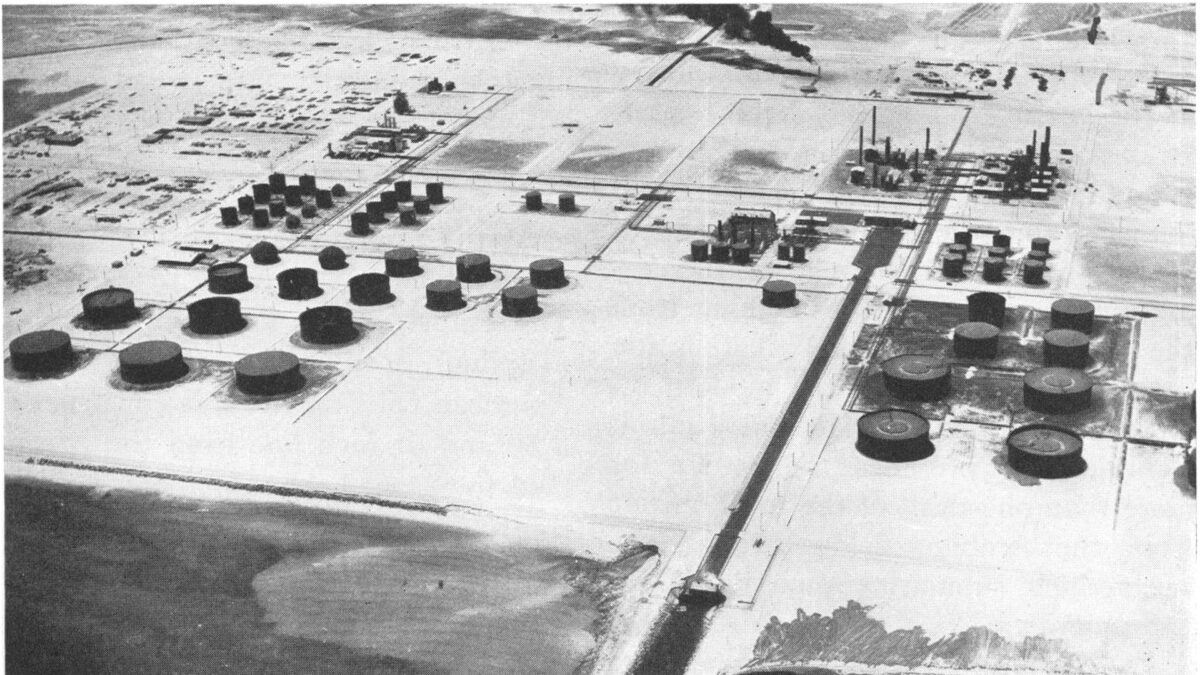
Look at the photograph that heads this column. It is Ras Tanura as it was in about 1949, seen from the air: rows of black storage tanks standing in the white glare of the Gulf shore, the refinery behind them, the sea at the edge of the frame. The men who built it could not have imagined ballistic missiles. They imagined tankers. They imagined a world that would need, forever, what lay beneath the sand. Seventy-seven years later the tanks are larger, the pipes are longer, the capacity is counted in hundreds of thousands of barrels a day — and the vulnerability is exactly the same. A place that concentrates so much value in so small a space will always invite the attention of the desperate and the ambitious alike. That is not a judgement on Saudi Arabia. It is a law of geography, and geography, unlike politics, does not negotiate.
Consider what Ras Tanura is. It is the kingdom’s largest refinery, on the Gulf, at the heart of the export system of the world’s biggest crude exporter and second-largest crude producer. Refining is not the same as pumping. A well can be capped and reopened; a refinery is a living chemistry set, a chain of heat and pressure in which one broken link can strand the oil that is still perfectly recoverable in the ground. That is why the Houthis did not need to conquer a province. They needed only to be believed, for a morning, about one plant. The East India Company once understood this arithmetic better than any army in Asia: you do not need to own the country if you own the port, the warehouse and the ledger. The Company came for spices and stayed for sovereignty; oil came for fuel and stayed for foreign policy. The flags changed. The logic did not. Whoever can interrupt the flow, even for a day, holds a veto over the daily life of strangers he will never meet.
You feel that veto before you understand it. You feel it when the petrol station changes its board overnight. You feel it when the airline adds a surcharge, when the baker raises the price of bread because the oven and the delivery van both run on the same black river, when the farmer counts the cost of diesel before he counts the harvest. The rich feel it as a number on a screen. The poor feel it as a meal that is no longer there. That difference — between a number and a meal — is the moral heart of this story, and I will return to it, because it is the difference our politics most loves to forget.
1973: When Oil Learned to Speak Politics
History is a mirror, and I hold it up now, because we have seen this morning before. In October 1973, Arab members of the Organization of Petroleum Exporting Countries, led by King Faisal of Saudi Arabia, announced an embargo on oil sales to America, Britain, Canada, Japan and the Netherlands, in retaliation for their support of Israel in the Yom Kippur War. The United States Office of the Historian records it plainly: the embargo banned petroleum exports to the targeted nations and introduced cuts in oil production, at a moment when several years of hard bargaining between oil-producing nations and oil companies had already destabilised a decades-old pricing system. The result, as Chatham House put it fifty years later, was a quadrupling of prices within a year and the first oil crisis. The price of oil rose from about $3 a barrel to nearly $12. Cars queued for petrol. Inflation spread like a fever. The embargo itself lasted about six months; the price rise lasted a decade.
Read that history slowly, reader, and notice what it does not say. It does not say that the world ran out of oil. The world did not run out of oil in 1973, and it has not run out of oil this week. It says that the world discovered, all at once, that oil is not only a commodity. It is a language. A producer who withholds it is making an argument. A fighter who threatens it is making an argument. A president who warns about it is making an argument. And the argument is always the same, in every decade, in every accent: you need what I control, and I know it. King Faisal’s embargo taught the West a lesson it has spent fifty years trying to unlearn — that energy dependence is not an economic inconvenience but a political condition, a kind of slow surrender, signed one fill-up at a time. The West answered with strategic reserves, with new fields, with efficiency and, eventually, with alternatives. And yet here we are, in 2026, watching a single claim about a single refinery move the price of everything, because the lesson was learned by governments and forgotten by peoples. Governments built reserves. Peoples built habits. Habits are harder to reform than policies, and far more expensive to break.
There is a second lesson in 1973, and it is the one our own age refuses to hear. The embargo hurt the embargoed, yes — but it also remade the embargoeing world. The sudden wealth of the producers financed cities, universities, armies and ambitions across the Gulf; the sudden shock to the consumers financed a rethinking of energy that, however incomplete, still shapes our debates about climate and independence today. Every oil shock is therefore two shocks at once: a shock to the price, and a shock to the imagination. The price shock passes. The imagination shock decides what kind of world comes next. Ask yourself, as you read this: what is this week’s shock teaching our imagination? That we are hostages? Or that hostages, sooner or later, must either pay the ransom or find another road home?
2019: The Night Abqaiq Burned and the Market Blinked
If 1973 is the mirror of politics, 2019 is the mirror of vulnerability, and it hangs much closer to our own faces. On 14 September 2019, drones and missiles struck Saudi Aramco’s Abqaiq oil processing facility and the Khurais oil field in eastern Saudi Arabia. The United States Energy Information Administration recorded what followed: Abqaiq, the world’s largest crude oil processing and stabilisation plant, with a capacity of 7 million barrels per day — about 7 per cent of global crude oil production capacity — was damaged, and on the first full day of trading afterwards, Brent and West Texas Intermediate crude prices experienced their largest single-day increase in a decade. Saudi production was knocked out by about 5.7 million barrels per day, roughly half the kingdom’s output at the time. The Houthis claimed responsibility; Saudi and American officials blamed Iran, which denied involvement. The EIA noted that by 17 September Aramco reported Abqaiq producing 2 million barrels a day and expected full restoration by the end of the month, drawing on inventories and other fields — and prices fell back almost as fast as they had risen.
Do you see the pattern, reader? The spike and the retreat. The terror and the repair. The market learned, in 2019, that Saudi Arabia could be hurt badly and healed quickly, and it has remembered that lesson ever since. That is why this week’s rise, though sharp, is not yet a panic. Traders are asking the 2019 question: is this a wound, or a warning? A wound closes. A warning repeats. The Houthis have been firing ballistic missiles and drones at Saudi airports, ports and oil installations for years, as Reuters noted this week, turning America’s ally into a pressure point in the wider war. Each claim, confirmed or not, tests the same proposition: how many mornings of fear can a market absorb before fear becomes the price itself? In 2019 the answer was reassuring. In 2026 the answer is complicated by something that did not exist in the same form in 2019 — a war with Iran that is no longer hypothetical, a fleet gathering in the Gulf, and an election calendar that has become, openly, a timetable for violence. Which brings me to the most chilling report of this week, and the one I most wish I could dismiss.
The Strait, the Tanker War, and the Geography That Will Not Change
Before I turn to that report, let me set the geography before you, because geography is the argument that no speech can answer. The Strait of Hormuz, between Oman and Iran, connects the Persian Gulf with the Gulf of Oman and the Arabian Sea. The United States Energy Information Administration, in its June 2025 analysis, put the flow through the strait in 2024 at an average of 20 million barrels per day — about 20 per cent of global petroleum liquids consumption — with very few alternative options if it were closed. About a fifth of global liquefied natural gas trade also passes through it. Pipelines exist that can bypass the strait, but the EIA is blunt: most volumes that transit the strait have no alternative means of exiting the region. There is no second sea door out of the Gulf. There is only Hormuz, twenty-one miles wide at its narrowest, and the patience of the powers that border it.
We have fought over this water before. During the Iran-Iraq war of the 1980s, the so-called Tanker War saw merchant ships attacked in the Gulf, and the United States ended up escorting reflagged Kuwaiti tankers under the American flag — a reminder that when trade is threatened, great powers do not merely protest; they put their own flags on other people’s ships and dare the world to fire on them. The parallel with today is not exact, and I will not force it. But the structure is identical: a narrow waterway, a regional war, a global economy that cannot afford to look away, and a great power that must decide how much risk it will carry in the name of keeping the water open. The Houthis, meanwhile, have already shown that the threat need not be at Hormuz itself to reach Hormuz. A missile at Ras Tanura, a drone at a pumping station, a claim about Riyadh airport — each one is a stone thrown into the same pond, and the ripples arrive, faithfully, at your petrol pump. The pond is the world. The stone is whoever dares to throw it.
And here, reader, I must speak of treachery — not the treachery of enemies, which is at least honest, but the treachery of arrangements. Every age has its Mir Jafars, men who open the gate from inside, and its Mir Sadiqs, men who sell the fortress while swearing to defend it. Our age has a subtler version: the ally who promises security and delivers dependence, the market that promises efficiency and delivers fragility, the leader who promises cheap energy and delivers a foreign policy written by other men’s missiles. I do not name names here, because the indictment is general and therefore more serious. We, the peoples of the world, accepted a system in which our daily bread travels through a strait controlled by our rivals, is refined in plants within range of our enemies’ missiles, and is priced in a currency we do not control. We called that system globalisation. History may call it something plainer: a gamble, taken with other people’s lives, by men who would never have to queue for petrol themselves.
The Warning After the Election: War on a Calendar
Now the report I promised you, and I ask you to read it with the same discipline I have asked of myself: as reported, attributed, and unconfirmed in its outcome, but impossible to ignore in its detail. The Wall Street Journal reported on Tuesday that the United States has told several Gulf Arab countries to prepare for a possible short, intense military campaign against Iran after the United States midterm elections on 3 November. The warnings, delivered through diplomatic and military channels, were described as among a growing number of signs that the United States and Israel are preparing for a new round of heavy combat operations aimed at degrading Iran’s capabilities and pushing Tehran towards negotiations. President Trump has not made a final decision, the Journal reported, citing people familiar with his thinking, but is leaning towards a large post-election attack that could target Iranian infrastructure and nuclear sites. The White House declined to comment on what it called sensitive military plans that may or may not exist, saying Mr Trump keeps all options on the table to ensure Iran never obtains a nuclear weapon.
The preparations described are specific, and specificity is what separates a rumour from a warning. The Journal reported that the United States military is sending an additional Patriot missile defence system to Israel from Texas, that it has moved troops off bases in the Middle East where they were vulnerable, that forces have been restocking munitions and that bomber and fighter aircraft are preparing for strikes. An additional aircraft carrier strike group and a Marine expeditionary unit are poised to join roughly 20 other American warships operating in the Middle East next month. Mr Trump, at a rally last week, said, according to the Journal, “We may do another little Epic Fury,” referring to the heavy United States and Israeli bombing campaign in the spring, “Or they’ll agree.” At a rally in Lubbock, Texas, on Tuesday, he told supporters, as reported, “You’ll see Iran in a couple of weeks, if you don’t mind.” He has said he will not attack Iran before the midterms. The election, in other words, is not only a contest for Congress. It is, openly, a countdown.
Pause on that, reader. A war, discussed as a date. A campaign, described as short and intense, as if intensity were a consolation and brevity a promise. I have covered enough wars, in print and in conscience, to know that no war has ever kept the promise of its adjectives. Short wars become long occupations. Intense campaigns become grinding sieges. Surgical strikes become funerals for people who were never consulted about the surgery. And the men who promise brevity are never the men who bury the dead. I do not say this to take a side between Washington and Tehran; both capitals have said enough, and done enough, to fill a library of blame. I say it because the calendar itself is a moral fact. When a democracy schedules violence for after its own election, it is admitting, in the plainest possible language, that the violence is politically inconvenient before the vote and politically useful after it. The voters are protected from the consequences of a decision they are, in effect, being asked to endorse in advance, without knowing it. That is not strategy. That is a sleight of hand, performed with other people’s sons.
Iran, for its part, has warned that it would hit economic and civilian targets across the region, and that it retains hundreds to thousands of missiles, according to the reporting of the Journal’s account. I do not repeat that as a threat I endorse, nor as a boast I admire. I repeat it because it explains the missile over Ras Tanura, or the claim of one. In a war of messages, the Houthis’ claim is itself a message: we can reach the refinery, we can reach the airport, we can reach the pump that feeds the world, and we can do it before any American carrier arrives. Whether the missile struck or not almost ceases to matter, once the message has been received by the market. The market heard it. The Gulf exchanges heard it. You, at your kitchen table, will hear it next, in the price of everything that travels.
Who Pays? The Driver, the Farmer, the Mother at the Market
Let us now speak plainly about who pays, because the headlines speak of barrels and benchmarks, and barrels and benchmarks do not eat. The EIA, writing after Abqaiq, gave the arithmetic with unusual honesty: crude oil prices are the biggest factor in the retail price of petrol, and each dollar per barrel of sustained price change translates to an average shift of about 2.4 cents per gallon in petroleum product prices in the United States. That sounds small until you multiply it. Brent has moved by dollars, not cents, in a matter of days, and it remains above $115. In Pakistan, in India, in Egypt, in Nigeria — in every country that imports its fuel and pays for it in dollars it must first earn or borrow — the arithmetic is crueller, because the currency falls as the oil rises, and the poor pay twice: once at the pump, once at the shop. The driver in Faisalabad does not follow the Brent curve on a terminal. He follows it in the rickshaw fare, in the price of flour, in the school fee that must wait another month.
And what of the producers’ own peoples? Saudi Arabia’s stock market fell, Aramco fell, and yet a higher oil price, sustained, fills a treasury. War is a strange accountant: it impoverishes the many and enriches the few, and it calls the enrichment growth. The oil majors will report. The shipping insurers will raise their premiums. The airlines will add their surcharges. The only people who will not be compensated for the week’s fear are the people who had no part in creating it — the mother who must choose between cooking gas and medicine, the farmer who must choose between diesel and seed, the student who must choose between the bus and the book. I write this not as economics but as moral philosophy, because economics without moral philosophy is merely bookkeeping for the powerful. A system that can transfer the cost of a missile claim from a Gulf refinery to a hungry child in another continent, within forty-eight hours, is a system that has perfected the distribution of pain and privatised the distribution of profit. That is not an accident of the market. That is the market, working exactly as it was designed to work, for exactly the people it was designed to serve.
There is also the question of what else this week is quietly deciding, while we stare at the price board. OPEC+ producers are expected to keep their December oil output targets steady when they meet on Sunday, according to three people with knowledge of the matter who spoke to Reuters, in line with market expectations — and production in most of the seven core OPEC+ members, including Saudi Arabia, Russia, Iraq, Kuwait, Algeria, Kazakhstan and Oman, is below their output targets. In plain language: the cushion is thin. The spare capacity that once absorbed a shock is, by some accounts, nearly gone. When the cushion is thin, every claim matters more, every rumour travels further, every missile — real or reported — lands harder. Add to that the American inventory picture, still unresolved at the time of writing: market sources citing American Petroleum Institute data put United States crude stocks down by 2.03 million barrels in the week ended 23 October, while analysts polled by Reuters had expected a small rise of about 15,000 barrels, with the official Energy Information Administration report due later on Wednesday. Two numbers, pointing in different directions, and a market that must choose which to believe. Uncertainty, like oil, is now a commodity. And like oil, it is traded by men who never have to live with its consequences.
What I Would Watch in the Next Seven Days
You will ask me, fairly, what to watch. I am not a trader, and I will not pretend to be one. But as a columnist who has watched oil shocks come and go like seasons, I will tell you the seven signs I will be watching, and I invite you to watch them with me. First, confirmation: does Saudi Arabia confirm, deny, or continue to say nothing about Ras Tanura — and does any independent evidence, satellite or otherwise, emerge? Silence is information, but it is information that can be read in two directions, and I will not read it for you. Second, repetition: does the pattern of claims continue — another plant, another airport, another morning — or does this week stand alone? A single claim is a warning. A sequence is a campaign. Third, Hormuz itself: does shipping through the strait continue normally, do insurance rates rise, do tankers slow or reroute? The strait is the thermometer of this crisis; take its temperature daily. Fourth, the OPEC+ meeting on Sunday: steady targets would confirm the thin cushion; any surprise would tell you how frightened the producers themselves are. Fifth, the American inventories and the official EIA report: a genuine drawdown would tighten the market further; a build would give the bears their argument back.
Sixth, the diplomacy that is happening in the shadows while the carriers gather in the light. The Tehran meeting on Monday — Saudi Arabia, Turkey and Pakistan with Iranian officials — is the most hopeful sentence in this week’s news, and the least reported. Mediators, the Journal noted, are trying to revive talks, with little progress so far. Little progress is not no progress. Every war that was avoided was avoided by men who kept talking after the headlines told them to stop. Watch for a second meeting, a quieter statement, a concession that neither side can admit to its own public. Seventh, and most important, the American election itself. The midterms on 3 November are now, whether anyone intended it or not, a referendum on a war that has not yet begun. If the warnings are accurate, the days after the vote will tell us whether “short and intense” was a description or a delusion. Mark the date. History will.
The Verdict History Keeps Repeating
And so I come to my verdict, which is not a summary — I promised you no summary, and I keep my promises — but a warning, in the manner of the columns from which this voice was learned. The missile over Ras Tanura, claimed or real, has already done its work. It has reminded the world that its wealth is stored in a few vulnerable places, that its peace depends on a strait it does not control, and that its politics can be priced, daily, by men with missiles and men with terminals. The empires of our age do not march with elephants, as the Company once did, nor with cavalry, as the conquerors of Seringapatam did. They march with pipelines and price curves, with sanctions and carrier groups, with claims made on a Tuesday and believed by Wednesday morning. The weapons change. The weakness does not. It is always the same weakness: a people that has outsourced its survival to a distant shore will always be governed, in the end, by whoever controls that shore.
What, then, is to be done? Not panic, which is the tax the fearful pay to the powerful. Not indifference, which is the tax the comfortable pay to the future. But the slow, unglamorous work that every oil shock has demanded and every oil shock has been denied: diversify the sources of our energy, shorten the distances our necessities must travel, build reserves that are real and not merely announced, and — above all — refuse to let the calendar of an election decide the calendar of a war. The people of the Gulf, of Iran, of Yemen, of Pakistan and of every country that will pay for this week at the pump, did not vote for a missile over Ras Tanura. They did not vote for a campaign after 3 November. They will pay for both, unless the men who decide such things are made to understand that the price of oil is not only a number. It is a mother’s choice. It is a farmer’s field. It is a child’s journey to school. And a civilisation that forgets that — that treats a barrel as an abstraction and a war as a timetable — will deserve the history it is about to receive.
I leave you with the photograph, and with the question I began with. In 1949, the tanks at Ras Tanura stood in the desert glare, new and gleaming, and the world believed it had found a fuel that would never run out and a peace that would never be tested. In 2026, the tanks still stand, and the test has arrived, in the form of a claim, a price, and a warning. Why is everyone silent? No — everyone is not silent. Everyone is watching. The question is whether watching will become wisdom, before wisdom becomes regret. The guns have not yet spoken in full. The market has. Listen to what it is saying, reader, and then ask yourself the only question that has ever mattered in a week like this: when the price of everything rises, who will you become — the man who hoards, the man who blames, or the man who finally understands that the cheapest fuel in the world is the war that is never fought?
Sources & References
- Reuters — Yemen’s Houthis say they launched an attack on Saudi Ras Tanura oil refinery (27 October 2026)
- Reuters — Oil prices rise after attack on Saudi Arabian refinery reignites supply concerns (28 October 2026)
- Reuters — Gulf stocks slide as Ras Tanura refinery attack rattles investors (28 October 2026)
- Reuters — Houthis say they attacked East-West oil pumping stations; no Saudi confirmation (26 October 2026)
- The Wall Street Journal — U.S. Warns Gulf of Possible Short, Intense Renewal of Iran War After Midterms (28 October 2026)
- U.S. Energy Information Administration — Saudi Arabia crude oil production outage affects global crude oil and gasoline prices (23 September 2019)
- U.S. Energy Information Administration — Amid regional conflict, the Strait of Hormuz remains critical oil chokepoint (16 June 2025)
- U.S. Department of State, Office of the Historian — Oil Embargo, 1973–1974
- Chatham House — Date with history: How the oil crisis changed the world

About the Author — Abdul Mannan
Related Articles

Work Hard in Silence: Harry Kane, the Ballon d’Or, and England’s 25-Year Wait
Harry Kane won the 2026 Ballon d'Or after scoring 73 goals in 65 games for club and country,…
The $25 Billion Lie: What Meta’s Record Fine Really Says About Your Life Online
A New Mexico court has ordered Meta to pay $25 billion for systematically deceiving Facebook users about their…
The Students Who Outlasted a Strongman: Serbia’s Night of Reckoning
Sixteen minutes of silence, held every day for two years, became the ballot that ended fourteen years of…