The Students Who Outlasted a Strongman: Serbia’s Night of Reckoning

What does a fallen roof weigh? Ask the students of Serbia, and they will not answer you in tonnes of concrete. They will answer you in minutes. Sixteen minutes of silence, held every day at 11:52 in the morning, the exact minute when a railway station canopy came down in Novi Sad and buried sixteen lives beneath it. Sixteen minutes, repeated until a whole country learned to stand still. And then, on Sunday night, a whole country learned to move again.
Listen to Belgrade on the night of 25 October 2026, because that sound is the rarest sound in modern politics: a strongman conceding, in his own voice, on live television, less than two hours after the polls closed. “We still do not have final results,” Aleksandar Vučić told his supporters at his party headquarters, “but it is clear that we have lost these elections. The Student List has won.” On his own count, the students would take between 135 and 140 seats in the 250-seat parliament, and his Serbian Progressive Party would take 105. Independent pollsters put it at 138 to 104. Nobody else, he said, would enter parliament at all.
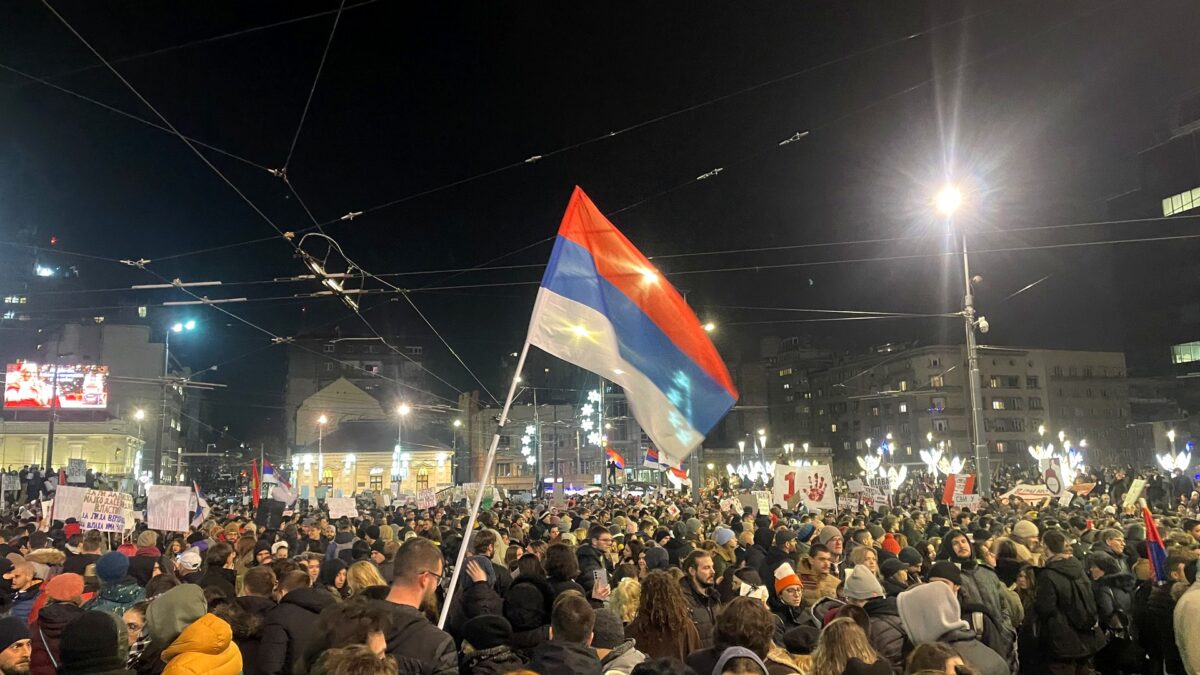
Within minutes the boulevards filled. Trams halted. Tens of thousands of people poured into the streets of the capital, waving flags, sounding car horns, setting off fireworks, hugging strangers. “The people have won! The people defeated a dictator! The people will lead Serbia!” shouted Nebojša Ćosić, waving a flag in the crowd, and the chant rolled down the avenues like a river finding its old bed. A law student named Milica, asked what the night meant, said simply: “That is the best thing that happened in my life. We will now breathe freely.” I have read a thousand victory speeches in my life, and I have never read a truer one than that single sentence. Freedom, when it returns, does not first announce itself in constitutions. It announces itself in the lungs.
The Night Belgrade Breathed Again
Do not let the neatness of the numbers fool you. This was not a neat election. It was a crowded, furious, frightened election, fought under allegations of fraud, with observers reportedly assaulted and turnout climbing so fast that by seven in the evening it had already reached 67.9 per cent, twelve points higher than at the same hour in 2023. By the close it approached 70 per cent, the highest parliamentary turnout in more than three decades, surpassing even the 1993 vote. Serbia has 6.4 million registered voters, and on Sunday they came as if the country itself were on the ballot, because it was.
At the students’ headquarters, the candidates themselves could scarcely believe what they were seeing. These were not professional politicians. They were, by design, unknowns: university professors, lawyers, actors, farmers, a cardiologist at the head of the list. “Tonight is a victory of courage over fear,” said Radomir Šaičić, a chemistry professor at the University of Belgrade who stood for the Student List, “and of faith that Serbia can and must be different.” He thanked everyone who “refused to give up, who stood by one another, and who showed that Serbia belongs not to a handful of people, but to all its citizens.” Then, with a discipline that told you everything about this movement, he added the sentence that separates a celebration from a revolution: “Let us celebrate with song, but tomorrow the serious work begins. We are not promising that it will be easy.”
Elsewhere in the capital, the symbolism wrote itself. Revellers used an angle grinder to cut through the metal fencing around a park near parliament, fencing that had sealed the ground for months to house a tent city of Vučić supporters. I linger on that image because it is the whole story in miniature: a barrier erected to protect power, cut open by ordinary hands, in public, without permission, to cheers. And in the same streets, crowds greeted police officers with handshakes and high-fives. A movement that had spent two years being called violent, foreign, and treacherous celebrated its victory by shaking the hand of the state it had just defeated. Remember that handshake. It is the difference between revenge and renewal, and the whole future of Serbia will depend on keeping that distinction.
Sixteen Minutes That Became Two Years
Every revolution has a date it cannot forget, and Serbia’s is 1 November 2024. On that day the concrete canopy of Novi Sad railway station, a building first raised in 1964 and renovated between 2021 and 2024, collapsed at 11:52 in the morning. Fourteen people were killed at once; the toll later rose to sixteen. The station had been reopened with ceremony. The canopy had been presented as proof of progress, of a modern Serbia racing towards Budapest on a gleaming new line. Instead it became proof of something else entirely: that when contracts are handed out in darkness, buildings fall in daylight.
At first the grief was quiet. Vigils. Flowers. Candles. Then the questions began, and the questions were not answered. Who signed what? Where were the documents? Who inspected the work? The government’s first response made everything worse: ministers and pro-government outlets claimed the canopy had never even been reconstructed, even though video of the minister opening the reconstructed station was still circulating online. A minister resigned while insisting he did not feel responsible. Arrests were made and quietly undone. Documents were promised and partially produced. The state performed accountability the way a bad actor performs grief: loudly, and without conviction.
So the students did what students have always done when institutions fail them: they occupied their own ground. On 22 November 2024, students and professors of the Faculty of Dramatic Arts in Belgrade gathered to honour the dead and were attacked. Three days later they occupied their faculty, and the occupation spread like light through a dark house: philosophy in Novi Sad, philosophy, philology, natural sciences, political science in Belgrade, then more than fifty campuses, then high schools, then whole towns. Every day at 11:52 they stopped. Traffic stopped. A country stopped, for sixteen minutes, for sixteen dead. “Serbia, stand still,” they called it, and the phrase became a moral summons: if you cannot stop for the dead, what will you ever stop for?
The movement grew teeth and legs. There were blockades of the public broadcaster’s headquarters, a general strike, marches that filled Belgrade with hundreds of thousands — an estimated 325,000 on 15 March 2025 alone, the largest gatherings in a generation. Students cycled to Strasbourg. Students ran a relay to Brussels. Farmers drove their tractors into the cause. Lawyers struck. Actors, miners, doctors, pensioners, bikers, and war veterans joined. What began as a demand for documents became a demand for a country: publish everything, punish the attackers of students, drop the charges against arrested protesters, and finally, from May 2025, hold snap elections. The students were not asking for power. They were asking for the truth, and when the truth was refused, they did the most dangerous thing a citizen can do in a captured state: they organised.
The Man Who Mistook Endurance for Permanence
Understand Vučić, because his fall is a lesson in the oldest illusion of power. He had ruled Serbia as prime minister or president since 2014, and his party had dominated since 2012. He presided over genuine economic growth, and he never let anyone forget it. He balanced Moscow and Beijing and Brussels with the dexterity of a man walking three tightropes at once, taking Chinese investment, Russian gas, and European accession talks, and telling each audience what it wanted to hear. He built, he paved, he raised wages and pensions on campaign posters. And he mistook all of this for permanence.
That is the error every long ruler makes. He confuses the length of his rule with the depth of his legitimacy. He begins to believe that because he has survived every crisis, he is the country, and that anyone who opposes him opposes Serbia itself. So the students were not citizens with a grievance; they were foreign agents, funded from Croatia and Montenegro, puppets of unnamed European powers, instruments of an “American deep state.” He said it again on election night, even in defeat, blaming independent media, European interference, and shadowy foreign hands for a loss by a margin no spin could shrink. A man who cannot name his own people as the authors of his defeat has not understood a single thing about the night that defeated him.
There is a particular cruelty in how the students were treated that history will not forgive quickly. They were beaten, detained, smeared as bad students and worse citizens, spied upon, and told, by a senior ruling-party official, that “children are property of the state.” Their mothers received visits from intelligence officers. Their grades were published to shame them. And still they did not break. I ask you, the reader, to sit with that for a moment: teenagers and twenty-year-olds, facing the full machinery of a state, choosing every morning to stand in a street for sixteen minutes of silence. Courage is not the absence of fear. Courage is a timetable. And theirs never slipped.
Vučić himself seemed to sense, late, that the ground had moved. On 27 September 2026 he resigned as president, barred from a third term, and stepped down to campaign as an ordinary citizen for prime minister, heading his party’s list. In his final acts he pardoned 49 people, 23 of them connected to the protests. It was a gesture that admitted, without saying so, what the whole country already knew: the protest had become the politics, and the only way left to compete with it was to join its arena. He lost there too, and to his credit — a credit history should record plainly — he conceded. He did not do what Flávio Bolsonaro did in Brazil on this same weekend, refusing the result and demanding annulment. He did not do what his own father-figure in the region’s dark history did in 2000, clinging until the streets had to drag him out. He said the words, “we have lost,” and that single honesty, late as it was, spared Serbia a night of blood. Do not underestimate it. Concession is the last civic virtue of a defeated ruler, and Vučić, for once, performed it.
History Was Watching from the Same Square
Here is where I must speak as I always speak to you: through history, because history is the only mirror honest enough for nights like this. Belgrade has seen this film before, and it knows how it ends. On 5 October 2000, the students of Otpor! — “Resistance!” — with their clenched-fist posters and their jokes and their impossible youth, helped bring down Slobodan Milošević, a man who had also believed his rule was the country. The crowds filled the same squares. The same chanting rolled down the same boulevards. The same disbelief, the same laughter, the same sudden, dizzying sense that the air had changed.
But do not make the lazy parallel, because the students of 2026 improved on the students of 2000 in the one way that matters most. In 2000, the old order fell to the street. In 2026, it fell to the ballot box. The students did not storm parliament; they outvoted it. They did not seize power; they won permission to exercise it, in an election the ruler himself called, on a turnout he could not suppress, under rules he wrote. That is harder than a revolution, and rarer. A bulldozer can clear a square in a day. A ballot takes two years of standing still at 11:52 in the morning, and then one long day of standing in line.
There is another mirror, closer and more uncomfortable, and I hold it up deliberately. The canopy that fell in Novi Sad was not only a Serbian failure. Every country has its own Novi Sad waiting somewhere: a bridge inspected by a friend of a minister, a hospital built by a donor’s company, a school roof signed off by a man who never climbed a ladder. Corruption does not announce itself with a press conference. It announces itself with a crack, a leak, a collapse, and then with silence from the people paid to speak. Serbia’s students understood this before the rest of us did: that a fallen roof is never only about engineering. It is about who is allowed to ask questions, and what happens to them when they do. When a state answers questions with batons, it has already confessed.
What the World Heard — and What It Must Not Mishear
Europe heard it immediately. European Commission President Ursula von der Leyen congratulated the Student List and promised support for reforms on the rule of law, media freedom, corruption, and strong democratic institutions, and for advancing Serbia’s future in the European Union. Enlargement Commissioner Marta Kos wrote that “Serbia has raised its voice,” after nearly two years of protests for democracy, the rule of law, and the fight against corruption. Council of Europe Secretary-General Alain Berset welcomed Vučić’s acceptance of the result and his commitment to a peaceful transition, and praised the students’ “perseverance, energy and commitment to European principles.” These are not empty diplomatic courtesies. They are the sound of a door opening that has been half-closed for a decade: Serbia’s European path, blocked less by Brussels than by Belgrade’s own refusal to meet its standards.
But the world must not mishear this victory as a fairy tale. The Student List is a coalition of strangers united by a common enemy, and common enemies make poor governing programmes. Its 250 candidates include professors, lawyers, actors, and farmers, led by cardiologist Ilija Srdanović, and they campaigned on accountability, transparent procurement, and the investigation of illegally acquired assets. All of that is necessary. None of it is a government. They must now do the unglamorous, unforgiving work: publish the Novi Sad documents in full, prosecute without vengeance, rebuild an independent judiciary and a free broadcaster, negotiate with a European Union that will demand proof rather than poetry, and manage a relationship with Russia and China that Vučić spent twelve years entangling. They must also face a presidential election within three months, with parliament speaker Ana Brnabić serving as interim president, and a defeated but far from destroyed Progressive Party holding more than a hundred seats and every grievance a defeated machine can nurse.
And they must resist the temptation that destroys every victorious movement: the temptation to become what they defeated. The test of the students will not be their first hundred days of speeches. It will be their first hard decision in which their own supporters demand a shortcut, a purge, a punishment without trial, a friendly judge, a quiet contract. Power does not corrupt only the wicked. It corrupts the tired, the impatient, and the righteous who believe their cause excuses their methods. The students won because they refused shortcuts for two years. Their government will survive only if it refuses them for two terms.
The Morning After the Miracle
So I end where the students ended their night: not with a slogan, but with a warning and a hope, held in the same hand. The warning is this: a victory is not a vindication, and a crowd is not a constitution. The cheers in Belgrade will fade. The fireworks will leave smoke and litter. The angle grinder will be put away. What remains is a parliament, a budget, a judiciary, and a railway station in Novi Sad where sixteen people died because somebody, somewhere, signed a paper they should not have signed, and nobody was punished until the whole country stood up. If the students’ government does not punish that somebody, lawfully, publicly, and soon, then the next generation will learn the lesson this generation refused to learn: that you can kill sixteen people with a signature and walk away.
The hope is larger, and I state it plainly. What happened in Serbia is the most encouraging political event of this year, not because students won an election, but because they proved something the cynics of our age had declared dead: that peaceful, patient, organised citizenship still works. In an era when strongmen from every continent tell their people that democracy is a Western luxury, that courts are obstacles, that journalists are enemies, and that youth is a nuisance to be managed, a group of young Serbs answered with silence, with ballots, and with handshakes to policemen. They did not burn the country down to save it. They voted it back to itself.
And so I ask you, wherever you are reading this, a question in the spirit of the column you have just read. Your country has its own canopy. It may be a school, a hospital, a contract, a court, a newsroom, a border, a budget line nobody is allowed to read. The question is not whether it will fall. The question is whether anyone will stand still for sixteen minutes when it does, and whether they will still be standing two years later, in a queue, with a ballot, refusing to be called foreign in their own home. Serbia’s students stood. They stood until a strongman sat down. And on a Sunday night in Belgrade, a whole nation discovered what its young people had known all along: that a country does not belong to the man who rules it longest. It belongs to the people who refuse to leave it.
Sources & References
- Reuters: Serbia’s Vučić concedes defeat to student-led movement in parliamentary election
- Reuters: Belgrade in rapture as Serbian students topple Vučić in historic election
- Reuters: Reactions to election victory of Serbia’s Student List
- Reuters: Serbia election — main players, voter concerns and what is at stake
- The Times: Serbia election results — Vučić concedes defeat to student party
- Wikipedia: 2024–present Serbian anti-corruption protests (background, timeline and casualty figures)

About the Author — Abdul Mannan
Related Articles
When an Airport Becomes a Battlefield: Riyadh, Yemen and the War the World Stopped Watching
On 25 October, Riyadh's King Khalid airport reopened two terminals — and was threatened again within hours. This…
The Streets Have Learned to Speak Again: Europe’s Autumn of Anger — and What It Is Really About
On one Saturday, Paris, Tirana, Milan, Madrid, Brussels and Lisbon all filled with protesters — six different wounds,…
The Forest Cannot Vote: Brazil’s Runoff, a Dynasty’s Second Act, and the Choice the Whole World Is Watching
Today Brazil votes in a runoff too close to call — an 80-year-old incumbent against the 45-year-old son…