The Day the Chequebook Closed: Trump, Netanyahu and the End of America’s $4 Billion Gift to Israel

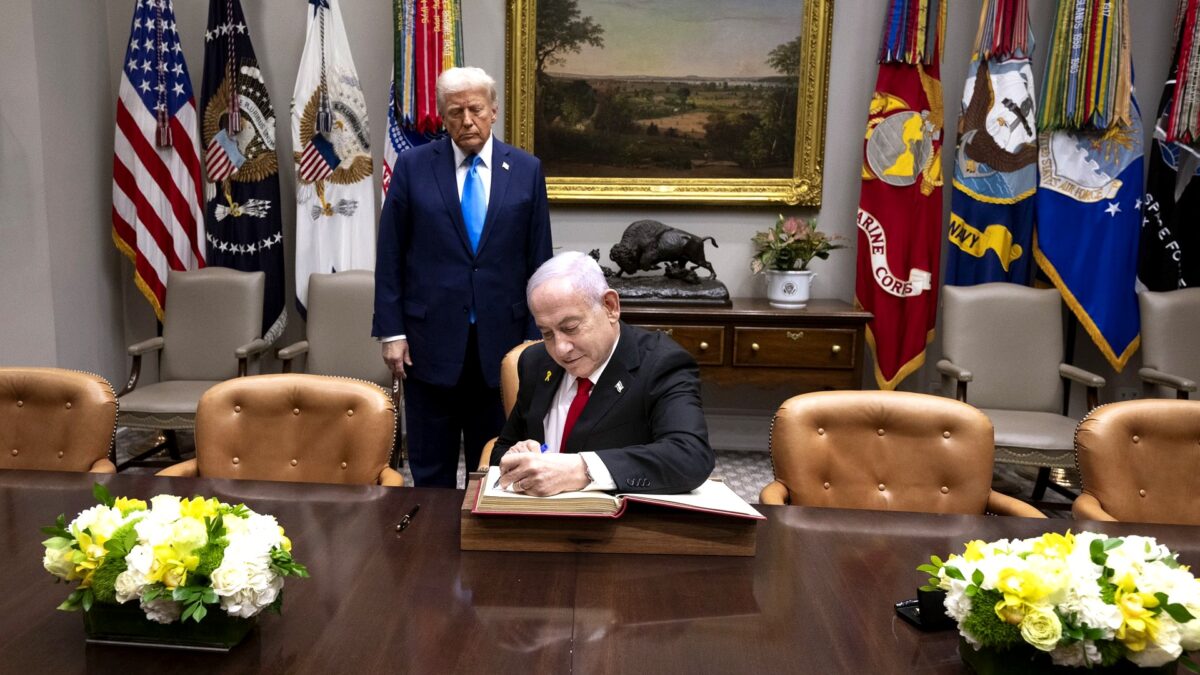
What is an alliance worth on the morning the cheque stops clearing? I ask you this plainly, because on Tuesday, as Americans walked to their polling stations to decide the fate of a Congress, their President walked into a television studio and cancelled, with a shrug, the most sacred financial promise in American foreign policy. Four billion dollars a year. Seventy-eight years of habit. Gone — or so he said — by the end of December.
“We’ve already agreed that by the end of this year we won’t be paying Israel,” Donald Trump told Fox News. “Now we’ll help Israel if they need it.”
Read that sentence again, slowly, because it contains a whole history inside it. “We won’t be paying.” Not “we will review”. Not “we will negotiate”. We won’t be paying. And the second half of the sentence is the quieter revolution: “we’ll help if they need it” — help, now, as a favour, not as a right; as charity, not as covenant. In one breath, the President turned an entitlement into an option, a treaty into a telephone call, and a superpower’s word into a weather forecast.
Was it real? Was it theatre? Was it the most consequential sentence of the year, or the most expensive Election Day slogan ever uttered? I have spent the day reading the small print, and the small print, as always, is where the truth hides.
The Announcement on Election Day
The facts, first, because a columnist who skips the facts is only a preacher, and I intend to be both. On Tuesday 3 November 2026, as voting began in the American midterm elections, President Trump appeared on Fox News’ Fox & Friends and said he had made a deal with the Israeli Prime Minister, Benjamin Netanyahu, months ago: Washington would stop roughly $4 billion a year in military aid to Israel after this year. The United States would still sell Israel weapons. It would still help if Israel needed it. But the annual grant — the money that arrives like the seasons, unquestioned and unexamined — would stop.
“Now, as far as paying Israel, Bibi Netanyahu and I have made a deal that we give Israel $4 billion a year, and we made a deal months ago that we’re stopping,” the President said. He gave no details. He did not explain how the funding would be halted, and the omission matters, because the Memorandum of Understanding that provides $3.8 billion in American military aid to Israel each year does not expire until September 2028. A deal announced on television is not a law passed in Congress, and the money, as we shall see, is appropriated by Congress — not by a morning show.
But the timing was the message. The President announced it on Election Day, in the middle of a midterm contest his party was about to lose — Democrats went on to win control of both the House and the Senate — and he framed it, openly, as politics. The aid, he said, had become a “bad talking point”, a weapon his enemies used against his party. “Why should we suffer the slings from lunatics like an El-Sayed when they don’t need it?” he said, naming Abdul El-Sayed, the Michigan Democrat who won his Senate seat on Tuesday to become the first Muslim elected to the United States Senate, and who has opposed unconditional military aid to Israel. “It’s a bad talking point.”
Pause on that phrase. A seventy-eight-year alliance, reduced to a talking point. A four-billion-dollar promise, discarded because it had become inconvenient in a campaign. I do not say this to mock the President; I say it because the honesty of it is startling. Most leaders dress their retreats in the language of principle. Mr Trump dressed his in the language of the ledger. And in doing so, he accidentally told the truth about what the money had become.
Seventy-Eight Years of the Chequebook
To understand what ended on Tuesday — or what was announced as ending — you must understand what the money was. America recognised Israel eleven minutes after its declaration of independence on 14 May 1948, the first great power to do so, and the chequebook opened soon afterwards and never really closed. After the Six-Day War of 1967 it widened. After the Yom Kippur War of 1973, when American transport planes flew a desperate airlift to a besieged ally, it widened again. After Camp David in 1978, the aid became architecture: roughly $3 billion a year, every year, as regular as the budget itself, until the arrangement was formalised in 2016 in a ten-year Memorandum of Understanding — $38 billion for the fiscal years 2019 to 2028, $33 billion in military grants and $5 billion for missile defence, the largest military aid package America has ever signed with any country.
Understand what that means in plain terms. The $3.3 billion in annual military grants is spent, overwhelmingly, on American weapons: F-35 fighter jets, missile interceptors, precision munitions. The $500 million for missile defence built the Iron Dome and its successors. Israel received about $3.8 billion in American foreign military financing grants in 2025 alone. For decades, this was not a policy. It was a fact of nature, like the tide. Presidents of both parties defended it. Congress approved it. Questioning it was, until very recently, the surest way to end a political career in Washington.
And that is precisely why Tuesday matters. The money was never only money. It was the visible proof of an invisible thing: that America would stand by Israel, whatever the cost, whatever the criticism, whatever the war. The cheque was the covenant made legible. Every year it arrived, it said: we are still here. Every year it arrived, it said: this alliance is not negotiable. Now a President has stood on television, on the morning of an election, and said: it is negotiable. It is, in fact, already negotiated away.
The Leash and the Loyalty
Here is where history holds up its mirror, and I ask you to look into it with me, because this is the oldest story in the book of empires. A great power pays a smaller ally. The payment begins as generosity and ends as a leash — or the leash begins as protection and ends as a purchase. Rome paid its frontier tribes and called them foederati, allies, until the day the payments stopped and the allies remembered they had swords of their own. Britain paid the princes of India and called it subsidy, and the East India Company — that first great corporation-state — discovered that a ruler bought with silver can always be sold again to a higher bidder. The Company kept its ledgers the way other empires keep their armies, and the ledgers always won in the end.
I think of Mir Jafar at Plassey, and of Mir Sadiq at Seringapatam, and I think of them not as villains of a distant century but as the eternal archetype of the bought man: the ally whose loyalty has a price, and whose price, once named, can always be renegotiated. The tragedy of the bought man is not that he betrays. It is that he cannot tell, in the end, whether he was a partner or a possession — and neither can the buyer.
That is the question Tuesday asks of both Washington and Jerusalem. Was the $38 billion a gift between friends, or was it a subscription? If it was a gift, then ending it is merely an economy. If it was a subscription, then ending it cancels the service — and the service, in this case, was influence. For decades, the money bought America something no treaty could: a say in what Israel did with its wars. The cheque was the leash. The leash was the leverage. And now the President has announced, in the same breath, that he is cutting the cheque and keeping the friendship, as though friendship between nations ever survived the removal of its price.
Do not misunderstand me. I am not arguing that the aid should continue forever. A nation that cannot defend itself without another nation’s annual grant is a nation that has mistaken dependence for strength, and there is a dignity in Netanyahu’s own position — he has said, more than once, that the aid would wind down. The question is not whether the money should end. The question is what ends with it, and who decided, and whether anyone in Jerusalem was even told.
Why Tuesday, Why Now
The timing, my friends, is the whole story. “The curious issue is timing,” said Jon Alterman of the Center for Strategic and International Studies, and he is right to be curious. Why did the President announce it on Election Day? Why did he announce it in the middle of speculation that a major joint American-Israeli military strike against Iran may be only days away, eight months after the two countries jointly attacked the Islamic Republic? Why did he announce it as his party was bracing for a defeat that, by nightfall, had arrived?
The polls supply the first answer. American public support for Israel has fallen, sharply, since the war in Gaza began after the Hamas-led attack of October 2023. A Quinnipiac University poll in June found that 48 per cent of voters — and 66 per cent of Democrats — believe America is too supportive of Israel. When the question was first asked in 2017, the figures were 16 per cent and 20 per cent. That is not a drift. That is a collapse. A generation of American voters has watched a war on its screens and drawn its own conclusions, and a growing number of Democratic candidates who are critical of Israel won their primaries this year. Even moderate lawmakers, who once treated the aid as untouchable, have begun to challenge it openly.
The second answer comes from inside the President’s own movement. Some of his most loyal supporters have grown openly critical of Israel, accusing it of having misled a President who campaigned on avoiding foreign interventions into believing Iran could easily be defeated. Most Americans oppose the war with Iran, which has driven up petrol prices and pushed down the President’s approval ratings. The aid, in other words, had become a liability on both flanks: attacked by the left as complicity, attacked by the right as entanglement.
And the third answer is the one the President gave himself. The money was a “bad talking point”. His opponents used it. So he took it away. This is the politics of the dealmaker applied to the politics of the alliance: if a thing costs you votes, stop paying for it. There is a brutal honesty in it, and there is a brutal danger in it too, because alliances that are priced by the day are honoured by the day, and a friend who is kept only while he is useful is not a friend at all. He is an asset. And assets, as every businessman knows, are sold when the market turns.
Even the President’s critics on the right noticed the manner of it. “Amazing how being on the verge of Republicans getting wiped out in the midterms changes hearts and minds,” wrote the former Republican congresswoman Marjorie Taylor Greene. Republican Representative Don Bacon told CNN, with admirable bluntness: “What I really had heartburn about is the Israelis didn’t know about it.” The Israelis did not know about it. Let that sentence sit with you. A decision about the strategic framework of a seventy-eight-year alliance, and the ally learned of it from the television.
Jerusalem Learns It from the Television
Put yourself, for a moment, in Jerusalem on Tuesday morning. The finance ministry, according to Israel’s Channel 12, first learned of the plan when Mr Trump announced it. Not from a diplomatic cable. Not from a telephone call between allies. From a morning show. The $3.8 billion in annual American military assistance had been expected to finance Israel’s defence budgets in 2027 and 2028. The economic commentator Shaul Amsterdamski, of the public broadcaster KAN, estimated that a cut beginning in January would leave an immediate hole of 12 billion shekels — $3.8 billion — a year in the defence budget. Israeli defence and finance officials spent the day assessing how the country would pay for weapons already on order, and how it would replenish military stocks depleted by three years of war.
And the politics in Jerusalem are, if anything, more fragile than the arithmetic. Israel’s future leadership is uncertain after the election of 27 October, in which Mr Netanyahu lost his governing majority but denied his opponents a clear path to unseat him, leaving protracted negotiations over a new government. Into that vacuum fell the President’s announcement. Gadi Eisenkot, the leader of the rival bloc seeking to oust Mr Netanyahu, wrote on X: “The fact that the security establishment, along with Israeli citizens, is learning about a change in the strategic relationship framework through the media highlights just how much Benjamin Netanyahu’s conduct poses a genuine danger. We can no longer rely on him and must replace him.”
Mr Netanyahu’s office did not respond to requests for comment. Neither did the White House. But Mr Netanyahu himself had, in a sense, warned his own people a month earlier. In an interview with an Israeli television channel in October, he said: “If you think we’re going to continue receiving what I secured twice, and that’s tens of billions of dollars in American aid for the defense budget, prepare yourselves and get used to the fact that it won’t happen because America has changed.” America has changed. He said it himself. He had proposed, years earlier, that Israel gradually reduce its dependence on American military assistance over a decade. What he did not propose — what no prime minister would propose — is to learn of the end from a television studio while his own finance ministry reaches for a calculator.
There is a particular humiliation in that, and humiliation, in the affairs of nations, is never a small thing. Nations forgive debts. They rarely forgive being made to look small in public. The manner of the announcement may matter more, in the long run, than the money itself — because the money can be renegotiated, but the memory of being told last cannot be unremembered.
The Catch: Congress Holds the Purse
And now, dear reader, the catch — because there is always a catch, and the catch is usually where the real story lives. The President cannot end this aid by himself. The money is appropriated by Congress. Congress passed a law in 2020 authorising the funding for Israel, but the Senate and the House must still pass appropriations bills every year to distribute and release the funds. A television announcement is not an appropriation. A deal between two men, however powerful, is not a law.
“President Trump will probably not cut off US military aid to Israel by the end of 2026,” Thomas Warrick of the Atlantic Council told Al Jazeera. “While he and Netanyahu agree that military aid should be phased out, there are several ongoing weapons programmes on missile defence and counter-drone warfare that can’t easily be switched over to a foreign military sales programme. So I expect military assistance will be phased out during 2027. But not by the end of 2026.”
Read that carefully, because it changes the shape of everything. The aid will not end with a bang on New Year’s Eve. It will end, if it ends, the way great arrangements usually end: gradually, messily, with lawyers and contracts and programmes that cannot be switched off like a light. And while the grants are wound down, something else is being wound up. This past summer, the House of Representatives passed a provision — Section 219 of the fiscal year 2027 National Defense Authorization Act — that would deepen American-Israeli military technology cooperation, binding the two countries’ defence establishments more closely together in weapons research, production and technology. Dozens of non-governmental organisations have called the idea “exceptionally dangerous” and urged lawmakers to scrap it. Debra Shushan of Georgetown University’s Center for Jewish Civilisation warned that the measures “cede US leverage over Israeli military actions, lack human rights conditions, and lack transparency” and give Israel “access to the most sensitive US technology”. The House passed the bill in a roughly party-line vote, and if the Senate does not pass it during the lame-duck session, it is less likely to pass at all under a Democratic Congress.
Do you see the shape of it now? The gift ends; the sale continues. The grant becomes a purchase. The aid becomes a contract. America will stop giving Israel weapons and start selling them instead — which is, in a sense, the oldest trick in the book of empires: the patron stops paying the client and starts charging him. The relationship does not end. It changes its nature. And a relationship that was once justified in the language of shared values will now be justified in the language of the invoice.
The politics of it are already moving. Representative Ro Khanna, a progressive Democrat from California, said on X that “Zero aid Israel” would be part of his party’s agenda if it wins congressional control — and on Tuesday night, his party did win control of both chambers. In July, the House defeated an amendment to cut off aid to Israel by 314 votes to 104, but nearly half of Democrats supported it — a rupture between the party’s progressives and Israel that would have been unthinkable a decade ago. The ground has shifted beneath this story while we were all watching the war. Tuesday’s announcement is not the beginning of that shift. It is the moment the shift became impossible to ignore.
The Verdict: Loyalty Bought Is Loyalty Rented
So what are we to make of it all? I have given you the facts, the history, the politics and the catch, and now I owe you the verdict, because a column that ends with a summary is a lecture, and a column that ends with a judgement is a reckoning.
Here is my judgement. The announcement on Tuesday was both less than it seemed and more than it seemed. Less, because a President cannot cancel by interview what Congress appropriates by law, and the money will most likely fade during 2027 rather than vanish at midnight on 31 December. The machinery of the state moves slowly, and the lawyers and the contracts will have their say. More, because something broke on Tuesday that no appropriations bill can repair: the assumption that the aid was permanent, untouchable, beyond politics. Once a President has said, on live television, that the money is a “bad talking point”, no future President can pretend it is sacred again. The spell is broken. The chequebook has been opened to inspection, and a chequebook that has been inspected is never again a covenant. It is a budget line. And budget lines are cut.
There is a lesson here for every patron and every client in the world, and I address it to all of them, because the story of America and Israel is only the latest chapter of the oldest story in statecraft. Loyalty that is bought is loyalty rented, and rent, by definition, comes due. A nation that builds its security on another nation’s generosity has built its house on another man’s land, and the landlord may one day decide that the rent is too high, or the tenant too troublesome, or the neighbours too loud. Israel is learning that lesson this week. Other nations, watching from the sidelines — in Kyiv, in Taipei, in every capital where an American promise is the foundation of a defence plan — are learning it too, and they are learning it in silence, because the lesson is too frightening to say aloud.
And there is a lesson for the patron as well. A great power that treats its word as a talking point will one day discover that its word is worth exactly what a talking point is worth: nothing, the morning after the election. America’s word was, for seventy-eight years, the most valuable currency in the world — more valuable than its dollars, because it was the promise behind the dollars. Every ally held it. Every enemy feared it. A President who spends that currency to win a news cycle is like a king who melts down the crown jewels to pay for a feast: the guests will eat well tonight, and tomorrow the kingdom will notice the crown is gone.
I do not know whether the money will truly stop in December, or fade through 2027, or survive in some new form as a sale rather than a gift. No honest columnist can know that yet. But I know this: on Tuesday, as Americans voted, the world heard a superpower say, out loud, that its oldest financial promise was negotiable. The words cannot be unsaid. The television clip cannot be unplayed. The finance ministry in Jerusalem cannot unlearn what it learned from a morning show. And somewhere tonight, in a dozen capitals, a dozen leaders are quietly asking their own finance ministers a question they never thought they would need to ask: if it can happen to them, can it happen to us?
That is the real announcement of Tuesday. Not that the money may stop. But that the promise has stopped being a promise — and has become, instead, a price. And prices, as every merchant in every bazaar in history has known, only ever go in one direction when the buyer has lost interest: down.
Sources & References
ThisDay — “US will end $4bn military aid to Israel – Trump” (4 November 2026)
Qazinform — “Trump says U.S. will end $4 billion in annual aid to Israel” (4 November 2026)

About the Author — Abdul Mannan
Related Articles
The Big Show Bows Out: Glenn Maxwell and the Night Cricket Learned to Believe in the Impossible
Glenn Maxwell has retired from international cricket. From the 201 not out at Wankhede to the 40-ball World…

At Twenty, He Took the Crown: Kimi Antonelli and the Day Formula 1 Grew Young Again
On Sunday in Mexico City, a twenty-year-old boy carried the whole weight of Formula 1 history — and…
Today in Antigua, the King Will Speak of Sorrow — But Sorrow Is Not an Apology
Today in St John's, Antigua, King Charles III will open the Commonwealth summit and speak of slavery with…