At Twenty, He Took the Crown: Kimi Antonelli and the Day Formula 1 Grew Young Again

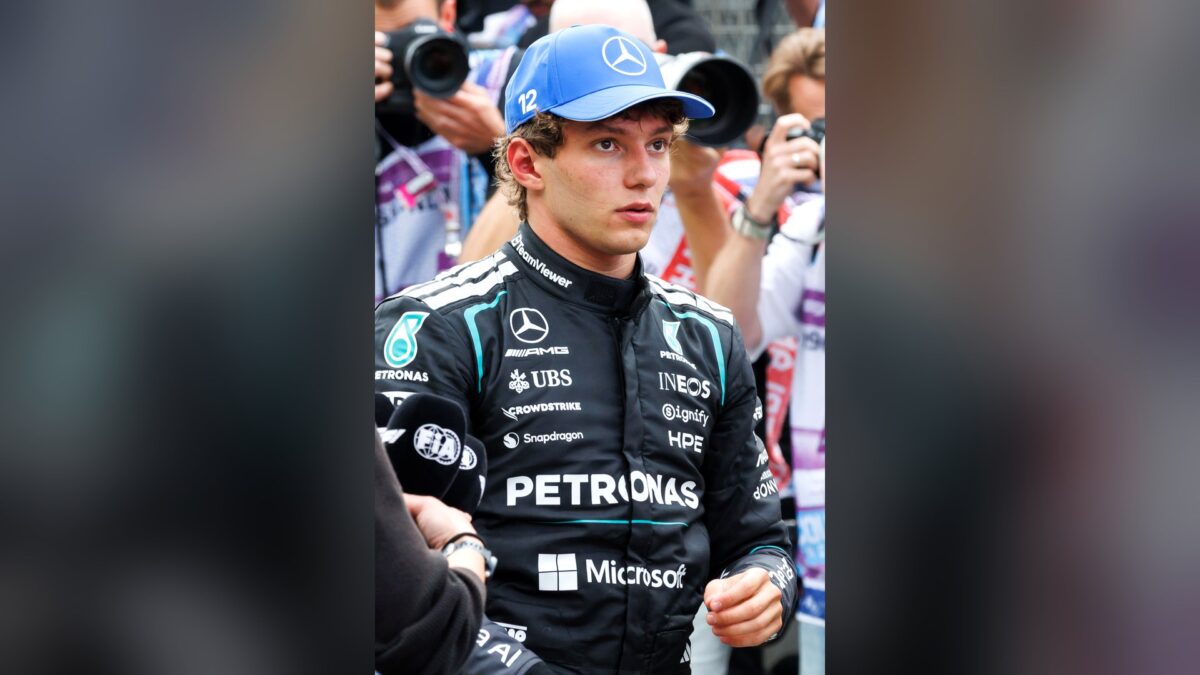
What does twenty years weigh? I ask you, reader, because on Sunday, in the thin air of Mexico City, a boy of twenty carried the whole weight of Formula 1 history on shoulders that have barely finished growing — and he did not bend. He did not even flinch. He finished third, took off his gloves, put his hands on the steering wheel, and said, in a voice that cracked like a schoolboy’s and rang like a champion’s, “We did it, we did it.”
Andrea Kimi Antonelli is the world champion of Formula 1. He is twenty years and sixty-eight days old. He is the youngest champion this sport has ever known, in seventy-six years of trying, and he is the first Italian to hold the crown since Alberto Ascari in 1953 — seventy-three years of waiting, ended by a child born in Bologna in the summer of 2006, a child who was not yet alive when Michael Schumacher won his last title, a child who was three years old when Lewis Hamilton won his first.
Stop and feel the strangeness of that for a moment. The man who lifted him into the air on the podium on Sunday — Lewis Hamilton, seven times world champion — won his first title when Antonelli was two years old. The other man who lifted him — Max Verstappen, four times champion — won his first when Antonelli was fifteen. Between the three men on that podium in Mexico City there were twelve world championships, and eleven of them belonged to the two men holding the twelfth man up in the air like a trophy they had both, in their different ways, helped to make. That is not a photograph. That is a passing of the torch, caught in the act, in front of two hundred thousand people in the Foro Sol stadium section, where the cars drive through a baseball stadium and the crowd roars so loudly that the drivers say they can feel it through the floor of the car.
And yet the boy did not arrive by accident, and he did not arrive by luck. Nothing about this story is an accident. That is the first thing you must understand, because the world will now spend weeks telling you that it is a fairy tale, and fairy tales are the lazy man’s way of avoiding the truth.
The boy who was never a boy
Antonelli joined the Mercedes junior programme when he was twelve years old. Twelve. At twelve, most children are arguing about homework. He was already the property — in the sporting sense, in the sense that a team invests in a future it can see before anyone else can — of the most successful racing team of the modern age. Toto Wolff, the Mercedes team principal, looked at a child in a go-kart and saw what the rest of us only learned to see on Sunday: a generational talent, the word the paddock has used about him for years, the word that is usually a curse, because it raises a boy up so high that the fall, when it comes, breaks him in public.
He did not fall. He won the Italian and German Formula 4 titles in 2022. He won the Formula Regional European championship in 2023. He went to Formula 2 in 2024, the last school before the throne, and he passed through it in a single year. And then, at the end of 2024, the door that no young driver dares to dream about opened: Lewis Hamilton, the greatest driver of his generation, the man whose seat at Mercedes was supposed to be untouchable, left for Ferrari. And Mercedes did not go shopping for a champion. They did not buy experience. They promoted the eighteen-year-old boy.
Think about that decision, because it tells you everything about the age we live in. The most conservative, most data-driven, most risk-averse organisation in modern motorsport looked at a teenager and decided that youth was not the risk — that waiting was the risk. That is a judgement on all of us, not only on racing. How many institutions in your life, reader, would rather buy a fading name than trust a young one? How many nations, how many companies, how many families, keep the old hands on the wheel long after the old hands have forgotten where the road goes, because the young hands frighten them? Mercedes did the opposite. They handed the fastest machine in the world to a boy who had never driven it in anger, and they said: show us.
He showed them in his very first race. Australia, March 2025. He started sixteenth on the grid, in the rain, in a debut that was supposed to be a quiet learning exercise. He finished fourth. He became the second-youngest points scorer in the history of the sport, and the paddock — that cynical, exhausted, seen-it-all village that travels the world together for nine months a year — stopped talking about whether he was ready and started talking about when he would win.
The answer was: almost immediately, and then again, and then again. Before his twentieth birthday, in August of this year, he had already won six Grands Prix. He became the youngest driver ever to lead the world championship, the youngest ever to start a race from pole position, and the youngest ever to win the Monaco Grand Prix — the race that every driver, from Fangio to Senna, has called the one that matters most, the race where there is no room for error and no place to hide, the race where the walls are so close that the great ones say they drive it with their fingertips and their memory. He won it as a teenager. Let that sit with you. He won Monaco as a teenager.
Seventy-three years of Italian silence
But the record that matters most is not about age. It is about a country. Italy has given Formula 1 more than any other nation except Britain: the passion, the noise, the red cars, the tifosi who turn Monza into a cathedral every September, the engineers, the designers, the dreamers. And yet Italy had not produced a world champion since Alberto Ascari won his second title in 1953. Seventy-three years. Three generations of Italian children grew up, fell in love with racing, grew old, and died without ever seeing one of their own lift the crown.
Ascari himself is a ghost that haunts this story, and I want you to meet him, because Antonelli’s triumph is also his resurrection. Alberto Ascari was the son of Antonio Ascari, a racing hero of the 1920s who was killed at the French Grand Prix when Alberto was seven years old. The boy grew up in the shadow of a dead father, in a garage in Milan, and became the fastest man alive: world champion in 1952 and 1953, driving for Ferrari, winning nine consecutive Grands Prix, a record that stood for sixty years. And then, in 1955, testing a sports car at Monza, he crashed at a corner that now bears his name, and he was dead at thirty-six. Italy has been waiting for his heir ever since. Not a fast Italian driver — Italy has had plenty of those. An Italian champion. The difference is everything.
And so, when Antonelli crossed the line in Mexico City on Sunday, it was not only a boy who was crying on the team radio. It was a nation exhaling for the first time in seventy-three years. The Italian flag was everywhere in the celebrations. His parents were there. His sister Maggie was there. Toto Wolff was there, the man who had bet the reputation of his team on a twelve-year-old child and had now been proved right in the most public way imaginable. And somewhere, I do not doubt, the old men in the bars of Bologna and Milan and Turin were raising a glass to Ascari, and saying what old men always say when the young finally do what they could not: at last. At last.
History does not repeat itself, reader. History answers itself. That is the difference, and it is the whole of my argument to you today. The past is not a museum. It is a question, asked again and again, until someone is finally brave enough, or young enough, or mad enough, to answer it.
The race that asked for everything
Now let me tell you about the race itself, because the manner of the winning matters as much as the winning. Antonelli did not need to win in Mexico. He needed only to finish ninth or higher to seal the championship with four races still to go. Ninth. In a car that had won nine races this season, ninth would have been a formality, a Sunday drive, a coronation procession.
It was nothing of the sort. He arrived in Mexico City battling illness and exhaustion, by his own team’s account, and the race itself was chaos from the start. He started fourth on the grid. Max Verstappen, the defending instinct of the sport, the man who never gives anything away, won the race for the sixth time in Mexico City, because that is what Verstappen does. Lewis Hamilton, in his first season at Ferrari, finished second, because that is what Hamilton does. And the race was stopped on lap forty-six, under a red flag, after Valtteri Bottas crashed into the wall at the first corner with a failure in his right-side suspension — a reminder, if anyone needed one, that these machines are not toys, and that the line between a championship and a hospital is measured in centimetres and milliseconds.
Through all of it, the boy held his nerve. He finished third. Third, when ninth would have done. Third, when he was ill. Third, in a race that kept trying to take the title away from him. That is the part I want you to remember, because it is the part that separates champions from prodigies. A prodigy is fast. A champion is fast when it matters, and calm when it does not, and the two things are not the same. Sebastian Vettel, the man whose record Antonelli broke on Sunday, understood this better than anyone: Vettel was twenty-three years and a hundred and thirty-four days old when he won his first title in Abu Dhabi in 2010, and his record stood for sixteen years, and he was the first man to congratulate Antonelli when it fell. That is what greatness looks like when it is not threatened by the future. It applauds it.
Consider the numbers, because numbers are the one language in which this sport cannot lie. Antonelli is the thirty-sixth different world champion in the seventy-six-year history of Formula 1. He won the title in his second season — only the fourth driver ever to do so, after Juan Manuel Fangio, Jacques Villeneuve and Lewis Hamilton. He has won nine races this season, more than his own team-mate George Russell, who has been racing in Formula 1 since 2019 and has eight. Before the race in Mexico, he led the championship by a hundred and two points, with three hundred and forty to his name. These are not the numbers of a promising youngster. These are the numbers of a man who has taken the sport by the throat.
And the sport knows it. Formula 1 has now crowned a first-time world champion in consecutive seasons — Lando Norris last year, Antonelli this year — and the old order, the order of Hamilton and Verstappen and Alonso, the order that has ruled the sport for two decades, is ending in front of our eyes. Fernando Alonso is still racing in 2026, at forty-five, a living museum of the sport’s history; he was twenty-four years and fifty-eight days old when he won his first title in Brazil in 2005, and now he shares a grid with a champion who was born the year after Alonso won his second. That is not a changing of the guard. That is a changing of the generations.
What twenty years old really means
But here, reader, is where I must stop celebrating and start asking the question that this column exists to ask. Because a twenty-year-old world champion is not only a sporting story. It is a mirror, held up to a world that has grown old and frightened, and the mirror does not flatter us.
We live in an age that does not trust the young. We make them wait. We tell them to get experience, to pay their dues, to sit at the back of the room until their hair turns grey. We build systems — in politics, in business, in every institution that matters — that reward endurance over talent, and survival over brilliance, and we call this wisdom. And then we wonder why nothing changes. We wonder why the same faces sit in the same chairs for thirty years. We wonder why the young leave, or give up, or stop believing that the world has a place for them.
Formula 1, of all places — the most expensive, most dangerous, most unforgiving sport on earth — has just proved the opposite. It looked at a twelve-year-old child and said: we will build you. It looked at an eighteen-year-old boy and said: we will trust you with everything. It looked at a twenty-year-old young man and said: you are the champion, and the two greatest drivers alive will lift you onto their shoulders, because that is what the future looks like when you stop being afraid of it.
There is a lesson in that for every father who tells his son to wait, for every manager who passes over the brilliant young woman because she has not “done her time”, for every nation that treats its youth as a problem to be managed rather than a resource to be unleashed. The question is never whether the young are ready. The question is whether the old are brave enough to let them try.
And there is a harder lesson, too, for the young themselves. Because Antonelli’s story is not a story about talent. Talent is cheap. The world is full of talented children. Antonelli’s story is a story about what happens when talent is met, every single day, by discipline that never takes a day off. He was twelve when Mercedes took him in, and for eight years he did the unglamorous work: the simulators, the fitness, the debriefs, the endless laps in junior categories where nobody was watching and nobody cared. He was ill in Mexico City, and he finished third anyway. He needed ninth, and he took third anyway. That is the difference between the boy who dreams and the man who wins: the winner does not do the minimum that is required. He does the maximum that is possible, even when no one would blame him for doing less.
The record that may never fall
Now the arguments will begin, as they always do. Can anyone ever be younger? The fans are already debating it online, and the answer, for now, is almost certainly not. The rules of the sport will not allow it: a driver cannot hold the superlicence that Formula 1 requires before the age of eighteen, and to win the title in your second season, at twenty, you must do what Antonelli did — debut at eighteen and win almost immediately. Some fans say the record will stand for fifty years. They may be right. Vettel’s record stood for sixteen, and Antonelli did not merely break it; he smashed it by three full years. He took a record that belonged to a four-time world champion and made it look like it had never been a record at all.
But records are not the point. The point is what the record means. It means that the youngest champion in the history of the fastest sport on earth is a boy who still has his whole life in front of him, and that the sport — and, if we are honest, the world — has just been reminded of something it had forgotten: that the future does not arrive when we are ready for it. It arrives when it is ready for us. And it does not ask our permission.
The championship now moves to São Paulo, for the Brazilian Grand Prix on the sixth of November, and then to Las Vegas, and the season will play itself out with four races still to run. But the season is already over, in the only sense that matters. The crown has been won. The boy has become the king. And the king is twenty years old.
So I ask you one last time, reader: what does twenty years weigh? On Sunday, in Mexico City, it weighed exactly as much as a world championship. And the boy who carried it did not bend, did not flinch, did not look down. He looked up, at the men who lifted him, at the crowd that roared for him, at the flag of his country that had waited seventy-three years for him — and he said, in a voice that cracked, “We did it.”
He did not say “I did it”. He said “we”. Remember that, too. Because the boy who wins at twenty and says “we” is the boy who will win at twenty-five and at thirty, and the boy who says “we” is the one the future belongs to. The rest of us — the old, the frightened, the ones who told the young to wait — we had better learn to say it too, before the future stops asking us altogether.
Sources & References
CNN — “Kimi Antonelli becomes youngest champion in F1 history at age 20”, 1 November 2026. Antonelli finished third at the Mexico City Grand Prix to clinch the title at 20 years and 68 days; first Italian champion since Alberto Ascari in 1953; Sebastian Vettel was the previous youngest champion at 23 in 2010.
Sky Sports — “Kimi Antonelli: How Formula 1’s newest world champion has rewritten the record books at barely 20 years of age”, 2 November 2026. Youngest champions table (Antonelli 20 years 68 days; Vettel 23 years 134 days); six wins before his 20th birthday; 36th world champion; nine wins in 2026.
ESPN — “Kimi Antonelli on winning historic F1 title: ‘A day I will remember forever’”, 2 November 2026. Needed only ninth to clinch; joined Mercedes as a 12-year-old; title sealed with four rounds remaining; podium shared with Verstappen and Hamilton.
USA Today — “Kimi Antonelli clinches 2026 title, becomes youngest champion in F1 history”, 1 November 2026. Born 25 August 2006; debut 2025 aged 18; replaced Lewis Hamilton at Mercedes; battling illness and exhaustion before the race; fourth driver to win the title in his second season (with Hamilton, Villeneuve and Fangio).
The Drive — “Kimi Antonelli: F1’s Youngest World Champion Is Crowned in Mexico”, 2 November 2026. Hoisted into the air by Verstappen and Hamilton; twelve world championships between the three men on the podium; nine wins against team-mate George Russell’s eight; red flag on lap 46 after Valtteri Bottas crashed.
Understanding Italy — “Andrea Kimi Antonelli: Mercedes’ Youngest F1 Star in 2025”. Born 25 August 2006 in Bologna; joined the Mercedes Junior Programme at 12 in 2019; debut at the Australian Grand Prix 2025, from 16th to fourth, second-youngest points scorer in F1 history.
YallaYou — “Kimi Antonelli, 20, Becomes Formula 1’s Youngest World Champion”, 2 November 2026. Championship moves to the São Paulo Grand Prix, 6–8 November 2026.

About the Author — Abdul Mannan
Related Articles
Today in Antigua, the King Will Speak of Sorrow — But Sorrow Is Not an Apology
Today in St John's, Antigua, King Charles III will open the Commonwealth summit and speak of slavery with…
The Drum Beats Twice: Cyclone Murasu and the Warning India Has Learned to Hear
Tonight, between Nellore and Narsapur, the sea will come ashore for the second time in a week. Cyclone…

Tomorrow, America Votes — and History Is Holding Its Breath
Fifty-three million Americans have already voted before Election Day. On Tuesday 3 November 2026, the rest of America…