The Keys in Their Hands: Spain Stopped Work, and a Generation Asked for Its Home Back

What do you do when a full month of honest work cannot buy you a roof over your head? Not a palace. Not a villa with a garden. A roof. Four walls and a door that locks. What do you do when the arithmetic of your life no longer adds up, when the salary arrives and the rent devours it whole, and there is nothing left for food, for fuel, for the future?
On Wednesday, 11 November 2026, four million people in Spain gave their answer. They stopped. They put down their tools, they closed their shops, they left their classrooms and their factories, they stood in the rain in Madrid and Barcelona and dozens of other cities, and they said, in one voice, enough. It was the first general strike in Spain in fourteen years. And it was not called over wages alone, or over pensions, or over the usual quarrels of politics. It was called over the most basic question a society can be asked: who is a home for?
Reader, stay with me, because this is not only Spain’s story. It is the story of every young person who works all month and still cannot leave their parents’ house. It is the story of every city where the cranes build towers nobody who lives there can afford. And it begins, as such stories always do, not with a statistic, but with a woman.
Maricarmen: The Woman Who Became a Warning
Her name is María del Carmen Abascal. Everyone calls her Maricarmen. She is eighty-seven years old, and she had lived in the same rented flat in Madrid’s Retiro neighbourhood for seven decades. Seventy years. She had grown old inside those walls. Her life was in them.
Then an investment fund bought her building. Her rent, which had been 500 euros a month, was raised to 2,650 euros. More than five times over. A rise of over four hundred per cent, imposed on a pensioner whose pension could never stretch to meet it. In September, she was evicted.
I want you to sit with that for a moment. Seventy years of rent paid, seventy years of a life lived in one place, and a fund that had never met her, that had never slept a night under that roof, decided that her home was worth more with her outside it. That is not a housing policy. That is a moral verdict on a system. And Spain heard it as one.
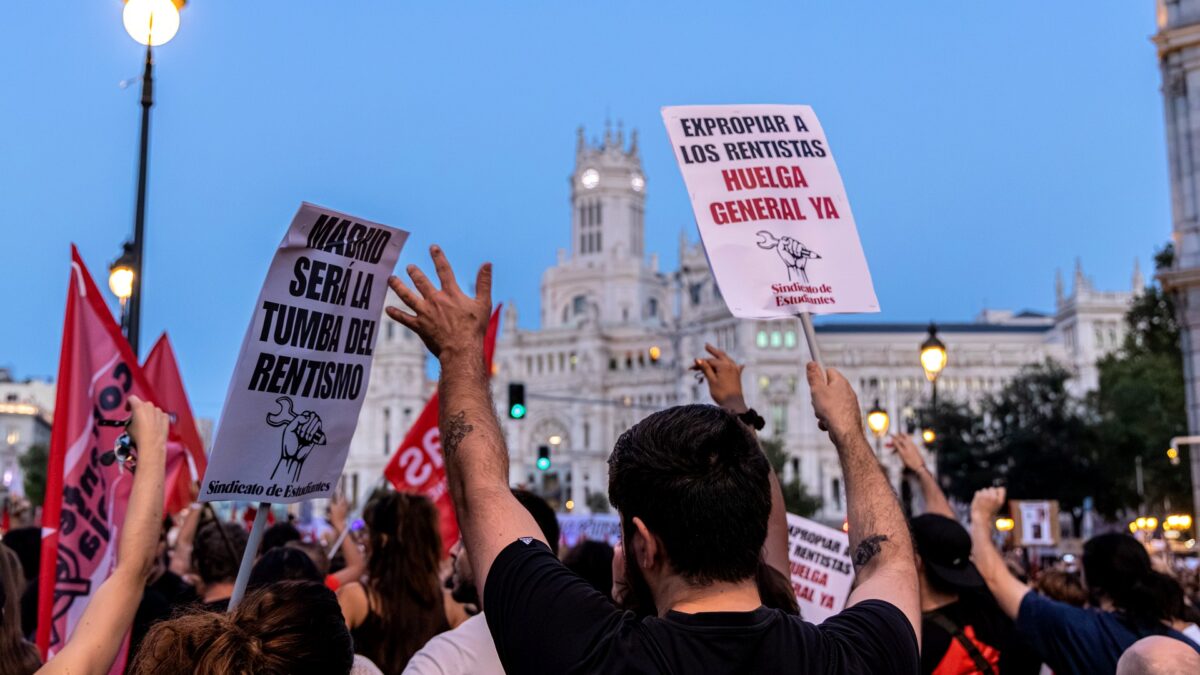
The marches that followed her eviction carried a slogan that should be translated and remembered everywhere: “Not one more Maricarmen.” Not one more old woman thrown out of the home she built her life in. Not one more family told that their street belongs to a spreadsheet now. In the Plaza de Cibeles in Madrid, on a September evening, demonstrators held up placards that read “Expropriate the landlords: general strike now.” They were not asking for charity. They were naming the thing that had been done to them.
The Day Spain Stopped
The strike they called was the 11N, named for its date, and its slogan was three words long: “Salaries. Housing. Prices.” Three words, because three words were enough. Spain’s two great unions, the UGT and the CCOO, which together represent more than a million workers, called it jointly with tenants’ associations and student unions. It was the first general strike backed by both unions since 14 November 2012, and the first in the country’s history whose principal cause was housing.
The unions said four million workers took part. The tenants’ union said the figure could reach five million by the end of the day. Spain has around twenty-three million workers, so even the cautious reading is that roughly one worker in five stopped work. In the car factories and the ports, the organisers reported participation of ninety per cent, with complete stoppages at the Volkswagen and SEAT plants. Around five per cent of flights were cancelled. Trains, schools, shops, distribution centres, all felt it.
In Madrid, the wide Paseo del Prado became a sea of umbrellas as a huge crowd turned out for the evening march despite heavy rain. On the Gran Vía, protesters held up bunches of keys. Keys. Think about that image. They held up the keys to homes they do not own, keys to doors they cannot afford to open, and they held them up as an accusation. There were ugly moments too. Police sprayed pepper spray and swung batons, and Reuters counted at least seventy-three arrests across the country by nightfall. But the day belonged, overwhelmingly, to ordinary people who had simply had enough.
Unai Sordo, the secretary-general of the CCOO, said the strike had exceeded the unions’ expectations. He was right to be surprised, and wrong about why. Nobody should be surprised that a country stops when its young cannot afford to live in it. The surprise is only that it took this long.
The Arithmetic of Impossibility
Now let me give you the numbers, because the numbers are the indictment. The average rent in Spain is 1,176 euros a month. The Spanish Youth Council, in its May 2026 report, calculated that this single figure consumes 98.7 per cent of a young person’s average monthly salary. Ninety-eight point seven per cent. Read that again. A young Spaniard who rents a flat alone has, on average, one point three per cent of their salary left for everything else. For food. For transport. For clothes. For life.
It is not that young people are lazy, or feckless, or unwilling to work. The young people of Spain work. They simply work in an economy where the mathematics has been rigged against them. Between 2015 and 2025, house prices in Spain rose by 84.6 per cent, according to the National Statistics Institute, while average gross wages rose by 27.85 per cent. In the second quarter of this year, house prices climbed 12.2 per cent in a single year, while wages rose by three to four per cent. The gap is not closing. It is widening, year after year, like a wound that is never allowed to heal.
The result is a generation that cannot leave home. Only 14.5 per cent of Spaniards aged sixteen to twenty-nine have left their parents’ house, the lowest figure the Youth Council has ever recorded. The average age of leaving home is 30.2 years, against 26.3 across the European Union. More than two million people aged between twenty-six and thirty-four, 44.3 per cent of that age group, still live with at least one parent. Of those who stayed, more than a third said they could not afford to rent. These are not children. They are adults, with jobs, with degrees, with ambitions, living in their childhood bedrooms because the country they were born in has priced them out of adulthood.
And those who do rent pay a punishment for it. Oxfam Intermón reported that housing costs have pushed Spain’s in-work poverty rate to 15.49 per cent, affecting around 770,000 people. One in three people who rent at market prices falls into poverty after paying the rent. The Bank of Spain’s own annual report warns that four in ten households living in rented accommodation spend more than forty per cent of their income on rent. Work, in Spain today, no longer guarantees a home. A job is no longer a ladder. For hundreds of thousands of people, it is a treadmill.
And behind all of this sits a simple shortage that nobody in power has been willing to fix. Spain faces a housing deficit of about 750,000 homes, according to the central bank, a figure set to grow beyond one million by 2028. In 2025, around 225,000 new households were formed, and only about 92,000 new homes were completed. Fewer than two per cent of Spain’s housing is publicly owned rental stock, against a European Union average of around eight per cent. The market was left to provide homes, and the market provided assets instead.
Three Acts of the Same Play
But here is what I want you to understand, reader, because this is where the present meets the past, and the past explains the present. This strike did not come from nowhere. It is the third act of a play that began almost twenty years ago.
Act one was 2008. Spain’s great housing bubble burst, and the country learned what it means when homes are treated as chips in a casino. The banks that had lent recklessly were rescued. The families that had borrowed in good faith were evicted. The word for eviction in Spain, desahucio, entered the language of everyday life, and a movement of the evicted rose up to defend their neighbours from the bailiffs. The state saved the lenders and abandoned the tenants. Remember that sentence, because everything that followed flows from it.
Act two was 2012. On 14 November of that year, the last time Spain held a general strike, workers stopped the country against the austerity measures imposed during the eurozone debt crisis. They were told the pain was necessary, that the country must tighten its belt, that sacrifice today would bring prosperity tomorrow. Fourteen years later, the prosperity never arrived for the people who sacrificed, but the property market recovered beautifully for those who owned it. The funds moved in. The rents climbed. The wages stood still.
And now act three, 2026. The generation that was a child in 2008 and a teenager in 2012 is now an adult, and it has discovered that the promise made to it was never kept. Work hard, they were told, and you will have a home. They worked hard. There is no home. So they stopped work. Do you see the symmetry? In 2012, the workers struck because the state took their money to save the banks. In 2026, they struck because the banks’ successors, the funds, are taking their homes. It is the same story, told twice, and the second telling is angrier because the lesson was not learned the first time.
History does not repeat itself, the saying goes. It rhymes. But sometimes it does something worse than rhyme. Sometimes it returns to collect a debt.
The Rentier and the Key
There is a word on the placards in Madrid that has no clean equivalent in English: rentismo. The rule of the rentier. The rentier is the person who grows rich not by making anything, not by building anything, not by working at anything, but by owning the thing everyone else needs and charging for access to it. The land. The flat. The roof. In the old order, the lord owned the land and the peasant paid him for the right to live on it. Today the fund owns the block and the worker pays it for the right to sleep in it. The costume has changed. The relationship has not.
That is why the protesters held up keys. A key is a small thing, but it is the most honest symbol in this whole story. A key means: this door opens for me. This place is mine to enter. I belong here. When a young Spaniard holds up a key on the Gran Vía, they are saying something that no economist can measure and no minister can dismiss: I work, I pay taxes, I am a citizen of this country, and I cannot open a door of my own. What kind of citizenship is that?
Ask yourself the same question wherever you live. In how many of the world’s great cities can a teacher, a nurse, a bus driver, a young journalist starting out, afford a home near the place they work? The arithmetic of Madrid is the arithmetic of London, of New York, of Sydney, of Toronto. The numbers differ. The story does not. Everywhere, the home has been turned from a place to live into an asset to trade, and everywhere the people who actually live in cities are being priced out of them. Spain is only the first country where the people stopped the whole nation to say so.
The Election in the Shadow of the Strike
None of this is happening in a vacuum. Spain goes to the polls on 29 November, less than three weeks after the strike, in a snap general election. Prime Minister Pedro Sánchez hopes to ride the anger over housing, to turn the resentment of tenants into votes for his left-wing coalition, and to shift the conversation away from the corruption cases touching his inner circle and the deadly train crash of last month.
His opponents call the strike an electoral stunt. Miguel Tellado, speaking for the conservative Popular Party, dismissed it as “an electoral strike” rather than a general strike. There is a cynical reading of everything in politics, and the cynics are not always wrong. But notice what the cynical reading concedes. It concedes that housing is the question on which this election will be won or lost. It concedes that millions of people are angry enough to stop work over it. A strike that the opposition calls electoral is still a strike. Four million people do not stop work for a slogan. They stop work because the rent is due.
The deeper question, the one the election cannot answer by itself, is whether any government can fix a market it spent decades refusing to govern. The demands of the strike are concrete: rent controls that bite, an end to tourist flats eating the housing stock, a crackdown on speculation, automatic renewal of leases, and a real programme of public housing. These are not revolutionary demands. They are the demands of people who want the rules of the market to remember that a home is not a share certificate. Whether the politicians who promise them will deliver them, after the votes are counted, is another question entirely. Spain has heard promises before.
What Spain Is Really Asking
So what, in the end, is Spain asking for? Not charity. Not pity. The marchers are not asking to be given homes. They are asking to be allowed to earn them. They are asking for a country in which a month’s work buys a month’s shelter, with something left over for a life. That is not a radical demand. It is the oldest bargain in the world: labour in exchange for a roof. When a society breaks that bargain, it breaks the first promise it makes to its people, and no amount of growth figures or stock market records can paper over the crack.
There is a lesson here for every government that believes housing is a market like any other, and for every investor who believes a home is an asset like any other. A share certificate does not need to sleep at night. A flat does. A bond does not have a grandmother who has lived in it for seventy years. A building does. When you treat the place where human beings live as though it were a number on a screen, the human beings will eventually come to your door and remind you of the difference. In Madrid, they came with keys in their hands.
Maricarmen is eighty-seven years old. She lived in one flat for seventy years, and she lost it to a fund that raised her rent fivefold. The marchers have promised her that she will be the last. “Not one more Maricarmen.” It is a beautiful promise. It is also a test. A society is judged, in the end, not by how high its towers rise, but by whether the people who build them, clean them, teach in them and heal in them can afford to live inside them.
On the 11th of November, Spain stopped to ask that question. On the 29th, it will vote on the answer. And the rest of the world, which shares the same arithmetic and the same anger, will be watching to see whether a country can still be made to listen when its people, politely and then not so politely, refuse to carry on as before. The keys are in their hands. The question is whether anyone in power will finally open the door.
Sources & References
- Reuters via CNN — Millions of Spaniards stage first general strike in 14 years as anger rages over housing
- NPR via WHRO — Spain’s workers hold a general strike over housing costs before national election
- Common Dreams via Naked Capitalism — ‘A Mobilization That No One Imagined’: Furious Over Housing Costs, Millions Join General Strike in Spain
- Daily Guardian EU — ‘Having money is not enough’: Why a job no longer guarantees access to housing in Spain
- Radical Centre — €350 out of €1,300: what young people in Spain really pay for housing
- RusSpain — Rising Rents Force Young Spaniards Like Ana Ramos Back Home

About the Author — Abdul Mannan
Related Articles

The War Is ‘Effectively Over’ — But Iran Remains Behind an Iron Gate
The guns have gone quiet over Iran, but the gates have not opened. With Task Force Iron Gate,…

Eighty-One Years to Overnight Success: M. John Harrison, the Booker Prize, and the Revenge of the Patient Writer
On Monday night in London, an 81-year-old writer who spent sixty years outside the literary establishment's favour became…

The Night America Changed Its Mind: What the 2026 Midterms Really Mean
On 3 November 2026, American voters delivered a verdict that rewrote history: Democrats retook Congress and elected the…