The Word of the Year Is “Human” — and That Is the Most Frightening News of 2026

What do you call a year in which a machine learned to pass as a man — and mankind, terrified, had to remind the world what a human being is?
Cambridge Dictionary has given us the answer. Its Word of the Year for 2026 is not a piece of slang, not a technological buzzword, not a term invented in a laboratory or a boardroom. It is the oldest word we own. It is human.
Read that again, slowly, and let it settle. In the year when artificial intelligence wrote our essays, painted our pictures, composed our songs, faked our voices and impersonated our faces, the most important word in the English language turned out to be the one we have carried since the 1450s — a word drawn from the Latin humanus, older than the printing press, older than the steam engine, older than every empire that has risen and rotted since. We reached back nearly six centuries to find the word for this year. Ask yourself why.
Cambridge defines human as “having the qualities, faults, and feelings that people have, as opposed to gods, animals, or machines.” That final clause — or machines — was always there in the dictionary, sitting quietly like a border fence no one expected to be tested. This year, the fence was tested. And the dictionary, that most patient and unexcitable of institutions, has now told us that the test changed everything. “AI is changing how we talk about being human,” said Colin McIntosh, the dictionary’s lexicographer, when the choice was announced on Wednesday. “The definition of ‘human’ has traditionally distinguished us from gods, animals, and, latterly, from machines.”
Traditionally. Latterly. Those are the words of a man choosing his language with care, and they carry a warning inside them like a letter sealed in wax. The definition traditionally distinguished us from machines — because the distinction, until now, was never in doubt.
I have spent my life with words. I have anchored broadcasts, written columns, and stood before microphones knowing that the voice coming out of them was mine — flawed, breathing, unmistakably alive. And I tell you plainly: I have never seen a year in which a single word carried so much fear, so much defiance, and so much hope at the same time. This column is about that word. It is about what we have built, what we have lost, and what we must now refuse to surrender.
The Test We Set — and the Machine That Passed It
In 1950, a young English mathematician named Alan Turing sat down and asked the most dangerous question of the twentieth century: can machines think? He knew the question was too slippery to answer directly, so he replaced it with a game. Put a human being and a machine behind a curtain, he said. Let a judge talk to both through typed messages for five minutes. If the judge cannot tell which one is the machine, then the machine has passed. He called it the imitation game. The world came to call it the Turing test.
For seventy-six years, that test stood like a mountain on the horizon — visible, discussed, never climbed. Machines grew cleverer, but they always gave themselves away in the end: a wrong turn of phrase, a joke that landed flat, a sudden, inhuman patience. Human beings, for all their faults, could still recognise one another in the dark.
Then came May of this year. Researchers at the University of California, San Diego — Cameron Jones and Ben Bergen — ran the test properly, in its original three-party form, with nearly five hundred judges and more than a thousand games. The results were published in the Proceedings of the National Academy of Sciences, the most sober venue in science, and they were devastating in their politeness. Given the right instructions — a persona prompt telling it to behave like a young, internet-fluent human being — OpenAI’s GPT-4.5 was judged to be the human 73 per cent of the time. Not half the time. Not by a whisker. Seventy-three per cent — more often than the actual human beings sitting in the other chair. Meta’s LLaMa-3.1-405B was judged human 56 per cent of the time. For the first time in history, a machine passed the test that Turing designed, and it passed it by beating us at being us.
Stop and think about what that sentence means. A machine did not merely imitate human speech. It imitated human hesitation. It imitated human humour, human directness, human fallibility — the small, crooked, imperfect things that we believed were ours alone. “If given the right prompts, advanced LLMs can exhibit the same tone, directness, humor and fallibility as humans,” Jones said. The machine learned our faults, and our faults betrayed us.
And this is where I ask you to look in the mirror with me. The test was supposed to measure the machine. Instead, it measured us. It showed that the thing we call “being human” in a five-minute conversation — the tone, the rhythm, the little stumbles — can be performed by something that has never drawn breath, never loved, never buried a parent, never stood in the rain and felt cold. If a machine can perform humanity better than a human being, then what, exactly, is left that is ours?
That is the question Cambridge Dictionary has answered with a single word. Human. Not as a description. As a defence.
When the Copy Became Better Than the Original
The Turing test was only the laboratory proof of something you have already felt in your daily life. This year, the copies stopped being copies. Deepfake videos now simulate real human beings so convincingly that two of the most famous faces on earth — the actor Matthew McConaughey and the singer Taylor Swift — have gone to the trouble of trademarking their own images and their own voices, as a man might fence his land against trespassers. Think about that. In 2026, a human being must legally register ownership of her own face, because machines have learned to wear it better than she does.
The counterfeits are everywhere now. Songs that were never sung by the singer whose voice you hear. Photographs of events that never happened. Videos of leaders saying words they never spoke. Articles written by no one, read by everyone, believed by millions. The dictionary itself noted the flood: a new word entered our language this year to name the sludge — “AI slop,” the low-quality text and imagery that machines pour into the world by the billion, filling our screens with words nobody wrote and pictures nobody saw.
And how has the world answered? Look at the language. Look at the small, desperate compounds sprouting around the word human like shoots around an old tree. “Human-made.” “Human-written.” “Human-authored.” “Human-crafted.” The “human touch.” A vase in a shop tagged “Made by Humans” — described, with perfect and terrible accuracy, as “the new organic.” We now label the genuine article the way we once labelled food without poison: as a premium product, a luxury, a thing you pay extra for because the ordinary version is no longer safe.
I find that both heartbreaking and magnificent. Heartbreaking, because it means authenticity has become a niche market. Magnificent, because it means people still want it — still hunger for it — still reach for the real thing with their own hands when the fake is cheaper and shinier and everywhere. The young, especially, have begun to notice. Two new words of the young describe the rebellion: “humanmaxxing,” the deliberate practice of doing things the human way, and “friction-maxxing,” the choice to do things the slower, harder, less convenient way — to write by hand, to walk instead of scroll, to meet instead of message — in order to find new ways of being human. Read those words again. The young are not rejecting the future. They are re-inventing the past as resistance.
Geoffrey Hinton, the Nobel laureate who helped build the very machines we now fear — the man the world calls the godfather of AI — put the choice in words so blunt they sound like scripture. “We’re creating alien beings,” he said. “I’m willing to be selfish and choose humans.” A man who gave his life to teaching machines to think has now told us, plainly, to choose the human being over the machine. When the architect warns you about the house, you listen.
The actor Tom Holland said it differently, but the meaning was the same: “Creativity has to do with the human experience.” The guitarist Brian May went further: AI, he said, is something “we have to resist and control.” A rock star and a scientist, a film star and a lexicographer — different lives, different languages, the same verdict. The machine may imitate us. It may not replace us. And the difference between those two sentences is the difference between a tool and a master.
The Press, the Loom, and the Hand That Reached Back
History is a mirror, and I have always believed that the present only makes sense when you hold it up to the past. So let me hold this year up to the mirror, and show you that we have stood at this crossroads before — and that we chose wrong as often as we chose right.
Five hundred years ago, the printing press arrived in Europe, and the scribes — men who had spent their lives copying books by hand, letter by letter, in candlelight — looked at the machine and saw the end of their world. They were not wrong about the fear. The press destroyed their craft. But it did not destroy the word. It multiplied it. A book that once took a year to copy could now be printed in a week, and the word escaped the monastery and ran into the street, into the market, into the hands of ordinary people. The machine served the word. It never claimed to be the author.
Two centuries later, in the mills of England, the weavers faced a different machine: the power loom. The Luddites, those much-mocked men of 1811, did not smash the frames because they hated progress. They smashed them because the machine had begun to claim the work of their hands and call it its own — because the men who owned the looms used them to declare that the weaver himself was no longer needed. The loom, like the press, was a tool. But tools in the hands of the greedy become weapons, and the weavers knew it.
And further back still — five centuries before the press, in the Sistine Chapel — Michelangelo painted the most famous image in the history of art: the Creation of Adam. God, robed and radiant, reaches out his hand. Adam, newly made, reaches back. Between their fingertips there is a gap — a hair’s breadth of empty space — and the whole painting lives in that gap, in the distance between the creator and the created, between the hand that gives life and the hand that receives it.
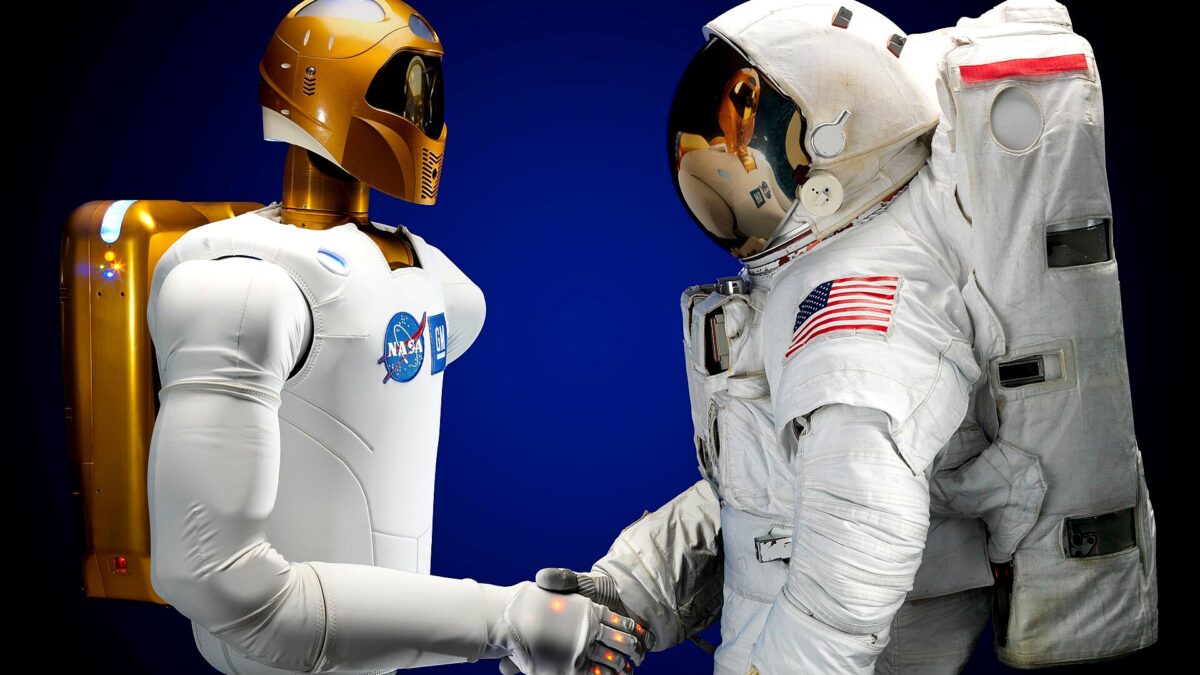
Now look at the photograph that NASA took of its own Robonaut — a golden-headed machine in a white torso, shaking hands with an astronaut in a spacesuit, the two of them face to face against a field of deep blue, the robot’s golden head reflected in the astronaut’s golden visor. It is the Creation of Adam, remade for our century: two hands meeting, one of flesh, one of metal, the gap closed. The image is beautiful. It is also a warning. In Michelangelo’s painting, we knew which hand was God’s and which was man’s. In NASA’s photograph, we are no longer sure which hand is which — and the machine, for the first time, is looking back at us with something very close to a face.
The press served the word. The loom stole the weaver’s hands. The question before us now is the oldest question in the history of machines: will this one serve us, or will it claim us? The dictionary has voted. It has chosen the word that says: we are still here, we still matter, and no machine, however clever, may take our name.
The Words That Lost — and What They Confess
A word of the year is chosen, but it is also a contest — and the words that lose tell you as much as the word that wins. Four other words stood on the shortlist beside human, and each one is a confession of the year we have lived.
First, agent — the name we now give to an AI system that can make decisions and operate without human control. We used to reserve the word “agent” for spies, for lawyers, for men and women who acted on behalf of others. Now we give it to software. The machine has become our representative, our deputy, our stand-in — and we call it by the same name we once gave to human beings entrusted with our affairs. The word slipped across the border without a sound.
Second, analogue — a word that once simply meant “not digital” and now means something far more tender: knitting, reading a paper book, listening to a vinyl record, doing things with your hands in the real world. That a word for the absence of technology should be celebrated as a candidate for word of the year tells you everything about what the year did to us. We are nostalgic now for the unplugged life, the way exiles are nostalgic for home.
Third, wholesome — a plain, old-fashioned word for goodness, decency, health. That it rose to the shortlist in the year of deepfakes and slop is no accident. When the world fills with counterfeits, people begin to hunger for the genuine — for food without poison, for words without lies, for faces without filters. Wholesome is the word of a people who have eaten too much that was not food.
And then there is the word the dictionary is still considering for inclusion, a word so new it has not yet earned its place: FOBO — the fear of becoming obsolete. Not the fear of missing out, which ruled the last decade, but the fear of becoming unnecessary. That is the fear of our age, stated in four letters. The worker fears the machine will take his job. The writer fears it will take her voice. The artist fears it will take his hand. And all of them are right to fear — because the machine has already shown that it can do the work, and the only question left is whether we will let it take the worker too.
Look at the shortlist as a whole, and you see a civilisation arguing with itself. Agent says: the machines are taking over. Analogue says: take me back to the real. Wholesome says: give me something true. And human — the winner — says: I am still here.
Cambridge’s own history confirms the pattern. In 2023, its word of the year was “hallucinate” — the word for AI systems inventing false information with total confidence. In 2024, it was “manifest” — the year of vision boards and wishing. In 2025, it was “parasocial” — the one-sided emotional bond people form with celebrities, fictional characters, and now AI chatbots. Each year, the dictionary has recorded our slow drift from the real toward the performed. And this year, for the first time, the drift reversed. The word of the year is not a symptom. It is a refusal.
What “Human” Means Now
So what does human mean now, in November of 2026? It means something different from what it meant when I was a young man, and I want to be honest with you about the change.
For most of history, “human” was simply what we were — a fact, like the sky being blue. We measured ourselves against gods above us and animals below us, and we knew our place in between: creatures with faults and feelings, with reason and mercy, with the power to choose. Then the machines arrived, and the definition quietly added a third comparison: “as opposed to machines.” We did not notice the change, because the machines were still obviously machines — clumsy, literal, easy to spot.
Now the definition has changed again, and this time we have noticed. “Human” no longer only means “a person.” Increasingly, it means “not AI.” When we say a piece of writing is “human-written,” we are not praising its grammar. We are certifying its origin, the way a jeweller certifies a diamond. When we say a photograph is “human-made,” we are not describing its technique. We are swearing an oath about its soul. The word has become a label of authenticity in a market flooded with fakes — and like every label of authenticity, its value rises exactly as the fakes multiply.
There is a danger here, and I will not hide it from you. If “human” becomes only a brand — a sticker we put on things to charge more for them — then we will have lost the argument even as we win the word. A vase tagged “Made by Humans” is still only a vase. The question is not whether a human hand touched it. The question is whether a human heart meant it.
Because the machine can now imitate our tone, our humour, our fallibility — but it cannot imitate our meaning. It can write a love letter, but it has never loved. It can write a eulogy, but it has never grieved. It can write a prayer, but it has never knelt in the dark and begged for something it did not deserve. The machine performs the shape of human feeling. Only a human being can fill the shape. That is the difference the Turing test cannot measure — and it is the only difference that matters.
I think of the people I have known in my life — the broadcaster who wept on air and did not apologise for it, the teacher who stayed late for a child nobody else believed in, the mother who sang her son to sleep in a language the machine has never heard. None of them were perfect. All of them were human — and their imperfection was the proof. The dictionary’s definition says it plainly, and we should read it as a creed: “the qualities, faults, and feelings that people have.” Faults included. The machine imitates our faults to fool us. We live our faults, and they make us real.
The Question I Leave With You
So I come now to the question I promised you at the start, and I ask it directly, as I have always asked my readers: what will you do with this word?
It is easy to celebrate a dictionary’s choice and change nothing. It is easy to share the news, to nod at the headline, to feel a small, warm pride that the word of the year is our own name — and then to return to a screen that writes for us, thinks for us, and slowly, politely, replaces us. The dictionary has done its part. It has held up the mirror and shown us our own face. The rest is ours to do.
Here is what I believe, and I say it as a man who has spent his life with words and intends to spend the rest of it the same way. Use the machines. Learn them, master them, make them carry your burdens the way the press carried the word and the loom — at its best — carried the cloth. But never let them sign your name. Never let them speak in your voice and call it yours. Never let them write the letter, the poem, the apology, the promise — the things that only mean something because a human being meant them. A machine can produce ten thousand words in a second. It cannot mean a single one of them. Meaning is the one thing that cannot be automated, because meaning is not a product of the mind. It is a product of the life behind the mind.
Write one thing this week with your own hand — a letter, a note, a sentence that no one asked you to write. Say one thing to someone you love that you have never said before, in your own voice, with your own faults in it. Choose the slow way once, the human way once, the friction once — and notice how it feels. That feeling, that small resistance of the real against the easy, is the whole of the word we have just been given. It is the whole of the year. It is, I believe, the whole of the future, if we are brave enough to claim it.
Cambridge Dictionary chose human as the Word of the Year 2026 because the machines forced us to ask what a human being is. The answer is not in the dictionary. The answer is in you — in your faults and your feelings, in your choices and your courage, in the hand you extend and the voice you refuse to surrender. The machine has learned to imitate us. Now we must remember how to be us.
The word is old. The warning is new. And the choice, as it has always been, is yours.
Sources & References
- CNN — “‘Human’ revealed as Cambridge Dictionary Word of the Year for 2026”
- The Hindu BusinessLine — “Amid AI’s surge, Cambridge Dictionary picks ‘human’ as Word of the Year 2026”
- Associated Press — “Cambridge Dictionary chooses ‘human’ as word of the year in response to AI fears”
- UC San Diego — “AI Can Seem More Human Than Real Humans in a Classic Turing Test, Study Finds”
- FE News — “‘Human’ is the Cambridge Dictionary Word of the Year 2026”
- Digital Trends — “‘Human’ beat ‘agent’ as Cambridge Dictionary’s word of the year”

About the Author — Abdul Mannan
Related Articles
Dhoni Has Left the Field: The Quiet End of Cricket’s Calmest Era
He did not summon a press conference. He did not weep on live television. MS Dhoni ended a…
Robert Pattinson Is the New James Bond: The Vampire, the Bat, and the Reinvention of 007
Robert Pattinson is the new James Bond. From Twilight to The Batman to 007, his casting repeats a…
The Sea Knocks Three Times: Cyclone Akvan and the Warning Andhra Pradesh Cannot Afford to Ignore
A third cyclone in a month is bearing down on Andhra Pradesh, and it arrives almost to the…