The $190 Million Painting a Dying Man Could Not Sell: Van Gogh, the Chestnut Tree, and the Price of Genius

What is a painting worth?
Ask the question in a quiet room and it sounds like philosophy. Ask it in a New York saleroom, with an auctioneer’s gavel in the air and billionaires on the telephones, and it becomes something else entirely: a number, shouted in five-million-dollar steps, until the room falls silent and history has a new price tag.
On Wednesday night, 18 November 2026, in the Manhattan saleroom of Sotheby’s, that number was one hundred and ninety million, four hundred thousand dollars. It was paid for a canvas painted in a few days, one hundred and thirty-six years ago, by a man of thirty-seven who had just walked out of a lunatic asylum, who had almost no money, almost no buyers, and — as far as he knew — almost no future. Within two months of painting it, Vincent van Gogh was dead.
Stop there. Read those two sentences again, and let them stand side by side, because everything this story has to teach us lives in the space between them. A dying man paints a tree. A century later, the richest men on earth fight for three minutes over the right to own it. The painter received nothing. The painting received everything. And somewhere between the asylum at Saint-Rémy and the auction room in New York, the world performed its oldest and cruellest trick: it buried the prophet first, and only then began to worship him.
Three Minutes in New York
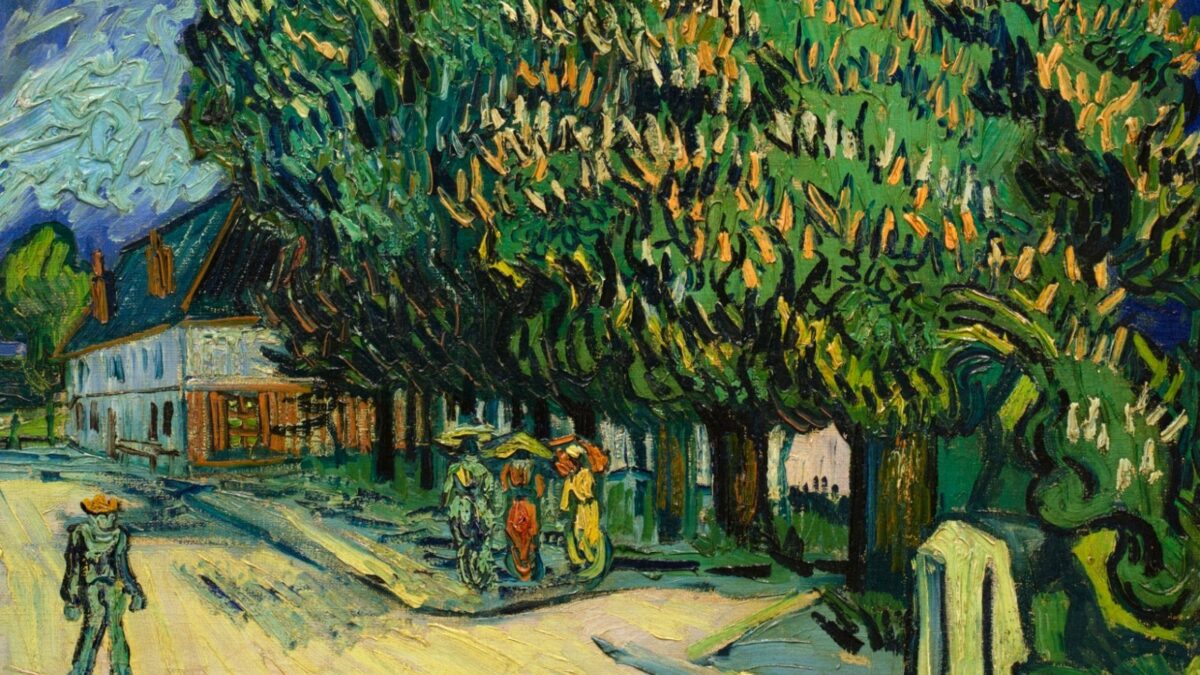
The painting is called Châtaigniers en fleurs — Blossoming Chestnut Trees. It shows a village street in Auvers-sur-Oise, a small town north-west of Paris, beneath the vast green crown of a chestnut tree in flower. A man in a straw hat walks the sunlit road. Women with parasols talk beneath the branches. A white house stands in the shade. The sky above is the deep, restless blue that only Van Gogh ever painted — a sky that seems to move even when you stand still before it.
It was the most valuable lot offered by any auction house in New York this season, and the room knew it. The bidding opened at one hundred and thirty-five million dollars. Auctioneer Oliver Barker called the increments — five million at a time — and in less than five minutes it was over. The hammer fell at one hundred and sixty-five million dollars. With Sotheby’s fees added, the final price came to one hundred and ninety point four million dollars: about one hundred and forty-five million pounds.
The winning bidder was William Acquavella, the veteran Manhattan dealer who runs Acquavella Galleries, seated in the front of the room with his two adult sons, Alex and Nick. He had come for the painting, and he had not come to lose it.
Consider what that price means. It shattered Van Gogh’s previous auction record — one hundred and seventeen point two million dollars, paid in 2022 at Christie’s for Orchard with Cypresses from the estate of Microsoft co-founder Paul Allen — by more than seventy-three million dollars, a leap of roughly sixty per cent. It made Blossoming Chestnut Trees the second most valuable object ever sold at Sotheby’s, behind only Gustav Klimt’s Portrait of Elisabeth Lederer, which fetched two hundred and thirty-six point four million dollars last November. And it made the painting the fourth most expensive painting ever sold at auction anywhere in the world, behind works by Leonardo da Vinci, Klimt and Andy Warhol.
Three minutes. Five-million-dollar steps. A record broken by seventy-three million dollars. And yet — and this is the part the headlines will not dwell on — the bidding was, by the standards of such nights, thin. The painting had been estimated at around one hundred and eighty million dollars, and it hammered below that estimate. It was not the only lot to do so. Six of the twelve works from the Blaquier-Arrieta collection hammered below their low estimates; five sold within their ranges; only one exceeded expectations. The collection as a whole, billed as the most valuable to come to auction in New York this season, brought in three hundred and fifty-eight million dollars before fees — four hundred and twelve million with them — against an estimate of roughly four hundred and fifty million. Even the two sales combined, which totalled seven hundred and seventy-seven point eight million dollars with fees, could not hide the fact that the market, for all its fireworks, was holding its breath.
Hold that thought, because it matters. A record price and a nervous market, in the same evening, in the same room. The world will pay almost any price for a Van Gogh — and yet it is no longer sure what anything is worth. That contradiction is not an accident. It is the story of our age, written in dollar signs.
The Man Who Could Not Sell a Painting
But before we talk about the money, let us talk about the man, because the money is the least interesting thing about this painting. Indeed, the money is almost an insult to it — a glittering, vulgar footnote to a life that the world treated with contempt while it lasted.
Vincent van Gogh sold exactly one painting in his entire lifetime. One. It was called The Red Vineyard, and it sold in Brussels in 1890 — the year he died — for four hundred francs, to a Belgian artist named Anna Boch. Four hundred francs. That was the sum total of the world’s commercial judgement upon the man who would one day command one hundred and ninety million dollars for a single canvas.
Think about that, honestly, and do not look away from it. The greatest painter of the modern age — the man whose sunflowers and starry nights now hang in the temples of every great city on earth — lived on money sent by his younger brother Theo, an art dealer in Paris, who believed in him when nobody else did. He ate badly. He dressed badly. He was mocked, pitied, and dismissed as a madman. He wrote hundreds of letters to Theo — letters that are now counted among the great documents of the human soul — in which he poured out his hopes, his theories of colour, his loneliness, and his faith that one day, somehow, his work would be understood.
He was right. He was simply a century too early.
And here, reader, is where history holds up its mirror to us, as it always does to those willing to look. For Van Gogh’s story is not only the story of one Dutchman with a brush. It is the story of how every age treats its prophets. The poet is ignored and the singer is mocked; the reformer is called a traitor and the visionary is called a lunatic. Then the prophet dies, the singer’s voice falls silent, the reformer is buried — and suddenly the very same world that starved them begins to build them monuments, print their faces on stamps, and pay fortunes for the things they made in hunger. We did not merely fail Van Gogh. We have failed him in every generation since, under different names, in different countries, with different excuses. The names change. The pattern does not.
Ask yourself this question tonight, and answer it without flinching: how many living Van Goghs are around you right now — the painter, the poet, the teacher, the young man with an idea too large for his town — and what are you doing for them while they are still alive to be helped? Or will you, like the world, wait until they are safely dead before discovering their genius? The auction room has already answered that question for us. Its answer is written in the price of a painting whose maker could not afford his own paints.
A Tree Painted by a Dying Man
There is another reason this particular painting haunts the imagination, and it has nothing to do with money. It has to do with time.
Van Gogh painted Blossoming Chestnut Trees around 24 May 1890, in Auvers-sur-Oise. He had arrived in the village only days earlier, on 20 May, after spending a year as a patient in the asylum of Saint-Rémy-de-Provence, where he had suffered the worst crisis of his life. He was, by his own account and by the account of those who knew him, trying to begin again. He wrote to Theo with cautious hope. He painted with furious energy — some seventy paintings in the seventy days he had left.
Look at the painting again with that knowledge, and it changes before your eyes. The chestnut tree is not merely a tree. It is a living thing in full flower, green and gold against a violent blue sky — life insisting on itself, loudly, in the face of everything. The villagers walk in the sunlight beneath it, ordinary people on an ordinary day, unaware that they are standing inside a masterpiece. And the man who painted them had two months to live. He died on 29 July 1890, aged thirty-seven, from a gunshot wound whose full circumstances remain debated to this day. Theo, his brother, his only true friend in the world, died six months later, broken by grief.
This is why the painting was hidden from public view for more than half a century. After Van Gogh’s death it passed through the hands of his family and dealers, and eventually into a private collection in Argentina, where it hung unseen by the world for decades. The world forgot it existed. And then, on a Wednesday night in November, it reappeared — and the world remembered, all at once, what it had lost.
There is a lesson here that no auctioneer will ever announce from the rostrum. The tree Van Gogh painted still blossoms every May in Auvers-sur-Oise. It does not know that it is worth one hundred and ninety million dollars. It does not know that it was painted by a genius, or that it was hidden for fifty years, or that men in suits fought over it for three minutes. It simply blossoms, as it has blossomed every spring since the painter stood beneath it with his easel. Nature does not hold auctions. Only men do. And nature, I suspect, has the better of the bargain.
The Other Story in the Room
But there was a second story in that saleroom on Wednesday night, and it is the story that gives this record its moral weight — the story that separates a mere price from a matter of justice.
Before the Blaquier-Arrieta family ever owned the painting, it belonged to Samuel Fischer, a Hungarian-born German Jewish publisher whose house in Berlin published Thomas Mann and Hermann Hesse — two of the greatest writers of the age. Fischer bought the Van Gogh with his wife Hedwig in 1909, and it hung in their Berlin home for a quarter of a century. Then the Nazis came.
In 1936, the painting was sold in Paris to a couple named Henriette and Marcel Kapferer. The Fischer family has always maintained that the sale was made under the duress of Nazi persecution — that their publishing business had been battered by the regime, that they were being forced to flee Berlin, and that the painting was let go because a persecuted family had no real choice. On 12 November, just a week before the sale, the family’s lawyer in Berlin, Gunnar Schnabel, wrote to Sotheby’s challenging the 1936 transaction and asking the house to prove beyond doubt that the painting had been sold at a fair market value — and that the family would have wanted to sell it even without Nazi rule. Sotheby’s answered with records from the Cassirer archive showing a June 1936 price of sixty-eight thousand Swiss francs, roughly twenty-two thousand dollars at the time, and argued that the sum was fair.
The sale itself was almost stopped. And then, on the day before the auction, Sotheby’s announced that a settlement had been reached between the Blaquier heirs and the Fischer heirs, and the sale would go ahead under their agreement. The terms were not disclosed. The house issued a statement acknowledging, in its own words, “the painting’s complex Nazi-era history and the suffering endured by the Fischer family during the Holocaust”, and said the two families had reached “a mutually satisfactory resolution”.
Was justice done? I will not pretend to know. The terms are secret, the money is private, and the dead cannot be asked. But let us be honest about what happened here, because honesty is the least we owe the Fischer family. A painting was sold by a Jewish family in the shadow of the greatest crime in human history. Ninety years later, their grandchildren had to hire a lawyer and write a letter to stop the richest auction house on earth from selling it without answering for that history. And the answer they received was a private settlement, announced hours before the gavel fell, so that the bidding could proceed without the shadow of an ongoing fight.
That is how the world works now: justice as a transaction, completed just in time for commerce. And yet — and yet — I will not call it nothing. Gisela Berman Fischer, Samuel Fischer’s granddaughter, spent years campaigning for the return of her family’s artworks, including a Pissarro looted by the Nazis from their Vienna home in 1938. She did not live to see this settlement, but her fight made it possible. The painting went to auction only after the family’s claim was heard, answered, and settled. That is more than the victims of a thousand other thefts have ever received. The art world is full of paintings with blood on their frames and silence in their provenances. This one, at least, was forced to speak its history aloud before it could be sold.
Here, too, history holds up its mirror. The empires of the past — and the tyrants of the last century — understood something that the auction room understands perfectly: that to steal a people’s art is to steal their memory. The British took the treasures of the Punjab and the palaces of Delhi; the French took the loot of Egypt; the Nazis took the collections of Europe’s Jews, painting by painting, house by house. The looters are always different. The logic is always the same. And the question that faces us now is the same one that faced the Fischer family: when the stolen thing finally comes to light, do we ask where it came from — or do we simply admire the colours and reach for our wallets?
A Night of Records, A Market of Doubts
The Van Gogh was not the only record broken that night. It was an evening of triumphs that, taken together, tell a stranger and more hopeful story than the headline price alone.
Paul Cézanne’s Arlequin, the last of the artist’s four Harlequin paintings still in private hands, hammered at ninety-nine million dollars — one hundred and eleven million with fees — falling short of its one-hundred-and-twenty-million estimate, yet still becoming the most valuable Cézanne from the Harlequin series ever sold at auction.
And then came the two results that should have led every newspaper in the world, but did not. Aaron Douglas, the great painter of the Harlem Renaissance, saw his 1931 masterpiece Harriet Tubman — the abolitionist with her arms raised, breaking a chain — hammer at twelve million dollars, fourteen point four eight million with fees, after a seven-minute bidding battle that at one point pitted a father and daughter against each other on the telephones. His previous auction record was six hundred thousand dollars, set in 2008. The painting’s proceeds will benefit Bennett College, one of only two historically Black women’s colleges in the United States.
Mary Cassatt, the American Impressionist who painted women and children with a tenderness the art world took a century to value, saw her Summertime hammer at eleven million dollars — thirteen point three million with fees — breaking her previous record of seven point four nine million, set at Christie’s in 2022. The painting came from the collection of the late oil tycoon Armand Hammer, and its proceeds will benefit his foundation.
Pause on those two names: a Black artist of the Harlem Renaissance and a woman artist of the nineteenth century, both setting records on the same night as Van Gogh. For a hundred years the auction room was a temple built for dead white men. On Wednesday night, the temple’s doors opened a little wider. That, too, is a kind of justice — slow, partial, and long overdue, but real.
And yet the evening was not the triumph the headline numbers suggest. René Magritte’s L’Ami de l’ordre, from the estate of the beauty pioneer Sydell Miller, did beat its estimate handsomely — thirty-nine million dollars at the hammer, forty-five point five million with fees, against a twenty-five to thirty-five million estimate. But only one lot in the Blaquier-Arrieta sale exceeded expectations: a Pissarro snow scene that hammered at one point six two million dollars against a seven-hundred to nine-hundred-thousand estimate. Only one lot failed outright — Remedios Varo’s El vagabundo, which passed at one point five million — but three more works, by Matisse, Cézanne and Magritte, were withdrawn before they could be offered. The world’s richest collectors are still buying. They are simply no longer buying blindly.
What does that mean? It means that even the market — that cold, unsentimental machine — has begun to sense what the rest of us have known for some time: that the age of easy money is ending, that the old certainties are shaking, and that the only things still certain to hold their value are the things that were never really for sale at all. A Van Gogh. A Douglas. A Cassatt. The things that were made by human hands, in human suffering, for human eyes — not manufactured, not speculated upon, not flipped. The market, without understanding why, is reaching for the real.
What the Money Cannot Buy
And so we return to the question with which we began: what is a painting worth?
The auction room has given its answer: one hundred and ninety million, four hundred thousand dollars. But the auction room’s answer is not the only answer, and it is not the truest one. A painting is worth what it does to the person who stands before it. It is worth the silence it creates in a noisy room. It is worth the village street it preserves, the sunlight it remembers, the hand that painted it in the last weeks of a short and tormented life. None of those things can be hammered, or bid upon, or carried out of a saleroom in a crate.
Van Gogh believed, in the last months of his life, that he had failed. He wrote to Theo that he felt his work had come to nothing. He was wrong — but he died believing it, and no amount of money paid since can change the fact that the world let him die believing it. That is the true scandal of this story, and it is not a scandal about prices. It is a scandal about us. About how we treat the living, and how we honour the dead, and how rarely the two are the same thing.
The chestnut tree in Auvers-sur-Oise will blossom again next May, as it has blossomed every May since 1890. The painting will hang, now, in some private room or some distant museum, behind glass, behind guards, behind a price tag that no ordinary person will ever be able to pay. But the tree itself belongs to no one. The sunlight on that village street belongs to no one. The genius of the man who saw them belongs to everyone — to you, to me, to the child in a classroom who has never heard the name Van Gogh and yet will one day stand before a sunflower and feel something stir that she cannot name.
That is what a painting is worth. Not one hundred and ninety million dollars. Everything. And nothing that money can buy.
So I ask you, reader, one last time: what will you do with the living genius around you, while there is still time to do it? The auctioneer has already given his answer. Now give yours.
Sources & References
- The Art Newspaper — “Van Gogh painting sells for record $190m at Sotheby’s following Nazi loot claims”, 19 November 2026.
- Reuters — “Van Gogh’s ‘Chataigniers en Fleurs’ sells at auction for record $190.4 million”, 19 November 2026.
- Artnet News — “Sotheby’s Notches $778M Night, $190M Van Gogh, But Bidding Is Thin for Blaquier-Arrieta Works”, 19 November 2026.
- The Wall Street Journal — “Van Gogh Painting Sells for $190.4 Million, Most Ever for the Artist”, 19 November 2026.
- Glasgow Times — “Van Gogh painting sells for record £145 million at auction”, 19 November 2026.
- Wikimedia Commons — Vincent van Gogh, Châtaigniers en fleurs (1890), public domain artwork; photograph courtesy Sotheby’s.
Featured image: Vincent van Gogh’s Blossoming Chestnut Trees (Châtaigniers en fleurs), 1890. Photo: Sotheby’s / Wikimedia Commons (public domain artwork).

About the Author — Abdul Mannan
Related Articles

Justice, Nine Years Late: The World Court Finally Calls the Rohingya Atrocity by Its True Name — Genocide
On 19 November 2026, the International Court of Justice ruled that Myanmar committed genocide against the Rohingya —…
GTA 6 Has Arrived — and the Whole World Stopped to Watch
Thirteen years of waiting ended at midnight as Grand Theft Auto VI launched to a record-tying 99 on…

The Word of the Year Is “Human” — and That Is the Most Frightening News of 2026
Cambridge Dictionary has named 'human' its Word of the Year for 2026 — the oldest word we own,…