GTA 6 Has Arrived — and the Whole World Stopped to Watch

What is it that makes millions of grown men and women set an alarm for midnight, sit in the dark with a controller in their hands, and wait for a fictional city to open its gates? Ask yourself that question honestly tonight, because tonight the whole world is doing exactly that. At midnight, in country after country, a game thirteen years in the making finally unlocks — and before a single player has even reached its streets, it has already broken the internet’s back.
I have watched many launches in my life. I have watched elections, wars, coronations, and World Cup finals. But I have rarely watched anything quite like this: a video game so awaited that the very network built to deliver it collapsed under the weight of the waiting. On the eve of its release, the PlayStation Network — Sony’s vast digital highway, used by hundreds of millions — staggered and fell. Players could not sign in. Downloads froze. Error codes flashed across screens like distress signals. And somewhere in the middle of that digital traffic jam sat the reason for it all: Grand Theft Auto VI, the most anticipated entertainment product of our lifetime, finally coming home.
So let me ask you, dear reader, the question this night demands: when was the last time a piece of art made the whole planet hold its breath at the same time?
Thirteen Years of Waiting
Thirteen years. Say the number slowly, and feel its weight. Thirteen years ago, in September 2013, Grand Theft Auto V arrived on the PlayStation 3 and the Xbox 360 — machines that now belong in museums. Barack Obama was in the White House. A teenager who queued for that game in 2013 is today a married adult with a child of his own, and he is queuing again tonight. An entire generation has grown up inside the wait.
Rockstar Games, the studio behind the series, announced Grand Theft Auto VI and then did something almost unheard of in the age of instant gratification: it made the world wait. The game was delayed not once but twice — first from the autumn of 2025, then from May 2026 — and each delay was met not with anger but with a strange, reverent patience. Gamers did not riot. They nodded. Because Rockstar has earned something no marketing budget can buy: trust. The studio’s last two epics, Grand Theft Auto V and Red Dead Redemption 2, both scored 97 on Metacritic, the review aggregator that has become the world’s scoreboard for games. When a studio with that record says “it is not ready,” the world believes it.
And history, as always, is the mirror in which the present must be read. In 2013, Grand Theft Auto V did not merely sell well; it rewrote the record books of human entertainment. On its first day it sold 11.21 million copies and took in 815.7 million dollars. Within three days it had passed one billion dollars — faster than any film, any album, any game in history. Guinness World Records confirmed six sales world records around that launch, including the fastest entertainment property ever to gross a billion dollars. To put that in perspective, Call of Duty: Black Ops II, the previous record holder, had needed fifteen days. The Avengers, the biggest film of its age, needed far longer still. A game about fictional criminals in a fictional California had out-earned the entire machinery of Hollywood.
That is the bar Grand Theft Auto VI must clear tonight. And if the early signs mean anything, it will not merely clear it. It will shatter it. Industry watchers have already reported pre-orders alone passing 1.5 billion dollars before release day — a figure so large it sounds like a misprint, and yet it keeps being repeated by market trackers who have no reason to flatter Rockstar. The game’s first trailer, released back in December 2023, was watched 90.4 million times on YouTube in its first twenty-four hours, making it the most-viewed video game reveal in the platform’s history. People were not merely excited. They were hungry.
A Perfect Score — and a Broken Network
Then came Wednesday morning, 18 November, and the reviews. I want you to understand what happened, because it is genuinely historic. Grand Theft Auto VI scored 99 out of 100 on Metacritic — based on more than a hundred critic reviews, every single one of them positive, not one mixed, not one negative. That ties the record held since 1998 by The Legend of Zelda: Ocarina of Time, a game many critics still call the greatest ever made. Think about that: twenty-eight years. Thousands of games. Nobody had ever matched it — until last night.
The rival aggregator OpenCritic put it at 98. IGN awarded it a perfect 10 out of 10. Game Informer gave it a perfect 10. The Independent’s reviewer, Jake Brigstock, spent sixty-five hours inside the game before writing his verdict — sixty-five hours, more than most people spend at work in a week — and called it, simply, the best game he had ever played. The lowest confirmed score from any major critic was 90. In an industry where a single 7 out of 10 can start a war online, this was unanimity. A chorus. A coronation before the crown had even been worn.
And then, as if the universe wanted to remind us that no triumph comes without irony, the network broke. Hours before launch, PlayStation Network users around the world began reporting that they could not sign in, could not connect, could not download. The outage tracker Downdetector recorded a violent spike in complaints — nearly 1,800 reports in a single burst on Wednesday afternoon — and players shared screenshots of error codes and “services are busy” messages. Sony later confirmed a major outage, even as its own status page insisted, for hours, that all services were up and running. The contradiction itself became part of the story: the machine could not see its own failure, even as millions stared at it.
There is a dark poetry in this. Grand Theft Auto VI is a digital-only release — the boxed copies sold in shops contain a download code instead of a disc — and the game itself is a 210-gigabyte download. That means every single player, on the biggest night in gaming history, had to pass through the same narrow digital doorway at the same time. It is the modern equivalent of a million people trying to enter a stadium through a single gate. Of course the gate buckled. The wonder is not that it broke; the wonder is that anyone expected it to hold.
And here, dear reader, is where the moral of the story begins to form — because the outage is not a footnote. It is the story. We have built a world in which nothing is owned any more, only licensed; in which the game you paid eighty dollars for does not exist on your shelf but on a server a thousand miles away; in which your midnight can be cancelled by someone else’s server room. The players who pre-loaded a week early played at midnight without a care. Those who trusted the network to deliver on the night learned, again, the oldest lesson of the digital age: convenience is a loan, and the interest is paid in moments like these.
The Eighty-Dollar Question
Let us talk about the price, because the price is itself a revolution. Grand Theft Auto VI costs 79.99 dollars for the standard edition and 99.99 dollars for the Ultimate Edition. For the first time in the history of mainstream gaming, the eighty-dollar game has arrived — and the world did not blink. Pre-orders flooded in anyway. Take-Two’s chief executive, Strauss Zelnick, had already told the press that the game would be, in his words, an incredible bargain at eighty dollars, and that the company was not trying to maximise price. The market has answered him with its wallet.
History will judge whether he was right. But consider what eighty dollars buys here. The game’s co-creator Sam Houser almost never speaks in public, and yet on launch day he broke his silence — a rare statement from a man who lets his worlds do the talking. The game runs at thirty frames per second on every console, even the mighty PlayStation 5 Pro, according to the technical analysts at Digital Foundry — a deliberate choice, a trade of speed for scale, of smoothness for sheer density of life. Reviewers describe a world so detailed that its beaches have individual grains of sand in the mind’s eye, its swamps breathe, its cities pulse with a simulated life no game has attempted before. Eighty dollars, for what may be eighty hours or more of that world, is less than a dollar an hour. The cinema charges you fifteen dollars for two.
But the price is also a door closing. When the standard game cost sixty dollars, a teenager could save his pocket money and buy it. At eighty — and at a hundred for the full edition — the hobby quietly becomes a luxury, and the industry quietly admits what it has become: not a pastime, but the largest entertainment business on earth, charging what the market will bear because the market has proven, again and again, that it will bear it. I do not condemn this. I only ask you to notice it. The same week this game launches, food banks in Britain are warning that donations are critically low before winter. The same world, the same week: eighty dollars for a fictional city, and empty shelves for real ones. Hold both facts in your mind at once. That tension is the story of our age.
Vice City, or America in a Mirror
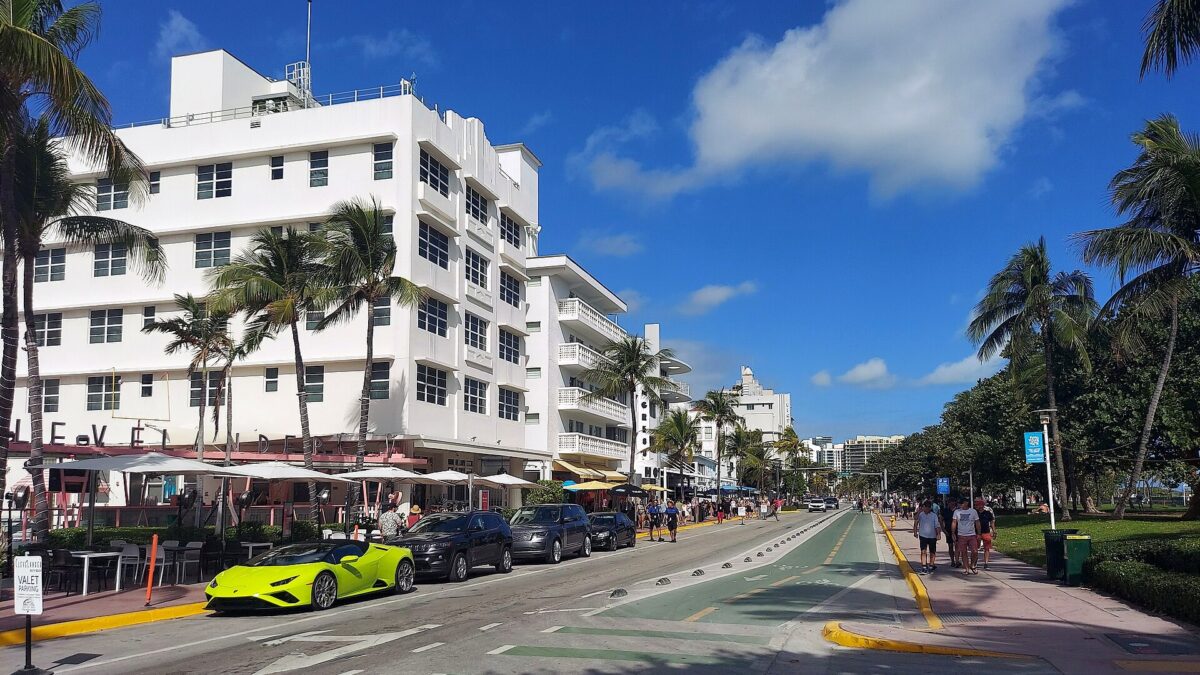
But why does this game matter? Why should anyone who has never held a controller care about a game set in a fictional Florida, in a fictional Miami called Vice City? Because Grand Theft Auto has never really been about crime. It has always been about America — and America, for better and worse, is the mirror in which the whole world still sees itself.
Vice City first appeared in 2002, a neon-soaked love letter to the Miami of the 1980s, all pastel hotels, palm trees, speedboats, and cocaine money. It was a cartoon of American excess, and the world laughed and played along. Now, twenty-four years later, Rockstar returns to that city in a Florida that is no longer a cartoon. The real Florida of 2026 is a state of hurricanes and flooding, of alligators in swimming pools and headlines that read like satire, of a swamp that is literally sinking into the sea. Rockstar’s fictional state of Leonida — Florida with the names changed and the volume turned up — holds up a mirror to a country that has spent the last decade asking itself, loudly and angrily, who it really is.
This is what the great satirists have always done. Jonathan Swift did it with an island of tiny people. George Orwell did it with a farm of talking pigs. Rockstar does it with a stolen car and a city that never sleeps. The game’s two heroes — Jason Duval and Lucia Caminos — are not superheroes. They are, by Rockstar’s own account, two ordinary people on the wrong side of the American Dream, trying to claw their way towards it by the only means their world has left them. Lucia begins the story as a former inmate of the fictional Leonida Penitentiary, a woman the system has already chewed up and spat out. Jason is a man trying to outrun his past. Their story is Bonnie and Clyde for the age of the gig economy: not glamorous criminals, but desperate ones, in a country where the legal road to prosperity has narrowed to a footpath and the illegal one is a six-lane highway.
And here is the uncomfortable truth that makes the game more than entertainment. Millions of people will spend this weekend living inside that fiction because the fiction tells the truth about their lives more honestly than the news does. The news tells you that wages are stagnant and housing is unaffordable and the future is uncertain. Vice City shows you. It lets you feel, in your hands, what it is to be locked out of the dream and to decide — as millions of real people decide every day, in smaller and quieter ways — what you are willing to do to get in.
Lucia and Jason: A New American Story
There is another first tonight, and it matters more than any score. For the first time in the history of the main series, Grand Theft Auto has a woman as one of its two central protagonists. Lucia Caminos, played by the actress Manni L. Perez — whose performance has already earned a nomination for Best Performance at The Game Awards 2026 — is not a sidekick, not a love interest, not a prize to be won. She is the story. She is the one with the past, the plan, and the fury.
Think about how long this took. The series began in 1997. For twenty-nine years, its heroes were men — mostly angry, mostly violent, mostly alone. The world changed around the games while the games refused to change. And now, in 2026, the biggest entertainment launch in human history puts a Latina woman at its centre, in a story about a system that failed her and a partner who chose to stand beside her rather than above her. Whatever you think of video games, that is a cultural shift you can measure in dollars: a hundred dollars for the Ultimate Edition of a story about a woman the world gave up on. The market did not merely accept it. It queued for it.
The game has earned eight nominations at The Game Awards 2026, the industry’s grand ceremony, before most of the world has even played it. That, too, is a sign of the times: the ceremony now anoints what the crowd has already crowned. But the deeper truth is simpler. People do not queue for thirteen years for graphics. They queue for a story. They queue because somewhere in that neon city, in that woman’s anger and that man’s loyalty, they recognise something of themselves — the feeling of being small in a system built for giants, and the stubborn refusal to stay small.
What the Wait Teaches Us
And so we arrive at the question I promised you at the start. What does it mean that the whole world stopped tonight — not for a war, not for an election, not for a disaster, but for a game?
I will tell you what I believe it means, and you may disagree with me, but hear me out. We live in an age that has abolished waiting. Everything arrives instantly: the food, the film, the message, the answer. We have been taught that patience is a defect and delay is an insult. And then comes a studio that says, “No. It is not ready. Wait.” And the world — the same world that riots when a video buffers for three seconds — waits. For thirteen years it waits. And when the wait ends, the reward is not disappointment but a perfect score, a broken network, and a midnight that belongs to everyone at once.
There is a lesson here that goes far beyond games, and it is the lesson the old books tried to teach us. The Quran tells us that God is with the patient. The poets of our tradition — Iqbal above all — warned us that a nation that cannot wait cannot build. The pyramids were not streamed. The great novels were not downloaded. Everything worth having in this world was once waited for, and the waiting was part of the having. Rockstar did not merely make a game. It reminded a generation that has never waited for anything that waiting is not the enemy of joy — it is the price of it.
But there is a warning inside the celebration, too, and I would not be honest if I hid it from you. A world that can unite at midnight for a game and cannot unite at noon for a famine is a world whose priorities have been inverted by the very machines that connect us. The same network that collapsed tonight under the weight of joy collapses every day under the weight of truth — under misinformation, under outrage, under the noise that drowns the signal. We have built a civilisation that can deliver a 210-gigabyte dream to a hundred million homes simultaneously and cannot deliver clean water to a village ten miles from the server farm. That is not Rockstar’s fault. But it is our mirror, and we should have the courage to look into it.
So tonight, as the servers recover and the downloads complete and the neon of Vice City flickers to life on a hundred million screens, I ask you to remember two things. First, that human beings are still capable of shared wonder — that we can still agree, all at once, on a single moment of joy, and that this agreement is itself a kind of miracle in a divided world. And second, that the patience which built this night is a power we have forgotten we own. We waited thirteen years for a game. Imagine what we could build if we waited thirteen years for anything else — for justice, for peace, for a world in which the real cities are as full of promise as the fictional ones.
The game will be judged in the weeks to come, as the scores settle and the players render their verdict. But tonight belongs to the waiting. Thirteen years of waiting, ended at midnight — and the whole world, for once, watching the same horizon together. If that is not worth writing about, then nothing is.
Sources & References
- KeenGamer — “Grand Theft Auto VI Earns a 99 Metascore, Tying Ocarina of Time’s Record” (18 November 2026)
- QNC News — “GTA 6 Ties All-Time Metacritic Record With 99 Review Score” (18 November 2026)
- The Independent — “GTA 6 LIVE: Latest launch news as PlayStation outage hits” (18 November 2026)
- Polygon — “PlayStation Network Outage Hits On GTA 6 Release Day Eve” (18 November 2026)
- Screen Rant — “PlayStation Network Problems: Is GTA 6 Causing An Outage?” (18 November 2026)
- Final Weapon — “PlayStation Network Faces Technical Issues Ahead of Grand Theft Auto VI Launch” (18 November 2026)
- Guinness World Records — “Confirmed: Grand Theft Auto 5 breaks 6 sales world records” (8 October 2013)
- GTA 6 Everything — “Is GTA 6 worth it?” — pricing, editions and review round-up (18 November 2026)
- Journal Todays — “GTA 6 Reviews: 99 Metacritic Ties Ocarina of Time Record” (18 November 2026)

About the Author — Abdul Mannan
Related Articles
The Word of the Year Is “Human” — and That Is the Most Frightening News of 2026
Cambridge Dictionary has named 'human' its Word of the Year for 2026 — the oldest word we own,…
Dhoni Has Left the Field: The Quiet End of Cricket’s Calmest Era
He did not summon a press conference. He did not weep on live television. MS Dhoni ended a…
Robert Pattinson Is the New James Bond: The Vampire, the Bat, and the Reinvention of 007
Robert Pattinson is the new James Bond. From Twilight to The Batman to 007, his casting repeats a…