The Guitar Has Gone Quiet: Remembering Andy Taylor, the Fire Inside Duran Duran

The Silence After the Riff
Have you ever heard a silence that has a sound of its own? Not the silence of an empty room, but the silence that falls when a song you have carried inside you for forty years suddenly loses one of its voices. That is the silence that fell this week. On Monday, 23 November 2026, Andy Taylor died at home, surrounded by his family, at the age of sixty-five, after what his family and his bandmates called, in their joint statement, a long and courageous battle with prostate cancer. The news was announced on Wednesday, 25 November, and within hours the tributes were pouring in from every corner of the world, from rock legends to teenagers who were not yet born when his guitar last shook a stadium. I read them, one after another, and I found myself thinking about something larger than one man’s death. I found myself thinking about what it means when the music of an entire age begins to lose its players, one by one, and what it is that we are really mourning when we mourn them.
Because we are not only mourning a guitarist. We are mourning a decade. We are mourning the sound of our own youth. And we are mourning, whether we know it or not, the passing of a particular kind of honesty in popular music, the kind that Andy Taylor carried in his hands every time he picked up his guitar.
Let me tell you who he was, because the world knew the band, but it did not always know the man. Andrew Taylor was born on 16 February 1961 in Tynemouth, on the cold North East coast of England, and raised in the fishing village of Cullercoats in Northumberland. He was a fisherman’s son. He began learning the guitar at eleven. By thirteen he was playing professionally, in working men’s clubs and later at military bases in Germany, six forty-five-minute sets a day from a repertoire of three hundred songs. Think about that for a moment. Before he was old enough to vote, before he was old enough to drink, this boy had already learned the hardest lesson any musician can learn: that music is not a hobby, it is work, and the audience does not owe you its attention. You earn it, note by note, night after night.
That is the first thing I want you to hold on to, because everything that followed makes sense only in its light. In April 1980, at nineteen years old, Andy Taylor saw an advertisement in the weekly music paper Melody Maker. A band in Birmingham was looking for a live-wire guitarist. He got on a train, travelled south, and auditioned. The band was Duran Duran. Within seven months they had signed to EMI Records. Within a year they had released their debut album. Within two years they owned the world.
The Five Boys Who Painted the Eighties
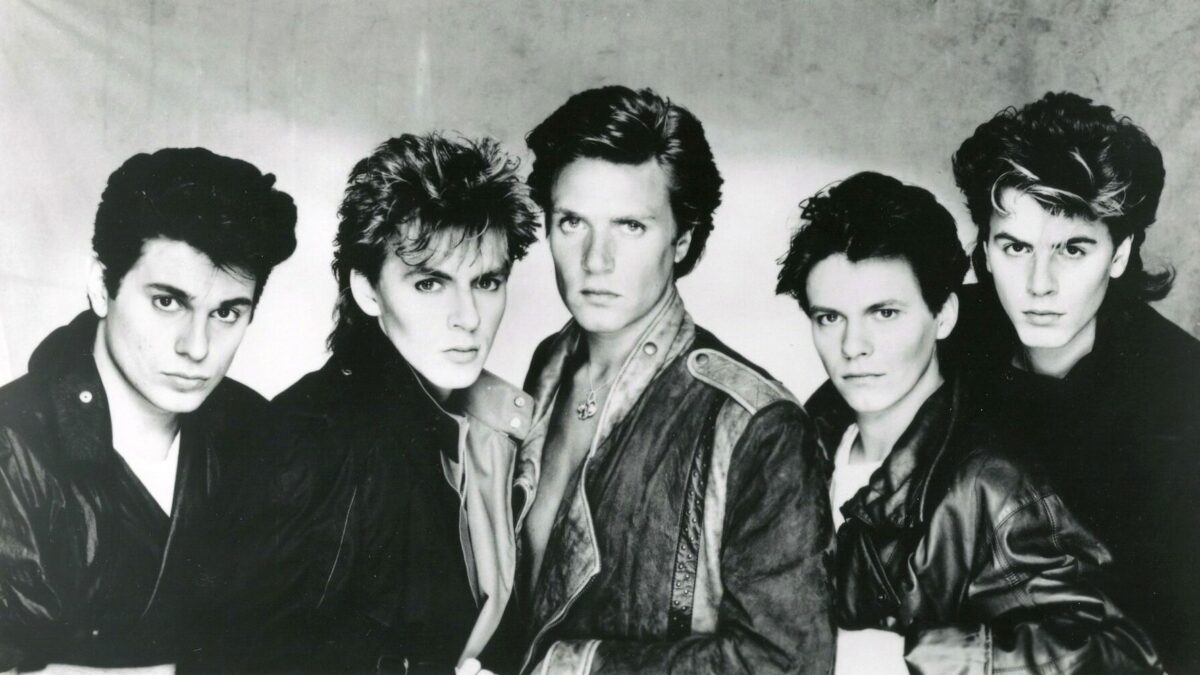
You have to understand what the world looked like in 1981 to understand what Duran Duran did. Music television had just been born. MTV launched in the United States in August 1981, and suddenly a band was not only heard, it was seen, and the image mattered as much as the sound. Duran Duran understood this before almost anyone else. They were beautiful, they were stylish, they filmed their videos like miniature movies on yachts in Sri Lanka and in the deserts of Antigua, and they became the face of the Second British Invasion, the wave of British bands that conquered America through the television screen. Simon Le Bon, the singer. Nick Rhodes, the keyboardist. John Taylor, the bassist. Roger Taylor, the drummer. And Andy Taylor, the guitarist. The press called them the Fab Five, and the name stuck, because that is what they were: five young men who looked like they had stepped out of a fashion magazine and sounded like the future.
But here is the thing the glossy photographs never told you. Beneath the glamour, beneath the silk shirts and the yachts and the videos, there was a spine of steel, and that spine was Andy Taylor’s guitar. Listen to “Rio” again, really listen to it. The keyboards shimmer, the bass dances, Simon Le Bon sings like a matinee idol, and underneath it all, driving it forward, is a guitar riff with the force of a working man’s fist. Listen to “Hungry Like the Wolf”, to “Girls on Film”, to “The Wild Boys”, to “Save a Prayer”. In every one of them, Andy Taylor is the grit in the oyster. He was a rock guitarist, a self-taught Northern boy who had learned his trade in working men’s clubs, playing inside a band that was supposed to be all synthesisers and style. And that tension, that beautiful, electric tension between the gloss and the grit, is precisely what made Duran Duran great. Without him they would have been a fashion shoot with a soundtrack. With him, they were a band.
The numbers tell part of the story. The debut album, Duran Duran, arrived in June 1981. Rio followed in 1982 and became one of the defining records of the decade. Seven and the Ragged Tiger came in 1983. “The Reflex” reached number one in Britain and America in 1984. In that same year, the band won two Grammy Awards, for best music video in both the short-form and long-form categories. In 1985 they recorded “A View to a Kill”, the theme for the James Bond film of the same name, and it became the only Bond theme ever to top the American charts. The band has sold more than one hundred million records around the world. But numbers are a poor way to measure what Andy Taylor did. The true measure is this: forty years later, play the opening bars of “Rio” in any room in the world, and every person over forty in that room will smile before they even know they are smiling. That is not a statistic. That is immortality, of the only kind a musician can hope for.
The Fire That Would Not Be Tamed
And yet the story of Andy Taylor is also a story about the price of the dream, and I do not want to tell you a fairy tale. I want to tell you the truth, because the truth is where the lesson lives. Fame came to those five young men like a flood. By 1985, after Live Aid, after the Bond theme, after the world tours, the band was exhausted and fracturing. Andy Taylor himself wrote about it years later in his autobiography, Wild Boy: My Life in Duran Duran, published in 2008. He described the mood on the way to one show in those final days: they had reached rock bottom and had absolutely nothing to say to each other, and inside their bus the atmosphere was as if they were on their way to a funeral. Read that sentence again. These were young men at the absolute summit of the world, and they were driving to their own funeral. That is what fame does when it is not handled with care. It gives you everything and it takes away the one thing that made it worth having: the joy of making music with people you love.
He left in 1986. He did not disappear. That is the second thing I want you to notice. He formed the supergroup The Power Station with his bandmate John Taylor, the singer Robert Palmer and the Chic drummer Tony Thompson, and their self-titled album reached the top ten in America, driven by “Some Like It Hot” and their cover of “Get It On (Bang a Gong)”. He played the searing lead guitar on Robert Palmer’s “Addicted to Love”, one of the most famous guitar parts of the entire decade. He released his debut solo album, Thunder, in 1987. He co-wrote and co-produced Rod Stewart’s album Out of Order in 1988, including the hit “Forever Young”, and he played lead guitar on Belinda Carlisle’s “Mad About You”. Do you see the pattern? Wherever Andy Taylor went, the songs got sharper. He was, in the words of his bandmate John Taylor this week, a killer riff-merchant, a melodist, a singer with a great voice. He was the man other stars called when they needed their record to have a pulse.
And then, in 2001, came the reunion that nobody had dared to hope for. All five original members came back together, recorded the album Astronaut in 2004, and toured the world to audiences who had waited nearly twenty years. For five years, the Fab Five were five again. It did not last; he left once more in 2006, while the band was recording a new album, and the old frictions returned. But the reunion mattered, because it proved something. It proved that the music had been real, that the bond had been real, and that time had not been able to kill either of them. The band’s surviving members said so themselves this week: it was great to make music with him again when the original five reunited, and that time together, both on stage and in the studio, meant a tremendous amount to all of us.
The Letter He Could Not Deliver in Person
Now I come to the part of the story that has stayed with me since I first read it, and that I believe is the true heart of this man’s life. In November 2022, Duran Duran were inducted into the Rock and Roll Hall of Fame. It should have been the crowning night of Andy Taylor’s career, the night the five of them stood together and took their place among the immortals. But he was not there. He was too unwell to attend. Instead, Simon Le Bon stood on that stage and read aloud a letter Andy had written. And in that letter, Andy Taylor told the world something he had been carrying in silence for four years: he had been diagnosed in 2018 with stage four metastatic prostate cancer. There was no cure, he wrote, only sophisticated, life-extending treatment, and he had recently suffered a setback. He wrote with what his bandmates this week called remarkable courage, honesty and grace. He wrote that he had the Rodgers and Edwards of doctors, a joke only a musician would make in such a letter, and he thanked the fans, the greatest fans a group could have, and he accepted the honour with profound humility.
I want you to sit with that image for a moment. A man who had lived his whole life at full volume, on stages in front of tens of thousands of people, chose to face the hardest news of his life with quiet dignity, and to tell the world about it not for sympathy, but with honesty. He did not hide. He did not pretend. He faced his illness, in his bandmates’ words, with remarkable courage, honesty and grace, and he kept making music. In 2023, he returned as a session musician on the band’s album Danse Macabre, playing guitar once more on the songs he had helped to build. He fought until the very end, his wife Tracey said this week, never losing his love of life. That is not a small thing. That is everything.
And there is something else I cannot ignore, something that makes this week feel like the closing of a chapter rather than the loss of a single man. Just eleven days before Andy Taylor’s death was announced, his bandmate Roger Taylor, the drummer, announced that he was stepping down, citing a worsening diagnosis of tinnitus, the ringing in the ears that is the occupational wound of a lifetime spent behind a drum kit. Two members of the same band, struck down in the same fortnight, one by a disease and one by the slow damage of the music itself. It is as if the decade is calling its players home, one by one, and reminding us that even the loudest music has a human cost, paid in bodies that were never built to carry that much noise for that many years.
What His Death Is Asking of Us
So what do we do with this? What does the death of a guitarist from a band you may have danced to in 1984 ask of you, here, today? I believe it asks two things of us, and I want to say them plainly, because Andy Taylor spent his last years being plain about the things that mattered.
The first is about the men reading this. Prostate cancer is the most common cancer in men in many parts of the world, and it is a quiet disease. It does not announce itself with drama. It grows in silence, and by the time it speaks, it is often too late for a cure. Andy Taylor was diagnosed in 2018, already at stage four, when the cancer had spread. He lived eight more years with it, with treatment that extended his life, but the treatment could only delay what the diagnosis had already decided. His family has asked, in lieu of flowers, that donations be made in his name to Prostate Cancer UK. That is a request, and it is also a warning. One man in eight will be diagnosed with prostate cancer in his lifetime, according to Prostate Cancer UK. If you are a man over fifty, or a man with a father or a brother who has had this disease, do not wait for symptoms. Get checked. Talk to your doctor. The test takes minutes. The regret of not taking it lasts a lifetime. I say this to you directly, as one man to another, because the tributes this week are full of fans sharing their own stories of this disease, and every one of them says the same thing: I wish I had gone sooner.
The second thing his death asks of us is harder, and it is about how we live. Read again what his wife Tracey said about him this week, because in those few sentences there is a whole philosophy of life. “To the world, Andy was a brilliant guitarist, but to us, he was the most wonderful husband, a loving dad and the proudest grandfather. He was the rock of our family. For all the incredible experiences music brought him, family always came first. Nothing made him happier than having us all together, and no matter how far music took him, his heart was always at home.”
His heart was always at home. Think about the distance in that sentence. This was a man who had played to stadiums, who had flown on private jets, who had stood on yachts in music videos and walked red carpets in Los Angeles. And what did he carry with him through all of it? A fisherman’s son from Cullercoats, who never forgot where he came from, and whose heart was always at home. There is a lesson in that for every one of us who chases a dream. The dream is real, and it is worth chasing. But the dream is not the destination. The destination is the people who love you, and who will be standing around your bed at the end, the way his family stood around his. Everything else, the fame, the money, the applause, the gold records on the wall, is only the road you travelled to get back to them.
Simon Le Bon, the singer who stood beside him for more than forty years, said this week that there is a massive Andy Taylor-shaped hole in his heart, that it will never close up, and that he will not let it. That is how love speaks when it has lost someone. It does not speak in press releases. It speaks in holes that will never close. John Taylor called him a demon on the guitar. Rod Stewart, who made music with him and shared what he called outrageous fun with him, called him his dear pal. Belinda Carlisle called him a genius. But the words that will stay with me longest are the simplest ones, from the woman who knew him best: we will miss him every single day.
The Riff Outlives the Guitarist
And so the guitar has gone quiet. But here is the thing about music, and it is the thing that makes the mourning bearable. The man is gone. The riff remains. Somewhere tonight, in a car in Birmingham, in a kitchen in Karachi, in a bar in Bogotá, someone will press play, and the opening of “Rio” will fill the room, and for three minutes and fifty-seven seconds, Andy Taylor will be nineteen years old again, on a train to Birmingham with a guitar and an unshakeable belief in what he could become. That is what his bandmates said about him this week, and they were right. He arrived from the North East with a guitar and an unshakeable belief in what they could become, and he brought an indelible fire and swagger to their music. The fire is still there. It is in every note he played. It will be there long after all of us are gone.
That is the final verdict I want to leave with you. History does not remember the glitter. It remembers the fire. Empires of style rise and fall; the yachts sink, the videos fade, the fashion changes. What endures is the work done by honest hands, the sound made by a boy who learned his trade the hard way and never forgot the price of it. Andy Taylor did not set out to be a legend. He set out to be a guitarist. He became a legend because he never stopped being a guitarist first, a husband second to no one, and a son of Cullercoats always. The world will go on making noise. But it will be a quieter world now, and a poorer one, because one of its true voices has gone silent. Play his music tonight. Play it loud. And if you are a man, make the appointment you have been putting off. That is the tribute he would have wanted, and it is the only one that matters.
Sources & References
- Reuters — Duran Duran guitarist and songwriter Andy Taylor dies at 65
- CNN — Andy Taylor, original guitarist for Duran Duran, dies at 65
- People — Andy Taylor, Duran Duran Guitarist, Dies at 65 After ‘Courageous Battle’ with Prostate Cancer
- NME — Duran Duran pay tribute after death of guitarist Andy Taylor, age 65
- Consequence — Andy Taylor, Duran Duran Guitarist, Dead at 65
- Side-Line — Andy Taylor, Duran Duran guitarist, dies aged 65
- Wikimedia Commons — Duran Duran in 1983 (Brian Aris / Capitol Records, public domain)

About the Author — advmannan1
Related Articles
From Wembley to the Dock: Raheem Sterling and the Long Fall from Grace
On 25 November 2026, four-time Premier League champion Raheem Sterling stood in the dock at Basingstoke Magistrates' Court…

A Pakistani Reached the Stars Today — and Iqbal Saw It Coming a Century Ago
"I'm not flying for myself. I carry the name of Pakistan on my shoulder." On 25 November 2026,…

Putin Declares Moscow the Third Rome — But History Has Heard This Sermon Before
"Moscow is the Third Rome, a fourth there shall not be." In a 20 November interview, Vladimir Putin…