From Wembley to the Dock: Raheem Sterling and the Long Fall from Grace

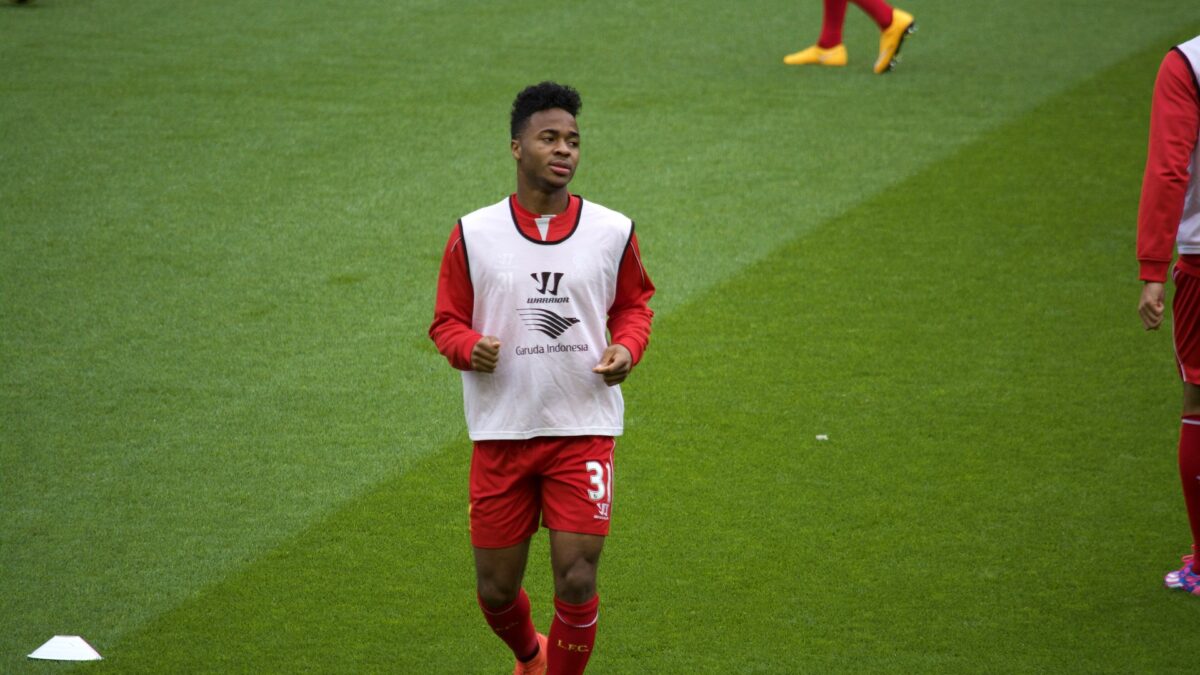
What do you do when the boy who once carried a nation’s hope walks into a courtroom in a black jumper, sits in the dock, and says nothing at all?
That is the question I have carried with me since Wednesday, 25 November 2026, when Raheem Sterling, once the fastest feet in English football, stood before District Judge Kirsty Allman at Basingstoke Magistrates’ Court and heard his fate read aloud. Twelve months in prison, suspended for eighteen months. One hundred hours of unpaid work. A two-year driving ban. A young man of thirty-one, a four-time Premier League champion, an England international eighty-two times over, told that he will have to retake his driving test before he is ever allowed behind a wheel again.
And I ask you, reader, to sit with that image for a moment before you rush to judgement. Because this story is not really about a car crash on a motorway. It is about how quickly a nation builds its heroes, and how much faster it watches them fall.
The Morning of 28 May
The facts, as they were laid before the court, are stark enough to need no decoration. On the morning of 28 May, in the rush hour, Sterling was seen driving erratically on the M25 and the M3 motorways in southern England. Witnesses said he was inhaling from a balloon as he drove, weaving between lanes in his black Lamborghini Urus. Dashcam footage showed him almost colliding with the central reservation. The driving, Judge Allman said, was “prolonged and persistent and a deliberate course of dangerous driving”. She told him he had acted with “conscious disregard for the safety of other road users”.
Then came the crash. Sterling’s car left the road on the M3, and when the police arrived they found him sitting in the passenger seat of the wrecked Lamborghini, holding two canisters of nitrous oxide. No other vehicle was involved. By some mercy, nobody was hurt. That single fact, that nobody else was harmed, is perhaps the only grace note in the whole sorry affair, and it matters, because it could so easily have been otherwise.
On 15 September, Sterling pleaded guilty to three offences: dangerous driving, possession of six nitrous oxide canisters for wrongful inhalation, and failing to provide a specimen. He did not hide behind lawyers. He did not plead not guilty and drag the matter through months of denial. He admitted what he had done. That admission, and everything that followed it, is where this story stops being a simple tale of a fallen footballer and becomes something more human, and more instructive.
The Balloon and the Law
You may ask what a balloon has to do with a prison sentence. The answer tells you a great deal about the Britain of today. The balloon contained nitrous oxide, the gas the streets call laughing gas. Since November 2023, possessing it to inhale for a high has been a criminal offence in England and Wales, the gas reclassified as a Class C drug. The small silver canisters, sold legally for whipping cream, have become one of the most visible symbols of a quiet epidemic. Walk through any British town centre on a Sunday morning and you will see them glinting in the gutters, hundreds of them, the litter of a generation’s weekend.
The law changed because the harm became impossible to ignore. Nitrous oxide starves the brain of oxygen. It can cause nerve damage, paralysis, and, in the worst cases, death. Behind the wheel, it is not a party trick. It is a loaded weapon pointed at everyone sharing the road. Sterling was not merely breaking a new and fashionable rule. He was doing something the judge rightly described as a conscious disregard for the lives of strangers.
And yet, and yet. There is a second half to this story, and a court that only punished would have missed it. The court heard that after a difficult period in his career, nitrous oxide had become what his own representatives called a “maladaptive coping mechanism”. On 15 June, three weeks after the crash, Sterling did something that many men in his position never do. He picked up the telephone, contacted UK Addiction Treatment, and voluntarily admitted himself to the Banbury Lodge addiction treatment centre, where he stayed for twelve days. Nobody ordered him to go. No judge compelled him. He went because, by his own account, he knew something had gone wrong inside him and he wanted it fixed.
That matters. It matters enormously, and not only for the sentence. A suspended sentence is not a free pass. For eighteen months, that twelve-month prison term hangs over him. One slip, one further offence, and the cell door that stayed open on Wednesday will close. But the judge weighed his guilty plea, his clean record, the fact that he had no previous convictions and a clean driving licence before his arrest in May, and the treatment he sought for himself. Mercy, in a courtroom, is not weakness. It is the law recognising that a man who tries to repair himself deserves a chance to do so.
The Boy from Kingston
To understand how far Sterling has fallen, you must first remember how far he climbed, and from where. Raheem Shaquille Sterling was born on 8 December 1994 in Kingston, Jamaica. He spent his earliest years there before his family moved to London, where he grew up a stone’s throw from Wembley Stadium, in the shadow of the great arch, in a neighbourhood where dreams are cheap and escapes are rare. He joined the academy at Queens Park Rangers as a small boy, and by the time he was fifteen, Liverpool had signed him. He made his senior debut at seventeen. In 2014, the year the photograph that leads this column was taken, he won the Golden Boy award as Europe’s finest young player.
I think of that boy often when I think of this case. The boy from the shadow of Wembley who grew up to play beneath its arch for England. The boy whose pace made defenders look as though they were running in sand. There is a particular cruelty in the geography of his story. He was raised in the shadow of the stadium, and he conquered it, and now, at thirty-one, he is without a club, without a driving licence, and with a suspended prison sentence hanging over his head.
History is full of such arcs, and that is why this story belongs in a column rather than a news bulletin. The Greeks told it as Icarus, the boy who flew too close to the sun on wings of wax. The Romans told it as the gladiator who forgot that the crowd’s roar is rented, never owned. In our own tradition, we have known kings who mistook the applause of the court for the judgement of God. The pattern never changes. Talent lifts a man higher than his character has yet grown to hold, and the fall, when it comes, is measured not in feet but in the distance between who he was and who he believed himself to be.
The Golden Years
Let us be honest about what Sterling achieved, because the temptation in a week like this is to rewrite a man’s whole life in the light of his worst morning. In July 2015, after a long and bitter dispute over a new contract at Liverpool, Manchester City signed him for £49 million, the highest fee ever paid for an English player at the time. Under Pep Guardiola, he became one of the most effective wide forwards in the Premier League. He helped City win consecutive Premier League titles in 2017-18 and 2018-19, and two more in 2020-21 and 2021-22. In the 2018-19 season he was named in the PFA Team of the Year and won both the PFA Young Player of the Year and the Football Writers’ Association Footballer of the Year awards. He left City with 339 appearances and 131 goals, four league titles, five League Cups and an FA Cup, and a Champions League final to his name.
For England, he earned eighty-two caps and scored twenty goals. He played at three World Cups, in 2014, 2018 and 2022, and at the European Championships in 2016 and 2020, where he was one of the standout performers as England reached the final at Wembley, the very stadium in whose shadow he had grown up. For a boy from Kingston via north-west London, that is not a career. That is a fairy tale that came true.
And fairy tales, as every child learns too late, always have a price. The price here was not paid in one moment. It was paid in instalments, quietly, over four years.
The Slow Unravelling
In July 2022, Chelsea paid around £47.5 million to bring Sterling to Stamford Bridge. He was the first signing of the new Todd Boehly era, a statement of intent. The then-manager, Thomas Tuchel, had fought to bring him in. Within weeks of Sterling’s debut, Tuchel was sacked. The club lurched from manager to manager, from plan to plan, and Sterling, who had been bought as the main attacking piece, became a symbol of the dysfunction instead.
His first two seasons in west London were solid without being spectacular. In 2023-24 he recorded ten goals and eleven assists from forty-three appearances, a respectable return, but it would prove to be as good as it gets. When Enzo Maresca arrived in the summer of 2024, he made it plain that Sterling would struggle for minutes, and a loan to Arsenal followed. At the Emirates, under Mikel Arteta, a manager who had known him from their Manchester City days, Sterling was little more than a bit-part player. In January 2026, Chelsea and Sterling reached a mutual agreement to terminate the remaining eighteen months of his contract. In February he joined Feyenoord in the Netherlands on a short-term deal under Robin van Persie. Eight appearances later, the Dutch club declined to extend his contract. Today, at thirty-one, an age when a winger of his gifts should still be at his peak, Raheem Sterling has no club at all.
Read that sequence again, slowly. Four Premier League titles, eighty-two England caps, a £49 million transfer, a £47.5 million transfer, and then a loan, a mutual termination, eight games in Rotterdam, and nothing. The descent was not a cliff. It was a staircase, and every step down was taken in public, with the cameras watching and the commentators narrating. That is a particular kind of pain, the kind that does not make the headlines but hollows a man out from the inside. Is it any wonder that a man in that position reached for something, anything, that would quiet the noise in his head for an hour? It does not excuse what he did. Nothing excuses driving a Lamborghini down a motorway while inhaling laughing gas. But if we cannot understand it, we cannot learn from it, and if we cannot learn from it, then this week’s headlines are nothing but entertainment.
What the Court Saw, and What We Should See
Here is what I find most striking about Wednesday’s hearing. The judge did not only see a footballer who had disgraced himself. She saw a man with no previous convictions, a clean driving licence, a guilty plea entered without a fight, and a voluntary stay in a treatment centre. She saw a man who, when the crash stripped away the last of his illusions, did not run, did not deny, and did not blame anyone else. She gave him twelve months, suspended for eighteen, and one hundred hours of unpaid work, and she sent him home to rebuild.
That is the law doing what the law is supposed to do, and it is worth saying so plainly in an age when every sentence is either too soft or too harsh depending on which newspaper you read. Justice is not only punishment. Justice is also the recognition that a human being is more than his worst morning. Sterling endangered lives, and he must live with that knowledge for the rest of his days. He has also taken the first steps, on his own initiative, to make sure it never happens again. Both things are true. Hold them both at once.
But there is a wider question here, and it is the question I would put to you, the reader, because it reaches far beyond one footballer. Nitrous oxide is not a footballer’s drug. It is a young person’s drug. The canisters in the gutters belong to teenagers and students, to young men and women who have been told, a thousand times a day, that life is a party and the only rule is to feel good now. The gas is cheap, it is easy to buy, and its dangers are mocked as an overreaction by exactly the people who profit from selling it. Sterling’s case is the most famous face of this epidemic, but he is not its cause. He is its latest symptom, and its most visible warning.
Ask yourself this. If a man with eighty-two England caps, four league titles, and more money than most of us will ever see can find himself inhaling from a balloon at seventy miles an hour on the M3, what does that tell us about the pressures that produced him, and about the world we have built for our young people? Fame, we are told, is the prize. Wealth is the prize. But fame without purpose is a cage, and wealth without peace is a prison with better furniture. Sterling had both, and on the morning of 28 May, neither could save him from himself.
The Road Back
So where does Raheem Sterling go from here? The honest answer is that nobody knows, and anyone who pretends otherwise is selling you something. He is thirty-one, a free agent, banned from driving for two years, carrying a suspended sentence and one hundred hours of community service. The football world, which once queued to sign him, has moved on with the ruthlessness it always shows to players it no longer needs. The phone may ring. It may not. A club in a smaller league, a project that values experience over pace, a manager willing to bet on a man rather than a reputation, these are all possibilities. But none of them is guaranteed, and none of them matters as much as the question that will decide everything else.
Has he learned? Not the lesson of the courtroom, which any man can recite. The deeper lesson, the one that comes in the quiet hours, when there is no crowd and no contract and no one left to impress. The lesson that the boy from Kingston learned once before, when he was small and fast and hungry, and the whole world was still ahead of him. That talent is a trust, not a possession. That the body which carries you to glory can also carry you to ruin. That the applause ends, and when it ends, what remains is the man.
I think of the old stories again, the ones my own tradition taught me as a boy. The hero is not the man who never falls. Every hero falls. The hero is the man who, having fallen, looks at the wreckage honestly, picks himself up, and walks back toward the light. Sterling has taken the first steps. He admitted his guilt. He sought treatment before anyone ordered him to. He stood in the dock and said nothing, and in that silence there was, I believe, the beginning of accountability.
History will judge him, as it judges all of us, not by a single morning on a motorway, but by what he does with the mornings that remain. The road back is long, and it is steep, and it begins, as all roads back begin, with a single honest step. The court has given him eighteen months to prove he can take it. The rest of us would do well to watch, not with the appetite of spectators at a fall, but with the hope of people who know that every man, even a fallen hero, deserves the chance to rise again.
For the boy who grew up in the shadow of Wembley taught us something once, with his feet, about what is possible. Perhaps now, in his hardest season, he can teach us something more important, with his life, about what it means to fall, to own it, and to begin again.
Sources & References
- Reuters — Ex-England soccer player Sterling spared immediate jail sentence for dangerous driving
- The Times — Raheem Sterling sentencing: forward avoids jail after spell in addiction centre
- Sky Sports — Raheem Sterling: Former England international given suspended 12-month jail sentence for dangerous driving
- Associated Press via Bleacher Report — Soccer Star Sterling Gets Suspended Jail Sentence for Dangerous Driving While Inhaling From Balloon
- Wikipedia — Raheem Sterling (career record and honours)
- TNT Sports — Free agents: Raheem Sterling available after Feyenoord spell

About the Author — advmannan1
Related Articles
The Guitar Has Gone Quiet: Remembering Andy Taylor, the Fire Inside Duran Duran
Andy Taylor, the guitarist whose riffs powered Duran Duran's imperial 1980s, has died aged 65. A tribute to…

A Pakistani Reached the Stars Today — and Iqbal Saw It Coming a Century Ago
"I'm not flying for myself. I carry the name of Pakistan on my shoulder." On 25 November 2026,…
Putin Declares Moscow the Third Rome — But History Has Heard This Sermon Before
"Moscow is the Third Rome, a fourth there shall not be." In a 20 November interview, Vladimir Putin…