A Million Machines in the Sky: Who Owns the Night Now?

When was the last time you looked up at the night sky and saw nothing but stars?
I mean really looked up. Not a glance between buildings, not a hurried peek on the way to the car, but the long, unhurried gaze of a child lying on a rooftop in a village where the electricity has gone, watching the Milky Way pour itself across the darkness like spilled milk. If you have ever done that, you carry the memory in your bones. And if you have not, then I am sorry, because you may never get the chance again. Not in the way your grandfather did. Not in the way your children will not.
On Wednesday, 25 November 2026, the day before Thanksgiving in America, the Federal Communications Commission quietly handed one company the keys to the heavens. SpaceX, the rocket company of Elon Musk, has been authorised to deploy one million satellites into orbit around the Earth. One million. Not one thousand. Not ten thousand. A million machines, each one a small data centre, wired together by lasers, drinking sunlight and thinking for us, forming a constellation called Starmind. The Commission called it a historic first. The chairman, Brendan Carr, declared that America is leading the world “into the era of super intelligence” and that the decision “opens a bold new frontier”.
A bold new frontier. I have heard those words before. I have read them in the history books, and history has taught me to be afraid of them.
The Day the Sky Changed Hands
Let me tell you plainly what has been decided, because the numbers are so large that the mind refuses to hold them, and what the mind refuses to hold, the powerful are free to take.
SpaceX applied to the FCC on 30 January 2026 for permission to launch up to one million “orbital compute modules” — satellites carrying the chips that power artificial intelligence — to process vast amounts of data in space and send the results back to Earth. On 25 November, the Commission said yes. It is the first time any regulator anywhere has approved a full constellation of orbital data centres. The satellites will fly in shells between 500 and 1,002 kilometres above our heads, linked to one another by optical laser links and connected down to Earth through the existing Starlink network. They will be built in Bastrop, Texas, in partnership with Nvidia, the chipmaker at the centre of the AI boom. Musk has said he expects the first of them to launch in the third quarter of 2027. His chief financial officer, Bret Johnsen, told investors last week that the company plans to put its first data centres in space in 2027 and expand through 2029.
The licence carries deadlines, and the deadlines are not gentle. SpaceX must have at least one working satellite in its assigned orbit by 25 November 2033. By the same date in 2035, it must have 100,000 of them up there — a tenth of the constellation. By 2038, half a million. By 2040, the full million, or the licence dies. The authorisation runs for fifteen years from the day the first compliant satellite is certified in orbit, and the company must report twice a year on close approaches, retired satellites, re-entries and deployment totals.
There are conditions, and I will be fair to them. The FCC did not grant everything SpaceX asked for. The company wanted to fly as high as 2,000 kilometres; it was cleared only up to 1,002. Nothing may operate above 600 kilometres until SpaceX files a modification with a final orbital-debris plan. The request to park dead satellites in so-called graveyard orbits, rather than bringing them down to burn up in the atmosphere, was refused. The radio frequencies granted are restricted to backup and emergency use. The American Astronomical Society, the satellite company Viasat and Amazon’s Kuiper Systems all urged the regulator to deny the application outright. The Commission declined to rule on whether the business case makes sense, declined to invent a satellite cap its rules do not contain, and treated the question of waste heat in the infrared as outside a radiofrequency licence.
That is the decision. Now let me tell you why it frightens me, and why I believe it should frighten you too.
One Sphere, and the Whole World Held Its Breath
On 4 October 1957, the Soviet Union launched a polished metal sphere the size of a beach ball into orbit. Sputnik 1. It weighed 83 kilograms. It did nothing but beep. And the entire world stopped and listened, because for the first time in human history something made by human hands was circling the Earth, and every nation on the planet could hear it passing overhead.
I think about that beep often. One satellite. One small, lonely machine. And it changed everything — the space race, the Cold War, the way children in schools dreamed about the future. Now consider what we have done with that inheritance in less than seventy years. Today, according to the catalogue kept by the astrophysicist Jonathan McDowell at the Harvard-Smithsonian Center for Astrophysics, there are about 17,247 working satellites in orbit. Roughly two in every three of them — 11,195 — belong to a single company, SpaceX, through its Starlink internet network. Add the dead satellites, the spent rocket stages and the broken pieces, and more than 35,000 human-made objects large enough to be tracked are circling above us. The European Space Agency counts about 47,000 regularly tracked objects, and estimates another 1.5 million fragments between one and ten centimetres across — too small to track, large enough at orbital speed to cripple a spacecraft — and some 230 million smaller still. More than 17,400 metric tonnes of human-made material now orbits the Earth, and Starlink alone accounts for about 6,188 tonnes of it.
We went from one beeping sphere to seventeen thousand machines in a single human lifetime. And now, in a single regulatory decision, we have authorised a million more — roughly fifty times everything currently in orbit. The satellites in the sky tonight are about to become a rounding error.
Do you understand the scale of that? Imagine a city of seventeen thousand people. Now imagine a city of one million, built above your head, by one landlord, in fourteen years. That is what 25 November means.
The Enclosure of the Last Commons
History is a mirror, and I have spent my life holding it up to the present. When I read this news, the mirror showed me the East India Company.
Understand me: I do not compare a rocket company to a colonial army. I compare the pattern. The East India Company arrived as traders, asking only for permission to do business. It asked for a factory here, a port there, a small favour, a charter. Each request was reasonable. Each grant was small. And one day the people of the subcontinent woke up to discover that the traders had become the rulers, that the commons had been enclosed, and that the thing which had belonged to everyone now belonged to a company — and the company answered to no one but its shareholders.
That is how commons are lost. Never in one dramatic theft, but in a thousand small permissions, each defensible, each irreversible. The sea was once a commons. The air was once a commons. The night sky was the last commons of all — the one thing no army could occupy, no king could fence, no company could buy. The shepherd in Balochistan and the astronomer in Chile and the child on a rooftop in Faisalabad all looked up at the same stars, and nobody owned them. In 1967, the nations of the world wrote that truth into law: the Outer Space Treaty declared space “the province of all mankind”. No nation may claim it. No flag may be planted on it as territory.
But the treaty was written for nations, and nations are no longer the actors that matter. The treaty says no country can own the sky. It says nothing about a company filling it with a million machines. It says nothing about the day when one man’s constellation outnumbers every satellite ever launched by every nation in history, fifty times over. The law, as so often, was written for the last century’s problem, and the new century has walked straight through the gap.
Ask yourself the simplest question: if one company controls two-thirds of the working satellites today, and it is authorised to add a million more, who will govern the sky tomorrow? The FCC is an American regulator. Its writ runs in Washington. But the sky it has just leased out belongs to the whole Earth. A farmer in Punjab will see those satellites. A fisherman off the coast of Africa will navigate beneath them. A schoolteacher in Bolivia will watch her students’ view of the stars dim behind them. None of them was consulted. None of them has a vote. The decision was made in one country, and its consequences will fall on every country — and that, my friend, is the oldest story in the book of power.
The Promise, and What It Costs
I am not a man who fears progress. I will not pretend the case for Starmind is empty, because it is not. The argument is powerful, and any honest column must state it fairly.
Artificial intelligence is hungry. The data centres that train and run it already consume enormous amounts of electricity and water on Earth, and the demand doubles and doubles again. SpaceX’s pitch is elegant: put the computers where the sun never sets. In orbit, a solar panel drinks unfiltered sunlight around the clock, with no night, no clouds, no land to buy and no river to drain for cooling. The company describes Starmind as “capturing solar energy in space to power low-cost, high-performance AI compute for Earth”. Its rivals agree with the direction, if not the scale — Google and Blue Origin are pursuing orbital data centres of their own. The chairman of the FCC put it bluntly: compute capacity is essential to sustaining America’s leadership in artificial intelligence, and moving it beyond Earth meets the moment.
There is a genuine vision here, and I respect it. The men who built the railways were also told they were mad. The men who laid the undersea cables were also told the sea would swallow them. Every great infrastructure of the modern world began as an absurd number in a proposal.
But every great infrastructure also had a price, and the price was usually paid by people who were never asked. So let me count the costs that the press release did not.
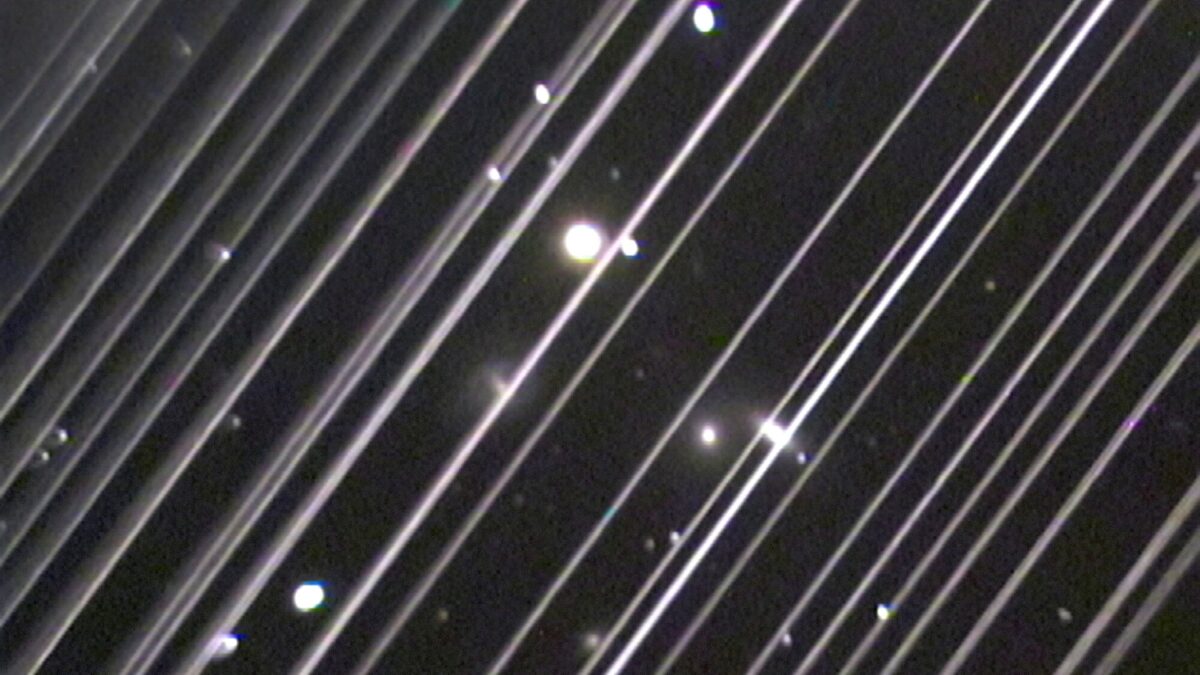
First, the night itself. Astronomers have been warning for years that satellite constellations are already damaging their science. The photograph that leads this article is not an illustration. It is a real image: long-exposure star trails slashed across by the bright streaks of Starlink satellites. That was taken when there were a few thousand of them. The American Astronomical Society told the FCC plainly that this constellation would undermine decades of federal investment in astronomical facilities. Every major telescope on Earth — and the science they do, from tracking asteroids that might one day threaten us to peering back toward the beginning of time — now competes with a sky filling up with moving lights. When a million machines are up there, what will the astronomers see? Their own reflections?
Second, the debris. In 1978, a NASA scientist named Donald Kessler warned of a tipping point: one collision creates thousands of fragments, those fragments strike other satellites, and the wreckage multiplies on its own until whole altitudes become too dangerous to use. It is called the Kessler syndrome, and it is not science fiction. The European Space Agency’s 2026 report warns that the long-term outlook for the debris environment has worsened sharply. Starlink’s own satellites already make hundreds of thousands of collision-avoidance manoeuvres — more than 355,000 in the year to May 2026, more than three times the total of two years earlier. Each dodge is automatic, each leaves a tiny residual risk, and the mathematics is merciless: double the satellites in a band and you roughly quadruple the number of pairs that could collide. One research institute estimates that if every satellite stopped dodging today, a major collision would be expected within about four days.
Now multiply the traffic by fifty. Then tell me the plan is safe, and tell me who pays if it is not. Because the cost of a Kessler cascade would not fall on the company that launched the satellites. It would fall on every nation that needs orbit — for weather, for navigation, for disaster warning, for the internet itself. The profits are private. The risk is planetary. That asymmetry is the signature of our age.
Third, the silence of the people. When the news broke, NBC News posted the story on Instagram, and the reaction was not celebration. Fourteen thousand likes, two and a half thousand comments, and the overwhelming tone was anxiety — fear for the night sky, fear of Kessler syndrome, fear of surveillance, fear of power concentrating in private hands. Ordinary people, with no telescopes and no shares in any company, looked at the headline and felt something was being taken from them. They were right. You do not need a degree in orbital mechanics to know when a commons is being enclosed. You only need eyes, and the memory of a sky that was once dark.
The Question We Must Ask Before 2027
The first Starmind satellite may fly in the third quarter of 2027. That gives the world less than a year to ask the question that should have been asked before the licence was signed: who speaks for the sky?
There is no parliament of the heavens. There is no global regulator with the power to say “enough”. The Outer Space Treaty, noble as it is, has no enforcement mechanism and no traffic rules. Each nation licenses its own companies, and each company races the others, and the sky absorbs the consequences. This is precisely the structure that produced the tragedy of the commons on land and sea — and now we are repeating it, higher up, faster, with larger numbers.
I am not asking for the end of spaceflight. I am not asking for the end of artificial intelligence, or of ambition, or of the extraordinary human gift for building impossible things. I am asking for the one thing history teaches us to demand before the irreversible is done: a pause, a debate, and rules written by all of humanity, not by one regulator in one capital for one company.
We need a limit on numbers. We need enforceable debris rules with real penalties. We need protected darkness for astronomy, the way we protect national parks on Earth. We need the nations of the world — including the ones who will never launch a rocket — to have a seat at the table where the sky is divided. The 1967 treaty said space is the province of all mankind. It is time the practice matched the promise.
And we need honesty about what is being built. This is not only a data centre. It is the largest infrastructure project in human history, placed in the one environment that belongs to everyone and to no one. If it is built well, governed fairly and shared honestly, it could be a wonder. If it is built as a race, governed as a monopoly and shared as an afterthought, it will be remembered as the moment humanity sold the sky — cheaply, quietly, the day before a holiday, while nobody was watching.
The Stars Are Not Ours to Spend
I return to where I began: a child on a rooftop, looking up.
That child did not own the stars. Nobody did. That was the point. The stars were the one wealth that could not be hoarded, the one inheritance that passed equally to the prince and the shepherd, the one text that every civilisation on Earth read together, in every language, and understood. The Babylonians charted them. The Greeks named them. The Muslim astronomers of Baghdad and Samarkand measured them. The sailors of the Indus found their way home by them. The night sky is the oldest shared book of humankind, and we are about to write across its pages in machine light.
Perhaps that is progress, and perhaps progress demands it. Perhaps my grandchildren will look up at a sky full of thinking machines and call it beautiful, the way I call a railway beautiful. I do not know. What I know is this: a civilisation is judged not by what it can build, but by what it refuses to destroy. We could pave the last wilderness, drain the last river, and fill the last darkness, and call each act progress, until the day we look around and discover that progress has left us with everything except the things that made us human.
So I ask you, reader, directly: the next clear night, go outside. Look up. Count how many moving lights cross the sky in ten minutes. Remember the number. Then remember that a million more are coming, and that the decision to send them was made without you. If that does not move you, nothing I write ever will.
The sky was never ours to spend. It was ours to keep. Let us not discover, too late, the difference.
Sources & References
- Reuters — “US authorizes SpaceX to deploy 1 million satellites for data centers in space”, 25 November 2026.
- CNN — “US authorizes SpaceX to deploy 1 million satellites for AI data centers in space”, 26 November 2026.
- Gizmodo — “FCC Approves SpaceX’s Plan to Deploy 1 Million Satellites to Orbit”, 25 November 2026.
- Spaceflight Now — “FCC green lights SpaceX’s plan to launch 1 million ‘Starmind’ data center satellites”, 26 November 2026.
- The Wall Street Journal — “SpaceX Gets Approval to Launch One Million Satellites for Orbital Data Centers”, 26 November 2026.
- Phys.org — “FCC says SpaceX can deploy 1 million satellites for data centers in space. Scientists are skeptical”, 26 November 2026.
- SpaceTechTimes — “How Many Satellites Are in Orbit? The Count in November 2026” (Jonathan McDowell’s catalogue: 17,099 active satellites, 11,148 Starlinks, October 2026).
- The World Data — “Space Debris Statistics 2026” (European Space Agency figures, October 2026).
- Data Center Critical — “Traffic Jam in Orbit: A Million Data Center Satellites, China and Space Junk” (collision-avoidance manoeuvres, Kessler syndrome).
- Technology.org — “FCC Clears 1 Million Starmind Satellites”, 26 November 2026 (licence conditions and milestones).

About the Author — advmannan1
Related Articles
The Guitar Has Gone Quiet: Remembering Andy Taylor, the Fire Inside Duran Duran
Andy Taylor, the guitarist whose riffs powered Duran Duran's imperial 1980s, has died aged 65. A tribute to…

From Wembley to the Dock: Raheem Sterling and the Long Fall from Grace
On 25 November 2026, four-time Premier League champion Raheem Sterling stood in the dock at Basingstoke Magistrates' Court…
A Pakistani Reached the Stars Today — and Iqbal Saw It Coming a Century Ago
"I'm not flying for myself. I carry the name of Pakistan on my shoulder." On 25 November 2026,…