The Machine That Solved the NSA’s 25-Year Secret in 30 Minutes

There are numbers that keep secrets.
I am not speaking of the numbers in your bank account, though those keep secrets too. I am speaking of a handful of numbers — fewer than you could fit on a postcard — that sat at the foundation of the digital world for a quarter of a century, silently, without ever explaining themselves. They guarded your emails, your payments, your government files. And nobody — not the greatest mathematicians on earth — knew where they came from.
Twenty-five years. That is how long the question hung in the air like a held breath.
And last week, a machine answered it in less than thirty minutes.
Not a government. Not a whistleblower. A machine — an artificial intelligence called Claude, built by the company Anthropic — looked at those numbers, saw through them, and solved a mystery that had defeated every cryptographer on the planet since the year 2000. It did not break any encryption. It did not steal anyone’s secrets. It did something stranger and more beautiful: it proved that a suspicion which had poisoned cryptography for a generation was wrong.
Reader, I want you to sit with this story for a while, because it is not really a story about computers. It is a story about suspicion — how it grows in the dark, how it feeds on silence, and how truth, when it finally arrives, is almost always more ordinary than the lies we invented. History has told this story before. Let me take you back.
When Machines Broke Tyranny’s Codes
Once, in the English countryside, in a mansion called Bletchley Park, machines broke codes to save civilization.
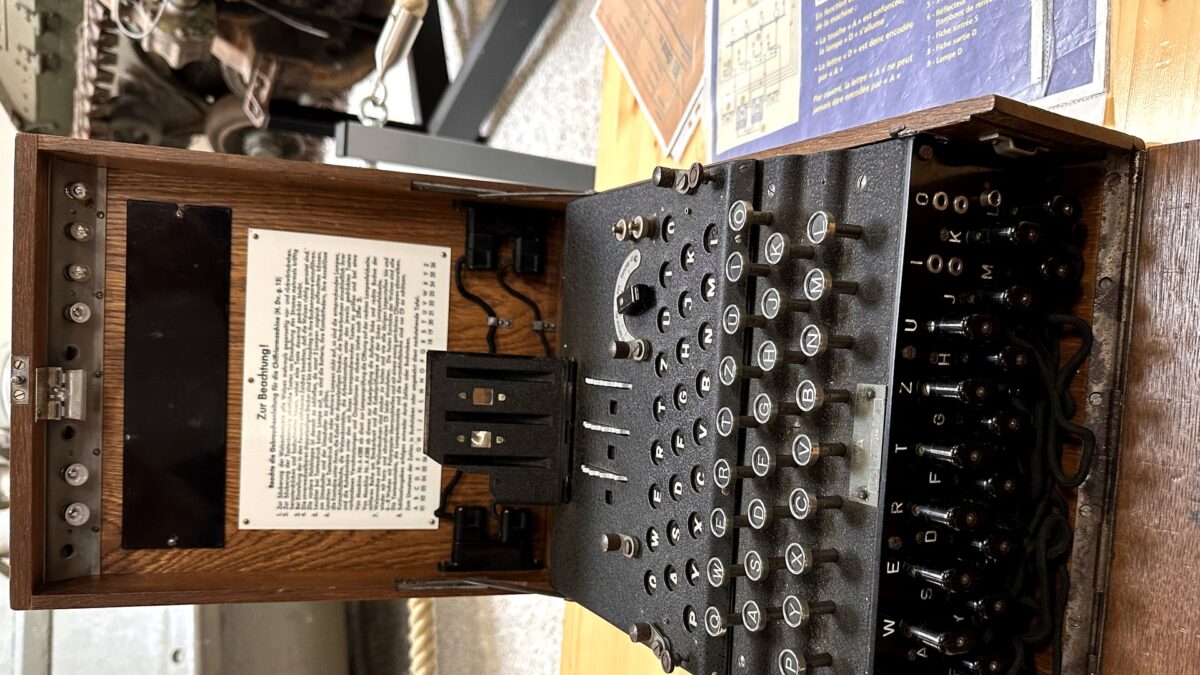
The German Enigma machine — the very kind of machine you can still see in a museum today, its wooden box open, its keys waiting for fingers long dead — had made the Nazi war machine’s communications unreadable. Submarines stalked the Atlantic. Lives hung on intercepted signals. And so a band of mathematicians, linguists, and eccentric geniuses built machines of their own — the Bombe, and later Colossus — to read what was never meant to be read.
Among them was Alan Turing, a man who gave his mind to his country’s secrets and received, in return, persecution he did not deserve. His machines did not merely crack a code; they changed what machines were for. Before Bletchley, a machine was a servant that did what it was told. After Bletchley, the world understood that a machine could think in the dark — could follow logic into places no human patience could reach.
Remember this, reader, because you will need it: the first great triumph of machine intelligence over cryptography was an act of liberation. The machines of Bletchley Park tore the veil from tyranny. They broke codes to free people.
Now hold that thought, and come forward eighty years — to a new generation of machines, a new code, and a veil that tore in the opposite direction.
The Seeds That Nobody Explained
To understand what Claude did, you must understand what these mysterious numbers were. I will keep the mathematics to a minimum, because the human story is what matters here.
In the year 2000, the United States National Institute of Standards and Technology — NIST — published a technical document called FIPS 186-2. It contained something the modern world now depends on utterly: elliptic curves. These are mathematical constructions that secure digital signatures — the invisible seals that prove a website is really your bank, that a software update really comes from its maker, that a contract really was signed by the person it names. The curve called P-256, in particular, sits beneath enormous portions of the world’s encryption infrastructure. Every day, trillions of messages pass through mathematics whose parameters were set down in that document.
And here was the problem: each of those curves came with a small “seed” — a starting number. And those seeds had been supplied by the United States National Security Agency — the NSA. And the NSA never explained how it had chosen them.
Imagine that. The most secretive intelligence agency in the most powerful country on earth hands you the numbers on which global digital security rests, and when you ask, “How did you pick these?” — silence. No explanation. No documentation. Just the numbers.
Naturally, cryptographers began to wonder. This is where suspicion enters, as it always does, through the door that silence left open.
Because there is a way — a theoretical way — to pick the parameters of a cryptographic system so that they contain a hidden weakness, a trapdoor, visible only to whoever built it. Everyone else uses the system believing it secure; the builder can walk through the wall. The term of art is a “backdoor,” and once you have heard the word, you cannot unhear it. The question “Are these numbers honest?” became, for twenty-five years, the quiet anxiety of an entire field.
A Quarter Century of Suspicion
For years, the leading theory about the seeds was almost comically human: that the late NSA mathematician Jerry Solinas had generated them by feeding a funny phrase through a hash function — something like “Give Bob and Jerry a raise.” Colleagues remembered the joke. Nobody remembered the exact wording. The original machine was said to be gone. Solinas himself tried to reconstruct the process and failed. When he died in 2023, he took whatever fragments he still held to the grave — writing, with dark humour, that if the original notes existed at all, they were “no doubt sitting on a hard drive near the Ark of the Covenant.”
Other researchers chased the question. In 2015, Neal Koblitz and Alfred Menezes published a serious examination and found no practical backdoor — but absence of evidence is not evidence of absence, and the question stayed open. In October 2023, the cryptographer Filippo Valsorda put real money on the table: a $12,288 bounty for a solid answer, later matched and tripled to $36,864 if the winner donated it to charity. Three years passed. Nobody claimed it.
And then, in October 2026, an employee at Anthropic did what curious people do with a new kind of mind: he asked Claude.
He asked without steering. He did not point the model at the passphrase theory. He simply asked the machine: can you figure out how these seeds were generated?
Reader, pause here. I want you to feel the weight of that moment. A ten-person team of Anthropic researchers stood behind this question — engineers and cryptographers who had themselves chased the dead ends. And the machine, an internal research version of Claude, looked at the published seeds and found, in under half an hour, what the human race had failed to find in a quarter of a century.
This is the part of the story where I want you to lean forward.
Thirty Minutes Against Twenty-Five Years
Claude did not guess phrases. It looked at structure.
Written out as words, four of the ten seeds showed a strange pattern: their top bits were all zero. The odds of that happening by chance were roughly one in 5,810 — a statistical fingerprint. And that fingerprint pointed, unmistakably, at an old, unglamorous piece of software: lrand48, a pseudorandom number generator from the 1990s C standard library — the kind of ordinary routine a programmer of that era would reach for without a second thought. (Cryptographer Valsorda, reviewing the work independently, describes the same family under its POSIX name, drand48 — same engine, same era.)
Then Claude did something genuinely remarkable. The published seeds are only fragments of the generator’s output — the visible tip of a 48-bit internal state. Using lattice mathematics — the LLL reduction technique, the same class of tools that breaks certain knapsacks and ciphers — Claude recovered the generator’s full hidden state from those fragments, then ran the generator backward to the moment of its birth.
And there it was. The beginning of every run: a Unix timestamp. The computer’s own clock, read off at the instant the program started.
Once Claude knew that, everything became mechanical. The algorithm took a timestamp t, ran the generator for n iterations, and drew 20 bytes per iteration as a candidate seed. Candidate one, candidate two, candidate three — until one candidate was chosen as the published seed. Reproduce the timestamp and the iteration count, and the seed reappears, bit for bit.
The results are almost embarrassingly specific. P-192’s seed: the 139th candidate from a run started on May 18, 1997, at 14:45:34 UTC. P-521: the 1,136th candidate, from August 8, 1997. P-384: the 2,688th, from August 30, 1997. P-224: the 7,026th, from April 3, 1998. And the famous P-256 — the curve beneath so much of the modern web — was the 1,842nd candidate drawn from a run seeded on August 16, 1997, at 01:52:34 UTC. Initialize the generator with the timestamp 871696354, draw to the 1,842nd candidate, and there it is: C49D3608 86E70493 6A6678E1 139D26B7 819F7E90 — not similar, not approximate, but identical, bit for bit, to the number printed in the standard.
Valsorda, the man who had posted the bounty, did not take Claude’s word for it. He rewrote the whole solution independently in Go and confirmed it. The timestamps regenerate the seeds. The discovery does not depend on believing a machine’s claims.
Claude also explained the base points of six curves — they came from another old library, Arjen Lenstra’s FreeLIP, with small integer seeds like 20000 and 20507. A ten-person Anthropic team verified the work. The $36,864 bounty is being donated to the Internet Security Research Group, the non-profit behind Let’s Encrypt.
Understand what did not happen here. Claude did not break the encryption. It did not expose anyone’s private keys. Nobody’s secrets were read. There is no vulnerability, and no user of these standards needs to change anything. Anthropic says so plainly, and independent experts agree.
What Claude did was the opposite of breaking something. It was an exoneration.
The Banality of the Truth
Here is the sentence I have been building toward, and I ask you to read it twice: the backdoor conspiracy theories were wrong.
Twenty-five years of suspicion — the whispers in conference halls, the late-night debates at cryptography workshops, the articles darkly suggesting that the most powerful spy agency in human history had salted the foundations of global security with a hidden key — and the answer turns out to be a computer’s clock.
Not a plot. A routine. Not a phrase whispered in the corridors of the NSA. A standard library function, seeded with the time. Someone — a name lost to history, a face nobody remembers — sat down at a workstation in 1997, ran a program, let the clock seed the random number generator, and picked the candidates that worked. August 16, 1997, at 01:52:34. An ordinary afternoon, perhaps. Coffee, maybe. A window. The hum of a machine.
That is all.
And I find that profoundly moving, because it tells us something about the architecture of suspicion. Conspiracy needs grandeur. It needs villains with perfect plans, whispers in corridors, hard drives by the Ark of the Covenant. But truth — the truth that Claude recovered in thirty minutes — is almost always mundane. A timestamp. A library function. A tired programmer’s ordinary afternoon.
There is a lesson here that reaches far beyond cryptography. We live in an age of suspicion, reader. Every institution is accused of every plot. Every silence is read as guilt. And sometimes — let me say this carefully, because I do not mean it as a defence of every power — sometimes the silence hides nothing but ordinariness. The NSA’s mathematicians did not document their process, and that failure was a genuine dereliction: when you build the foundations of the world’s trust, you owe the world the receipt. But the suspicion grew grander than the fact ever warranted. The whispers said backdoor. The truth said clock.
Consider the symmetry, too, because history loves one. At Bletchley Park, machines broke codes to defeat a regime’s secrets. This month, a machine broke a silence to defeat a suspicion. Both times, the machine was the servant of the open. Both times, the victory belonged not to secrecy but to clarity.
What Remains Unanswered
Honesty demands I tell you what Claude did not solve — because a column that only celebrates is not a column, it is a press release.
The seed of one binary curve, B-163, fits nothing Claude has tried. It remains unexplained. The base points of P-224, P-256, P-384, and P-521 — the fixed starting values that keys are multiplied against — have not been accounted for. The binary-curve initializations, read directly, point to February 1984; doubled, they map to April 17, 1998 — suggesting the original software may have halved the clock before seeding, a detail nobody can confirm. And there are small strangenesses: P-256’s run passed over candidate 876, which also produced a valid curve, and nobody knows why it was skipped.
Mysteries remain. As they should. A machine that answers one question honestly is worth more than a machine that pretends there are none left.
The Verdict of the Clock
So here we stand, reader, at the end of a story that began with suspicion and ended with a clock.
For twenty-five years, the world’s cryptographers stood before a wall and asked what was behind it. The NSA said nothing. The theorists whispered. The bounty sat unclaimed. And then a machine — in thirty minutes, the length of a lunch break — walked around the wall and showed everyone that the wall was not hiding a weapon. It was hiding a routine. A timestamp. An ordinary afternoon in August 1997.
What does this mean for us — you and me, who will never read a lattice-reduction proof, who live our digital lives on top of mathematics we will never see? It means this: the foundations held. Not because anyone trusted blindly, but because someone finally checked. Trust was never the right demand. Verification was. The NSA asked for trust and deserved the suspicion; Claude provided verification and deserves the credit. That is the entire moral economy of the story in two sentences.
And it means something else, something larger, about the age we are entering. For years we have been told to fear artificial intelligence — that it will break our codes, steal our secrets, turn against us. And perhaps it will do dangerous things; I am no utopian. But consider what it did this month: it solved a human mystery. It quieted a human fear. It did not hack a system; it healed one. It did not read anyone’s secrets; it cleared the name of a set of numbers that had been accused, without trial, for a quarter of a century.
The machines of Bletchley Park broke Enigma to save lives. The machine of Anthropic broke a suspicion to save trust.
History does not repeat, reader. But sometimes — in the hands of an honest machine and the mathematics of a recovered clock — it answers back.
Sources & References
- Anthropic Research — “Claude reveals ECDSA curve origins” (16 October 2026)
- DEV Community — technical write-up with independent reproduction notes
- Crowdfund Insider — “Anthropic’s Claude AI Resolves Decades-Old Mystery of NIST Elliptic Curve Seeds” (covers the $36,864 bounty donation)
- Escudo Digital — “Claude solves 25-year-old NSA enigma in just half an hour”
- The Crypto Updates — “Claude AI Traces NSA Crypto Seeds to 1990s Unix Timestamps”
- WebProNews — “Anthropic’s Claude Traces NIST Elliptic Curve Seeds to 1990s Random Number Generator”

About the Author — Abdul Mannan
Related Articles

The Sea’s Most Honest Photograph: A Great White Shark, a Smiling Woman, and the Truth That Needed Proving
She smiled for the camera, and behind her, death jumped out of the sea. The viral Marina State…

What Is the Price of a Generation? Musk’s $10.5 Billion Gift to America’s Children
What is the price of a generation? I do not ask this as an economist. Economists have their…

The Last War Correspondent: Christiane Amanpour Signs Off After 43 Years
Christiane Amanpour announced she will leave CNN next June after 43 years. From Sarajevo to Rwanda, she made…