They Have Left the Earth: Google’s Suncatcher and the New Empire of the Sky

What do you do when the ground can no longer feed your hunger — you take to the sky.
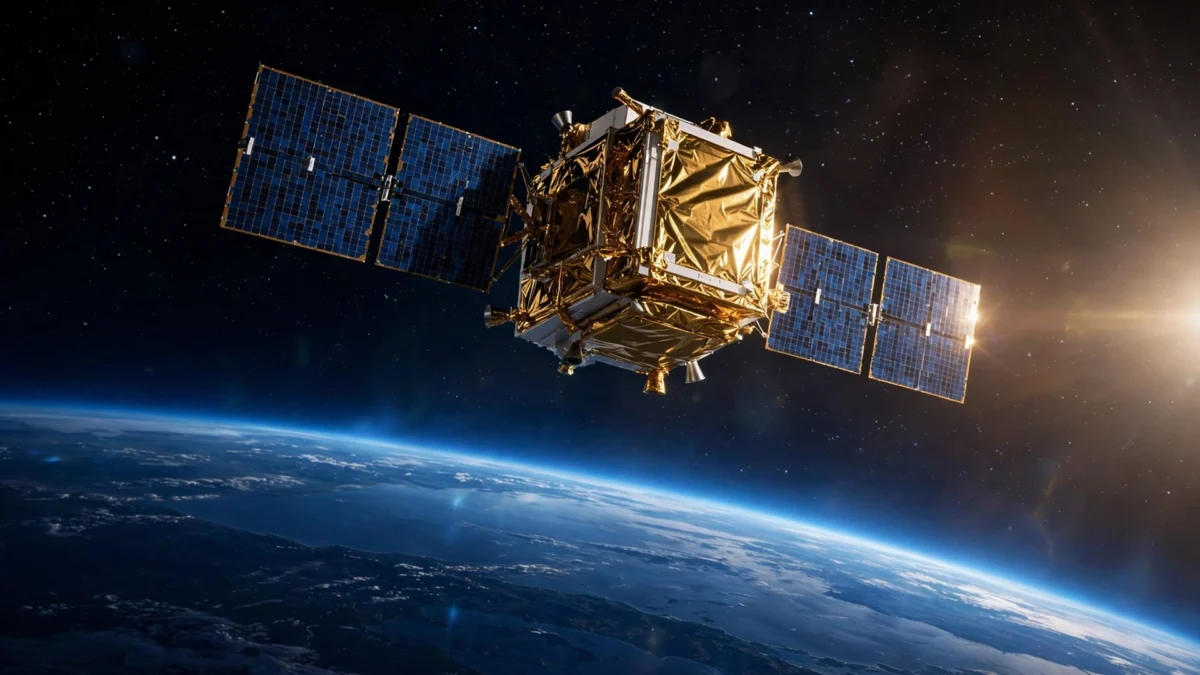
That is not a line of poetry. It is the business plan of the most powerful companies on earth. Yesterday, on the 1st of October, a SpaceX Falcon 9 rocket rose from Vandenberg Space Force Base in California carrying a refrigerator-sized satellite built by the imaging company Planet Labs — and inside it, four of Google’s most advanced artificial intelligence chips, the Trillium TPUs, bolted into orbit. The mission is called Project Suncatcher, and Google has confirmed it made contact with the satellite shortly after launch. It is working exactly as planned.
I want you to pause here, reader, and feel the weight of what has just happened. The machines that write your emails, answer your questions, and train the models that are reshaping your economy can no longer live on your planet comfortably — so they have been sent where the sunlight never ends. In the sun-synchronous orbit where this satellite now circles, solar panels can gather up to eight times more power than identical panels on the ground. There is no night there, no shadow, no electricity bill. The engineers will watch these chips for a year, running bursts of Google’s open Gemma model for about fifteen minutes at a time — that is all the heat they can shed before thermal limits force a shutdown — and they will study whether radiation degrades the silicon and whether the brutal temperature swings of orbit break what worked perfectly in a data hall on earth.
“Some things,” wrote Google Research’s senior director in the company blog on launch day, “can only be tested in space.”
Some things. Let me tell you what some of those things are — and why they matter to you far more than to a satellite.
The hunger beneath the boom
The truth is that artificial intelligence is starving for power, and it is starving on a scale that should frighten anyone who pays an electricity bill. The International Energy Agency estimated that data centres consumed some 460 terawatt-hours of electricity in 2022 — and projected that by this very year, 2026, that figure could more than double, to over 1,000 terawatt-hours. That is, in the agency’s own comparison, roughly the entire electricity consumption of Japan, a nation of 125 million people. Swallowed not by people, not by homes or factories — but by buildings full of humming chips.
And power is only half the thirst. A report published this August by the sustainability nonprofit Ceres found that data centres in seven major American states — Virginia, Texas, California, Illinois, Georgia, Ohio, Arizona, which together host about half of America’s data centres — depend on some 3.4 trillion gallons of freshwater withdrawals every year through the electricity generation that powers them. Twelve times the combined annual water use of Los Angeles, Phoenix and Washington, D.C. By 2030, Ceres estimates, that figure could rise to between 4.1 and 7.6 trillion gallons. Two-thirds of that electricity is generated in regions facing medium-to-extremely-high water stress.
I ask you plainly: in a world where farmers watch their wells run dry and cities ration water in summer, who gave permission for the machines to drink first? Nobody asked you. Nobody asked the towns either — and now the towns are answering back.
The towns that said no
Across America, communities have begun to fight the data-centre rush. Zoning battles, construction bans, local moratoriums — in Texas, Georgia, Ohio, Iowa, Pennsylvania, Indiana and South Carolina, the resistance has become serious enough to be called a material constraint on the industry’s expansion. The companies’ own polling in Ohio found that 67 percent of residents view data centres unfavourably, against just 18 percent favourably. The support flips only when developers promise lower power costs, jobs and tax revenue — promises that, as the environmental group Food & Water Watch notes, dissolve on inspection: data-centre construction jobs are, in their words, “transitory and fleeting,” and their research found only 23,000 people working permanently in data centres across the whole of the United States as of 2024.
And so, last week, the giants did what giants have always done when the governed refuse to be governed. On the 28th of September, OpenAI, Blackstone, QTS and SoftBank — joined by five building-trades unions — announced the American Infrastructure Alliance, a multimillion-dollar coalition, first reported by Axios, whose stated purpose is to work with officials in those seven states on data-centre “standards” by 2027 and, in the same breath, to head off the local moratoriums. “Responsible growth requires clear expectations,” said the co-CEO of QTS. The union president called blanket bans a threat to “good middle-class jobs.”
Read that twice, reader. The alliance is not asking whether these facilities can ever be regulated safely — Food & Water Watch’s managing director says that is “truly an open question,” and has called for a moratorium precisely to study it. The alliance is organised to make sure the question is never seriously asked.
The mirror of history
Here is where I must hold up the mirror, for that is what I do in this space: the present read through the past.
Four centuries ago, another set of companies arrived on foreign shores with ships full of goods and promises of prosperity. The East India Company did not come to conquer — it came to trade. It came with account books, with jobs for locals, with assurances to the rulers that commerce would enrich everyone. And when the towns resisted, when the ledgers did not balance in the Company’s favour, it did not pack up and sail home. It changed the rules. It lobbied, it bought influence, it wrote its own standards — and eventually, the trading company became the empire.
I am not saying Google, OpenAI, Blackstone and SoftBank are the East India Company. I am saying that history does not repeat itself, but it rhymes — and this rhyme is loud enough to hear. A trading post becomes a fort; a fort becomes a presidency; a presidency becomes a raj. A data centre becomes a grid; a grid becomes a state; and when the state refuses — when the town council votes no, when the farmers guard their water — the company simply looks for a place where no one can vote at all.
The sky has no town councils. The sky has no water tables to deplete, no neighbours to complain about the hum of cooling fans, no ballot box. One report on the Suncatcher launch put it with accidental honesty: in orbit there is “virtually unlimited free energy and no protesters.”
No protesters. Let those two words sit in your mouth. The most valuable sentence in the entire space-data-centre business case is not about solar efficiency or thermal radiators. It is about jurisdiction. It is about escaping the one force on earth that has ever restrained the powerful: the people who live next door.
The verdict
Do not misunderstand me. The engineering is magnificent. I am a man who loves the human mind at its finest, and to run a thinking machine on starlight, cooled by nothing but the vacuum of heaven, is a triumph of that mind. Google is not alone in this race — the startup Starcloud already placed an Nvidia H100 chip in orbit and trained an AI model on it, and SpaceX itself plans large-scale orbital data-centre deployment as early as 2028. The sky, it seems, will soon be crowded with our machines’ hunger.
But I end with the question that a columnist must ask, the one no engineer is paid to ask: what does it mean when the tools of human progress can only survive where humans cannot live?
For two hundred years, every industrial revolution fed on the earth and gave back to it — coal dug from the ground heated the homes above it; the steam engine’s soot was the price paid by the same streets that got the railway. There was a moral economy to it: the land suffered, but the land’s people shared the gain. Now we are building machines whose appetite has grown so vast that the land refuses them, whose thirst outruns the rivers — and instead of asking whether the appetite itself is just, we are teaching the machines to feed in heaven.
Mark my words, reader: the companies that once needed your water and your grid will one day need neither. And on that day, ask yourself what leverage you will have left. The East India Company needed the Indian soldier to hold India. The new companies need nothing but the sun.
Power that answers to no one is not innovation. It is empire — with better lighting.
Sources & References
- Startup Fortune — “Google launches four TPUs into orbit to test AI data centers in space” (October 2026)
- Seoul Economic Daily — “Google Launches Satellite Carrying Four TPUs to Test AI Chips in Space” (2 October 2026)
- WebProNews — “Google Puts AI Chips in Orbit: First Test of Solar-Powered Space Data Centers” (2026)
- Aroged — Falcon 9 launch details, Starcloud and SpaceX orbital data-centre plans (2 October 2026)
- AI Weekly — “OpenAI, Blackstone, SoftBank ally with unions on data centers” (September 2026), originally reported by Axios
- Let’s Data Science — “OpenAI, Blackstone and unions form seven-state data-center coalition” (September 2026)
- ESG Dive — Ceres report on data-centre electricity’s water footprint (31 August 2026)
- New Scientist — International Energy Agency findings on data-centre electricity demand (January 2024)

About the Author — Abdul Mannan
Related Articles

Hawaii’s Iconic Hōlei Sea Arch Collapses Into the Pacific After 500 Years
Hawaii Volcanoes National Park has confirmed that the 90-foot Hōlei Sea Arch, formed more than five centuries ago,…
New AI ‘Brain Decoder’ Reconstructs What People Are Viewing From Brain Scans
Weizmann Institute scientists have built an AI "brain decoder" that reconstructs what a person is viewing from fMRI…
Google’s Project Suncatcher Reaches Orbit as SpaceX Deploys 130 Payloads
Google's Project Suncatcher prototype carrying four TPU AI chips reached orbit aboard SpaceX's Transporter-18 mission — the first…