Twenty Minutes in Hebron: Two Soldiers Dead, 3.4 Million Under Lockdown, and an Election Built on Fear

Tell me, reader — what does a vote weigh when it is cast to the sound of gunfire?
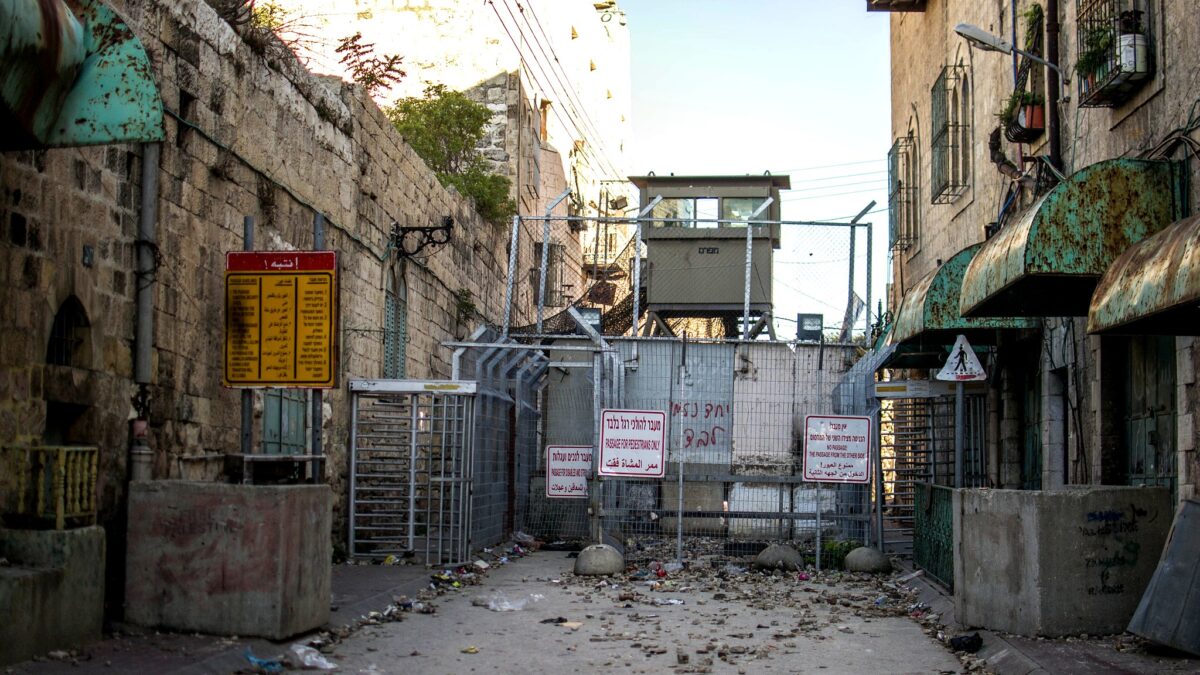
It was seven-thirty on a Friday morning when the bullets started flying. Not in Gaza, not on some distant battlefield, but at Yehuda Junction, a roadside checkpoint on the northern edge of Hebron, in the occupied West Bank. A photographer from the French news agency AFP was driving past on his way to another assignment entirely — one of those ordinary mornings journalists have — when the gunfire erupted in front of him and he became, by accident, the world’s eyewitness. Two Palestinian men had stepped out of a car near the Farsh al-Hawa checkpoint carrying a handgun and an M16 rifle. What followed was twenty minutes of sustained fire, the kind of noise that rearranges a person’s whole morning, and by the end of it, four young men lay dead on the asphalt next to a petrol station — two Palestinian gunmen, and two Israeli soldiers.
The soldiers had names and ages, and I will give them to you because a man who takes a life in uniform was, before the uniform, somebody’s son. Staff Sergeant Ron Yonatan Roytman, 23. Sergeant Yuval Shai Svilem, 20. Three more soldiers were lightly wounded. The gunmen were named by Israeli security officials as Mohammad Jaaba and Firas Jaaba, both 27, both from Hebron. Twenty minutes. Four mothers who will never again hear a door open in quite the same way.
And by noon, Benjamin Netanyahu — the prime minister of Israel, facing the tightest election of his political life — had ordered the army to prepare for a full lockdown of the West Bank.
Stop. Read that sentence again. Not a lockdown of Hebron, where the shooting happened. Not a lockdown of the neighbourhood the gunmen came from. A full lockdown of the West Bank — the whole of it. Every road, every checkpoint, every gate through which a population of 3.43 million Palestinians moves to work, to school, to hospital, to the olive groves. That figure, 3.43 million, is not mine; it is the Palestinian Central Bureau of Statistics’ estimate for the end of 2025. Three point four three million people, ordered into stillness because of what two men did in twenty minutes.
This is what fear does to a democracy, four days before an election. And it is what revenge does to a nation, when it mistakes collective punishment for justice.
Hebron: a city that has bled from both sides
If you want to understand what happened on Friday, you must first understand the city where it happened — because Hebron is not an ordinary place, and it has never been one. Hebron is one of the oldest continuously inhabited cities on earth, a place where the stones themselves seem to keep accounts. In this city, both communities bury martyrs, and both have blood on the ground. That is what makes Hebron different from almost everywhere else in this conflict: nobody here can claim the clean ledger.
In August 1929, during the riots that swept British Mandatory Palestine, 67 Jewish residents of Hebron were massacred by Arab rioters. The survivors were evacuated by the British, and the city’s centuries-old Jewish community was extinguished overnight. Ninety-seven years later, the memory of 1929 is still taught, still commemorated, still carried.
Sixty-five years after that, in February 1994, an Israeli settler named Baruch Goldstein walked into the Cave of the Patriarchs — the Ibrahimi Mosque, one of the holiest sites in Islam, sacred to Jews as well — during Ramadan morning prayers, and opened fire on Muslim worshippers. Twenty-nine were killed. The Palestinian memory of 1994 is carried with exactly the same fidelity.
Two massacres, sixty-five years apart, in the same stones, by the sons of opposite tribes. And now, in October 2026, another Friday morning, another round of fire, and the city is once again under siege — the IDF’s own words, a “full siege” of Hebron, announced within hours of the shooting.
I tell you this history not to balance the books — no columnist, however arrogant, can settle accounts in a city like Hebron — but so that you see the pattern that history is showing you. Every act of violence in Hebron is answered with a larger act of force, which plants the seed of the next act of violence, which is answered with a larger act of force. The circle does not break. It only widens. The question Friday’s events pose to us is not who fired first at Yehuda Junction. It is why, after a century of this, we still believe that the answer to four deaths is the punishment of three million people.
The anatomy of an escalation
Let us examine, with the cold eye the columnist must sometimes use, exactly what happened in the hours after the shooting — because the sequence of events tells you everything about the political season in which they occurred.
At 7:30 a.m., the attack. By mid-morning, both gunmen were dead, and Israel’s emergency service, Magen David Adom, had carried away five wounded Israelis, two of them in critical condition. The military announced that soldiers had “eliminated two terrorists.” Hamas, the militant group that rules Gaza, praised the attack as a “heroic operation” and called for more — though, notably, it did not claim responsibility for it.
Then came the orders, rapid-fire, each one larger than the last. Netanyahu ordered the immediate cordoning of Hebron and instructed the military to prepare for a full lockdown of the entire West Bank beginning that same Friday. The IDF announced it was imposing a “full siege” on Hebron. Within hours, Israeli forces began demolishing buildings and forcing residents to evacuate a neighbourhood in the city. A joint statement from the military and the Israel Security Agency announced a counterterrorism operation lasting “several days” — house-to-house searches, they said, “precise, targeted and thorough,” to “locate and dismantle terrorist infrastructure and weapons.”
And then Netanyahu added the phrase that should make every student of history flinch. He said the military would forcefully evacuate the area of the attack and “transform it completely” — employing, his office confirmed, the same operational model used in the Jenin, Tulkarm, Nur Shams and Al-Far’a refugee camps in early 2025. That model, for those who did not follow it, involved the displacement of thousands of Palestinians and the evacuation of entire neighbourhoods. The Palestinian statistics bureau reports that some 40,000 Palestinians in the northern West Bank camps have been displaced since October 7, 2023. “Transform it completely.” In the language of war, there is always a phrase for the erasure of a place. History has heard them all before.
But here is the detail that reveals the machinery: hours after ordering the full lockdown, Netanyahu appeared to scale it back. The full West Bank closure, it turned out, might become “a cordon” around Hebron and the neighbouring town of Halhul — a cordon that “may extend to other areas.” The order had been issued in the heat of the morning; the reality of locking down an entire occupied territory was something else.
And why was the order issued in the first place? Because on Tuesday — four days after the shooting — Israel votes. This is the first national election since October 7, 2023. Netanyahu is trailing in most polls, according to The Wall Street Journal. His challenger, Gadi Eisenkot — a retired general — has attacked him relentlessly for the security failures of October 7 and for putting his own political survival ahead of everything else. Netanyahu’s campaign message, distilled to its essence, is this: Israel still faces mortal danger from Iran, from Palestinian militants, from its enemies everywhere — let me finish the job.
Friday morning, twenty minutes of gunfire near Hebron did more for that campaign message than a thousand rallies could. By afternoon, Netanyahu had cancelled all Likud campaign meetings for the day. Then he drove to the scene of the shooting in a bulletproof vest and stood before the cameras, vowing a large-scale operation. Meanwhile, his national security minister, Itamar Ben-Gvir, seized the moment to demand that the Palestinian Authority be “dismantled and demilitarised, and its terror infrastructure wiped out completely.”
Reader, I ask you plainly: when an attack happens four days before an election, and the incumbent’s entire campaign is built on the promise of security, and the response is an order to lock down 3.43 million people — do you still believe the order was about security alone? Or has fear become, quite simply, a campaign strategy?
The oldest law of empire: punish the many for the few
There is an old Roman word for what was ordered on Friday. Decimation: the punishment of every tenth man for the crimes of a few. The Romans understood, two thousand years ago, what every empire since has rediscovered — that if you make the innocent share the guilt of the guilty, you will terrify them into obedience. At least, that is the theory. In practice, it breeds exactly what it claims to prevent: a population that has nothing to lose, and everything to hate.
The British perfected the art in India, and I remind my own countrymen of this because we have been on the receiving end. After 1857, whole villages were fined, disarmed and humiliated for the uprising of a few. During the Quit India movement of 1942, the colonial government imposed “collective fines” on entire towns where sabotage had occurred — if one man cut a telegraph wire, the whole village paid. The logic was identical to Friday’s order in the West Bank: make the community pay for the militant, and the community will turn against the militant. It never worked. It produced not submission but the deep, burning memory of injustice that eventually expelled the British from India.
The legal DNA of Friday’s order is even more specific, and more ironic. Israel’s military closures of the West Bank rest, in part, on the architecture of the Defence (Emergency) Regulations of 1945 — regulations written by the British colonial administration in Palestine to crush Jewish and Arab resistance alike. The empire’s emergency laws, inherited by the state that was founded in rebellion against that same empire. History’s mirrors are rarely flattering.
Consider the arithmetic of what was ordered. Two gunmen. Three million, four hundred and thirty thousand people to be locked down. The ratio is roughly one to one-point-seven million. If a gunman attacked a police post in London, would the British government lock down the whole of England? If a shooter opened fire in Texas, would Washington order the closure of every road in America? The question answers itself — because in those places, the population being punished would be voters. In the West Bank, the 3.43 million Palestinians have no vote in the election that was four days away. They could not punish the government that punished them. They could not reward it either. They were simply, as they have been for nearly sixty years, the audience at someone else’s political theatre.
Whose blood counts?
Now I must say the thing that will anger readers on both sides, and I say it because a columnist who only angers one side is a propagandist, not a writer.
The killing of Staff Sergeant Ron Yonatan Roytman and Sergeant Yuval Shai Svilem was a crime. They were 23 and 20 — young men, soldiers at a checkpoint, shot dead in a gunfight. No political cause, no historical grievance, no “context” turns the deliberate killing of a human being into a virtue. When Hamas calls the attack a “heroic operation,” it is not describing heroism; it is describing the corrosion of a movement that once claimed to speak for a people’s dignity and now applauds the orphaning of other people’s children. A cause that celebrates death has already lost the argument, whatever the justice of its grievances.
And the collective punishment of millions is also a crime — a slower, duller, more bureaucratic crime, but a crime against the same moral law. The child in Halhul who cannot reach school on Monday because of a cordon did not fire a rifle on Friday. The dialysis patient in Hebron whose appointment is cancelled did not choose this war. The shopkeeper in Nablus whose goods rot at a closed checkpoint is not a militant. When a government punishes them anyway, it teaches them the single most dangerous lesson an occupation can teach: that innocence is no protection, and therefore innocence is no strategy.
A life is a life is a life. The moment you begin to weigh them — this blood counts more than that blood, these dead deserve headlines and those dead deserve footnotes — you have left the moral universe and entered the arithmetic of the tribe. The tribes have been doing that arithmetic in Hebron for a century. It has produced only funerals.
The election, the vest, and the mirror
Let me return to the image that will define this story for me: a prime minister arriving at the scene of a shooting in a bulletproof vest, four days before an election he is expected to lose.
The vest is honest, at least. It says: I am afraid, and I want you to be afraid too, and I want you to vote for the man who promises to end the fear. Every incumbent in a time of violence learns this choreography. The visit to the scene. The vow of vengeance. The order that is larger than the event — the full lockdown announced in the morning, quietly softened by evening, because it was never truly about the logistics of the West Bank. It was about the optics of the campaign. Strong men do not scale back; but prime ministers who must govern on Wednesday do.
And what of the challenger? Gadi Eisenkot, the retired general, praised the soldiers and said they had “prevented a major terrorist attack against civilians.” The opposition, too, must genuflect before the altar of security — no Israeli politician, left or right, can afford to be the one who flinched. So the election becomes what such elections always become in such seasons: a contest not of visions but of fears, each candidate promising to be the harder fist. The Palestinian, who has no vote, watches from behind the checkpoint and learns, again, that his existence is someone else’s campaign prop.
History is holding up a mirror here, and I beg you to look into it. In 1994, after the Goldstein massacre, Israel imposed a curfew on Hebron’s Palestinian population — the victims’ community was locked down, while the settlers’ movement was not. The punishment fell, once again, on the many for the crime of one. Thirty-two years later, the reflex is unchanged. The names change. The orders do not.
What the lockdown generation will remember
There is a generation in the West Bank that has never known a day without checkpoints. They were born after the Oslo Accords collapsed into the Second Intifada. They grew up with the separation barrier, with permits, with night raids, with the vocabulary of occupation as their mother tongue. They are now in their twenties — the age of the two gunmen, the age of the two dead soldiers.
What will they remember of Friday, October 23, 2026? Not the twenty minutes of gunfire, most likely — gunfire is weather in the West Bank. They will remember the lockdown. The closed road. The missed exam. The wedding postponed. The humiliation at the checkpoint, the soldier’s hand raised, the long wait in the sun. And some of them — not all, not most, but some — will draw the lesson that every collective punishment in history has taught: that the system does not distinguish between the innocent and the guilty, so there is no profit in innocence.
This is the terrible, self-fulfilling prophecy of the iron fist. It is deployed in the name of preventing the next attack. It guarantees the next attack. And then the next election arrives, and the fist is displayed again, and the voters — frightened, grieving, human — reward the fist. The cycle does not require villains. It requires only frightened people making frightened choices, on both sides, forever.
Do you see now why I began with a question about the weight of a vote? On Tuesday, Israelis will vote in the shadow of Friday’s gunfire, and their votes will be shaped by it — that is the nature of democracy, and no one can begrudge a frightened people their fear. But 3.43 million Palestinians will wake up on Wednesday under whatever version of the lockdown survives the election, and they will have had no say in any of it. A democracy that rules millions who cannot vote is a democracy with an asterisk. The asterisk has been there for fifty-nine years. It is getting larger, not smaller.
The road not taken
I am a columnist, not a statesman. I do not have a peace plan to sell you, and I distrust anyone who claims to. But I know what the road not taken looks like, because history has shown it to us in glimpses.
It looks like this: punish the guilty, and only the guilty. Mourn the dead soldiers — all of them, on all sides — without turning their funerals into campaign rallies. Refuse the ancient, lazy logic of decimation. Understand that every time you lock down a million people for the crime of two, you are not buying security; you are buying the next recruit, the next gunman, the next twenty minutes of gunfire at the next checkpoint. The arithmetic is not complicated. It has simply never been tried with conviction, because fear is easier to sell than justice, and always has been.
Hebron has been burying its dead for a century — in 1929, in 1994, and now in 2026. The stones of that city have absorbed more grief than any stones should have to bear. They will absorb more, because the men who order the lockdowns have learned nothing from the stones, and the men who fire the rifles have learned nothing either. Each side believes it is the first to suffer, each believes its violence is the answer to the other’s, and the wheel turns.
Twenty minutes of gunfire. Four dead young men. An order to lock down millions. An election four days away. A prime minister in a bulletproof vest. If you cannot see the shape of the tragedy in those six facts — if you cannot see that every element feeds every other, that the fear feeds the vote and the vote feeds the fist and the fist feeds the fear — then no column I write will open your eyes.
But if you can see it, then you already know the verdict this column must end with. The lockdown will end. The election will pass. The checkpoints will reopen, or they will not. And somewhere in the West Bank, a young man who spent Friday locked in his house through no fault of his own will be deciding what kind of man he wants to become. History is watching that decision more closely than any of us are watching the election. For it is in rooms like his — not in campaign war rooms, not in security cabinets — that the next twenty minutes of gunfire are being written, right now, as you read these words.
Break the wheel, or be broken by it. There has never been a third option.
Sources & References
- CNN — “Israel begins demolitions in West Bank city after two soldiers killed in shooting attack” (23 October 2026): the IDF’s “full siege” of Hebron, demolitions, the several-day counterterrorism operation with the Israel Security Agency, and Netanyahu’s scaled-back “cordon” around Hebron and Halhul.
- The Wall Street Journal — “Netanyahu Calls for West Bank Lockdown After Deadly Attack” (23 October 2026): the 20-minute firefight at Yehuda Junction, Hamas’s “message to our Zionist enemy” statement without claiming responsibility, the 27 October election context with Netanyahu trailing in most polls, and challenger Gadi Eisenkot.
- TBS News (AFP) — “Netanyahu orders West Bank closure as attack wounds Israelis before election” (23 October 2026): the AFP photographer’s eyewitness account of the gun battle at the Farsh al-Hawa checkpoint, the five wounded (two critical), and the cancelled Likud campaign meetings.
- New York Post — “Dramatic moment Israeli soldiers kill 2 Hamas terrorists who were ‘planning a major attack’ in the West Bank” (23 October 2026): names and ages of the two soldiers killed — Staff Sgt. Ron Yonatan Roytman, 23, and Sgt. Yuval Shai Svilem, 20 — and the attackers’ weapons.
- Palestinian Central Bureau of Statistics — press release on the 78th commemoration of the Nakba (15 May 2026): 3.43 million Palestinians in the West Bank at end of 2025; ~40,000 displaced in the northern West Bank since October 7, 2023; 645 settlements and military sites and 778,567 settlers by end of 2024.

About the Author — Abdul Mannan
Related Articles
The Earth Spoke at 10:33 PM — and the World Kept Scrolling
On 22 October 2026, a magnitude-7.0 earthquake struck Nagqu, Tibet, killing 16. As the world queued for a…
Ebola Has Reached Nigeria — And the World Is Looking Away Again
Nigeria — 230 million people — has confirmed its first Ebola case in the fastest-spreading outbreak in history.…
The Frozen Map: Ukraine’s 75-Percent Peace Gamble and the Ghosts of History
What is the price of a country? Not the whole country — just twenty-five percent. Zelensky's "freeze and…