Henri Kagan and Kenso Soai Win 2026 Nobel Prize in Chemistry for Solving the Century-Old Mystery of Mirror Molecules

STOCKHOLM — The 2026 Nobel Prize in Chemistry has been awarded to French chemist Henri Kagan and Japanese chemist Kenso Soai for solving one of the most stubborn mysteries in the history of science: how mirror-image molecules come to exist in nature, and how human beings can finally recreate that feat in a laboratory.
The Royal Swedish Academy of Sciences announced the decision on Wednesday, honouring the pair, according to Reuters, “for the discovery of non-linear effects and autocatalysis in asymmetric organic synthesis.” The two scientists will share 12 million Swedish crowns — roughly $1.2 million — along with the fame of winning arguably the world’s most prestigious science award.
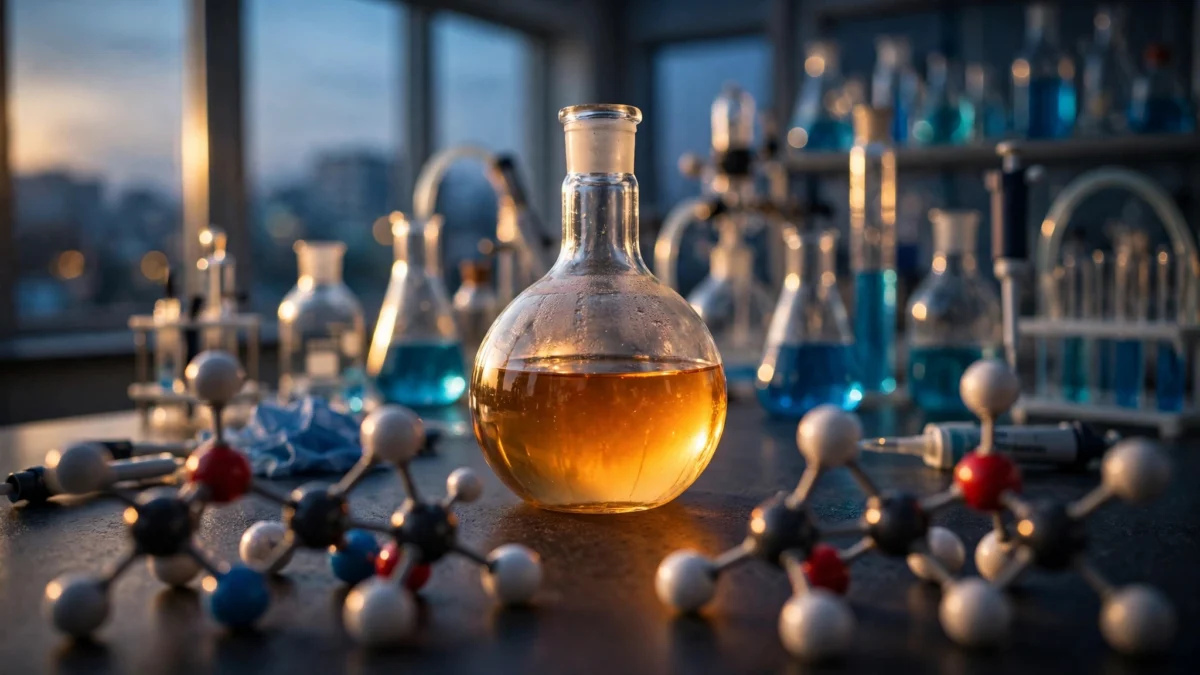
At the heart of their achievement sits a deceptively simple observation. Many of the molecules that make up living things exist in two mirror-image forms, the way a left hand mirrors a right hand, according to CNN’s report from the announcement. Yet nature, for reasons scientists could not explain, almost always chooses just one of the two versions. Amino acids, sugars, the proteins that build every cell — all appear in living organisms in overwhelmingly a single “handedness.” For more than a century, chemists understood that this one-sidedness — scientists call it homochirality — must matter enormously, but in the laboratory, the same chemical reactions stubbornly produced an even 50-50 mix of both mirror images. “Other than life itself, no one had previously achieved this feat,” the Nobel committee noted, according to CNN.
That is where Kagan and Soai, working decades apart and on different continents, changed the story.
Henri Kagan, the French chemist, began in the early 1980s to find ways of steering chemical reactions with special catalysts so that one mirror-image molecule would dominate the product, according to CNN. The breakthrough was conceptual as much as technical: Kagan demonstrated that a small, carefully chosen excess of a single-handed catalyst could produce a disproportionately large excess of a single-handed product — the so-called non-linear effect. It was proof that the symmetry between left and right handedness could be broken on purpose, not merely observed in nature.
Kenso Soai, a Japanese scientist based at the Tokyo University of Science, then took the idea to a place no one had imagined. According to Le Monde, Soai designed a chemical reaction in which only one of the two possible mirror images was formed — and the product of the reaction itself acted as a catalyst, so that the phenomenon amplified with every cycle. In the Soai reaction, a tiny initial imbalance — perhaps just a trace excess of one form — could be magnified thousands of times over, until the laboratory flask contained almost exclusively one mirror image. As Le Monde reports, Soai himself connected the dots to the deepest question in science: in a 2003 paper, he described how a minuscule original excess of one enantiomer, amplified through thousands of repeated cycles, could have triggered the asymmetric chemistry of living metabolism — in other words, the very origins of life.
“Henri Kagan and Kenso Soai have provided a solution to a chemical mystery that is over a century old: how homochirality can emerge spontaneously. The chemical reactions they have developed are spectacular,” Heiner Linke, chair of the Nobel Committee for Chemistry, said in a statement quoted by CNN.
The human texture of the announcement was classic Nobel theatre. Soai told reporters by telephone, according to CNN, that receiving the prize marked “one of the most exciting days” of his life — and revealed that he had been “out shopping” when the call from Stockholm came. Chemistry World’s live coverage of the announcement described a laureate so in demand that he had to cut short an interview upon learning that Japan’s prime minister was trying to reach him.
For Kagan, the award also carries the flavour of a long-overdue correction. As Chemistry World noted during its live coverage, the French chemist had been overlooked for the 2001 chemistry Nobel Prize for his work on asymmetric synthesis — an omission that prompted a furious article in Le Monde at the time by fellow French chemist Didier Astruc. Le Monde’s profile this week quoted Odile Eisenstein of the French Academy of Sciences, who chose Kagan for her thesis jury in 1977, describing a scientist whose “modesty was inversely proportional to the significance of his discoveries” and whose “immense creativity” spanned pioneering asymmetric catalysis, the discovery of the famous non-linear effects, and the development of samarium-based chemistry that produced a reagent bearing Kagan’s name.
The prize matters far beyond the laboratory because mirror images can behave completely differently inside the human body. The two forms of a molecule can be identical on paper and worlds apart in effect: one version of a drug may heal, while its mirror image may do nothing — or worse. Pharmaceutical companies have long known that making drugs in single-handed form is safer and more effective, but producing them cleanly, without the contaminating mirror twin, was extraordinarily difficult. Kagan’s and Soai’s chemistry gave industry the conceptual toolkit to do exactly that, and their methods have shaped how modern medicines are manufactured, the award committee said, according to CNN.
The announcement also completes the first half of Nobel Week 2026. On Monday, the medicine prize went to Karl Deisseroth, Peter Hegemann and Georg Nagel for their discoveries concerning light-gated ion channels and optogenetics, according to Reuters; on Tuesday, the physics prize went to Francis Halzen of the University of Wisconsin–Madison for his decisive contributions to the IceCube Neutrino Observatory and the discovery of high-energy neutrinos of astrophysical origin, according to CNN. The literature prize is scheduled for Thursday, the peace prize for Friday, and the economics prize for October 12, according to the official Nobel schedule. The laureates will receive their medals from Sweden’s King Carl XVI Gustaf at a ceremony in Stockholm on December 10.
Analysis: Why It Matters
The 2026 chemistry Nobel is, in a sense, the opposite of a fashionable prize — and that is precisely what makes it significant. In an era when Nobel committees have often rewarded headline-grabbing applied technologies, this year’s award goes to chemists who answered a question first posed more than a century ago: why does life choose left over right? That the academy chose a fundamental riddle, solved patiently over four decades, sends a clear signal that the deepest questions still command the highest honours — a reassuring message for any young researcher tempted to chase only the fashionable and the fundable.
There is also a quiet drama of vindication in the choice. When Kagan was passed over in 2001 for the asymmetric-synthesis prize, the anger in the French chemistry community was real enough to spill into the national press. Twenty-five years later, the same body has effectively said: we were wrong to wait so long. Science prizes are supposed to be above such score-settling, but the timing — rewarding both Kagan’s foundational catalysis and Soai’s breathtaking amplification of it — reads as a deliberate act of historical completeness. The committee did not just honour a discovery; it closed a chapter.
Look closer at the substance, and the prize reveals how theory and application fuse in modern chemistry. The same mechanism that lets a chemist imagine how homochirality emerged on the early Earth also lets a pharmaceutical manufacturer cut the waste and risk out of drug synthesis. That double dividend — cosmic mystery and factory floor — is the hallmark of the most consequential chemistry. Every patient who takes a modern single-enantiomer medicine is, in an indirect but real way, a beneficiary of the flasks Kagan and Soai filled decades ago.
The origins-of-life dimension deserves emphasis because it turns a chemistry prize into a philosophy prize. If a trace imbalance can amplify itself into the single-handed chemistry of all life, then the asymmetry of biology is not a miracle but a mechanism — one that might be replaying itself, right now, on some distant world. That is why the Soai reaction keeps appearing in astrobiology seminars: it is one of the few known chemical engines that can take a whisper of imbalance and turn it into the roar of living chemistry.
Finally, there is the matter of what comes next. Nobel Week is only half over. The literature announcement on Thursday and the peace prize on Friday will complete the cultural arc of the week — and the peace prize, in particular, will be watched with extraordinary attention given the state of the world. But the chemistry prize has already done the quiet, permanent work that Nobels do best: it has etched two names into textbooks, given every chemistry student a new hero to study, and reminded the world that sometimes the most world-changing thing a scientist can do is ask, for forty years, why one hand is different from the other.
Sources
Nobel Prize in Chemistry 2026 — official press release, NobelPrize.org

About the Author — Abdul Mannan
Related Articles
Vance Says Iran Must Make ‘Meaningful’ Enrichment Cut to End Seven-Month War With the US
Vice President JD Vance has set out Washington's core condition for ending the seven-month US-Iran war: a concrete…
WHO Presses Russia for Answers on Siberian Lab Worker’s Death as US Sends Formal Information Request
The World Health Organization says it still does not know what killed a 28-year-old laboratory worker in Siberia,…

Taiwan’s Washington Envoy Says US Ties “Remain Robust” After Trump–Xi Summit, but $14 Billion Arms Package Stays on Hold
Taipei's envoy Alexander Yui says US-Taiwan relations remain strong after last month's Trump–Xi summit, even as a record…