Taiwan’s Washington Envoy Says US Ties “Remain Robust” After Trump–Xi Summit, but $14 Billion Arms Package Stays on Hold

Taiwan’s de facto ambassador to Washington has declared that ties with the United States remain strong in the wake of last month’s summit between Donald Trump and Xi Jinping, even as a record $14 billion package of American arms for the island stays frozen on the US president’s desk, according to Reuters.
Speaking at a symposium on Wednesday, Taipei’s Washington envoy Alexander Yui said the US side had made clear there had been no change in its position toward Taiwan. “I can say quite confidently that US-Taiwan relations remain robust,” he told the gathering, Reuters reported.
Yui’s remarks are the most direct public reassurance yet from Taipei that the warming between Washington and Beijing — capped by last month’s summit — has not come at Taiwan’s expense. But his emphasis on the timely delivery of American weapons betrayed the island’s deeper anxiety: that Taiwan is quietly becoming the currency of a much larger US–China bargain.
The $14 Billion Package Held Back as a “Negotiating Chip”
Trump has held back approval of a new $14 billion arms package for Taiwan in order to maintain warm relations and a fragile trade truce with Xi, Reuters reported, after approving a separate $11 billion package in December.
The pause dates to the May summit in Beijing between Trump and Xi, during which China pressed Washington to halt the arms sales. After that meeting, Trump said he was holding up the second package and described it as a “very good negotiating chip” — a phrase that alarmed Taipei and was noted by analysts worldwide.
China, which views democratically governed Taiwan as its own territory, has repeatedly called for the arms sales to end, Reuters reported.
One day before Yui’s speech, Taiwan’s defence minister Wellington Koo sought to calm nerves at home. Speaking to reporters in front of the Legislative Yuan in Taipei on Tuesday, Koo said existing US arms sales to the island remain unchanged and that Taipei is in continuous discussions with Washington over individual deals, the Associated Press reported.
“As for arms sales, we are in continuous discussions with the Americans on this,” Koo said. “We haven’t received any notice of any changes to sales or our cooperation.” He added that he had received assurances from the US side that its policy toward the island was unchanged, according to the AP.
The White House and the US State Department have not publicly broken with the pause. A State Department spokesperson declined to comment on pending arms sales when approached by Reuters, but added that the administration has been “very clear that the enduring US commitment to Taiwan continues” — pointing to the arms sale notification issued in December.
The split reality — existing sales untouched, the record new package frozen — has become the defining feature of the current phase of US–Taiwan defence ties: continuity in principle, uncertainty at the top of the pipeline.
First New F-16s Arrive as Deterrence Demands Grow
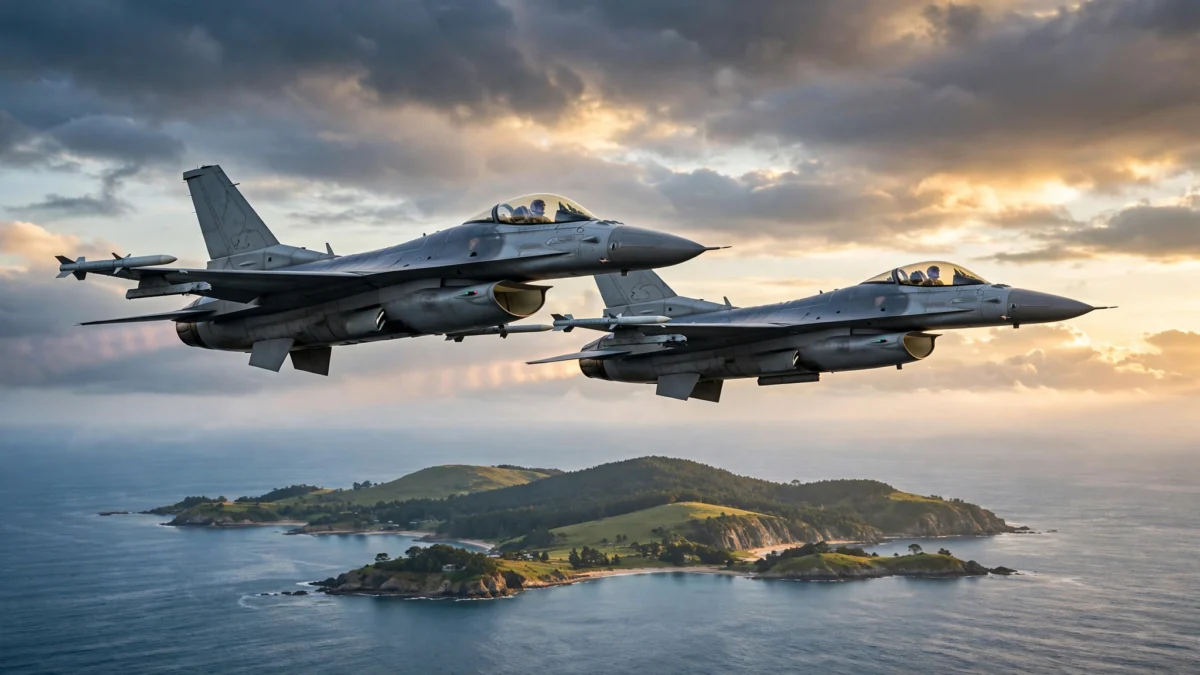
The most tangible piece of good news for Taipei is in the air. Yui told the symposium that the recent arrival in Taiwan of the first two new F-16 fighter jets was a welcome example of steady progress between Washington and Taipei in strengthening the island’s self-defence, Reuters reported.
The two aircraft are the first of a batch of 66 new F-16V Block 70 jets ordered in 2019. The jets were supposed to have been delivered in 2024, according to local media, but the project was delayed by the pandemic and production line issues, the AP reported. Defence Minister Koo said the jets have now reached a production stage where they are ready to be delivered.
Yui used the delivery milestone to make his broader pitch for deterrence, telling the symposium that the most effective way to maintain peace was through strength and to “ensure that aggression can never be regarded as an easy or an inexpensive option.”
“For deterrence to be credible, our own investment must also be matched by timely delivery, effective training, and the ability to translate these investments into real deterrence capabilities,” he said, according to Reuters.
The timing of Yui’s intervention was pointed. Both Taiwanese Foreign Minister Lin Chia-lung and former president Tsai Ing-wen are in the United States this week — Tsai’s first trip to the country since stepping down two years ago — a concert of visits that Taipei clearly hopes will steady nerves in Washington, Reuters reported.
Meanwhile, Reuters reported this month that US officials believe a Chinese invasion of Taiwan before 2028 is increasingly unlikely, despite Xi’s standing instruction to his military to be ready by 2027 to take the island by force if needed. Yui told the symposium that Taiwan’s preparedness was not built around any single date. “There’s been different opinions about maybe 2027, maybe 2028, or beyond,” he said. “But our responsibility is the same: to make Taiwan stronger, more resilient, and harder to be coerced by the adversary.”
North Korea Weighs In With a Warning Over Taiwan
The Taiwan arms question drew a pointed intervention from a second front on Wednesday. North Korea criticised the United States over its arms sales and military support for Taiwan, accusing Washington of fuelling tensions in the Taiwan Strait, state media KCNA reported.
A KCNA commentary cited North Korean international affairs analyst Kim Myong Chol as saying US policy on Taiwan was undermining peace and stability in the region. The commentary condemned the appearance of US-sold fighter aircraft in Taiwan, saying Washington “should think twice whether it is ready to stand in frontal confrontation with the powerful national power of the People’s Republic of China for the security of Taiwan and whether it can cope with its consequences,” according to the report carried by Devdiscourse.
In the same broadcast cycle, North Korean leader Kim Jong Un pledged continued support for Russia and its war effort in a birthday message to President Vladimir Putin, KCNA said. Kim said Pyongyang would continue to expand joint work under the two countries’ comprehensive strategic partnership, declaring he was convinced Russia’s “sacred war of justice” to defend its sovereignty, security interests and territorial integrity would end in victory.
North Korea has sent an estimated 14,000 to 15,000 troops to support Russia’s war in Ukraine since 2024, according to Ukrainian and South Korean estimates, and the two countries signed a mutual defence pact in June 2024. The twin statements — the warning over Taiwan and the pledge to Moscow — frame Pyongyang’s stake in a single narrative: that American power is overstretched and that its allies across Eurasia should read Washington’s constraints as their opening.
Why It Matters
The episode lays bare the transactional turn in Washington’s handling of Taiwan, and why the island has more reason than ever to worry about being treated as a bargaining chip rather than a partner.
The first lesson is about the language of leverage. When Trump called the $14 billion package a “very good negotiating chip,” he publicly assigned Taiwan’s defence a dollar value inside the US–China trade relationship. Even with Yui’s assurances and Koo’s calm tone, the message Beijing hears is that Taipei’s security is negotiable — and that is precisely the signal deterrence theory says an adversary should never hear. Deterrence, as Yui himself put it, depends on aggression never looking “easy or inexpensive.” A publicly haggled-over arms package makes the price look negotiable too.
The second is about the calendar. Analysts expect US arms sales to continue but acknowledge a short-term pause, the AP reported. Tamkang University professor Ma Chun-wei told the AP there are two more summits between the US and China scheduled within this year, “so I think neither side really wants to break things off, and the Taiwan issue will be put aside temporarily.” But he added that Taiwan remains key from a security perspective, and that “arms sales to Taiwan will still be inevitable going forward.” That reading — a temporary hold, not a reversal — is what Taipei is banking on, and what the F-16V delivery rhythm is meant to reinforce.
The third is the context no one in Taipei can control: the United States is simultaneously pressing Beijing for trade calm, pressing allies over Taiwan’s defences, and watching North Korea and Russia deepen a wartime partnership that pulls the same American attention in a different direction. Pyongyang’s Wednesday intervention linked all three — Taiwan, Moscow, and Washington’s bandwidth — in a single state-media day, which is exactly how an adversary reads a stretched superpower.
And the fourth is the quiet optimism in the intelligence. That US officials now believe a Chinese invasion before 2028 is “increasingly unlikely,” as Reuters reported, is a significant — if fragile — judgment. It gives Taiwan breathing room. But it also raises the bar for credibility: if the threat is further out, the political cost of delaying weapons deliveries rises, and the risk grows that urgency in Washington fades while Beijing’s pressure on Taipei does not. China’s People’s Liberation Army sends fighter jets and ships toward the island almost daily, the AP reported, a grinding routine of pressure that does not wait for summits to conclude.
What to watch next: whether the second scheduled US–China summit this year produces any movement on the $14 billion package; the pace of the remaining 64 F-16V deliveries; how Beijing reacts to Lin Chia-lung’s and Tsai Ing-wen’s US visits; and whether the US assessment that an invasion is unlikely before 2028 survives the year’s diplomacy. As one Taipei official’s week of careful messaging showed, Taiwan is not waiting to find out — it is buying insurance in public, with every word it says in Washington.
Sources
- Reuters: “Taiwan’s US envoy says ties robust after Trump-Xi summit”
- Reuters: “Taiwan says it has not heard new US arms sales will be carved into smaller chunks”
- Associated Press: “Taiwan says US arms sales to island are unchanged, but a $14B package remains on hold”
- Reuters via Devdiscourse: “North Korea warns US over Taiwan while Kim pledges support for Russia”

About the Author — Abdul Mannan
Related Articles
Šefčovič Heads to Beijing for Make-or-Break EU–China Trade Talks as October Deadline Arrives
EU trade chief Maroš Šefčovič meets China's Wang Wentao in Beijing on 8–9 October for make-or-break talks on…

Rubio Opens Four-Day NATO Tour in Iceland, Putting Arctic Security at the Centre of the Agenda
US Secretary of State Marco Rubio began a four-day tour of NATO allies in Iceland, calling for a…
Ukraine Scrambles for Money as War Costs Hit $155 Billion and Russian Strikes Batter Its Economy
Kyiv faces a $56bn budget gap as the daily cost of fighting climbs to $190m, forcing it to…