They Shot at a Funeral: The Karak Church Massacre and the War on Grief Itself

Tell me, reader — what do you call a murder that is committed twice?
Once, when the bullet finds its victim. And again, when the bullet finds the people who came to bury him.
On Friday, 23 October 2026, in the village of Hmoud in Jordan’s Karak governorate, some 180 kilometres south of Amman, mourners gathered in a Greek Orthodox church for a funeral. They came, as mourners always come, with bowed heads and heavy hearts, to do the oldest human duty there is: to stand beside a family at the edge of the grave and say, you are not alone in this. Between 150 and 200 people were in and around the church. And then gunmen arrived by car, walked toward the house of prayer, and opened fire.
State television footage, verified by international news agencies, showed three armed men approaching the church grounds, two with pistols and one with a rifle, firing from behind trees and a low wall before running toward the entrance. Inside, witnesses said, people threw themselves beneath the pews and away from the windows. Prayers and screams mixed in the air. One mourner told the BBC’s Arabic service that the shooting lasted around fifteen minutes. Fifteen minutes. In a church. At a funeral.
Jordan’s Public Security Directorate confirmed seven people killed. Dozens more were wounded. I will be honest with you about the numbers, because honesty is the first duty of a columnist in the fog of a breaking story: in the first hours the official counts moved — six dead, then seven; 28 wounded, then 34, then 40 in later reports. The fog always lifts slowly. What did not move, what no revision softened, was the fact itself: seven human beings went to a funeral and never came home, and dozens of families now carry two griefs where they carried one. No group has claimed responsibility. The gunmen, as I write, remain at large, and Jordan’s security forces are hunting them. The authorities call them extremists. The interior minister, Mazen al-Faraya, called the attack “painful and horrific” and “unprecedented in the history of the Hashemite Kingdom of Jordan”, perpetrated by a group with, in his words, “no relationship to humanity”.
Stop there. Read that phrase again. A funeral is the one place on earth where even enemies have historically laid down their weapons. Armies have observed truces for burials since the ancient Greeks. In Islam, the janazah prayer is a collective duty owed to the dead, and to interrupt it with gunfire is an offence against God and neighbour alike. In Christianity, the funeral liturgy is the community’s last embrace of one of its own. The gunmen of Karak did not merely kill seven people. They fired at grief itself. They told a grieving family: even your sorrow is not safe from us. That is why this attack, small in the arithmetic of the world’s daily bloodshed, has shaken a kingdom and stopped the world in its scrolling. There are crimes that kill the body, and there are crimes that kill the idea that any place is sacred. Karak was the second kind.
Karak: a city that has outlasted every siege
If you want to understand why Karak matters, you must first understand the stones it stands on — because Karak is not a village that history forgot. It is a city history could never conquer for long.
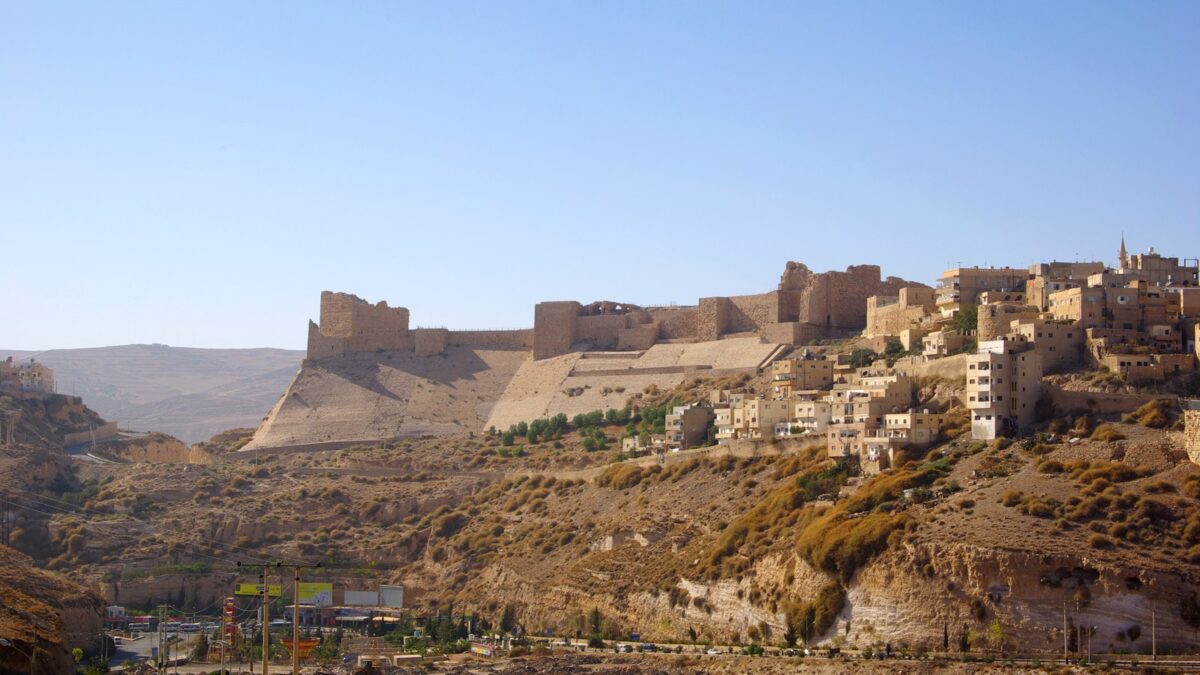
Above the modern town rises Karak Castle, one of the great Crusader fortresses of the Levant, built in 1142 as the anchor of a chain of fortifications guarding the Crusader Kingdom of Jerusalem. Its most infamous lord, Reynald de Châtillon, was a man so cruel that even his fellow Crusaders recoiled from him, and after the Battle of Hattin in 1187, Saladin himself ordered his execution. The castle held out against siege after siege until it finally fell to Saladin’s forces in 1188, passed to the Mamluks, and remained in use under the Ottomans into the modern age. Crusaders, Ayyubids, Mamluks, Ottomans — empires rose, planted their banners on those walls, and crumbled, and Karak is still there, its people still farming the same hills, still burying their dead in the same soil.
That is the first mirror history holds up to us, reader. A fortress built to withstand armies has watched, for nearly nine hundred years, as conqueror after conqueror discovered the same lesson: you can take the castle, but you cannot take the town’s soul by force. And now, in a single Friday morning, three gunmen with pistols and a rifle have done what no siege engine ever managed — they have made the world ask whether Karak, whether Jordan itself, is safe. The irony would be bitter if it were not so bloody. The castle survived Saladin. The church did not survive a carload of cowards.
But there is a second, darker mirror, and I will not hide it from you. Karak has bled before in our own lifetime. In December 2016, gunmen attacked security patrols and a police station in Karak before taking shelter in that same castle, and ten people were killed, including seven members of the security forces, two Jordanian civilians and a Canadian tourist. The so-called Islamic State later claimed responsibility. Jordan has also endured the coordinated hotel bombings in Amman in 2005, when al-Qaeda in Iraq killed dozens and wounded more than a hundred. Jordan is a country that knows the face of terror, and knows it by name. That is precisely why Friday’s attack is described, by Jordanians themselves, as unprecedented: not because Jordan has never been attacked, but because it has never been attacked like this — in a church, at a funeral, among mourners.
The island, and why the gunmen chose it
Look at the map, reader, and you will see why this matters far beyond one village in southern Jordan.
Jordan sits in the most combustible neighbourhood on earth, bordered by Syria, Iraq, Saudi Arabia, Israel and the occupied Palestinian territories, with the wars of the region lapping at its frontiers for decades. Yet Jordan has remained, by the standards of its region, an island of relative stability — a close ally of the United States, a peace-treaty partner of Israel since 1994, a host to millions of refugees, and a kingdom whose Christians, some 300,000 people, roughly two to three per cent of a population of about 11.5 million, have lived alongside their Muslim neighbours for generations. Most of Jordan’s Christians belong to the Greek Orthodox Church. They hold a guaranteed quota of seats in parliament. Their churches and pilgrimage sites — Madaba with its ancient mosaic map of the Holy Land, Mount Nebo where Moses is said to have looked upon the Promised Land, Bethany beyond the Jordan where tradition places the baptism of Christ — draw pilgrims from across the world.
More than that, Jordan carries a custodianship the world too often forgets. King Abdullah II is the custodian of the Muslim and Christian holy sites in Jerusalem, a role his Hashemite family has held for a century. When the King speaks for the sanctity of a church in Jerusalem, the world listens, because his own kingdom practises at home what it preaches abroad: that Muslims and Christians in Jordan are not guests in each other’s country, but partners in one land and one fate. His own words after Karak said it plainly: those who delude themselves into thinking they can divide Jordanians with bullets have no chance in the face of national unity, and every Jordanian life is precious.
Now ask yourself the question the gunmen’s bullets were really asking. Why a church? Why a funeral? Why Karak, a town where, as one correspondent put it, Christians and Muslims have lived side by side for generations and pride themselves on their interfaith solidarity?
Because the gunmen were not aiming only at the people in the pews. They were aiming at the idea of Jordan itself. Analysts who study these movements will tell you the same thing, in colder language: militants target a minority community to break social cohesion, to shake confidence in the security forces, and to recruit the next wave of killers from the anger that follows. It is the oldest strategy of the sectarian arsonist. Burn one house, and watch the neighbours blame each other for the smoke. The attack on a funeral is the arsonist’s masterpiece, because a funeral gathers the whole community in one room, at its most vulnerable, and turns its grief into a spectacle.
I have seen this script before, reader, and so have you, in other countries, in other decades. The bomb in the mosque that is meant to be answered by a bomb in the church. The bullet in the church that is meant to be answered by a bullet in the mosque. The merchants of sectarian war have one product to sell, and it is always the same: the lie that your neighbour, who prayed beside you yesterday, is your enemy today. Every time a community refuses to buy it, the merchant loses. Every time a community buys it, the merchant wins another war he could never win on a battlefield.
What Jordan answered
And here, reader, is where the story turns from horror to something I can only call hope — not the cheap hope of slogans, but the stubborn hope of a people who refused the script.
Within hours, the condemnation came not from one corner but from every corner, and that unanimity is itself the news. The United Nations Secretary-General’s spokesman said an attack not only on a place of worship but during a funeral procession is “especially heinous”. The Grand Imam of Al-Azhar in Cairo, Ahmed al-Tayeb, denounced the shooting as a heinous terrorist act. Lebanon’s President Joseph Aoun said terrorism has no religion and no homeland, and its aim is to strike at coexistence and spread strife. Egypt’s President Abdel Fattah al-Sisi pledged support for Jordan against all forms of violence. Saudi Arabia, the United Arab Emirates, Oman, Kuwait, Qatar, Bahrain, Syria and Iraq voiced support. Greece’s Prime Minister Kyriakos Mitsotakis said targeting a place of worship was “an affront to our shared humanity”. Canada’s Prime Minister Mark Carney said the attack violated the sanctity of a place of worship and struck families at a moment of profound sorrow. The United States ambassador to the United Nations, Mike Waltz, called it a brutal attack on a house of worship. The Palestinian presidency, and Palestine’s Higher Presidential Committee for Church Affairs, condemned it too, and urged churches to ring their bells and called for a solidarity gathering in Bethlehem’s Manger Square.
Read that list again, slowly. Sunni and Shia, Arab and European, Muslim and Christian, the neighbours Jordan quarrels with and the allies it leans on — all of them, for once, saying the same sentence. When was the last time the world agreed on anything? The gunmen wanted to divide Jordan from itself. Instead, for one weekend, they united the world in condemnation of themselves. That is the first defeat of terror, and it is never small.
The second defeat came from inside Jordan. Prime Minister Jafar Hassan attributed the violence to extremist ideology. The King vowed the harshest penalties and an iron fist against anyone who threatens the nation. The US embassy in Amman, on Saturday, said security had been stepped up at malls, embassies and other locations across Jordan. These are the necessary acts of a state, and I do not mock them. A state that cannot protect a funeral has failed in its first duty. But I must tell you plainly, as a columnist and not a courtier, that the iron fist alone has never defeated an ideology. It can catch gunmen. It cannot catch an idea. The idea is defeated only when the community it tried to divide stands closer together afterwards than it stood before.
And that, by every early sign, is what Karak is doing. The town’s Christians and Muslims have lived side by side for generations, and the correspondents who know the town best predict that if the attack was intended to create divisions, the community will come back stronger. I believe them. I believe them because I have seen how ordinary people answer the arsonist: not with a speech, but with a neighbour carrying a neighbour’s coffin, with a Muslim shopkeeper closing his shop for a Christian funeral, with a church bell and a mosque’s condolence sounding on the same street. The gunmen fired at a funeral. The answer to them is more funerals honoured, more neighbours standing together, more bells rung — not fewer.
The verdict history will write
So here is my verdict, reader, and I give it to you the way I give all verdicts — not as a summary, but as a question that history will answer.
The gunmen of Karak believed a lie that every sectarian killer in history has believed: that a bullet can redraw the map of who belongs. They believed that seven deaths in a church would prove that Christians and Muslims cannot live together in Jordan. But history has already answered that lie, in Karak itself. The castle above the town was built by Crusaders who believed the land belonged to one faith, and it is now guarded by the descendants of the people who took it back, and visited by pilgrims of every faith. The stones outlasted the Crusaders, the Ayyubids, the Mamluks and the Ottomans, and they will outlast three gunmen in a car. Empires that tried to divide this land by the sword are footnotes now. The people who stayed, who farmed, who buried their dead side by side, are still here.
That is the consolation, and it is a real one. But I will not insult the dead with consolation alone, because there is a warning here too, and it is addressed to all of us, far beyond Jordan’s borders. The attack on a funeral is a new threshold, and thresholds, once crossed, are crossed again. If the world shrugs at gunmen firing into a church during a funeral in Karak, it will shrug at the next church, the next mosque, the next synagogue, the next funeral, in the next town, until no place of grief is safe anywhere. The sacred is not defended by resolutions. It is defended by the refusal, repeated daily, to accept that any house of prayer is a legitimate target, that any mourner is fair game, that any community’s grief is another community’s victory.
Jordan’s King said every Jordanian life is precious. Hold him to that sentence, and hold every ruler to it, including your own. A life is a life is a life. The moment you begin to weigh them — these dead deserve headlines and those dead deserve footnotes, this funeral may be shot at and that funeral may not — you have left the moral universe and entered the arithmetic of the tribe. The tribes have been doing that arithmetic in this region for generations. It has produced only funerals.
Seven people went to a funeral in Karak and became the funeral. Remember their names when the news cycle moves on, as it always does, to the next horror. Remember the pews they hid beneath, the prayers that mixed with screams, the families who now grieve twice over. And remember the answer that Karak, and Jordan, and the world gave back in one voice: you will not divide us with bullets. The bell will ring. The neighbour will stand beside the neighbour. The funeral will go on, and the living will bury their dead in dignity, as human beings have done since the beginning of time, and as no gunman, in any century, has ever been able to stop.
That is the verdict. The castle still stands. The church will fill again. And the gunmen, whoever they are, will learn what every divider in history has learned too late: that the people you try to tear apart, by firing at their grief, are the very people who will hold each other tighter for it.
Sources & References
- Reuters — “US embassy says security ramped up in Jordan after deadly church attack” (24 October 2026): seven killed, dozens injured, no immediate claim of responsibility, attackers described as extremists, links to known groups not yet established, security stepped up at malls and embassies.
- The Wall Street Journal — “Gunmen Kill Seven in Church Attack in Jordan” (23 October 2026): the Karak church attack in context, the 2016 Karak Castle attack, the 2005 Amman hotel bombings, and the analysis that militants target Christians to break social cohesion.
- Independent Press — “Seven killed, dozens wounded in gunmen attack on church funeral in Jordan’s Karak” (23 October 2026): Interior Minister Mazen al-Faraya’s “unprecedented” remark, King Abdullah II’s “iron fist” vow, Christians numbering about 300,000 in a population of roughly 11.5 million, and Karak’s interfaith community.
- Daily Informiq — “Seven killed, at least 34 injured in attack on funeral gathering at Jordan church” (24 October 2026): the Hmoud church attack during a funeral, CCTV footage, witness accounts, and the shifting early casualty counts.
- Cyprus Inform — “Seven killed, 40 wounded in attack on church funeral in Jordan” (24 October 2026): Public Security Directorate briefing, the health minister’s wounded figure, and the continuing search for the attackers.
- AnewZ — “Jordan church attack: Why Karak shooting shocked the kingdom” (24 October 2026): the Greek Orthodox community, its parliamentary quota, Karak’s Crusader castle, and the December 2016 Karak attack.
- Times Now World — “Seven killed in armed attack on church funeral in Jordan” (24 October 2026): United Nations condemnation, Al-Azhar’s denunciation, regional leaders’ solidarity, and the 2016 Karak precedent.
- Europe Says — “Türkiye condemns Karak church attack, voices solidarity with Jordan” (24 October 2026): Arab League, Lebanese, Greek and Egyptian condemnation, and the call for a solidarity gathering in Bethlehem’s Manger Square.

About the Author — Abdul Mannan
Related Articles
Twenty Minutes in Hebron: Two Soldiers Dead, 3.4 Million Under Lockdown, and an Election Built on Fear
Friday morning, 7:30 a.m., Yehuda Junction near Hebron. Twenty minutes of gunfire left two Israeli soldiers and two…
The Earth Spoke at 10:33 PM — and the World Kept Scrolling
On 22 October 2026, a magnitude-7.0 earthquake struck Nagqu, Tibet, killing 16. As the world queued for a…
Ebola Has Reached Nigeria — And the World Is Looking Away Again
Nigeria — 230 million people — has confirmed its first Ebola case in the fastest-spreading outbreak in history.…