Meta, Google DeepMind and the US Government Join Biohub’s $1.8 Billion Push for an AI “Virtual Cell”

The United States government and the technology companies behind some of the world’s most powerful artificial intelligence systems have joined forces with the Chan Zuckerberg Biohub in a $1.8 billion initiative to generate the biological data needed to build predictive AI models of human cells. Biohub announced on Wednesday that Meta, Google DeepMind and Isomorphic Labs will jointly invest $300 million in its Virtual Biology Initiative, while the Department of Energy commits more than $500 million over five years and the National Institutes of Health contributes datasets built through more than $500 million of earlier federal funding. With Biohub’s own $500 million contribution from April, the combined commitment — spanning cash, data, computing power and new measurement technology — is, according to Biohub, the largest coordinated effort yet to generate AI-ready biological data.
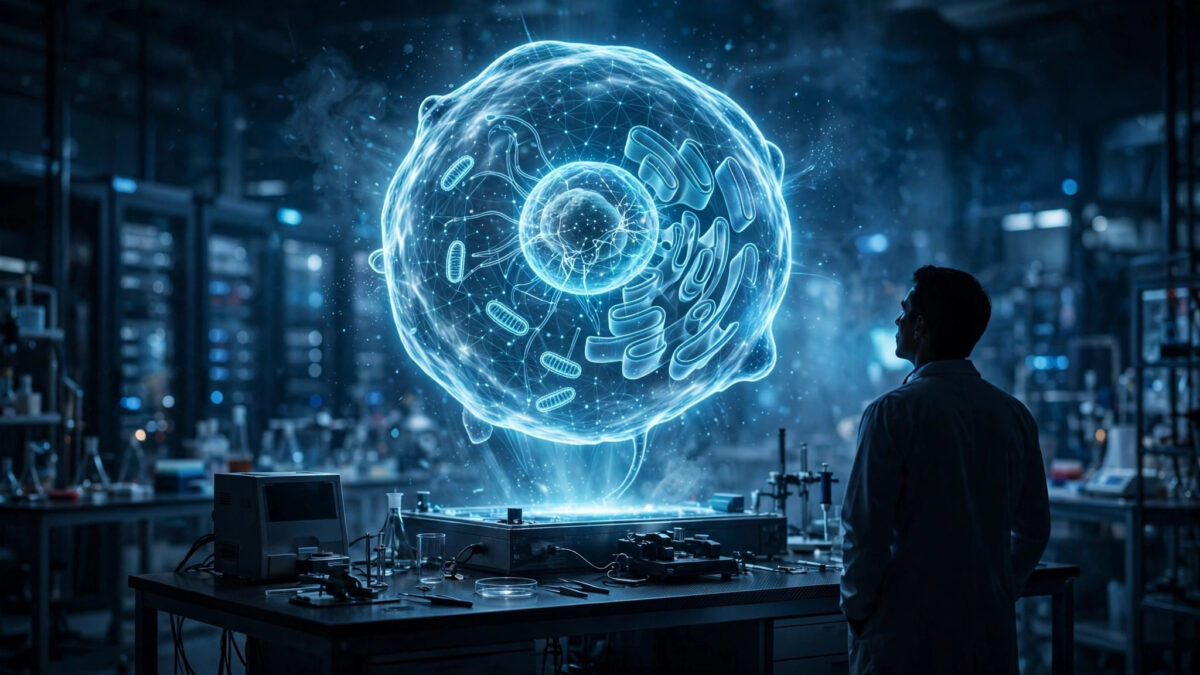
The stated goal is what the partners call a “virtual cell”: a software model detailed enough to predict how a human cell reacts to a drug, a mutation or a disease before anyone runs the experiment in a laboratory. In practice, it would work like a flight simulator for medicine — researchers introduce a variable, the model predicts the outcome, and only the most promising leads move on to costly lab testing. The effort aims to compress drug-development timelines that currently stretch across years.
The data will come from techniques including spatial transcriptomics, which maps molecular activity inside intact tissue, and large-scale screens that record how cells respond to changes in their environment. Much of that data has never been generated in a coordinated way, according to Biohub’s head of science Alex Rives, who told Reuters the partners aim to compress work that would normally take decades into five years, with a first dataset ready in about a year and accurate predictive models expected within five years.
The funding breaks down into four distinct contributions, according to Reuters and Biohub’s announcement. Google DeepMind, Isomorphic Labs and Meta are jointly committing $300 million. The Department of Energy will invest more than $500 million over five years in laboratory measurement, modelling and computation, flowing through the Genesis Mission — the AI-for-science programme created by presidential executive order in November 2025. The National Institutes of Health will coordinate the contribution of relevant datasets and repositories built through more than $500 million of prior federal investment, which Biohub will work to standardise for AI training. Biohub itself committed $500 million when it launched the initiative in April.
The datasets will eventually be released publicly, but the commercial funders get a head start, according to Rives. “With commercial funders we have embargo periods where there’s a period of time where the groups can work on the data, and then it becomes available as a public scientific resource,” he said. The arrangement, he said, is how Biohub draws private money into a project it describes as open science; the government-funded work running in parallel will carry no such restrictions. Biohub plans to approach pharmaceutical companies and philanthropies next.
“Biology has been just sort of a clever discovery-based science until this point,” Dr. Priscilla Chan said in an interview cited by Reuters, adding that the initiative is meant to be “a community asset, not just for one group, so that it can build upon itself over time.” Rives put the data problem bluntly: “We need to capture the language of biology, we need to capture the language of the cell. And that doesn’t exist today.”
The scale of that gap is striking. Current cell datasets run to hundreds of millions of cells, Rives said, while an accurate predictive model will require billions and eventually trillions. Biohub’s five-year goal is to close that gap — a task its leadership describes as work that would otherwise take decades.
The initiative was first announced on 29 April 2026 as a five-year effort to coordinate data generation across institutions and disciplines. Biohub, the nonprofit founded in 2016 by Meta CEO Mark Zuckerberg and his wife Dr. Priscilla Chan, anchors the work; its founding commitment covers $400 million for new measurement technologies — including cryo-electron tomography that resolves near-atomic detail inside the cell and microscopy capable of imaging millions to billions of cells in living tissue — plus $100 million for research outside Biohub. Partners named at the April launch included the Allen Institute, the Arc Institute, the Broad Institute and the Wellcome Sanger Institute, along with the Human Cell Atlas and Human Protein Atlas consortia, NVIDIA and Renaissance Philanthropy, according to Unite.ai.
Max Jaderberg, President of Isomorphic Labs — Google’s AI drug-discovery company — said the company is joining as a founding member and that generating the data to solve predictive systems biology requires scaling past the limits of what any single organisation can produce today. Pushmeet Kohli, Vice President of AI for Science at Google DeepMind and Google Cloud’s Chief Scientist, said the investment in biological data generation will help create an open, standardised data commons for researchers. Nicole Kleinstreuer, the NIH’s Deputy Director for Program Coordination, Planning, and Strategic Initiatives, said that combining resources and expertise could accelerate the development of universal cell models “with sufficient biological complexity to predict how any cell responds to an intervention,” adding that the return from such models could mean substantially faster timelines for medical breakthroughs than laboratory experiments alone could achieve.
Rival AI labs are pursuing parallel tracks. Anthropic has doubled down on its biology efforts with a wet lab, while the OpenAI Foundation has started a grant programme worth more than $125 million to fund biological and medical datasets for AI research, according to Reuters. Axios first reported the expanded Biohub deal ahead of Wednesday’s announcement.
Analysis: Why It Matters
The announcement reframes what the AI race is actually about. For most of the past year, the contest has been fought in model architectures and gigawatts — who has the best chatbot, who is buying the most Nvidia chips. But the history of machine learning says the decisive input is usually data: no ImageNet, no modern computer vision. Biology has never had an ImageNet. A few hundred million measured cells sound like a lot until you realise the target is trillions, and that no single lab, company or government could plausibly assemble it alone. The Virtual Biology Initiative is the first attempt to treat biological data the way the field now treats compute — as infrastructure that must be built at coalition scale, with a five-year deadline attached.
The embargo structure deserves scrutiny. Biohub is pitching this as open science, yet the commercial funders get a privileged window before the data becomes a public resource. That tension is the price of private capital: Google DeepMind, Meta and Isomorphic Labs are not putting up $300 million out of charity. The open question is how long the embargo periods run and whether the head start quietly becomes a permanent advantage — whoever trains on the first trillion-cell dataset first will define the field’s baseline models. Watch the fine print when the first dataset ships in about a year.
There is also a policy signal hiding in the partner list. The Department of Energy’s money flows through the Genesis Mission, a deliberate government bet on AI for science, and it arrives in a week when Washington’s AI agenda is otherwise dominated by regulation talk — a Super Intelligence task force, a Justice Department memo rebranding “AI” as “super intelligence” in court filings. The Biohub deal shows a parallel track: the federal government as a buyer of scientific infrastructure rather than merely a referee of the industry. That track has bipartisan appeal that the regulation fights lack.
Finally, the pharmaceutical courtship is the second act. Biohub says it will approach drug companies and philanthropies next, and Isomorphic Labs’ presence as a founding member hints at where the economics point: whoever cracks predictive cell models gets first dibs on compressing the industry’s decade-long, billion-dollar drug pipelines. If Big Pharma writes cheques into the coalition, the $1.8 billion figure will look like a down payment.
Three things to watch next: whether the first dataset really lands in about a year, which is the coalition’s first credibility test; the terms and length of the commercial embargo periods, which determine whether “open science” holds; and which pharmaceutical companies and philanthropies join the next funding wave — and what they ask for in return.
Sources
Unite.ai — Biohub, DOE, NIH and Partners Commit $1.8B to Virtual Biology Initiative
Startup Fortune — Google, Meta and the US government put $1.8 billion behind a virtual human cell

About the Author — Abdul Mannan
Related Articles
SpaceX Seeks $40 Billion Apollo-Led Financing to Buy Nvidia AI Chips, FT Reports
SpaceX is seeking $40 billion in Apollo-led financing to fund a blockbuster purchase of Nvidia AI chips, in…
US Justice Department Tells Staff to Call AI “Super Intelligence” in Court Filings Under Trump Order
In a Tuesday memo, acting Deputy Attorney General Trent McCotter ordered Justice Department employees to use “super intelligence”…

OpenAI to Test Visual Ads in ChatGPT’s Image Generation Later This Month
OpenAI says visual ads will be clearly labelled and kept separate from generated images as it expands its…