Nasdaq Hits Record High as AI Rally Brushes Off 24-Year-High Treasury Yields

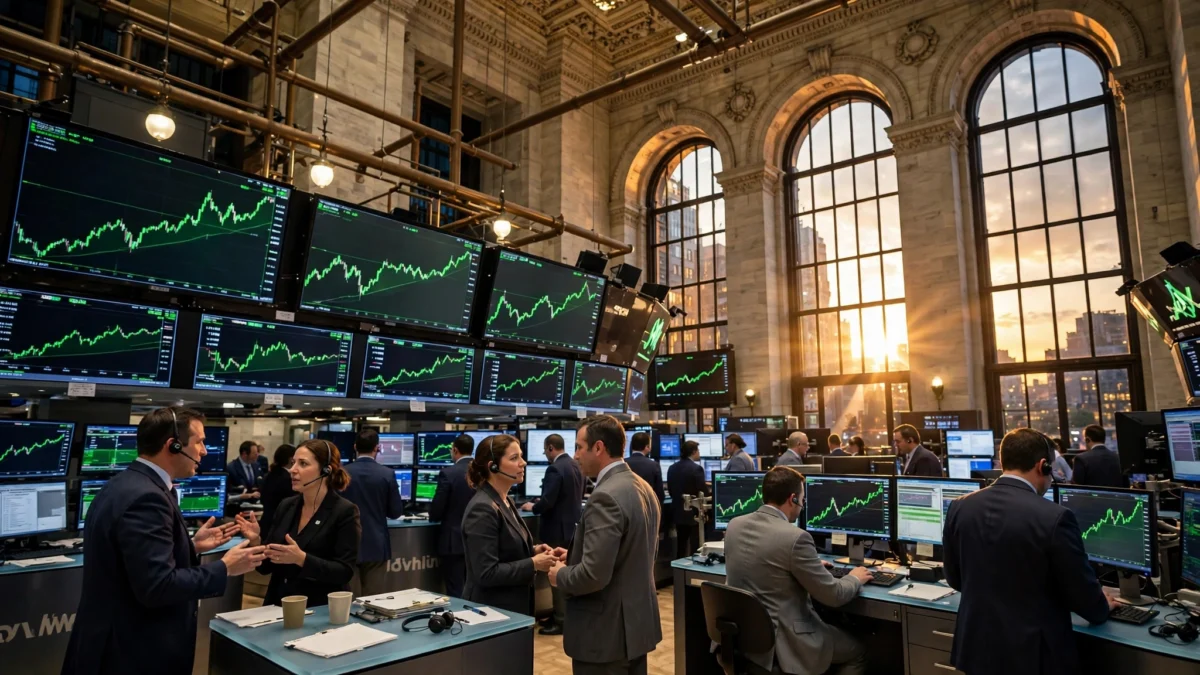
Wall Street’s technology giants drove the Nasdaq Composite to a record close on Monday, shrugging off a spike in long-term Treasury yields to their highest levels in 24 years, in a striking display of how thoroughly the artificial intelligence boom has taken over the market’s imagination.
The tech-heavy index climbed 1.05 per cent to close at 27,477.31, surpassing its previous record close set on September 22, according to the Wall Street Journal. The S&P 500 rose 0.66 per cent to 7,773.95, finishing within 0.3 per cent of its August 13 record, while the Dow Jones Industrial Average added 0.18 per cent to 51,267.90, Reuters reported.
Nvidia led the advance. The AI chipmaker gained 2.1 per cent to a record closing price of $238.90, lifting its market capitalisation to $5.76 trillion — a new peak for any listed company, according to Reuters. Microsoft added 1.5 per cent, while Meta Platforms and Tesla each rose roughly 2 per cent.
The rally unfolded against an unusual backdrop. The yield on the benchmark 10-year Treasury note climbed above 5.34 per cent intraday, its highest since April 2002, the Wall Street Journal reported, while the 30-year yield reached 5.664 per cent, its highest close since May 2002. Rising long-term rates normally punish growth stocks by raising the discount rate applied to their future earnings — yet on Monday, enthusiasm around AI investment overwhelmed that headwind.
"With the economic data calendar being light and earnings about a week away, investors are really groping for anything positive to glom onto," Art Hogan, chief market strategist at B Riley Wealth, told the Journal.
Softer-than-expected US employment data continued to support sentiment. Friday’s September jobs report showed only 29,000 new jobs, well below economists’ expectations of around 84,000, and traders now see only about a 24 per cent likelihood that the Federal Reserve raises rates at its late-October meeting, down from 71 per cent a week earlier, according to CME FedWatch data cited by Investopedia.
The optimism carried into Tuesday’s Asian session, where the MSCI Asia-Pacific index outside Japan rose 0.2 per cent and Japan’s Nikkei gained 0.7 per cent, Reuters reported.
Europe, however, was the day’s weak spot. The euro languished near a 17-month low of $1.116 as investors dumped French government bonds after an underwhelming budget, while political uncertainty deepened after Spanish Prime Minister Pedro Sanchez called a snap election, Reuters reported.
Oil prices retreated, offering further relief to markets. Brent crude lost 1.9 per cent overnight to around $100 a barrel as Middle East exports increased and the Group of Seven nations pledged to boost supplies. Aramco chief executive Amin Nasser warned, however, that global oil inventories have been depleted by the Middle East conflict and could take as long as two years to rebuild, the Journal reported.
The third-quarter earnings season kicks off next week. Goldman Sachs estimated that consensus forecasts point to 27 per cent growth in S&P 500 earnings for the quarter, with more than half of that growth coming from companies benefiting from AI infrastructure spending, according to Reuters.
Analysis: Why It Matters
Monday’s session delivered a market anomaly worth pausing on: stocks — and the most rate-sensitive stocks of all — soared on the same day the discount rate against which they are valued hit a 24-year high. That inversion tells you where this market’s real engine sits, and it is not in Washington’s bond market but in the server farms of the AI buildout.
The explanation most quoted on trading floors came from Infrastructure Capital Advisors chief executive Jay Hatfield, who characterized technology stocks as a trade moving in the opposite direction of bonds: AI computing demand is so strong, he argued, that leading technology companies are simply less affected by rising rates. Goldman Sachs’ numbers back the claim — if more than half of S&P 500 earnings growth this quarter comes from AI infrastructure spending, then the market’s winners are, for now, living in a parallel economy with its own gravity.
There are reasons to treat the euphoria with caution. Eric Diton of The Wealth Alliance warned that hopes for a broader rally could face "tough sledding" with rates still climbing, no resolution to the Iran war in sight, and the approach of the US midterms, a period that often brings volatility. The concentration is also extreme: a handful of AI giants — Nvidia, Microsoft, Meta and Tesla — are doing most of the heavy lifting, and market watchers have flagged the disconnect between buoyant equities and alarmed bond markets.
For ordinary borrowers, the bond market’s verdict matters more than the Nasdaq’s record. Thirty-year Treasury yields at 5.66 per cent translate directly into mortgage rates and corporate borrowing costs that make the economy’s real work more expensive. As one adviser put it to the Journal, think about what the monthly payment on an average-priced home looks like now versus a few years ago — and how much more of a household’s income goes to debt service instead of everything else.
What to watch next: the start of earnings season, when the AI infrastructure thesis meets actual numbers; whether the bond selloff deepens toward 5.5 per cent on the 10-year, a level that would strain even the optimists; Friday’s French bond auction; and any fresh signal from the Federal Reserve’s late-October meeting.
Sources

About the Author — Abdul Mannan
Related Articles

C.H. Robinson to Buy Freight Broker RXO in $5.8 Billion Deal, Creating a $25 Billion Logistics Giant
C.H. Robinson announced Monday it will acquire RXO in a $5.8 billion cash-and-stock deal that would create a…

Schneider Electric Agrees $22.6 Billion Deal to Buy US Software Firm PTC
France's Schneider Electric has agreed to buy US industrial software firm PTC for $22.6 billion in cash, deepening…
Asian Stocks Rally as Weak US Jobs Data Cools Fed Rate-Hike Bets
Asian stocks rose on Monday as a weak US September jobs report slashed bets on an October Fed…