Šefčovič Heads to Beijing for Make-or-Break EU–China Trade Talks as October Deadline Arrives

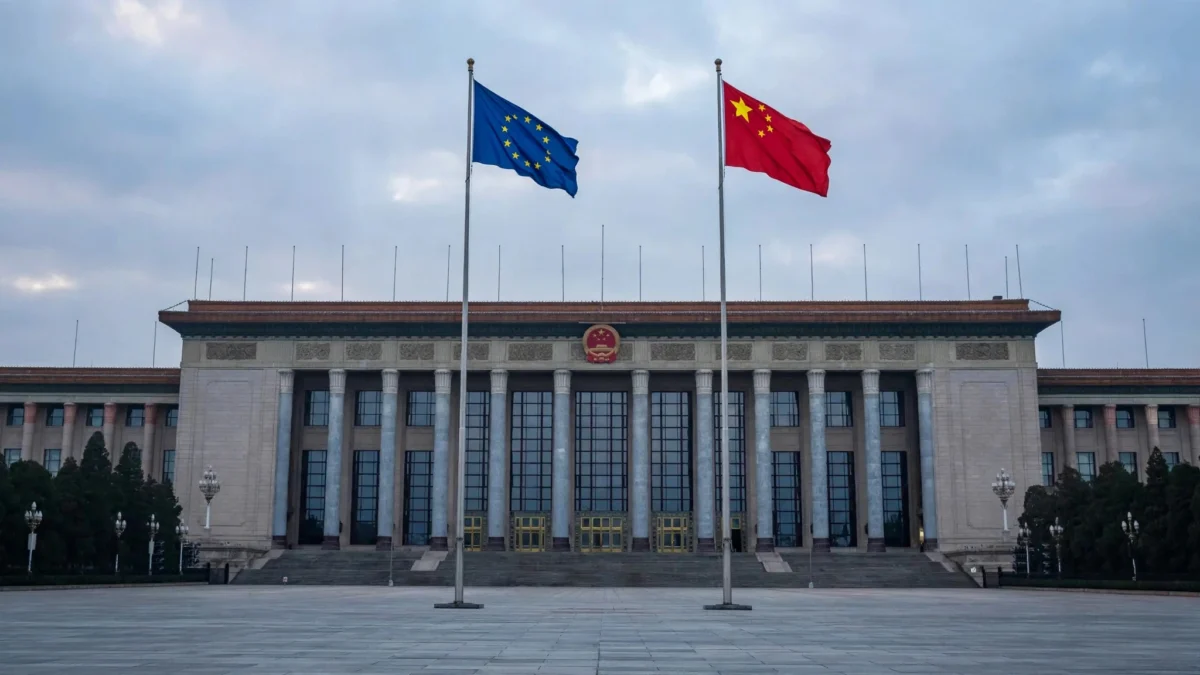
EU trade chief Maroš Šefčovič will land in Beijing on Thursday for two days of make-or-break meetings with Chinese officials, in a final push to stave off a trade war between the world’s second- and third-largest economies, according to AFP. The talks, on 8 and 9 October, arrive at the October deadline the European Union itself set in June for what it called “tangible results” from months of intensive negotiations with Beijing.
The meeting is the second session of the EU–China Trade and Investment Council, a mechanism the two sides established earlier this year, co-chaired by Šefčovič and China’s Commerce Minister Wang Wentao, according to the European Business Magazine. A Commission negotiating team has already travelled to China to prepare the ground, and last month, after an hour-long video call between the two ministers, a Commission spokesperson said it was equally important that the first tangible results be achieved at the Beijing session.
The stakes could hardly be higher. Brussels believes subsidised Chinese overcapacity is flooding European markets with cheap electric cars, steel and batteries, hollowing out the industrial heartlands of the continent. Beijing rejects the claim that its manufacturers’ competitiveness rests on state support, and has warned it will respond firmly to any European move to restrict Chinese businesses.
A €1-billion-a-day deficit
The numbers behind Europe’s alarm are stark. In her recent State of the European Union address, Commission President Ursula von der Leyen warned that the bloc’s trade deficit with China had reached a tipping point, describing it as “€1bn a day” and unsustainable, according to EU Reporter. Eurostat figures show that in 2025 the EU exported €199.6 billion worth of goods to China while importing €559.4 billion — a deficit of €359.8 billion. Over the past decade, Chinese exports to the EU have grown by 37.1 per cent, while EU imports from China have surged by 89 per cent.
Brussels’ demands are long-standing and specific. The EU wants China to rein in the subsidised overcapacity it says is behind the flood of cheap electric vehicles, steel and batteries; to open fairer access for European companies in China, including to public contracts; and to guarantee reliable supplies of rare earths — the materials inside car motors, wind turbines and defence electronics — according to the European Business Magazine.
The negotiations, led by Šefčovič, are organised under four headings: trade and investment balancing; export controls; intellectual property rights; and reform of the World Trade Organisation, EU Reporter reports. The talks have been running since June, when the two sides began intensive discussions over access to each other’s markets.
There are signs of how difficult those discussions have been. According to Euronews, the Commission has been pushing so-called voluntary export restrictions for electric vehicles — an arrangement under which China would voluntarily limit its EV exports to the EU, sparing Brussels from adopting defensive measures Beijing might view as aggressive — but China’s trade minister has rejected the idea. The same reporting said the Commission delayed the adoption of trade-defence mechanisms aimed at protecting the EU chemical industry, among the sectors most threatened by Chinese competition, to give the negotiations a chance.
France and Germany turn up the pressure
The talks come as the EU’s two biggest economies take a markedly more confrontational stance. France and Germany are urging the bloc to adopt new trade-defence powers that could, in effect, exclude China from the European single market, according to Bloomberg. Last week, as the European Business Magazine reported, the two governments pushed for a tool that could cut China off from the European market within 24 hours if Brussels judged its businesses were being harmed.
French President Emmanuel Macron and German Chancellor Friedrich Merz have also raised concerns about non-tariff barriers facing European exporters, products entering the EU that fail to comply with European rules, and the valuation of the renminbi, according to EU Reporter. The Commission is working in parallel on new instruments to protect European industries, expected to be presented to EU leaders in December.
The tougher line has not gone unanswered. On Saturday 3 October, less than a week before Šefčovič’s trip, China’s Ministry of Commerce announced it was opening an anti-dumping investigation into imports of p-nitrotoluene — a chemical used in dyes, pharmaceuticals, pesticides and pigments — from the European Union, according to AFP via the Malay Mail. The case follows an application submitted on 14 September by Chinese producers Jiangsu Huaihe Chemical and Hubei Dongfang Chemical, and will examine alleged dumping between July 2025 and June 2026. The investigation will conclude within 12 months, with the possibility of a six-month extension. In September, the EU had begun its own investigation into polyvinyl chloride imports from countries including China.
Modest expectations
Few observers expect the Beijing session to resolve the relationship. “There may be a few crumbs, but I would not expect any kind of major breakthrough,” Penny Naas, director of the Brussels office of the German Marshall Fund of the United States, told AFP. Zhu Tian, professor of economics at the China Europe International Business School in Shanghai, said the likeliest outcome was agreements on specific issues rather than any broad settlement of the trade relationship.
The picture is complicated further by the scale of Chinese investment in Europe. Chinese foreign direct investment in the EU and the UK rose 67 per cent to €16.8 billion in 2025, its highest level since 2018, according to EU Reporter. Germany attracted €2.5 billion and France €1.9 billion, while Hungary remained the largest recipient at €3.9 billion — a reminder that not all 27 member states view the relationship through the same lens.
Analysis: Why It Matters
The most important thing about Thursday’s talks is not what is on the table but the trap Brussels has built for itself. The October deadline was the EU’s own invention: Šefčovič warned in the summer that Brussels expected “tangible results by October” from the process, according to AFP. That makes the Beijing session a credibility test as much as a negotiation. If the commissioner returns with nothing, the question will not only be what China refused, but whether Europe’s threats — the December trade-defence package, the market-exclusion tools championed by Paris and Berlin — are real or rhetorical.
This is the essential tension of the EU’s current strategy: it is negotiating and arming at the same time. Delaying the chemical-industry trade defences to give talks a chance, while publicly preparing a December package and a 24-hour market-exclusion instrument, is meant to concentrate minds in Beijing. But it also gives Beijing reason to treat every concession as the prelude to the next demand. China’s October 3 anti-dumping probe reads as a deliberate signal of that dynamic — a reminder that retaliation can be aimed at politically sensitive European sectors at a moment of Europe’s choosing, not China’s.
The rare-earths dimension is the asymmetry that should worry Brussels most. Europe can credibly threaten to close market access to Chinese cars and batteries; China can credibly threaten the raw materials on which Europe’s green transition and defence electronics depend. Any European trade-defence escalation will be priced, in Beijing’s calculations, against that leverage. A trade war neither side can fully win is precisely the kind both sides have historically talked themselves into.
Then there is the question of European unity. The €3.9 billion of Chinese investment flowing into Hungary — the largest single recipient in the EU — illustrates why a common front is hard to hold. Trade policy is a Commission competence, which helps, but the political legitimacy of a confrontation with Beijing depends on capitals that do not all share Paris and Berlin’s urgency. Watch for the first cracks if the December package gets specific.
Finally, the “China Shock 2.0” framing deserves scrutiny. The first China shock of the early 2000s hit low-tech manufacturing; this one is aimed at cars, machinery and batteries — the industries where European identity and employment are concentrated. That makes the politics more explosive, but it also means the adjustment costs of a genuine rupture would fall hardest on the very industrial heartlands the policy is meant to protect. Europe is not choosing between openness and protection; it is choosing between two different kinds of economic pain, and Thursday’s talks are the last scheduled chance to choose neither.
What to watch next
First, whether any limited deal emerges on electric vehicles — voluntary export restraints or quotas would be the clearest signal that the October deadline produced something real. Second, whether Beijing’s p-nitrotoluene probe is the first of several retaliatory investigations, which would indicate China is preparing for the talks to fail. Third, the Commission’s December trade-defence package: its scope and timing will reveal whether Brussels was bluffing or loading the gun.
Sources
- EU, China to hold Beijing talks to avert trade war — AFP
- Europe’s October Deadline Arrives in Beijing — European Business Magazine
- Merz and Macron seek tougher EU trade tools ahead of crucial China talks — EU Reporter
- Beijing turns up trade heat on EU with fresh anti-dumping investigation days before crucial talks — AFP via Malay Mail

About the Author — Abdul Mannan
Related Articles

Rubio Opens Four-Day NATO Tour in Iceland, Putting Arctic Security at the Centre of the Agenda
US Secretary of State Marco Rubio began a four-day tour of NATO allies in Iceland, calling for a…
Ukraine Scrambles for Money as War Costs Hit $155 Billion and Russian Strikes Batter Its Economy
Kyiv faces a $56bn budget gap as the daily cost of fighting climbs to $190m, forcing it to…
India–US Trade Talks Hit “Plateau”, Finance Minister Sitharaman Says, as Tariff Threats Narrow Room for a Deal
India's finance minister says trade negotiations with Washington have levelled off with little room left to give, days…