India–US Trade Talks Hit “Plateau”, Finance Minister Sitharaman Says, as Tariff Threats Narrow Room for a Deal

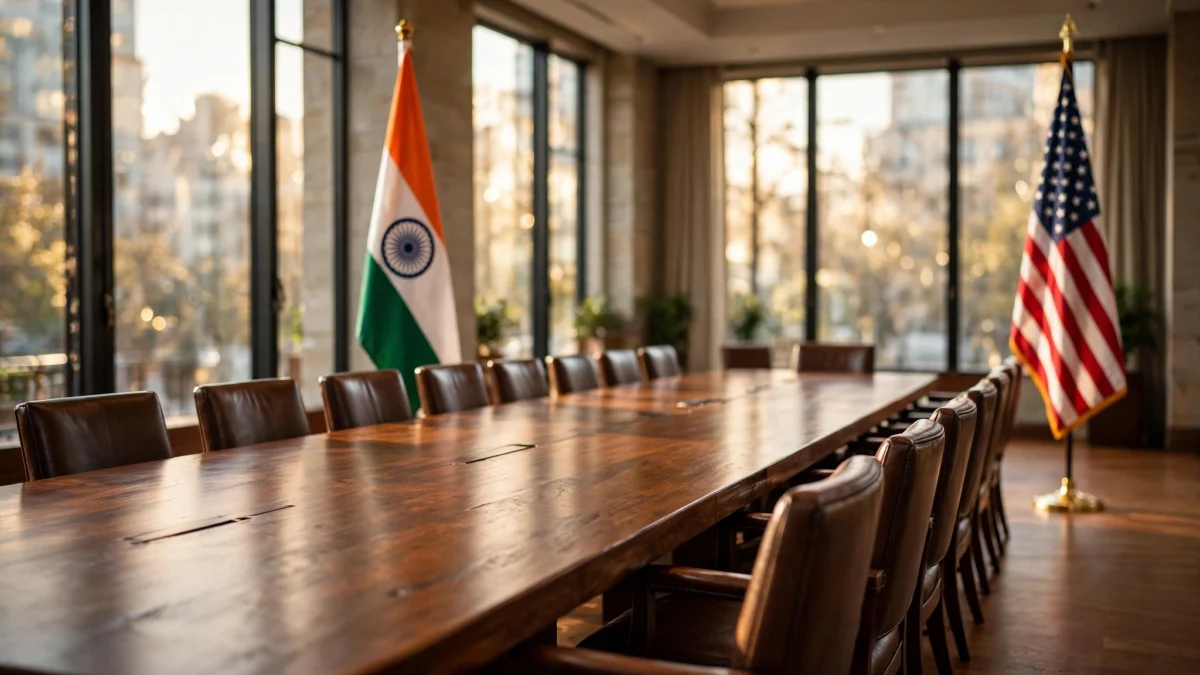
Trade negotiations between India and the United States have reached a “plateau” beyond which further concessions will be “very, very difficult” for either side, India’s Finance Minister Nirmala Sitharaman said on Monday, in New Delhi’s strongest public admission yet that the long-running talks have stalled.
Sitharaman told the Munich Leaders Meeting in the Indian capital that the agreement had been “hard and very vigorously negotiated”, adding that the negotiations were still continuing and that both sides would make use of any room left to operate, according to a Reuters report from New Delhi. She said the balance of trade currently favours India — the deficit is Washington’s — and that the United States naturally wants to narrow that imbalance and recoup what it believes it has lost over the years of the trade relationship.
Her remarks landed just days after US Trade Representative Jamieson Greer said on October 1 that a trade agreement with India is not imminent. Greer, speaking in Milwaukee after meeting India’s Commerce and Industry Minister Piyush Goyal on the sidelines of the G20 trade ministers’ meeting, described the conversation as constructive but said both sides were still working through a set of unresolved issues. Greer also disclosed that Prime Minister Narendra Modi and President Donald Trump had held a constructive telephone call on September 30 and could speak again to take stock of progress.
The scope for a compromise has narrowed sharply since President Trump signed into law a congressional bill giving him authority to impose tariffs of up to 100 per cent on countries that buy significant amounts of Russian oil — explicitly including India and China. The law, the Lindsey Graham Sanctioning Russia and Iran Act of 2026, has put Modi in a painful energy-policy bind, Reuters reported: India is among the world’s biggest buyers of Russian oil, and cutting those purchases could raise domestic fuel prices or strain government finances, while keeping them risks tariffs that could cripple exports to India’s largest market. New Delhi has warned that the new American measures could damage bilateral ties.
The talks, pursued since February 2025, were meant to deepen economic ties and settle long-standing market-access disputes. A framework for an interim agreement announced in February 2026 brought the punitive tariff on most Indian goods down to 18 per cent from 50 per cent, after an earlier round of negotiations collapsed last August. Washington’s negotiating hand was partly weakened when the US Supreme Court struck down the legal basis of Trump’s sweeping emergency-power tariffs, leaving a 10 per cent baseline rate — but the final deal between the world’s two largest economies remains elusive, a Reuters explainer noted on Tuesday.
A separate obstacle is an unresolved American Section 301 investigation into excess industrial capacity across several countries, which could yet produce additional tariffs against Indian goods. Both sides have meanwhile held out a broader ambition: more than doubling bilateral trade to $500 billion by 2030.
Analysis: Why It Matters
Sitharaman’s choice of word — “plateau” — is telling. It is neither collapse nor deadlock, but an admission that the easy concessions are exhausted. That framing itself is a signal: after nearly two years of negotiations, New Delhi wants Washington to know that the price of further give is now politically and economically prohibitive, not just difficult.
The central structural problem is that trade talks have become hostage to geopolitics. The Russian-oil tariff law means India is negotiating not just over tariffs and market access but over its energy sovereignty and its strategic autonomy with Moscow. Every concession on oil would ripple into domestic fuel prices in a country of 1.4 billion people; every concession on trade leaves Indian exporters exposed to the very tariffs the deal is meant to reduce. That is a bind no amount of “vigorous negotiation” can wish away.
There is also a multi-table dimension worth watching. At the same event, Sitharaman pointed to the India–EU trade agreement — which she noted would cover economies representing roughly a quarter of global GDP — as the model of India’s approach to trade pacts. The subtext is hard to miss: New Delhi is keeping alternatives warm while Washington stalls, and the United States risks finding that India secures its market access elsewhere.
What to watch next: first, whether the Modi–Trump channel produces another call and whether it moves anything substantive; second, the outcome of the US Section 301 investigation, which could impose new tariffs independent of any deal; third, whether India trims its Russian oil purchases at all — the one variable that could unlock American flexibility. Until one of those moves, the plateau is likely to become the status quo.
Sources
- Reuters: “India, US have reached a plateau in trade talks, Indian finance minister says” — https://www.reuters.com/world/india/india-us-have-reached-plateau-trade-talks-indian-finance-minister-says-2026-10-05/
- Reuters: “Why have India-US trade talks stalled again and what’s next?” — https://www.reuters.com/world/india/why-have-india-us-trade-talks-stalled-again-whats-next-2026-10-06/
- The Bridge Chronicle (IANS/ANI): “India-US Trade Talks Hit Plateau, Says Nirmala Sitharaman” — https://www.thebridgechronicle.com/news/nation/india-us-trade-talks-plateau-sitharaman

About the Author — Abdul Mannan
Related Articles
Drones Strike Two Cargo Ships Off Bulgaria’s Black Sea Coast, Sinking One and Leaving Its Crew Missing
Two cargo vessels were hit by drones inside Bulgaria's Black Sea economic zone on Tuesday; one sank with…

Separatist Parti Québécois Wins Quebec Election, Returns to Power With Minority Government
The separatist Parti Québécois has won Quebec's provincial election with 59 seats, returning to power as a minority…

South Korea’s President Says AI Appears to Have Been Used in Bank Hacks as Police Launch Full-Scale Probe
President Lee Jae Myung says AI models are believed to have been used in recent hacking attacks on…